FOSDEM 2025 ran on 1 and 2 February at the ULB campus in Brussels. My FOSDEM 2025 interviews post covers the conversations I recorded there. This one is the companion piece: the devroom talks I sat in on, rebuilt from the slides I photographed. I’ve only written up talks where my photos show the title or enough slides to say what was presented.
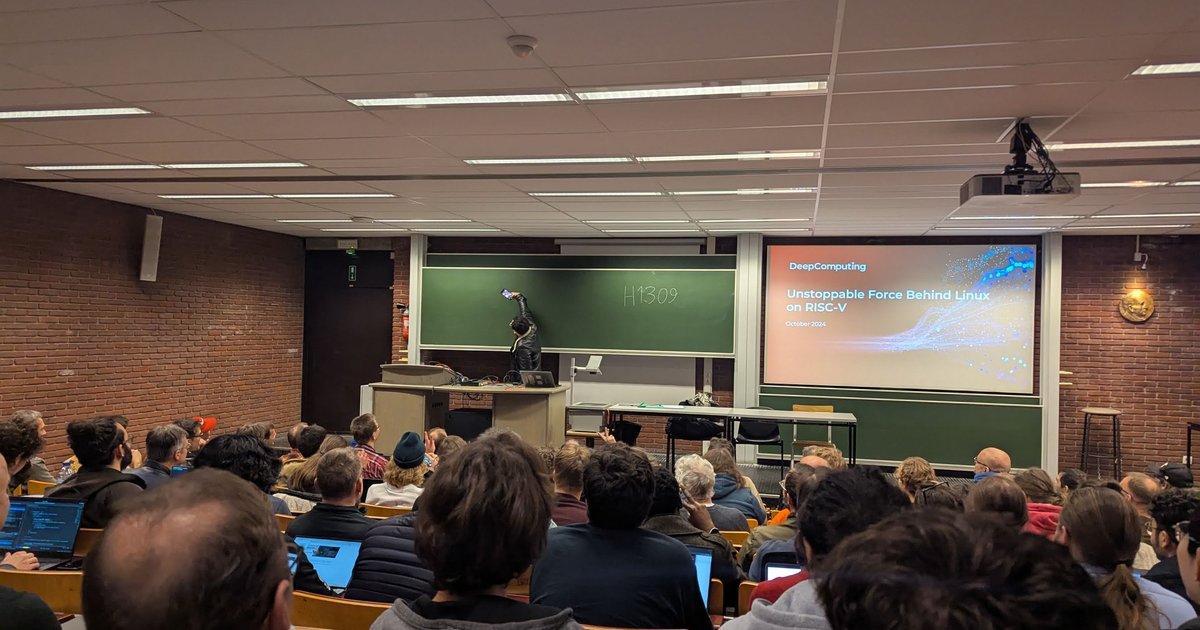
”Unstoppable Force Behind Linux on RISC-V” (DeepComputing, room H.1309)
On Saturday late morning I was in room H.1309, which had its number chalked on the board, for DeepComputing’s talk “Unstoppable Force Behind Linux on RISC-V”. The title slide was dated October 2024. The next slide introduced Yuning Liang, Founder of DeepComputing, who gave the talk.
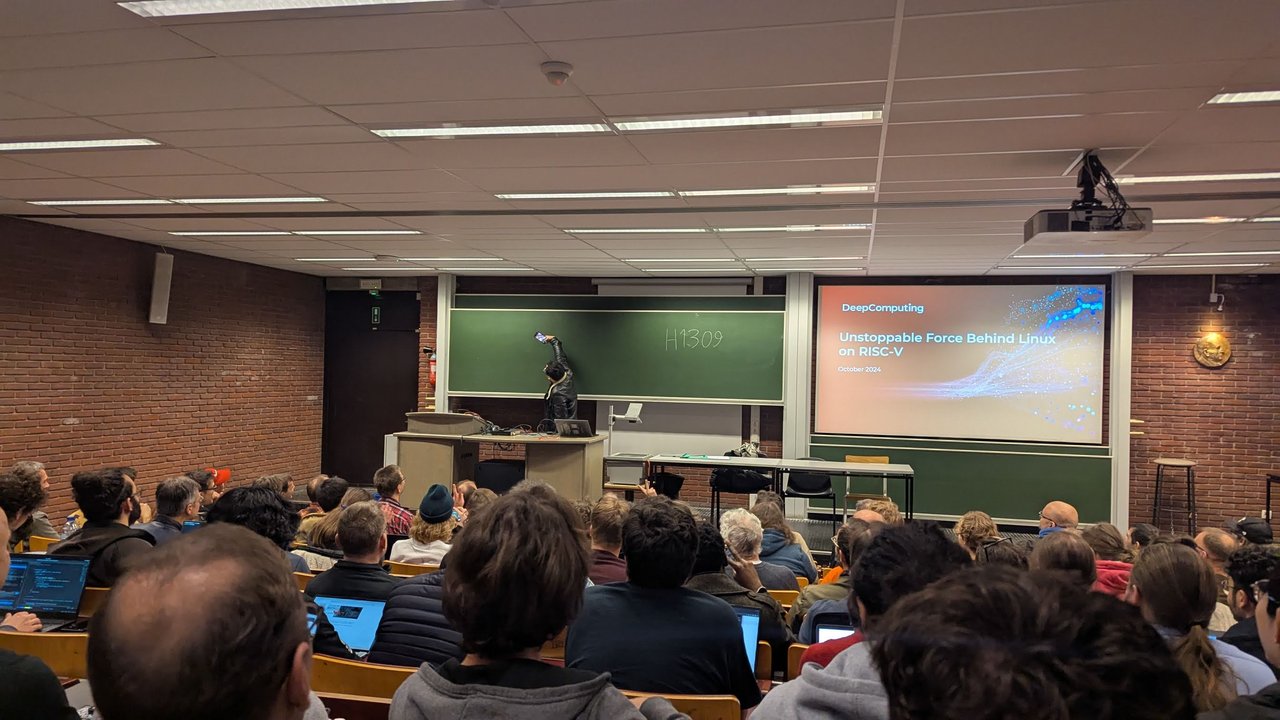
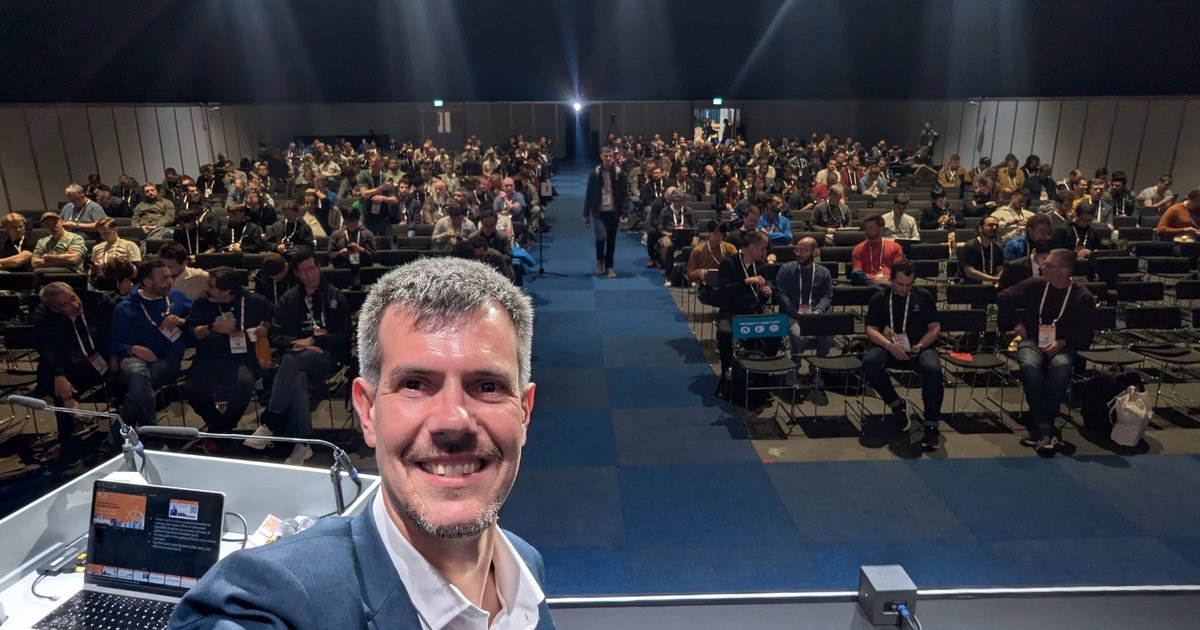
The room filled up before the first slide.
What the slides covered:
- Who DeepComputing is. The company called itself a “RISC-V Premium Product Pioneer” focused on consumer electronics, modern personal computing devices “and some RISC-V Run & Fun Gadgets”.
- Openness as history. A slide titled “RISC-V Faith and Destiny, like Linux Kernel?” compared three ISAs: x86 (from the US, closed, owned by Intel and AMD), ARM (from Europe, “semi-close, semi-open”, owned by ARM) and RISC-V (from the US, migrating to Europe and “driven by Asia”, described as “open, belong to Humanity”).
- Partnerships. Slides showed DeepComputing with Canonical at RISC-V Summit EU 2024 and with Framework at Ubuntu Summit 2024. The Framework slide quoted Framework’s CEO: “Open ecosystems are (very) powerful” and “Developer-ready today empowers consumer-ready tomorrow”.
- Upstreaming. The 2025 goal was that the latest released kernel and OS can be built and run on all DeepComputing products. The partners listed were Framework engineers, Linux kernel maintainers, SoC partner engineers (StarFive/Spacemit), OS partner engineers (Ubuntu) and upstream specialists (RISCStar).
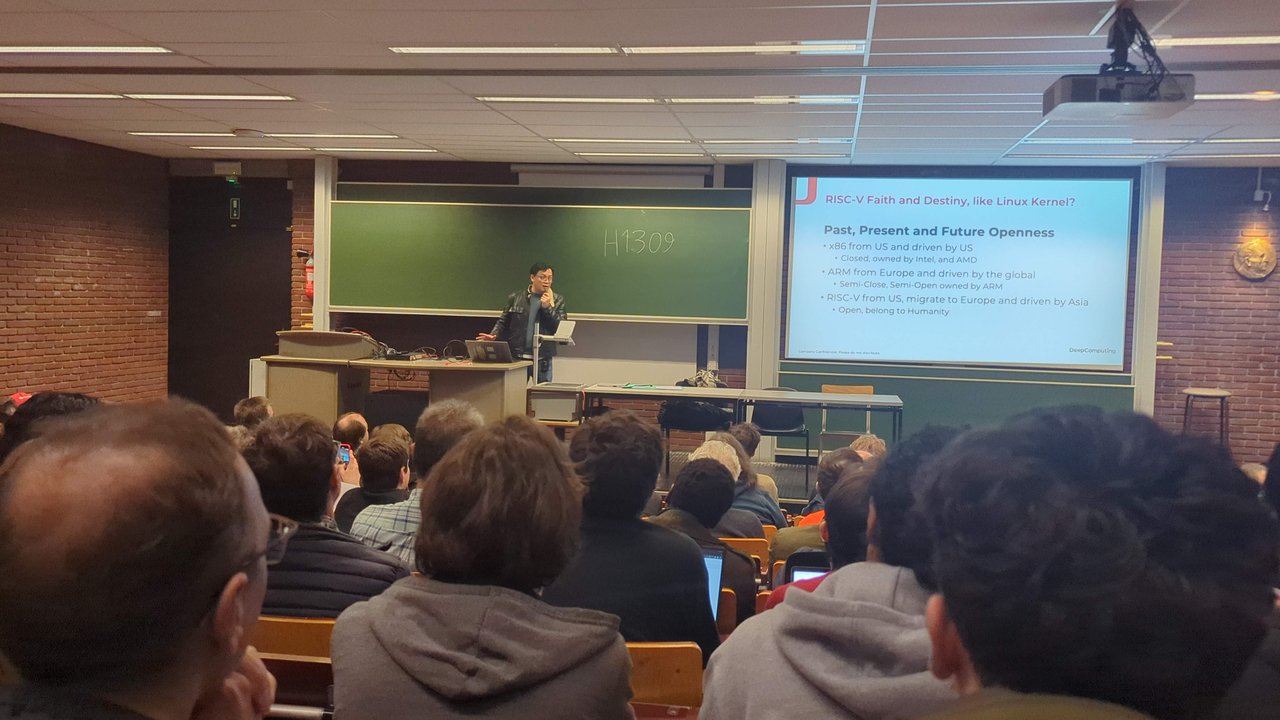
Past, present and future openness: x86, ARM and RISC-V on one slide.
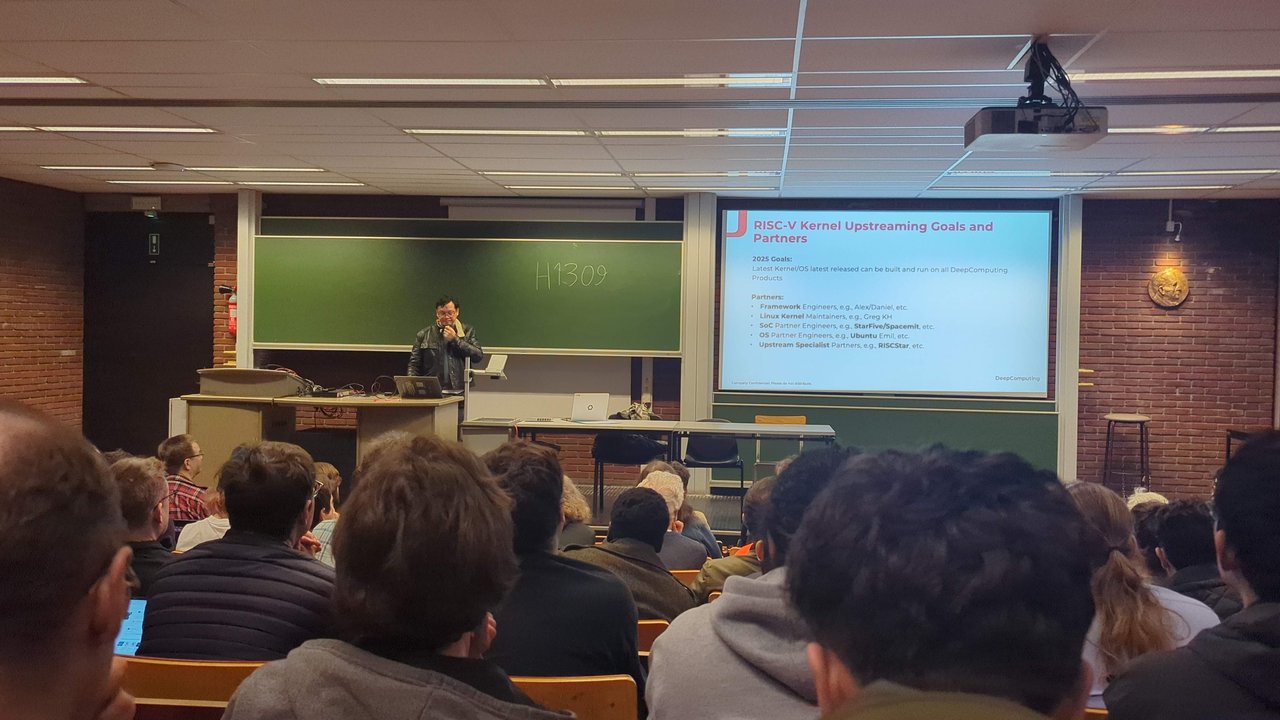
The 2025 upstreaming goal and the partners behind it.
The “Exciting 2025 Roadmap” slide started from the Framework 13” 4-core board, then a 64-core build machine in Q1, an 8-core AI machine in Q2 and an affordable 4-core ROMA III in Q3. The AI PC slides (covered in the companion post) ended with a “Call For Applications”: prompt, video/audio AGI, video conferencing, web, VS Code and robotics LLM use cases, illustrated with robots from Deep Robotics and DirectDrive.
My take: the upstreaming slide mattered most. A RISC-V laptop only becomes a dependable developer machine when it runs a mainline kernel and a stock distro image, and that’s also what makes it something you can automate and support at scale.
Podcasting 2.0 and the <transcript> tag (Benjamin Bellamy)
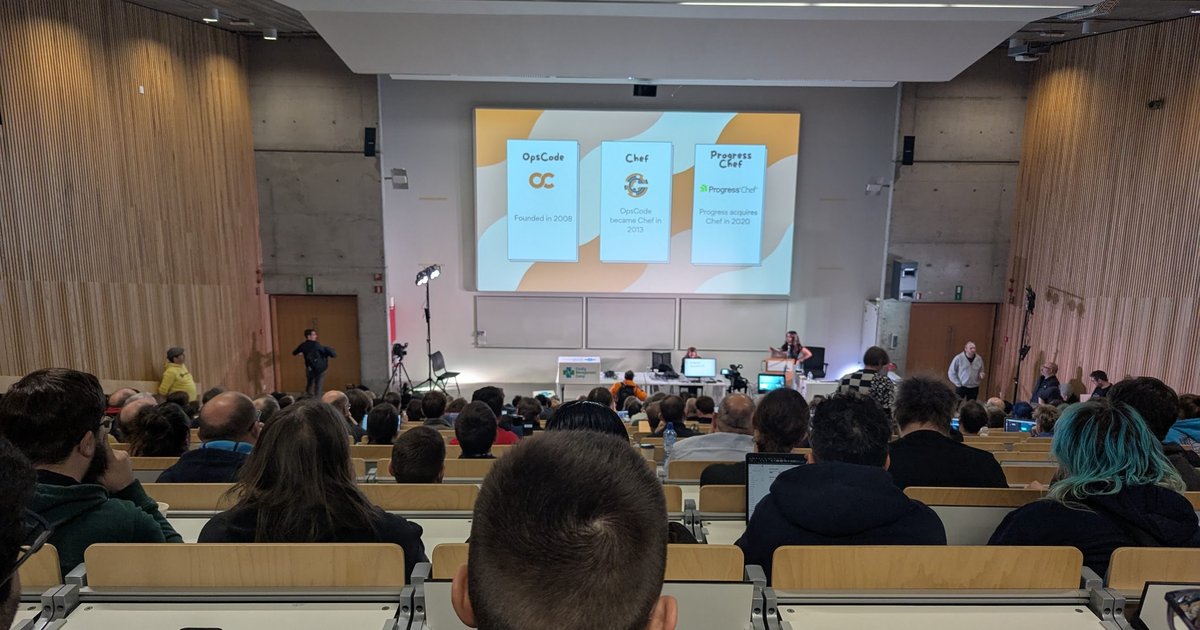
Saturday afternoon I moved to a large amphitheatre for Benjamin Bellamy’s talk on Podcasting 2.0. His name and “FOSDEM 2025” were in every slide footer, along with the date, 1 February 2025. I didn’t photograph the title slide, so I won’t guess the exact title.
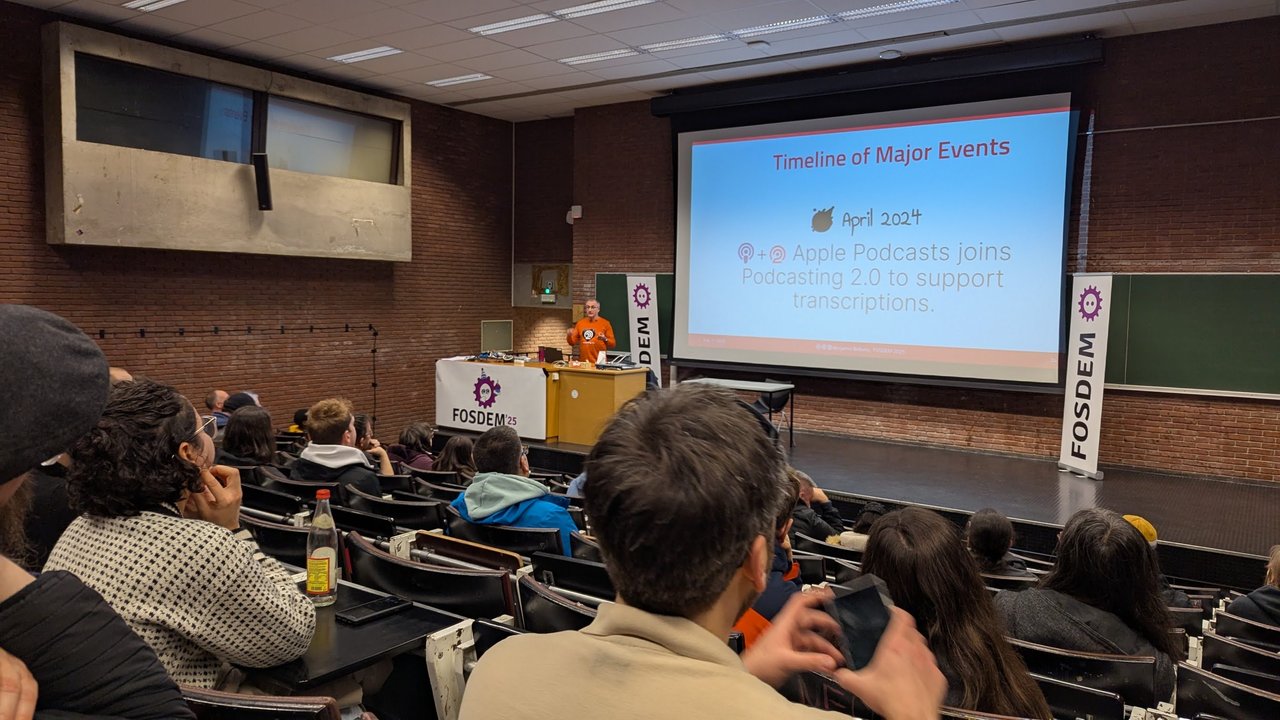
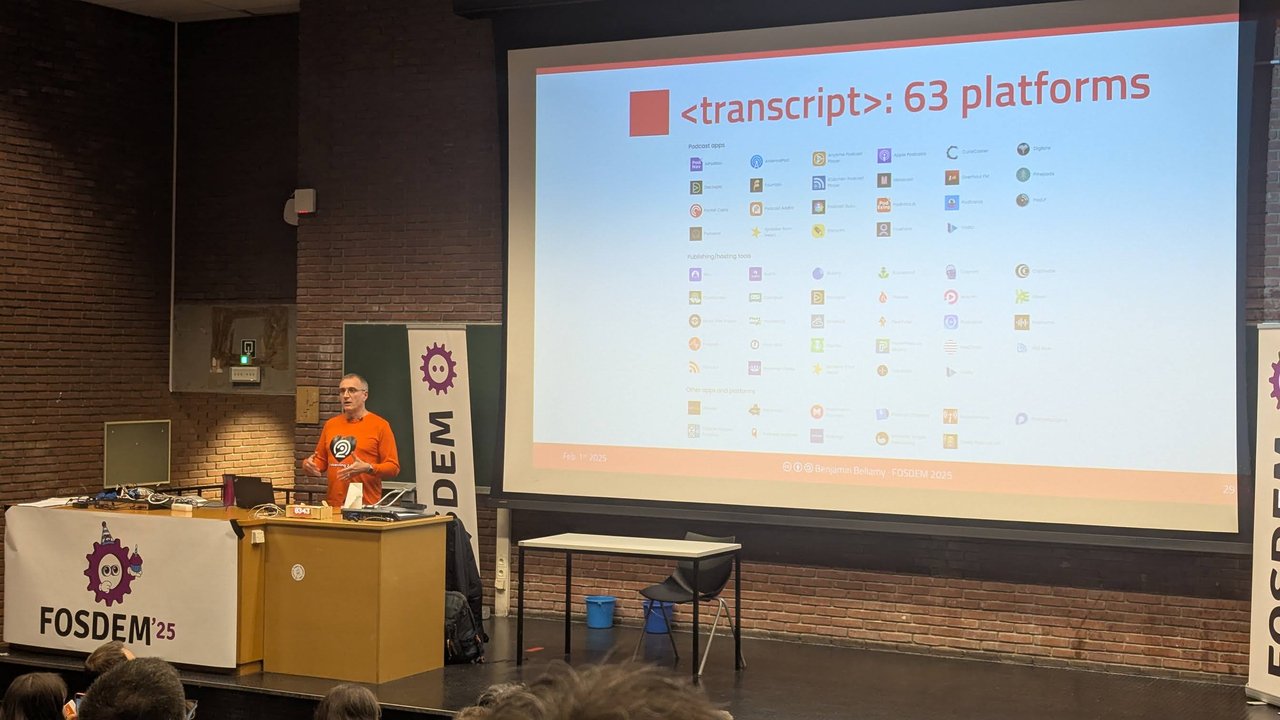
From the 2005 iTunes milestone to 63 platforms supporting <transcript>.
- A timeline of major events. It began in 2005 with “Apple launches iTunes Podcasts”. A later entry, April 2024, read “Apple Podcasts joins Podcasting 2.0 to support transcriptions.”
- Adoption in numbers. One slide read “
<transcript>: 63 platforms” and grouped the supporters into podcast apps, publishing/hosting tools, and other apps and platforms. - Where to start. “Visit podcasting2.org” showed the site’s pitch, “Podcasting 2.0 is making podcasting better for audiences, podcasters, and developers”, with separate sections for each group.
- What’s next. The closing slide promoted “Castopod & Web Monetization on the Social Web” at the Social Web BOF (Track A), Sunday 2 February from 12:00 in room AW1.121, with a link to castopod.org/fosdem25.
My take: an RSS extension reaching 63 platforms is a good example of how open standards win. One shared namespace, then many independent implementations.
”Verifiable Credentials with expressive zero knowledge query” (Jesse Wright, room AW1.126)
On Sunday morning the room with AW1.126 chalked on the board was full, with people standing along the back wall. The title slide, with a University of Oxford logo, read “Verifiable Credentials with expressive zero knowledge query” by Jesse Wright, February 2025. The opening example was a GOV.UK Wallet mock-up on a phone.
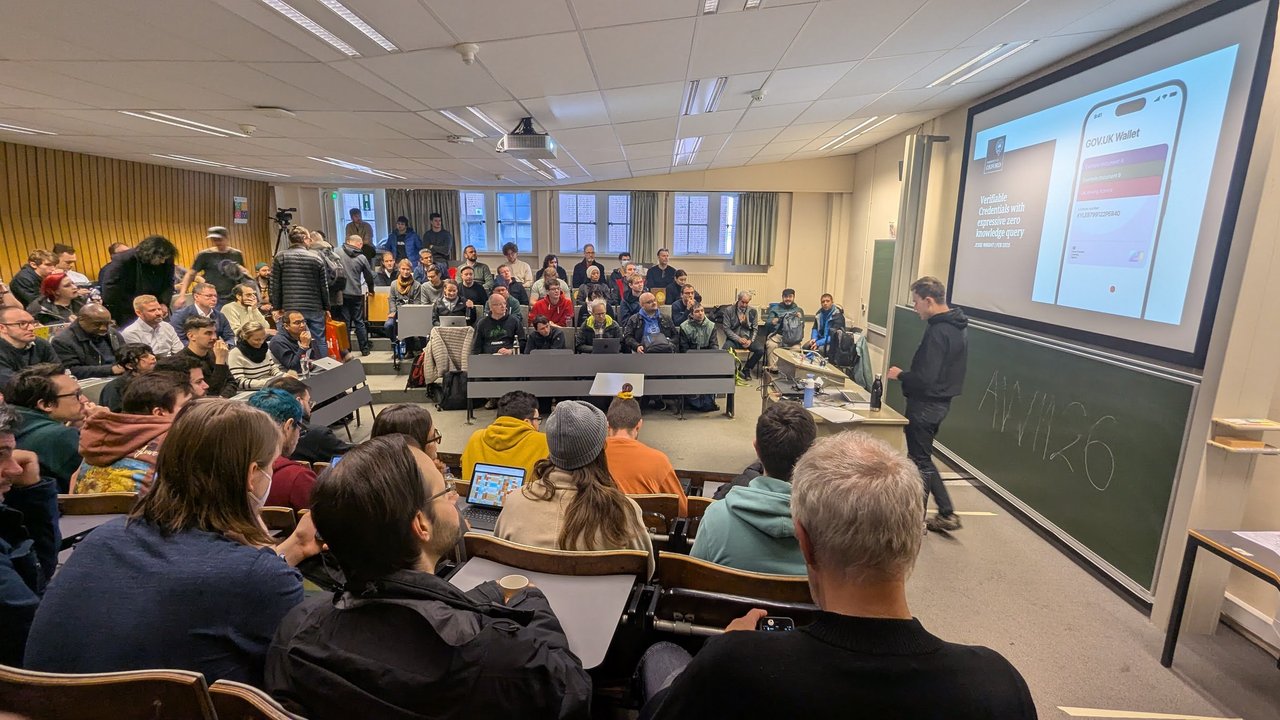
A full room for credentials and SPARQL on Sunday morning.
- Solid as the backdrop. A slide described Solid as “an open standard for managing digital identities and storing personal data for re-use across applications on the Web”, whose goal “is for people to have more agency over their data”. It linked Solid with the Open Data Institute.
- Provenance. “A generalisation is to supply some evidence that you can take something to be true. We call this provenance.”
- Secondary data reuse. One example, shown with the Gaia-X logo, was a dataset of the age and BMI of all men in the UK.
- The ask. Signed claims from a driving authority (date of birth) and an immigration authority (citizenship) were written as RDF. The goal was to run a SPARQL ASK query, and other read-only SPARQL operations (SELECT and CONSTRUCT), over them, with a zero-knowledge proof that the result came from claims issued by those authorities. The talk closed with a reading list: the SPARQL 1.2 Query spec, a W3C ODRL community group profile, solidproject.org and PROV-O.
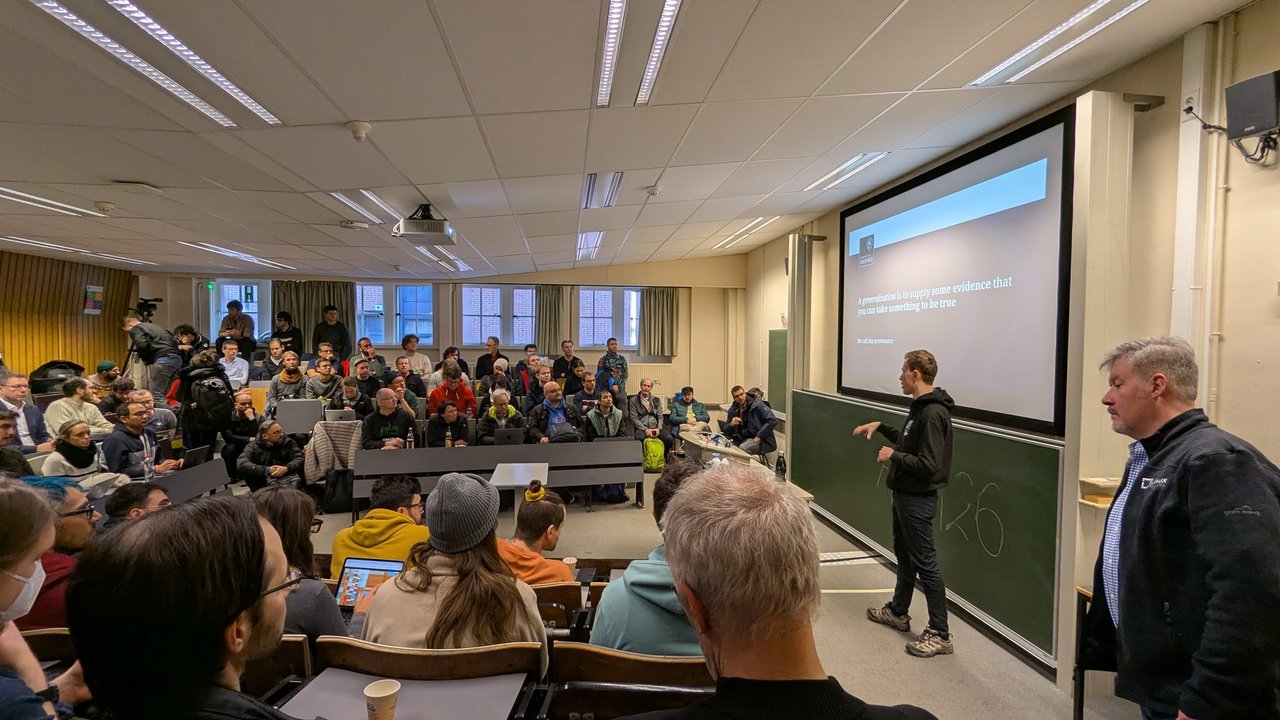
“We call this provenance.”
My take: this is the same pattern as policy-as-code in a platform. You prove one property (“over 18”, “Commonwealth citizen”) without handing over the whole record. If wallets can answer queries like this, that’s a much better default than copying passports into every onboarding flow.
Also on Sunday
Around midday I stopped by the Energy devroom. The chalkboard read “#energydevroom” and “#2025-energy:fosdem.org”, but I arrived during a changeover and people at the front blocked most of the title slide (it mentioned power and energy metrics). That’s not enough to write it up properly.
For the interviews, the RISC-V AI PC slide and more photos from H.1309, see Top Interviews from FOSDEM 2025.