On the morning of 10 January 2026 I walked through central Paris with my phone and recorded a run of short to-camera reels. I recorded several takes of the same message, some inside under an ornate dome and others outside on the pavement in front of the Petit Palais. I called it “AI for Europe”, and some takes opened with “Hey Europe, wake up on AI!”. This post turns those takes into one argument about European AI sovereignty, in my own words, plus the context and practical steps that sit behind it.

The Petit Palais, the building I pointed at when I said “a palace like this”.
Thinking about the future means looking at the past
The morning started at Place de la Concorde, where I recorded the first reel. My point there was simple: thinking about the future is mostly about thinking about the past. The historic landmarks around me were built in a different era, by people with different expectations who behaved differently, but they had a vision of the future.
I see AI doing something similar today. It’s helping us discover new materials, find new ways of communicating and build a new way of thinking about the future. I said I was glad to be part of these changes and part of this movement and community around AI, and that I wanted to learn more about which tools we’ll be using next.

Place de la Concorde, with the Eiffel Tower on the horizon: landmarks built by people who had a vision.
Context: the Petit Palais itself is a good example of that kind of vision. According to Paris Musées, it was built by the architect Charles Girault for the 1900 Paris Exposition Universelle and became the Paris Museum of Fine Arts in 1902.
My message: Europe, wake up and compete on AI
This is the core of what I said, merged from the takes:
In Europe we created a lot of the beauty of the world and a lot of the innovation that changed our lives. We built palaces like this one and showed the world what beauty, function and architecture mean. Now it’s time to wake up and be competitive on AI.
I want to see more European companies doing AI infrastructure, doing models, doing agents, doing everything. In one take I said “we need more and more and more”, and I meant it. Using the best of our brains and our innovation is how we get back to being competitive.
My argument rests on one comparison. If Europe could build places like the Petit Palais, with the best materials, the best architecture and the most ingenious minds, places that still make people travel from all over the world to visit every day, then the same talent and the same mindset can be applied to AI. I believe the European Union has the talent and the people to carry and create the AI of tomorrow.
I also said that Europe created well-being and what we now consider high standards. So I believe this continent has more to say in this new wave of innovation.

Iron, glass and a staircase built to impress, photographed a few minutes before the first “AI for Europe” take.
The narrative problem
Several takes came back to the same frustration. The AI narrative seems to be dominated by other nations, and it seems to benefit only certain countries. I want to hear more European voices in that conversation, and more European initiatives behind them.
That’s why the reels were also a question. In the final takes I said that AI is taking the world by storm, and that I’d already seen a lot of interesting startups, a lot of agentic AI and a lot of interesting initiatives. But I want to hear more. As European citizens, I really hope we can do better: better infrastructure, better technology.
Context: what Europe has already put in motion
My reels were an opinion, not a policy briefing. Since then I’ve checked what the EU has actually announced, because founders and platform teams should know what they can use. All of the following comes from official EU pages:
- InvestAI. On 11 February 2025, at the AI Action Summit in Paris, the Commission launched InvestAI to mobilise €200 billion for investment in AI, including a new €20 billion European fund for AI gigafactories.
- AI factories. The Commission’s AI Factories page says 19 AI Factories and 13 AI Factory Antennas are being set up, built around EuroHPC supercomputers, prioritising access for AI startups and SMEs. The list includes AI2F in France and NLAIF in the Netherlands.
- AI gigafactories. The same page says the EU has launched a call for tenders to establish up to seven AI Gigafactories, supported by up to €10 billion in EU and national funding and expected to unlock at least €20 billion in private investment, each with over 100,000 advanced AI processors.
- The AI Act. According to the Commission’s AI Act page, the regulation entered into force on 1 August 2024 and became applicable on 2 August 2026. Prohibited practices and AI literacy obligations applied from 2 February 2025, and the obligations for general-purpose AI models from 2 August 2025. After the “AI Omnibus” agreement, the rules for high-risk use cases in Annex III apply from 2 December 2027 and those for high-risk systems in regulated products from 2 August 2028. I covered the postponement in EU AI Act High-Risk Deadlines Postponed.
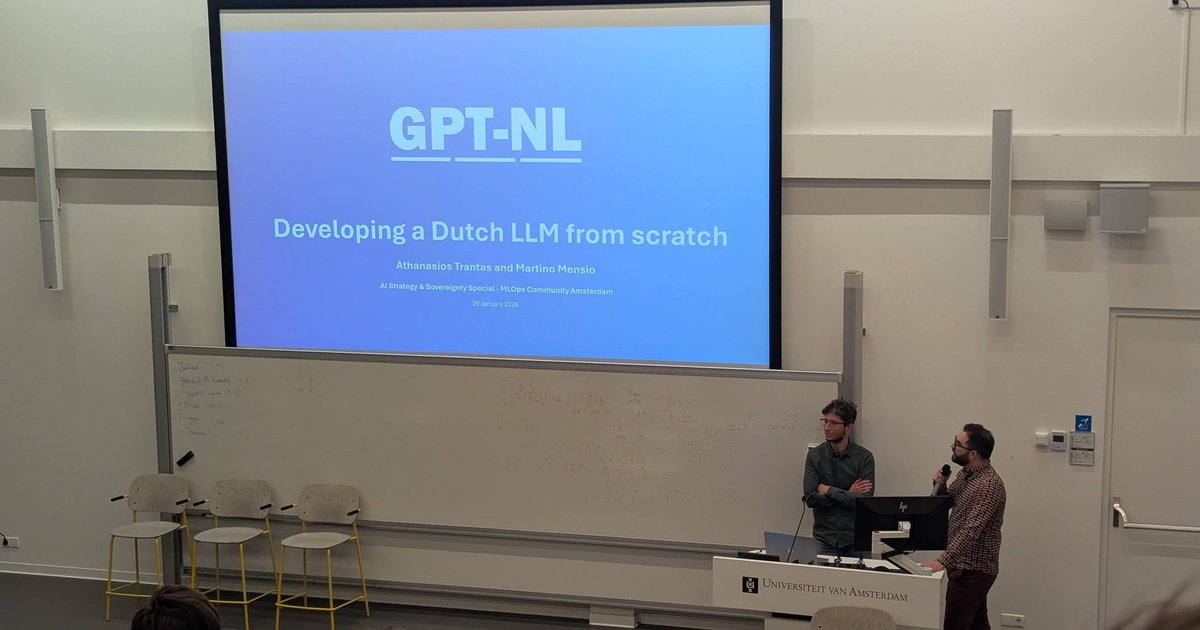
- European models exist. Mistral AI, which its about page presents as a European AI company, released Mistral Small 4 on 16 March 2026 under the Apache 2.0 licence; I looked at it in detail in Mistral Small 4 119B. In the Netherlands, TNO is building GPT-NL, a Dutch language model trained from scratch, which I wrote about after the MLOps Community Amsterdam sovereignty special.
My read of that list is the same as in the reel: the plans and the money are announced. What I asked for is more companies and more teams actually building on top of them.
What European teams can do now
The reels were about infrastructure, models, agents and talent. Here’s how I’d turn that into practical work for platform engineers and CTOs. This part is my professional view from client work, not something I said on camera.
- Build on open models you can run yourself. If we want European models to matter, we have to use them. Start your evaluation with open-weight models under licences like Apache 2.0, including European ones, and run them on your own serving stack. My guide to model serving on Kubernetes with vLLM, Triton and NIM covers the options.
- Run AI infrastructure under EU jurisdiction. “Doing infrastructure” doesn’t have to mean building a data centre. An on-premises or EU-hosted Kubernetes or OpenShift cluster with GPU nodes, shared fairly between teams, gets you most of the way. My notes on multi-tenant GPUs on OpenShift AI and digital sovereignty and EU cloud strategy go deeper.
- Look at the AI factories if you’re a startup or SME. The EU says access is being prioritised for AI startups and SMEs. If you’re training or fine-tuning, check what your national AI factory offers before you sign a long contract elsewhere.
- Keep your stack portable. Containers, Kubernetes and declarative automation let you move workloads between an EU provider, your own racks and a public cloud. That keeps your options open as European capacity grows.
- Invest in skills. My whole argument rests on European talent. Talent needs practice: give your engineers time to run models, operate GPU clusters and build agents in-house rather than only consuming APIs.

The Champs-Élysées after the recording, with the Arc de Triomphe at the far end.
Tell me your story
I ended the reels with an invitation, and it still stands. If you believe the same, I want to hear your stories. Let’s join forces, shape AI innovation together and create something remarkable in Europe.
If you’re a founder or engineer building AI infrastructure, models or agents in Europe, get in touch and tell me what you’re working on. And if your team needs help putting open models on a sovereign Kubernetes or OpenShift GPU platform, that’s the work I do in my AI integration services.