June 30, 2026. The eve of Ireland’s six-month EU Council Presidency, which started on 1 July. The right moment to ask a hard question in Amsterdam.
EU-Nough Tech Rules? was organized by DutchBasecamp, CCIA Europe, and the Embassy of Ireland in the Netherlands — a deliberate convening of founders, policy practitioners, and technology leaders in a stunning historic venue to confront something that rarely gets addressed directly: what EU digital regulation actually does to companies trying to grow.
I was in the room. These are my notes.
The research that set the frame
DutchBasecamp published a founder survey of 155 respondents — spread across 28 countries, from pre-seed startups to Series B scaleups — specifically to move this debate from policy text to founder experience. The headline numbers are striking:
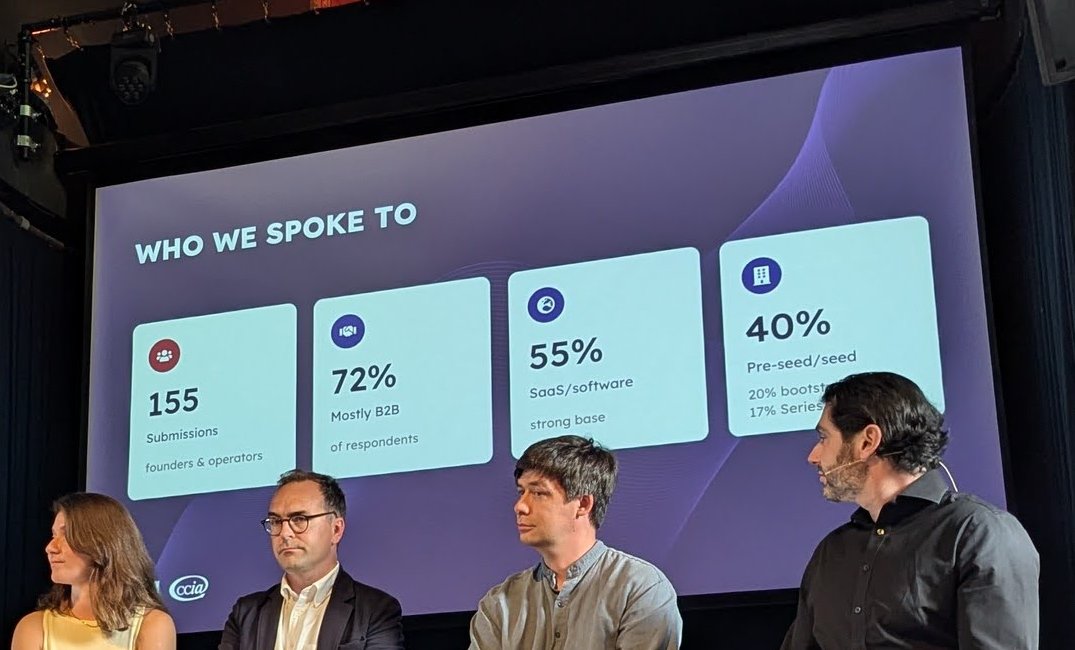
“Who we spoke to”, shown on stage in Amsterdam: 155 submissions, 72% mostly B2B, 55% SaaS/software, 40% pre-seed/seed.
| Finding | Share |
|---|---|
| Avoided entering another EU market over compliance concerns | 52% |
| Delayed market entry in the past 12 months | 58% |
| Paused or cancelled product features due to regulatory uncertainty | 45% |
| Lost or delayed deals | 44% |
| Weighing or already making an HQ move due to regulation | 24% |
| Spend more than 30% of operating budget on compliance | 23% |
| Reported no material impact | 21% |
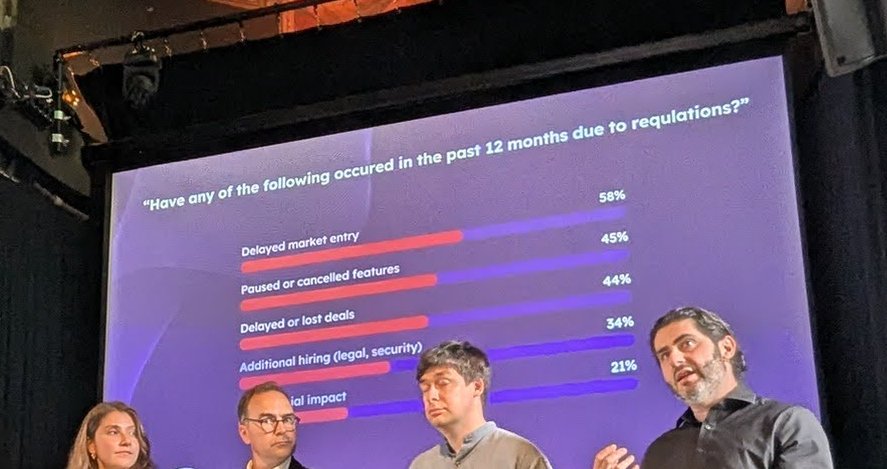
The slide behind the first rows of the table: delayed market entry 58%, paused or cancelled features 45%, delayed or lost deals 44%, additional hiring (legal, security) 34%, no material impact 21%.
The same slide shows a number the table above leaves out: 34% of respondents had to make additional legal or security hires because of regulation.
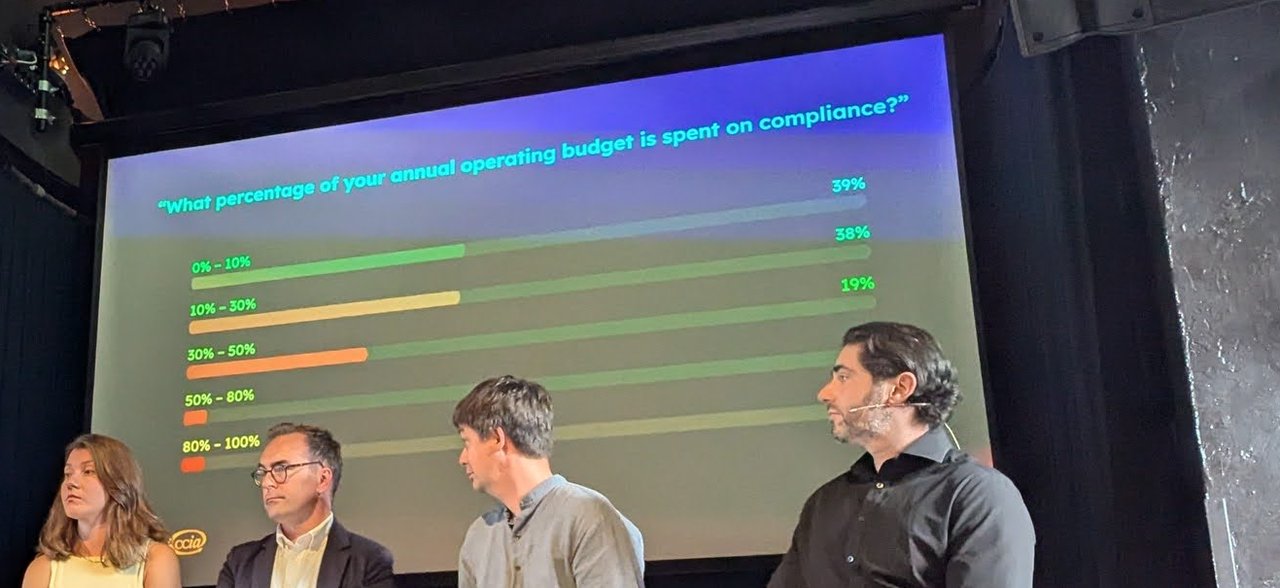
Compliance share of annual operating budget: 39% of respondents at 0-10%, 38% at 10-30%, 19% at 30-50%, and almost nothing in the 50-80% and 80-100% bands.
These are not abstract risks — they are decisions that already happened. Features not shipped. Markets not entered. Deals lost. And in many cases the decisive choice was made months or years before any relocation statistic captures it.
The European Investment Bank puts it this way: roughly one in ten EU scaleups has relocated abroad, around 85% of them to the United States. The JRC puts the HQ-relocation rate for VC-backed startups at 3.3–4.3% — ten times the rate for comparable non-VC-backed firms. These figures are, as the report notes, floors not ceilings: they count what has already happened, not what is quietly being planned.
Opening: Ireland steps into the presidency
Kieran Houlihan, Deputy Head of Mission at the Embassy of Ireland in the Netherlands, opened the event by framing it in terms of what Ireland’s presidency intends to accomplish in the next six months. Competitiveness, simplification, and a functioning single market for digital were not rhetorical goals — they were described as concrete agenda items on the presidency’s docket.
The timing was intentional. A new EU Council Presidency is one of the few moments when the legislative agenda can actually be shaped, and this conversation was partly meant to put founder evidence directly in front of the people who will be in Brussels negotiating it.
Presenting the evidence: Daniel Friedlaender, CCIA Europe
Daniel Friedlaender, Senior Vice President and Head of Office at CCIA Europe, walked through the DutchBasecamp research in detail. A few observations from his presentation stood out:
The cost is regressive. A €193,000–€330,000 quality-management system under the AI Act (CEPS estimate) is trivial overhead for an incumbent. For a bootstrapped ten-person team, it is existential. One founder in the survey put it plainly: “We found a lawyer, somewhere around €2,000–3,000 just to get the basics in place, and six to eight weeks of back-and-forth for a privacy policy, data-processing docs, and internal guidelines. For a bootstrapped startup that just launched, that’s a lot.”
Fragmentation is as damaging as strictness. The EU has 27 national interpretations of the same body of regulation, which has turned a notional single market into a patchwork. Founders said this repeatedly: the problem is not the existence of standards, but their inconsistency. “So when we were pre-seed we spent more money on GDPR lawyers than on marketing, while our competitors just ship code and push it to market.”
Uncertainty is its own tax. Much of the compliance cost does not come from meeting requirements — it comes from not knowing what those requirements will be. Founders are narrowing features and delaying launches because of AI Act uncertainty, before any obligation has formally bound them.
GDPR can be a competitive asset. The picture is not uniformly negative. For companies selling into enterprise accounts or handling sensitive data, GDPR compliance works as a mark of trust against US competitors. Founders in regulated verticals — health, fintech, legal tech — described it as a commercial differentiator. The problem is cost, unpredictability, and fragmentation, not the existence of standards.
Panel: what founders actually want
The panel — moderated by DutchBasecamp and featuring Graham Ó Maonaigh (Co-Founder & CEO, Tuarity), Lara Rogal (Customer Success Manager, Synthesia), Roman Belov (Innovation Lead, Brains), and Ceren Danis (Head of Fintech Product, per the panel slide) — was the sharpest part of the event.
A few themes that ran through it:
Not anti-regulation, anti-fragmentation. Every panelist was careful to separate “simplify regulation” from “remove regulation.” The ask is proportionate requirements, clearer guidance, and greater mutual recognition across member states — not a race to the bottom. The research backs this: when founders were asked what they want from the EU, deregulation was not the top answer. Simplification was.
The 28th regime as a solution. The proposed EU Inc. framework — a pan-European legal entity that would let startups incorporate once and operate across the single market — came up repeatedly as the structural fix that could address fragmentation at the source rather than patching it. The current system means 27 sets of compliance decisions for 27 markets, even for a company offering identical software across all of them.
Relocation is already happening quietly. The data says 24% are weighing or making an HQ move. In the room, the panel acknowledged that many of those moves are not announced — they happen gradually, through where the next hire is made, where the next entity is registered, where the next fundraise is closed. By the time a company appears in relocation statistics, the decision was made long ago.
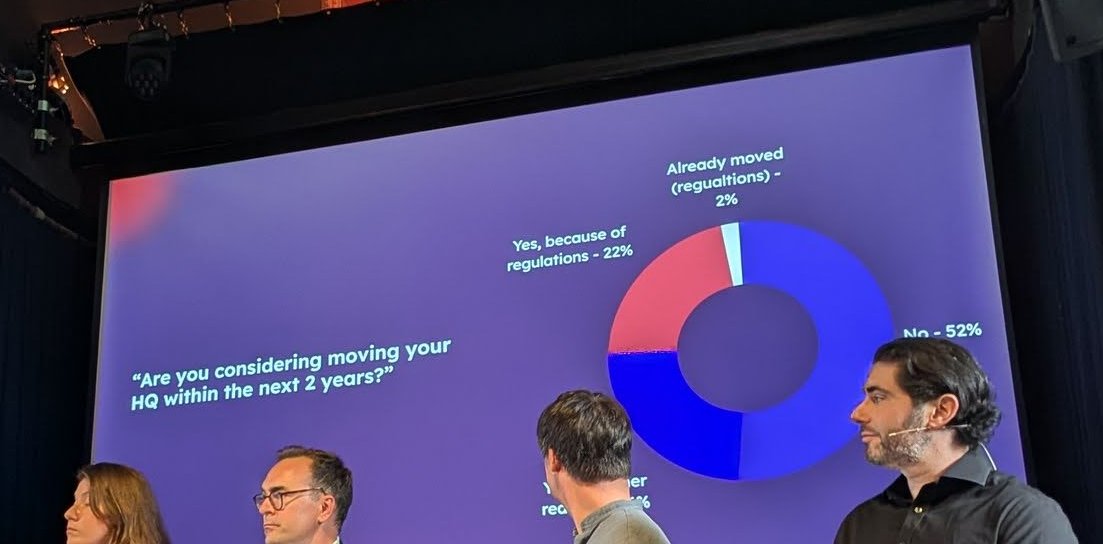
The HQ question as shown on stage: No 52%, “Yes, because of regulations” 22%, “Already moved (regulations)” 2%.
The slide breaks down the headline figure: the 24% weighing or making a move is 22% considering it because of regulations plus 2% who have already moved.
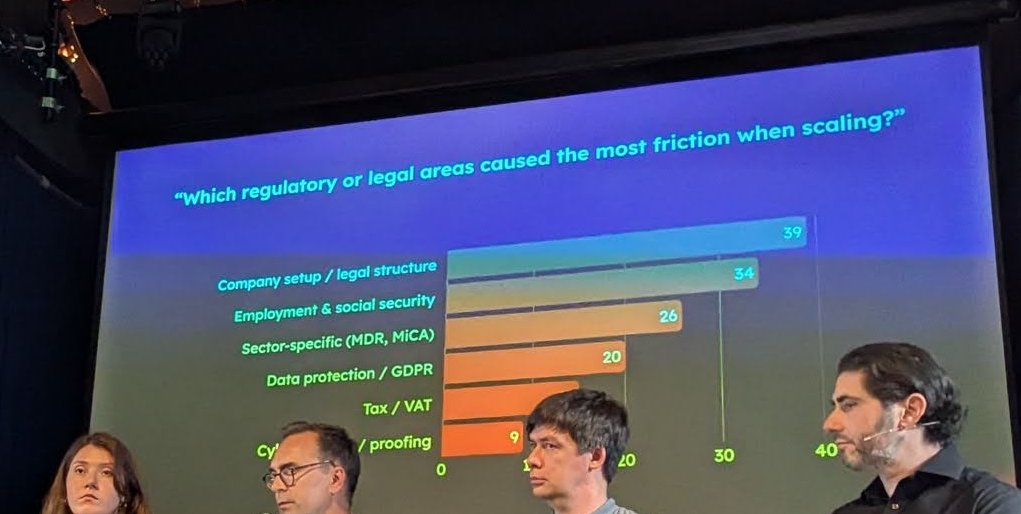
Where the friction is: company setup / legal structure (39), employment and social security (34), sector-specific rules such as MDR and MiCA (26), data protection / GDPR (20).
A point that fits the “28th regime” argument: on this slide, company setup and legal structure caused the most friction when scaling, ahead of GDPR.
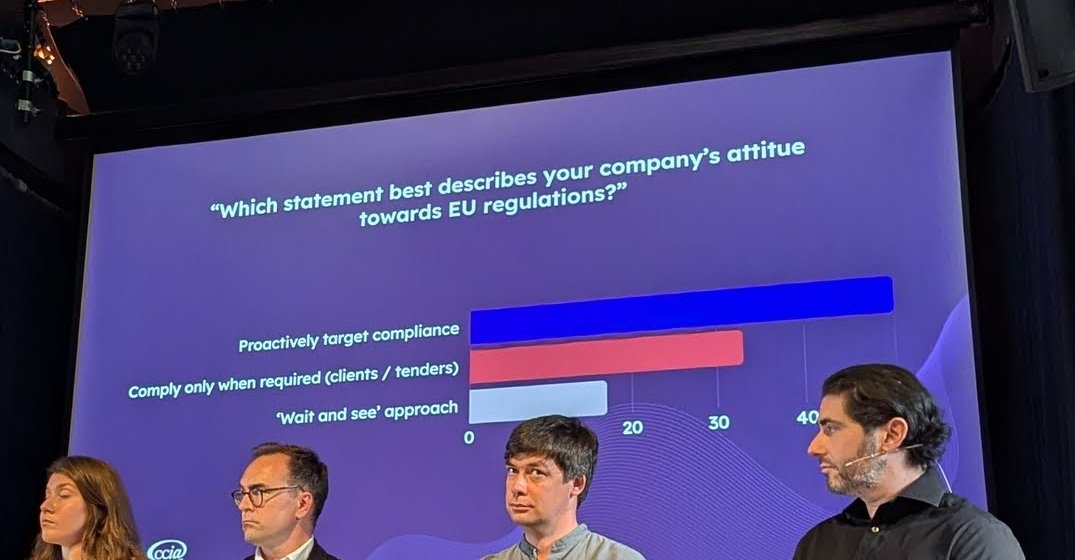
Attitude towards EU regulation: “proactively target compliance” is the longest bar, ahead of “comply only when required” and “wait and see”.
What this means for European tech
Europe creates more startups annually than the United States. What it has not built is an environment in which an ambitious company can scale across its own internal market as easily as an American company scales across the United States.
The regulatory framework is one cause. Not the only one — access to capital, talent density, and market depth all matter — but it is the cause that founder survey data consistently confirms, and the one most directly within EU policymakers’ control to change.
The founders at this event were not asking for a free pass. They were asking for rules that are proportionate, consistent across member states, and stable enough to plan against. That is a reasonable ask. Whether the Council Presidency that started the next day acts on it is a different question.
Full research: The Realities of Scaling in Europe — DutchBasecamp Founder Research, June 2026 (n=155). Event organized by DutchBasecamp, CCIA Europe, and the Embassy of Ireland in the Netherlands.
Tags: #EUInc #EuropeanTech #IrishEUPresidency #Startups #Scaleups #Innovation #Competitiveness #SingleMarket #Amsterdam