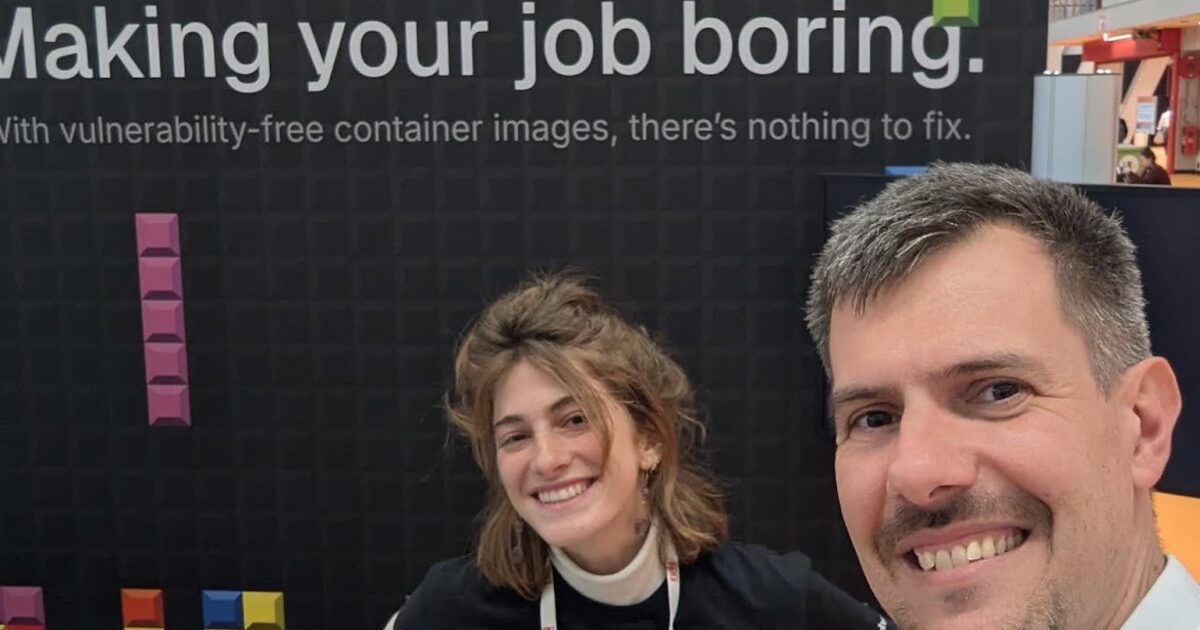
What if the ultimate goal of infrastructure and security was simply to make your job… boring?
I had a fantastic chat with Gabriela K. Wolin at the echo.ai booth at KubeCon, and I absolutely love their core mission: “Making your job boring.”
The Container Image Maintenance Trap
We talked about the endless cycle of maintaining, patching, and hardening container images. Developers constantly find themselves bogged down, spending hours fixing vulnerabilities in underlying layers that they did not even build.
The reality in most organizations looks like this:
- CVE alert fires — a critical vulnerability in your base image
- Developer context-switches — drops feature work to investigate
- Dependency rabbit hole — the fix requires updating a library, which breaks another dependency
- Rebuild and test — rebuild all affected images, run the full test suite
- Deploy and pray — push the patched images and hope nothing breaks
- Repeat next week — another CVE, another cycle
This is not engineering. This is janitorial work on infrastructure you did not build and do not control. And it consumes a staggering amount of engineering time across the industry.
Secure by Design, Not by Patching
echo.ai is tackling this by taking the most common container images and libraries and recreating them in-house with a secure-by-design approach. The result is a drastically smaller attack surface.
The key difference from traditional container security tools:
| Traditional Approach | echo.ai Approach |
|---|---|
| Scan existing images for vulnerabilities | Rebuild images from scratch, secure by design |
| Alert developers to fix CVEs | Take full responsibility for patching |
| Add security layers on top | Reduce attack surface at the foundation |
| Developers maintain base images | Developers focus on app layer only |
But the best part? They take full responsibility for patching and hardening those containers for you. You consume their images, and they handle the security lifecycle.
Why This Matters for Developer Experience
For me, this is a massive win for Developer Experience. When we remove the friction of maintaining base container artifacts, engineering teams can stop fixing things they did not break and finally get back to what actually drives value: building the app layer and shipping great features.
This connects to the broader platform engineering conversation I have been having at KubeCon. The best platforms abstract away undifferentiated heavy lifting. Container image maintenance is the definition of undifferentiated — every organization does it, none of them gain competitive advantage from it.
In the context of AI workloads on Kubernetes, this becomes even more relevant. AI container images are notoriously large and complex — CUDA drivers, Python dependencies, model serving frameworks, inference runtimes. Each layer is a potential vulnerability surface. Having a trusted provider handle the base layer security means your ML engineers can focus on model performance, not CVE triage.
The Smaller Attack Surface Advantage
A smaller container image is not just more secure — it is:
- Faster to pull — less data to transfer across the network
- Faster to scan — fewer packages to analyze
- Easier to audit — less code to review
- Cheaper to store — less registry storage
- Quicker to start — faster cold starts in Kubernetes
When you combine secure-by-design images with proper observability and incident management, you get an infrastructure stack where security is boring — and boring is exactly what you want.
Learn More
If you are ready to make your container maintenance a lot less “exciting” (in the best way possible): echo.ai
Related Posts
- Advancing Platform Engineering on AI, K8s, and the Product Mindset
- Rootly at KubeCon EU 2026: AI SRE Agents
- Dynatrace: AI Observability and Right-Sizing
- AI on Kubernetes: The First 90 Days
About the Author
I am Luca Berton, AI and Cloud Advisor. I help enterprises build secure, developer-friendly platforms that let teams focus on what matters. Book a consultation.