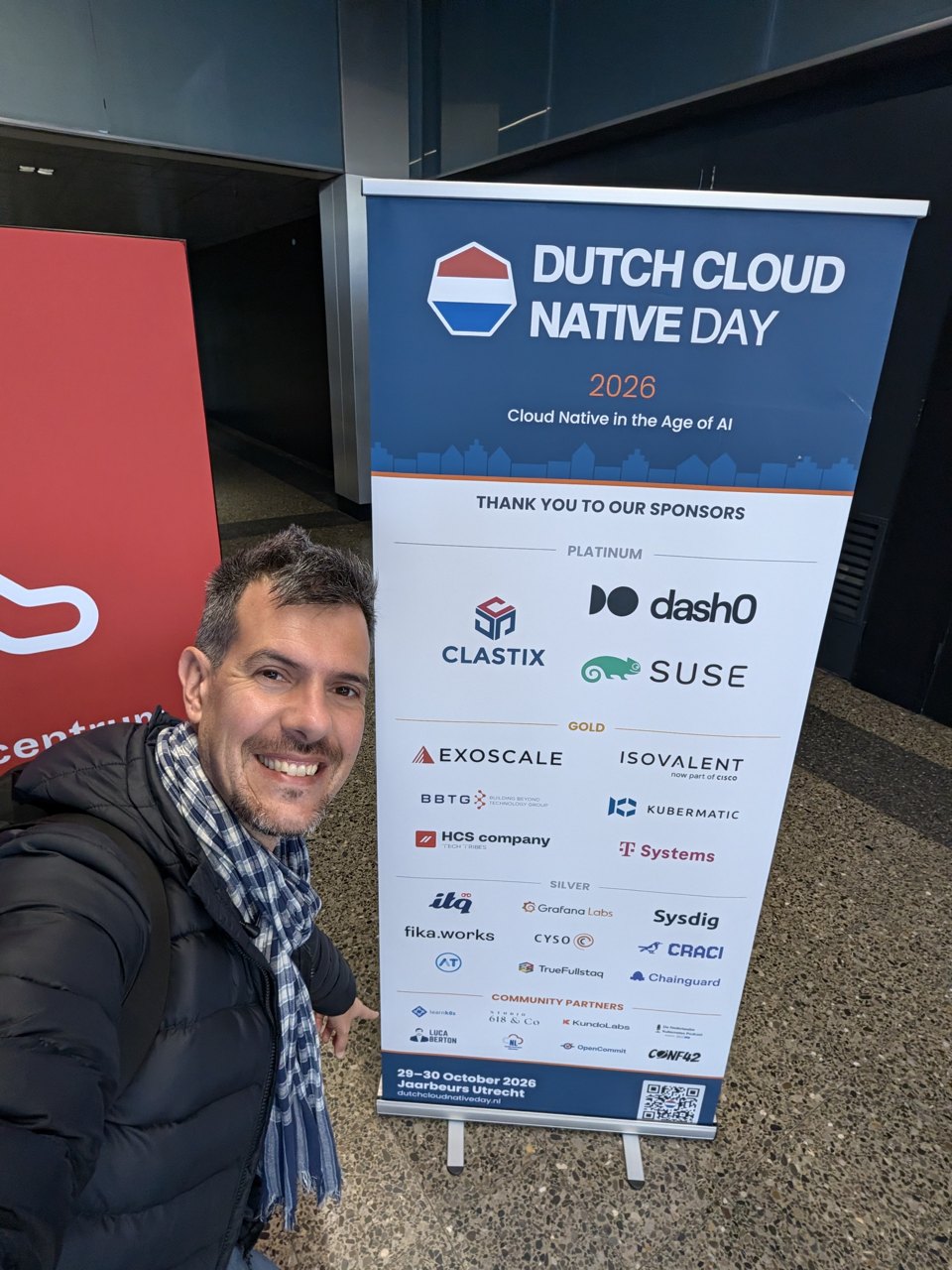
Three days after Techorama, I was back in Utrecht, at the Jaarbeurs, for Dutch Cloud Native Day 2026. Its theme was Cloud Native in the Age of AI, and it calls itself vendor-neutral, inclusive and community-first, “organized by the community, for the community”. Workshops ran on Thursday 29 October; the talks were on Friday 30 October, from 09:30 to 17:25, and the event was sold out. I was there for Udienza, my video podcast, and my name was on the event’s banner among the community partners. This is the day as I saw it, from the programme and from what was on the walls and the screens.
The programme: agents, GPUs, sovereignty
The morning opened in the main room, Progress, with the organisers and three fifteen-minute talks, each after a platinum sponsor’s introduction (Dash0, SUSE, Clastix). Pini Reznik, CEO at re-cinq.com, gave The AI Adoption Ladder: From First Licences to the Dark Factory. Simon Schrottner, CNCF Ambassador and OpenFeature maintainer, gave Two Standards Walk Into an Agent: Runtime Agent Control with OpenTelemetry and OpenFeature. Orlin Vasilev set the tone with a title that is also a command: kubectl apply -f european-sovereignty.yaml. Then three tracks, Progress, Mission 1 and Mission 2, ran half-hour talks until the closing.
Read the titles together and three threads come out:
- Agents. Alex Kotliarskyi, who works on dark factories at OpenAI, on No Token Budget: What Breaks When Agentic Software Factories Run on Kubernetes; Luiz Carneiro on Building Interoperable Agents: When A2A meets MCP; ING on VISTA, its “Self-Service Data, AI, and Agentic Platform”; Anna Kosek on Platform Engineering in the Agentic Engineering Era at RTL Netherlands; and Johan van Amersfoort of ITQ on Sit. Stay. Deploy! Teaching a Robot Dog with AI.
- GPUs. Viktor Farcic on From GPUs to Endpoints: A Crossplane Control Plane for Self-Hosted Inference, Dimitris Karakasilis on AI Broke Your DevOps Assumptions: Privacy, IP and $40k Idle GPUs, and Marino Wijay on Running Out of IPs Before You Run Out of GPUs: IPv6 for AI-Scale Kubernetes.
- Sovereignty and regulation. Orlin Vasilev’s morning talk; Petteri Pulkkinen and Erika Marttinen on SBOMbastic: Getting Ready for Upcoming EU Cybersecurity Regulation in Software Supply Chains; and the last talk in Progress, Aarno Aukia’s Data Sovereignty Is Built, Not Bought.
Sovereignty, made measurable
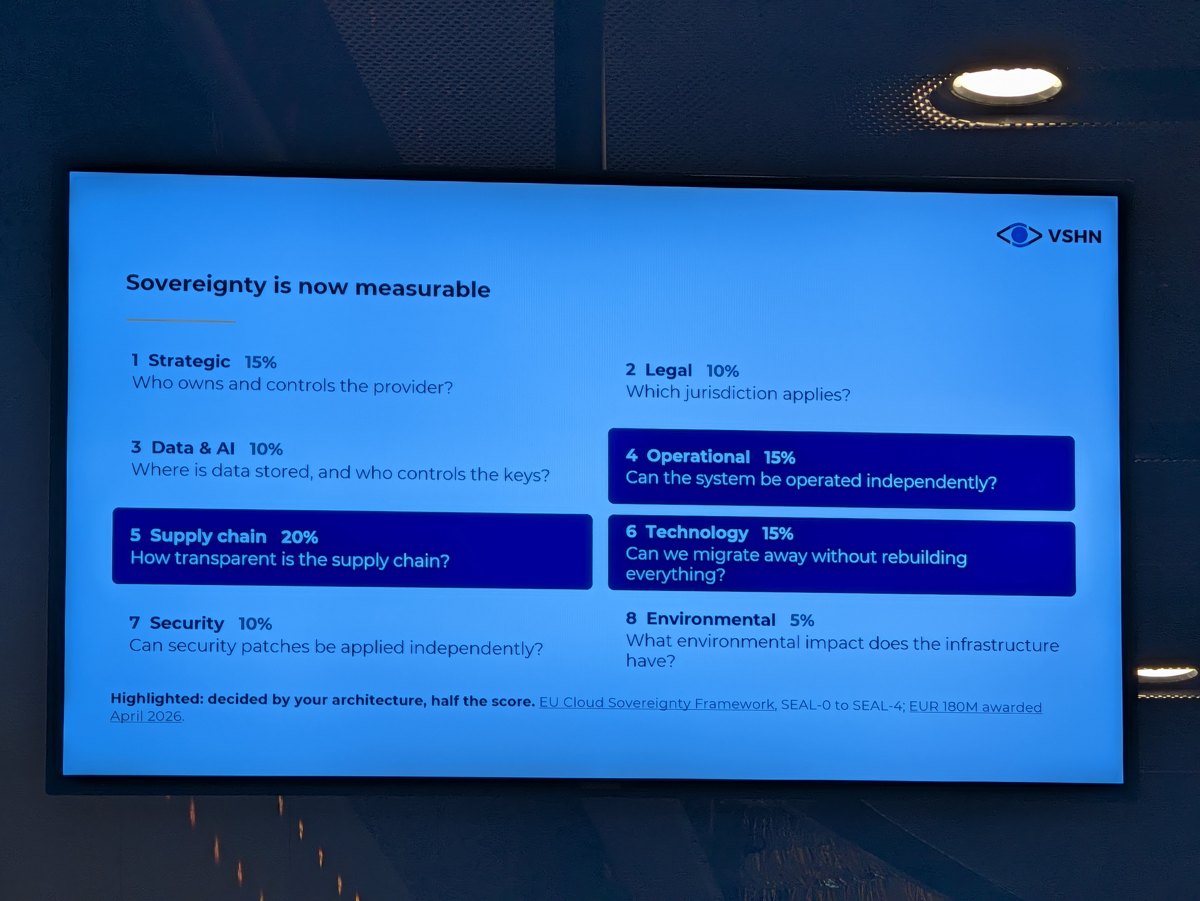
Aarno Aukia, partner at VSHN, closed the main room in the afternoon, and one of his slides turned sovereignty from a word into a score: eight dimensions, each with a weight and a question.
| Dimension | Weight | The question |
|---|---|---|
| Strategic | 15% | Who owns and controls the provider? |
| Legal | 10% | Which jurisdiction applies? |
| Data & AI | 10% | Where is data stored, and who controls the keys? |
| Operational | 15% | Can the system be operated independently? |
| Supply chain | 20% | How transparent is the supply chain? |
| Technology | 15% | Can we migrate away without rebuilding everything? |
| Security | 10% | Can security patches be applied independently? |
| Environmental | 5% | What environmental impact does the infrastructure have? |
Three of them were highlighted, operational, supply chain and technology: “decided by your architecture, half the score”. The slide set this against the EU Cloud Sovereignty Framework, with its levels from SEAL-0 to SEAL-4. The point I took home: half of your sovereignty is not a contract you sign but an architecture you build, which is his title.
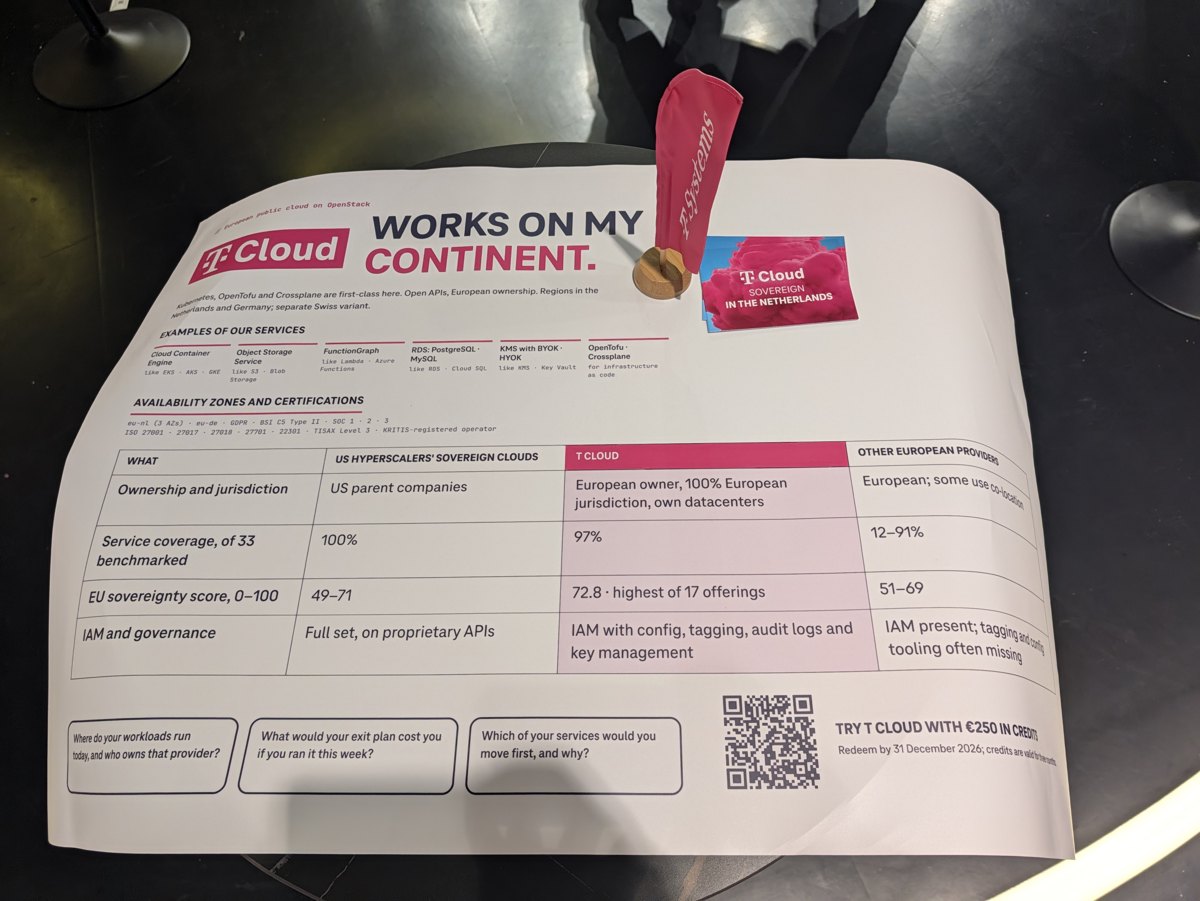
On the floor, sovereignty was a sales pitch too. T Cloud, the European public cloud on OpenStack from T Systems, handed out a sheet titled “Works on my continent”: Kubernetes, OpenTofu and Crossplane “first-class”, open APIs, European ownership, regions in the Netherlands and Germany. Its own comparison scored T Cloud at 72.8 out of 100 on EU sovereignty, against 49 to 71 for the US hyperscalers’ sovereign clouds and 51 to 69 for other European providers. The best line on it was a question, not a number: “What would your exit plan cost you if you ran it this week?”
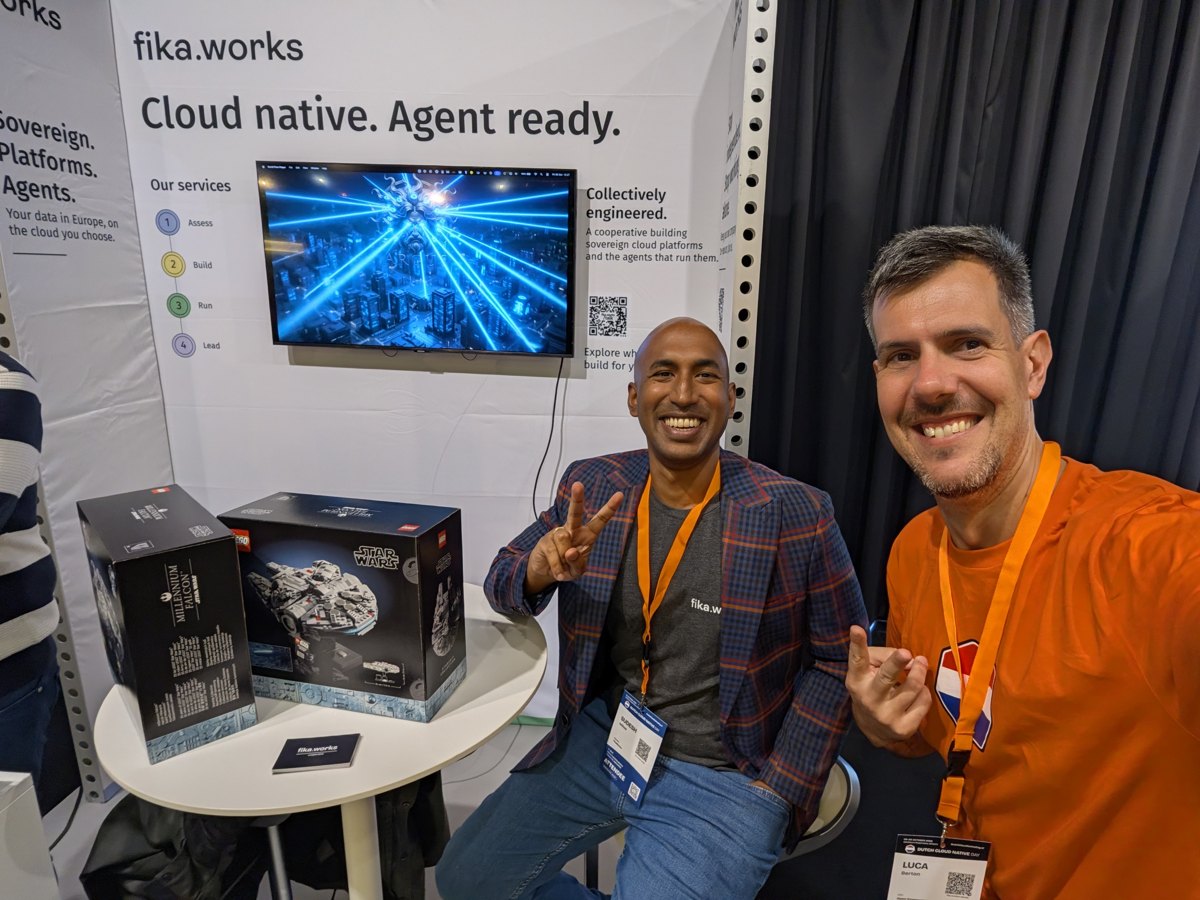
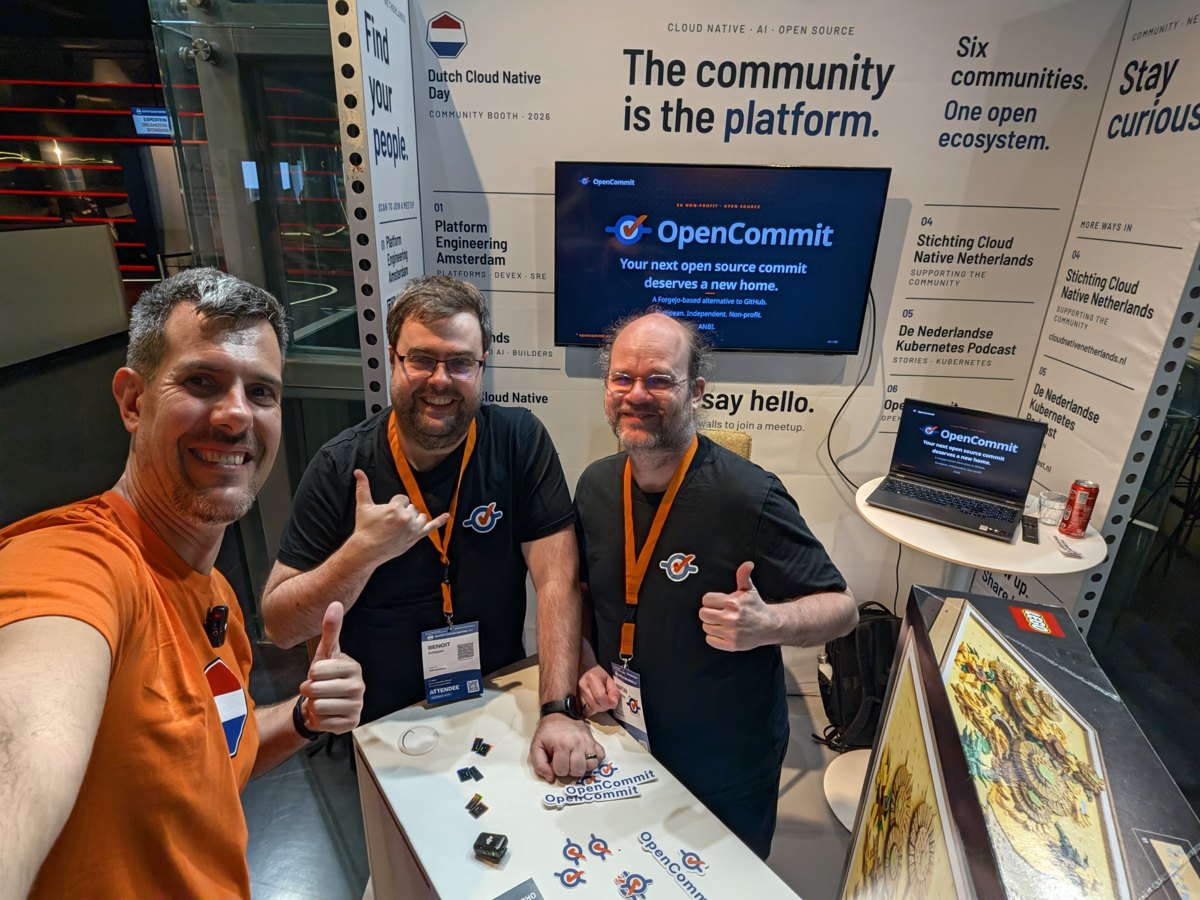
fika.works put sovereignty and agents on the same wall: “Cloud native. Agent ready.”, “Your data in Europe, on the cloud you choose”, from “a cooperative building sovereign cloud platforms and the agents that run them”. Its brochure was for Argus, a “cyber resilience and security agent”. And at the community booth, OpenCommit introduced itself as “a Forgejo-based alternative to GitHub”: “European. Independent. Non-profit.”
GPUs, sliced
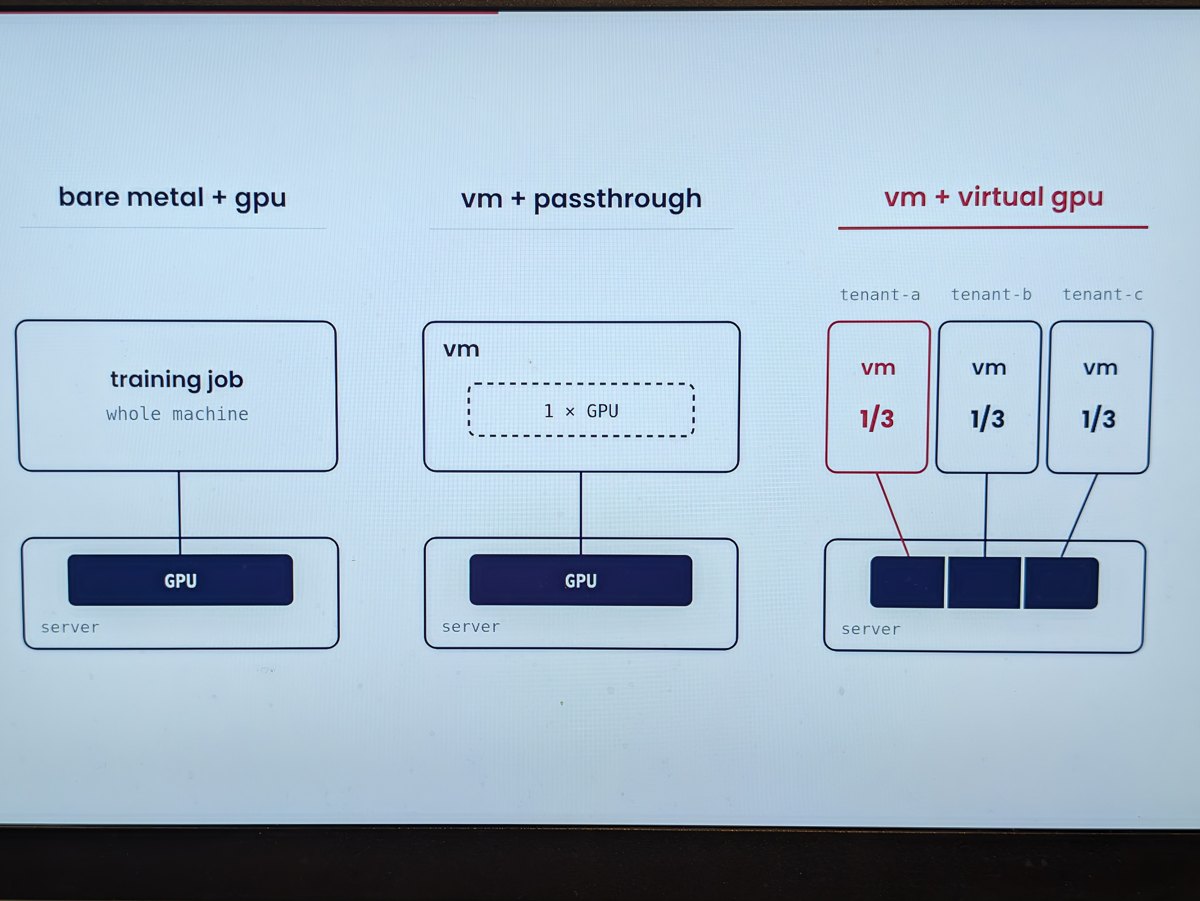
The GPU thread had its demo at the Clastix booth, which promised vGPUs as a service, bare metal orchestration and AI agent sandboxes, with the Mistral and NVIDIA logos on its wall. Its kMetal screen showed three ways to give a GPU to a workload: bare metal with a GPU, where a training job takes the whole machine; a VM with passthrough, one VM and one GPU; and a VM with a virtual GPU, where three tenants each get their own VM and a third of the card. Another view showed one physical card cut into four isolated slices, placed with a binpack policy. When idle GPUs cost what Dimitris Karakasilis’s title says they cost, slicing them between tenants is the cloud native answer: share the expensive thing, isolate the tenants.
Around it, the platinum and gold sponsors told the same story from other sides: Isovalent, now part of Cisco, with Cilium and Tetragon; Dash0, whose crew wore red overalls with OpenTelemetry patches under “Ship more. Break less. Keep AI building and production running.”; and Kubermatic, with “Scale Your Business on the AI Cloud-Native Platform”.
The community is the platform
The booth I kept coming back to belonged to no vendor. “The community is the platform”, said its wall, “Six communities. One open ecosystem.”: Platform Engineering Amsterdam, AI Native Netherlands, the Dutch Cloud Native & AI Community Group, Stichting Cloud Native Netherlands, De Nederlandse Kubernetes Podcast and OpenCommit, each with a code to scan and join a meetup. In the afternoon it was also Udienza’s corner: our episodes on its screen, a camera on a tripod and a microphone on the table.
What comes next
I recorded conversations for Udienza during the day, and they are still coming off the phone. Each will become an episode, with the people and their own words; this post will link them when they are out.