The numbers that should alarm every CTO
Let me lay out the 2026 developer productivity crisis in four brutal statistics:
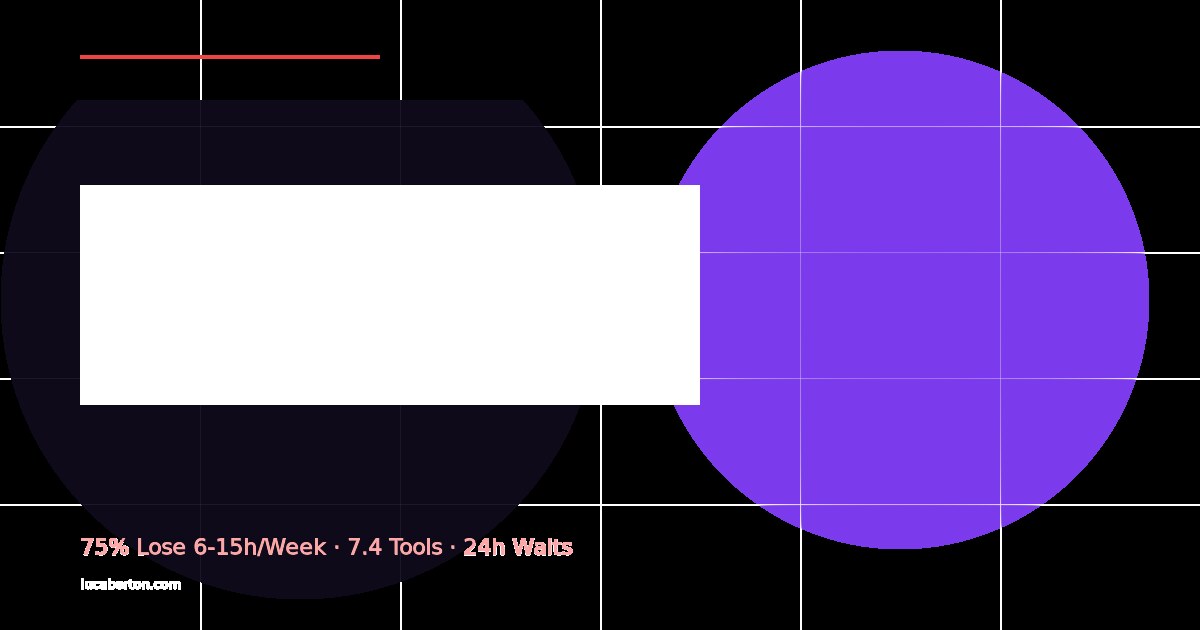
- 75% of developers lose 6-15 hours weekly to tool sprawl
- 7.4 different tools are needed for basic operational tasks — on average
- 78% of engineering teams wait 24+ hours for SRE/DevOps assistance
- 76% of organizations admit architectural complexity drives developer stress and low productivity
Read those numbers again. Three out of four developers are losing one to two full working days every week — not writing code, not shipping features, not solving customer problems — just fighting their own toolchain.
What tool sprawl actually looks like
Here is a typical day for a developer in 2026:
8:30 AM — Open Jira for the sprint board. Check Slack for overnight messages. Pull up Confluence for the design doc.
9:00 AM — Start coding. Need to spin up a dev environment. Open Docker Desktop. Check the internal wiki for the latest service mesh config. SSH into a staging box to check something.
9:45 AM — Ready to deploy to staging. Open ArgoCD. Wait. Check the CI pipeline in GitHub Actions. Look at the Grafana dashboard to see if staging is healthy. Open PagerDuty to check if there are active incidents.
10:30 AM — Deployment failed. Need to check logs. Open Datadog. Cross-reference with Jaeger traces. Check the Kubernetes dashboard. Realize the issue is in another team’s service. File a ticket. Wait.
11:00 AM — Still waiting. Context-switch to another task. Open a different repo. Different CI system. Different deployment process. Different monitoring stack.
That is 7.4 tools before lunch — and not a single line of production code shipped.
The hidden cost: $150K per developer per year
Let me do the math that most organizations refuse to do.
A developer earning $150K per year, losing 10 hours weekly to tool sprawl:
- 10 hours/week x 48 weeks = 480 hours/year
- 480 hours / 2,000 working hours = 24% of their time
- 24% of $150K = $36,000 per developer per year — wasted
For a team of 50 developers, that is $1.8 million annually burned on context-switching between tools, waiting for pipelines, and navigating architectural complexity.
For a 500-person engineering org? $18 million per year. That is not a rounding error. That is a product team, a market expansion, or an acquisition — gone.
Why 24-hour DevOps waits are killing velocity
The stat that should terrify every VP of Engineering: 78% of teams wait 24+ hours for SRE/DevOps help.
In practice, this means:
- Developer hits an infrastructure issue at 10 AM
- Files a ticket with the platform/SRE team
- SRE team is buried in their own queue
- Developer context-switches to something else
- Gets a response the next morning
- Has to context-switch back, re-load the problem, continue
The actual cost is not 24 hours — it is two full context switches plus the wait time. Research consistently shows that a context switch costs 20-30 minutes of deep focus. Multiply that across every developer, every day.
This is why the “throw it over the wall to ops” model is dead. Not because DevOps was wrong — but because the bottleneck moved from deployment to developer experience.
Architectural complexity: the silent killer
76% of organizations admit their own architecture is making developers miserable. And they are right.
The microservices promise was: small, independent, easy to understand. The microservices reality in 2026:
- 200+ services that nobody fully understands
- Service mesh configurations that require a PhD
- Distributed tracing across 15 hops to debug one request
- 12 different databases because each team picked their own
- API versioning chaos across internal services
- Secret management spread across Vault, AWS Secrets Manager, and that one team still using environment variables
The architecture was supposed to enable autonomy. Instead, it created a maze that developers cannot navigate without a guide — and the guides (SRE/DevOps) have a 24-hour response time.
The only way out: platform engineering
These four statistics point to one solution: Internal Developer Platforms (IDPs) that abstract complexity and give developers self-service capabilities.
What a good IDP solves
| Problem | Solution |
|---|---|
| 7.4 tools for basic tasks | Single developer portal (Backstage, Cortex, Port) |
| 24-hour DevOps wait | Self-service infrastructure provisioning |
| Tool sprawl | Golden paths with pre-integrated toolchains |
| Architectural complexity | Service catalog with dependency maps |
The platform engineering approach
1. Golden Paths, Not Golden Cages
Give developers a paved road that handles 80% of use cases:
- One-click environment creation
- Standardized CI/CD that just works
- Pre-configured observability (logs, metrics, traces in one place)
- Self-service database provisioning with guardrails
The key: golden paths are recommended, not required. Teams can go off-path when they have a good reason. But 80% of the time, the paved road is faster.
2. Self-Service Infrastructure
The 24-hour DevOps wait disappears when developers can:
- Spin up staging environments without a ticket
- Scale services without asking SRE
- Access logs and traces without special permissions
- Deploy to production through automated, guardrailed pipelines
This is not “shift left” in the old sense of dumping ops work on developers. It is building platforms that make infrastructure invisible — developers get what they need without understanding Kubernetes internals or Terraform state files.
3. Reduce Tool Count by Consolidation
7.4 tools for basic tasks is a governance failure. The fix:
- Audit your toolchain — map every tool to the workflow it supports
- Identify overlaps — you probably have 3 tools doing the same thing
- Pick winners — standardize on one CI system, one monitoring stack, one deployment pipeline
- Integrate the survivors — a developer portal that connects the remaining tools into one experience
4. Tame Architectural Complexity
You cannot simplify 200 microservices overnight. But you can:
- Build a service catalog that maps dependencies and ownership
- Enforce API contracts so services have clear interfaces
- Provide environment templates so developers do not need to understand the full mesh
- Use GitOps to make infrastructure state declarative and auditable
What the best teams are doing
The organizations that have solved the developer burden share three traits:
They measure developer experience
Not lines of code. Not story points. They track:
- Time to first deployment for a new developer
- Lead time for changes from commit to production
- Self-service success rate — what percentage of requests are handled without human intervention
- Tool satisfaction scores — regular developer surveys
They invest in platforms as products
The internal platform team has:
- A product manager (not just engineers)
- User research (talking to developers about pain points)
- An SLA (the platform is a product, not a side project)
- A roadmap driven by developer needs, not technology trends
They ruthlessly eliminate complexity
Every new tool, every new service, every new integration has to justify its existence against the developer burden it creates. The question is not “does this tool solve a problem?” — it is “does this tool create less burden than it solves?”
The bottom line
75% of developers losing 6-15 hours weekly is not a technology problem. It is a platform problem.
The tools exist. Backstage for developer portals. ArgoCD and GitOps for deployment. Kubernetes for orchestration. Ansible for automation.
What is missing is the platform layer — the team and product that stitches these tools into a coherent, self-service experience that respects developers’ time.
The organizations that figure this out will ship 2-3x faster than those that do not. Not because their developers are better — but because their developers spend their time building products instead of fighting tools.
If your team is drowning in tool sprawl, start with a platform engineering assessment. For hands-on Kubernetes platform building, check out my KubeCon talk on multi-tenant GPU infrastructure or the Packt workshop on AI workloads at scale.