🇨🇿 DevConf.cz 2023 — Brno, Czech Republic
DevConf.cz is one of the largest open source community conferences in Europe, hosted annually in Brno by Red Hat. This year, the event was a celebration of DevOps, automation, and the future of open source infrastructure — and Luca Berton was on-site to capture it all.
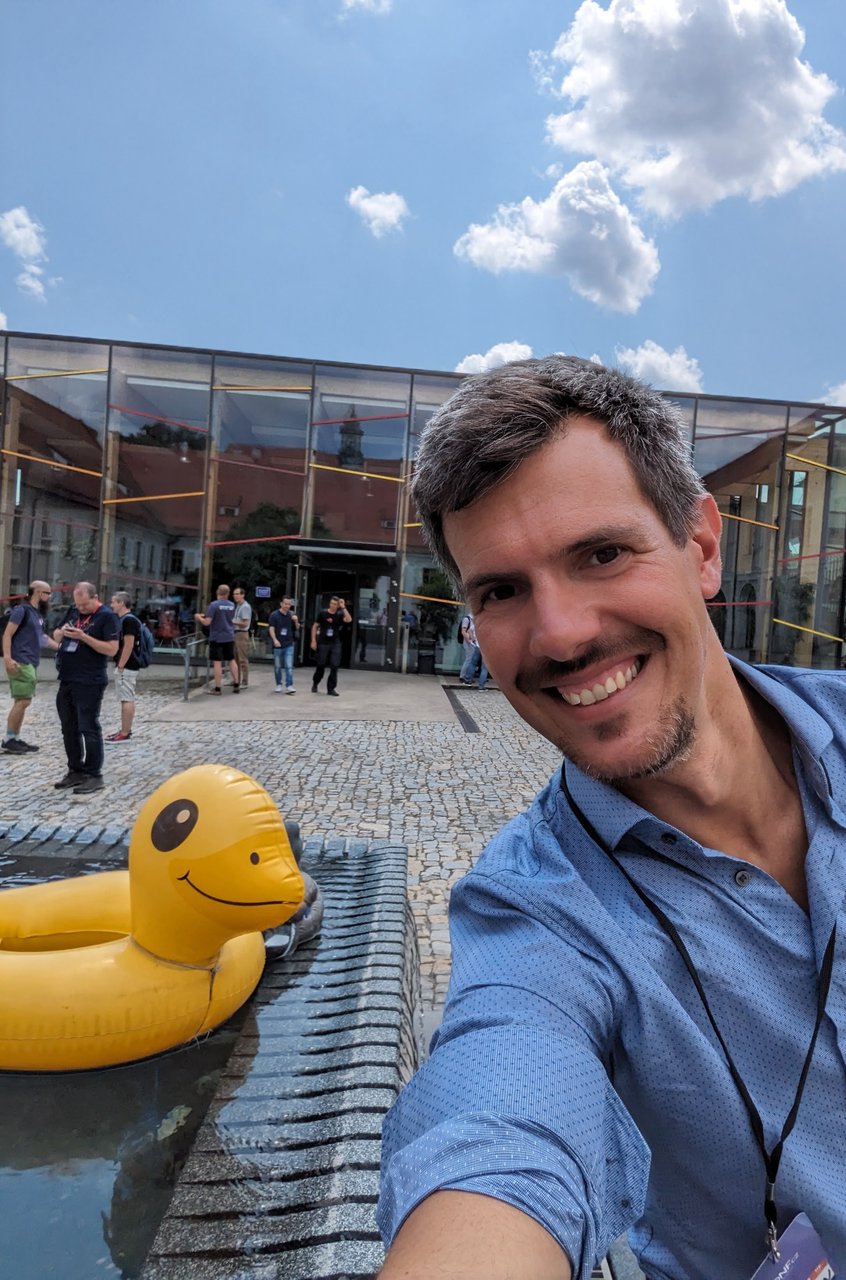
Day one in the venue courtyard, next to the giant rubber duck.
Top Interviews & Talks from DevConf.cz 2023
Interview — Arnav Bhati (Ansible Senior Consultant, Red Hat)
Arnav shared key insights into Ansible adoption, consulting practices, and enterprise-scale automation challenges.
Interview — Carol Chen (Open Source Community Architect)
A powerful conversation on community growth, contributor onboarding, and the evolving strategy of Ansible upstream collaboration.
Interview — Nejc Slabe (Spotter by XLAB)
A look at Spotter, the intelligent playbook advisor that’s revolutionizing Ansible playbook validation and structure.
Interview — Walter H. Bentley (Director, Ansible Community Strategy)
Insights from a veteran Red Hat strategist on how Ansible is evolving, especially with AI-powered guidance and the growth of event-driven automation.
Talks I Attended
Between interviews I sat in on a few sessions on day two, Saturday 17 June. Everything below comes from the slides I photographed.
DevOps for Ansible Lightspeed with IBM Watson Code Assistant
James Wong (Principal Software Engineer, according to his title slide) explained how the Lightspeed service itself is built and run. His agenda covered what Ansible Lightspeed with IBM Watson Code Assistant is, the high-level architecture, the platform, and the pipeline from PR to production.
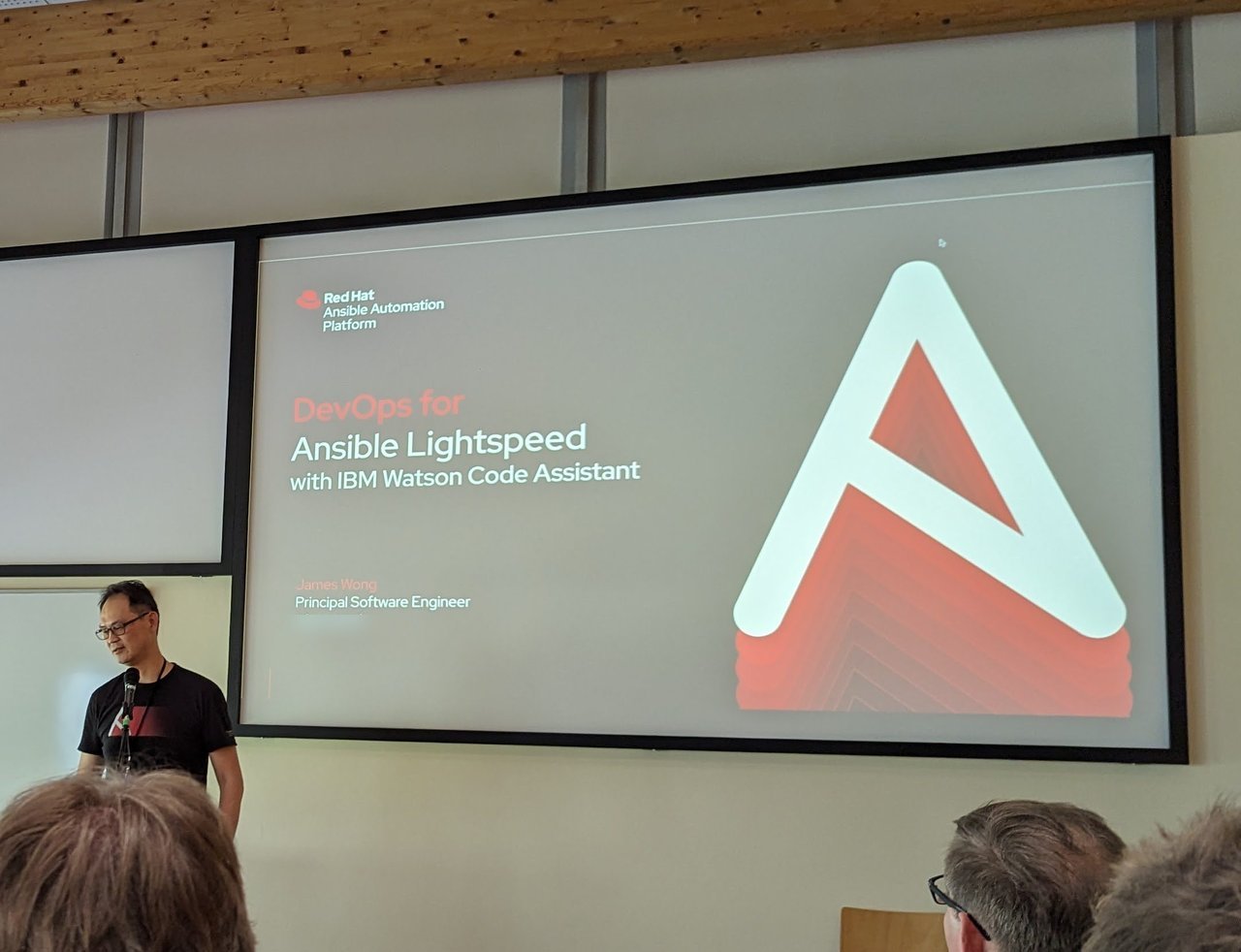
The title slide of the Lightspeed DevOps talk.
The architecture slide sent an Ansible task to /api/completions and returned code recommendations. Ansible Risk Insight rules then ran on the recommended code, and the model was served as an InferenceService GPU workload. A short demo showed a suggestion appearing in the editor, accepted with the Tab key. A content-matching panel then listed the sources the recommendation was based on.
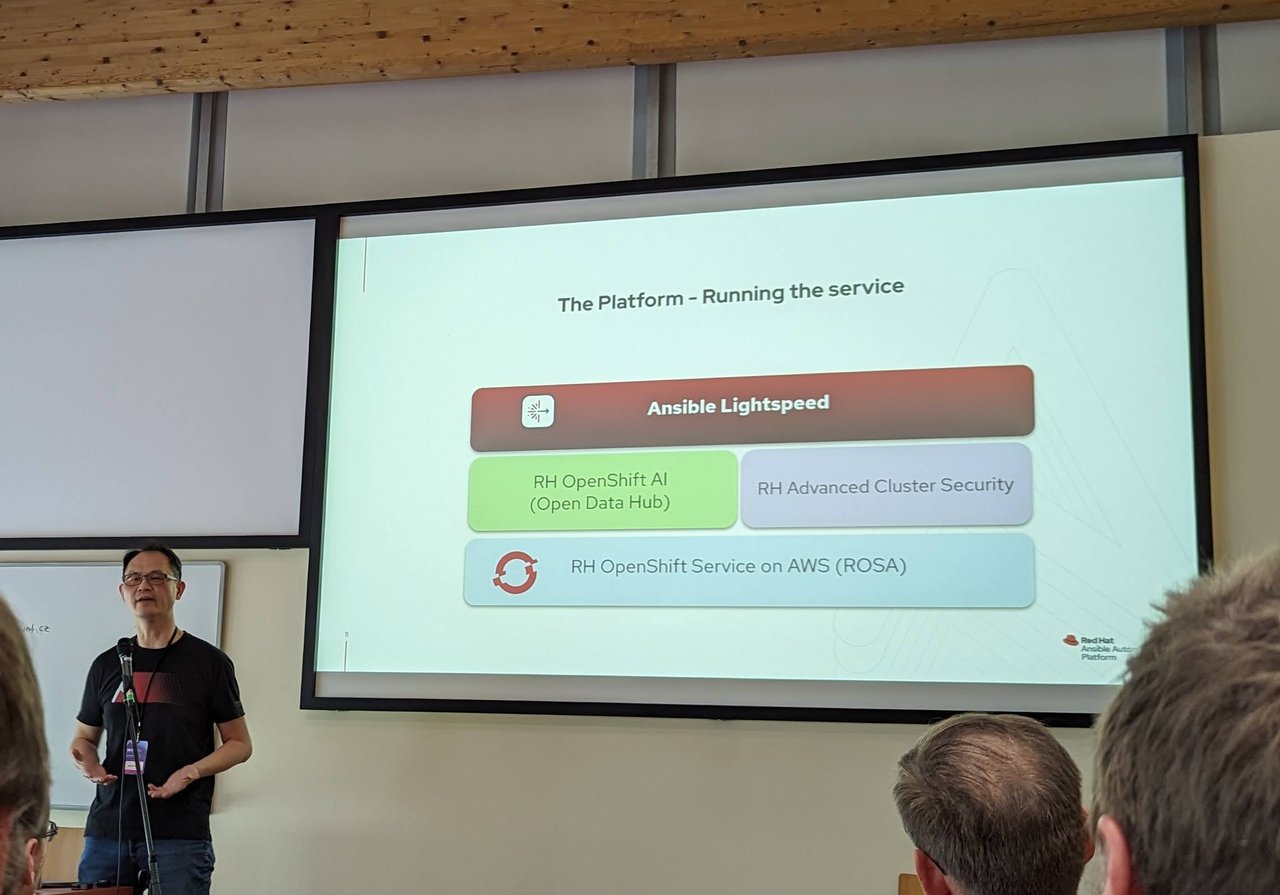
The platform stack behind the Lightspeed service.
The platform slide listed Red Hat OpenShift AI (Open Data Hub), Red Hat OpenShift Service on AWS (ROSA) and Red Hat Advanced Cluster Security. CI/CD used Red Hat OpenShift GitOps (Argo CD) and GitHub Actions. The pipeline ran from a PR check with unit tests through post-deployment and performance testing to production.
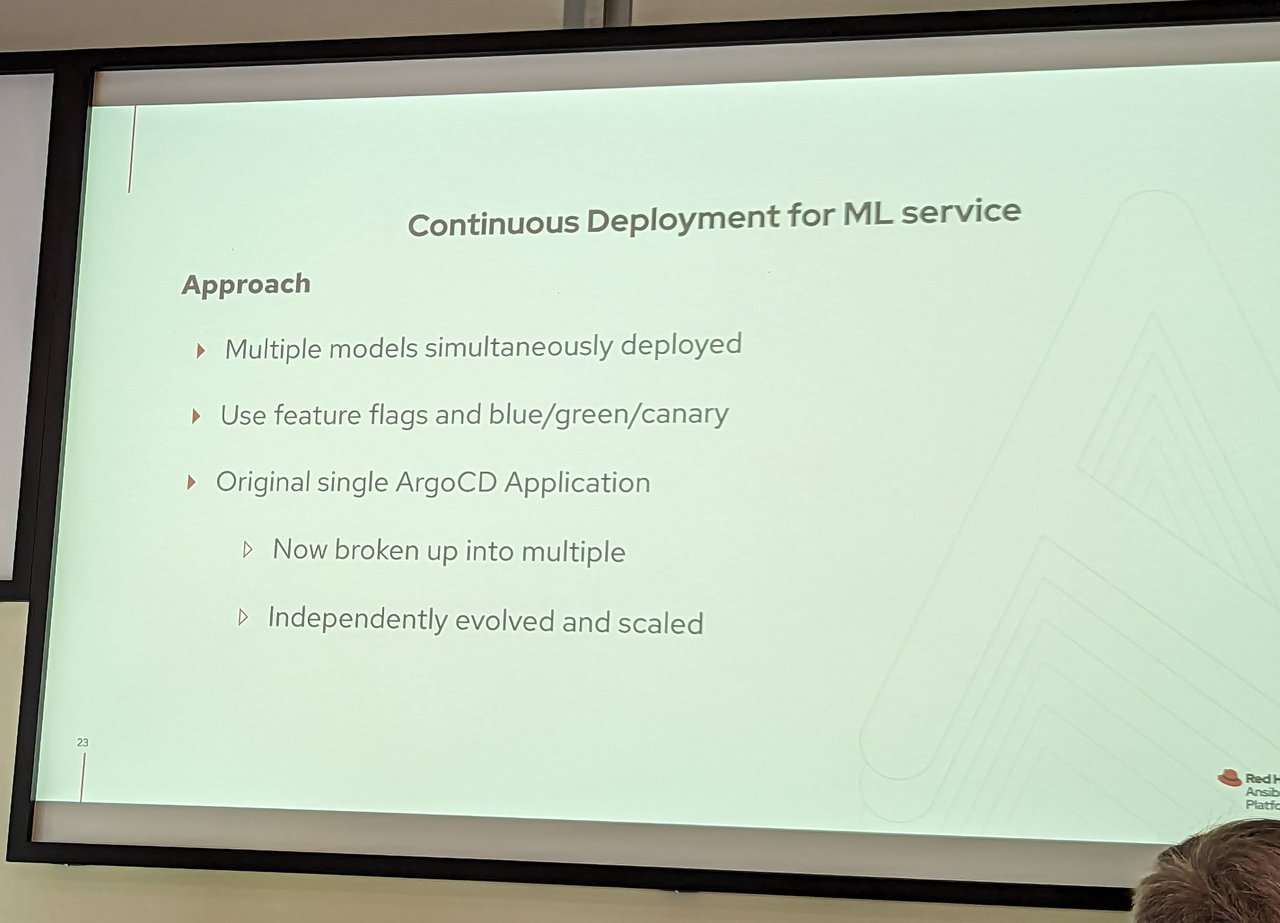
Continuous deployment for the ML service.
The continuous-deployment slide described several models deployed at the same time, rolled out with feature flags and blue/green or canary releases. The original single Argo CD Application had been broken up into several, which could evolve and scale independently. For observability, the stack was Prometheus and Grafana for metrics (with Dynatrace “coming”), CloudWatch for logs and Jaeger for tracing. The slide stressed that this was “not just for production monitoring”: dev and test need it to find bottlenecks and code-quality issues.
My take: the useful part is that the AI assistant was treated as an ordinary service, with a GitOps pipeline, progressive delivery and tracing. Splitting one Argo CD Application into one per model is a pattern I’d apply to any team serving several models, so each one can be rolled out and rolled back on its own.
DNF5: Next Generation of Software Management
Pavla Kratochvílová, Jaroslav Mráček and Jan Kolárik (as named on their slides) presented DNF5. An early slide showed the existing pieces (PackageKit, hawkey, microdnf, libhif, LIBDNF and more) before they moved on to the new design.
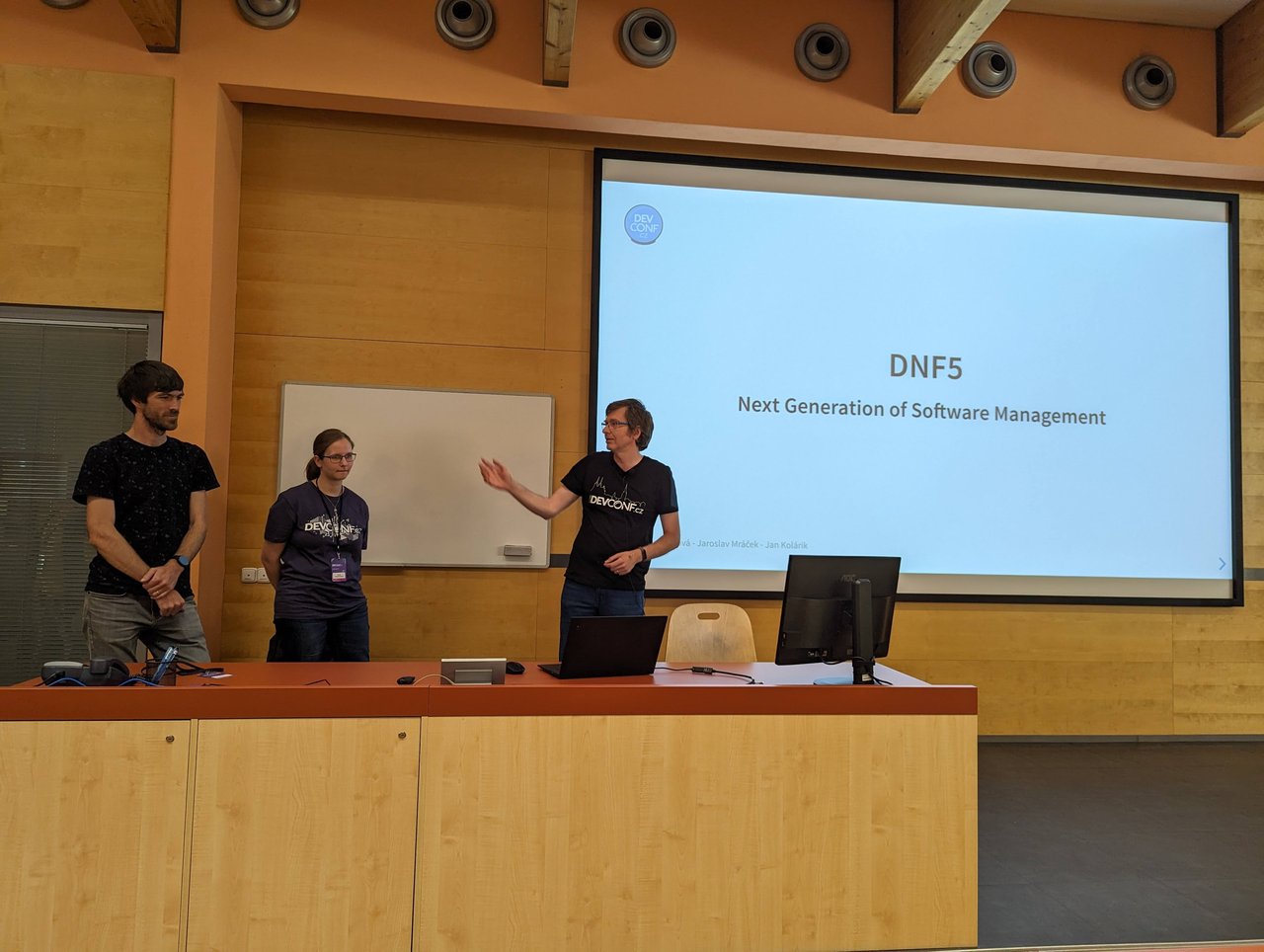
The DNF5 team on stage.
At the centre of the architecture slide is LIBDNF5, a C++ API. Around it sit SWIG bindings (Python, Ruby, Perl and more), C++ plugins, the dnf5 CLI tool with its own CLI plugins, and the dnf5 daemon with a D-Bus API. A “Loading of repositories” slide compared the two tools. DNF downloaded and processed each repository’s metadata one after another, while DNF5 overlapped the downloading and processing. The “Performance improvement” chart showed DNF5 with lower values than DNF in all three benchmarks, for example 25.1 against 82.9.
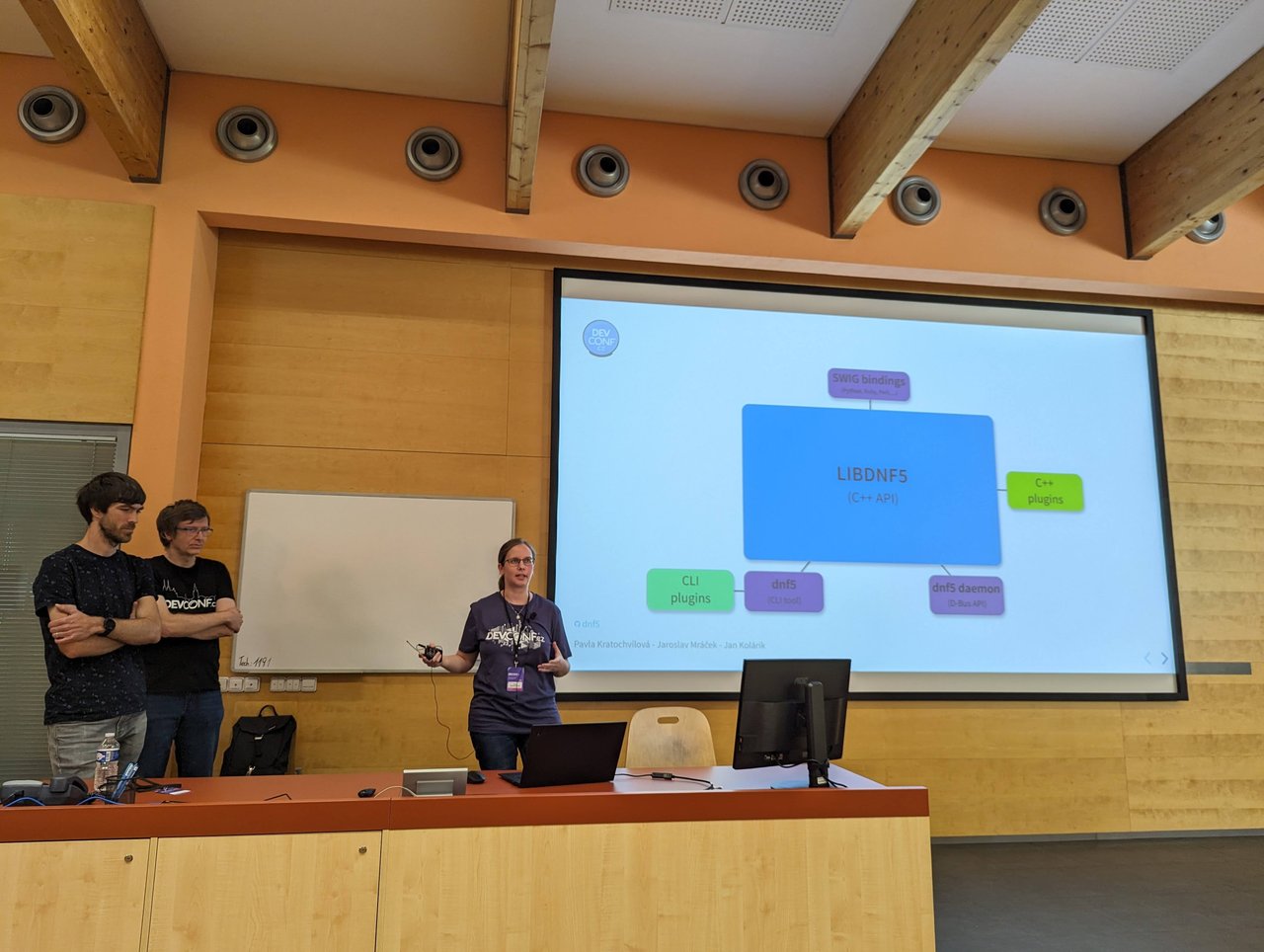
The LIBDNF5-centred architecture.
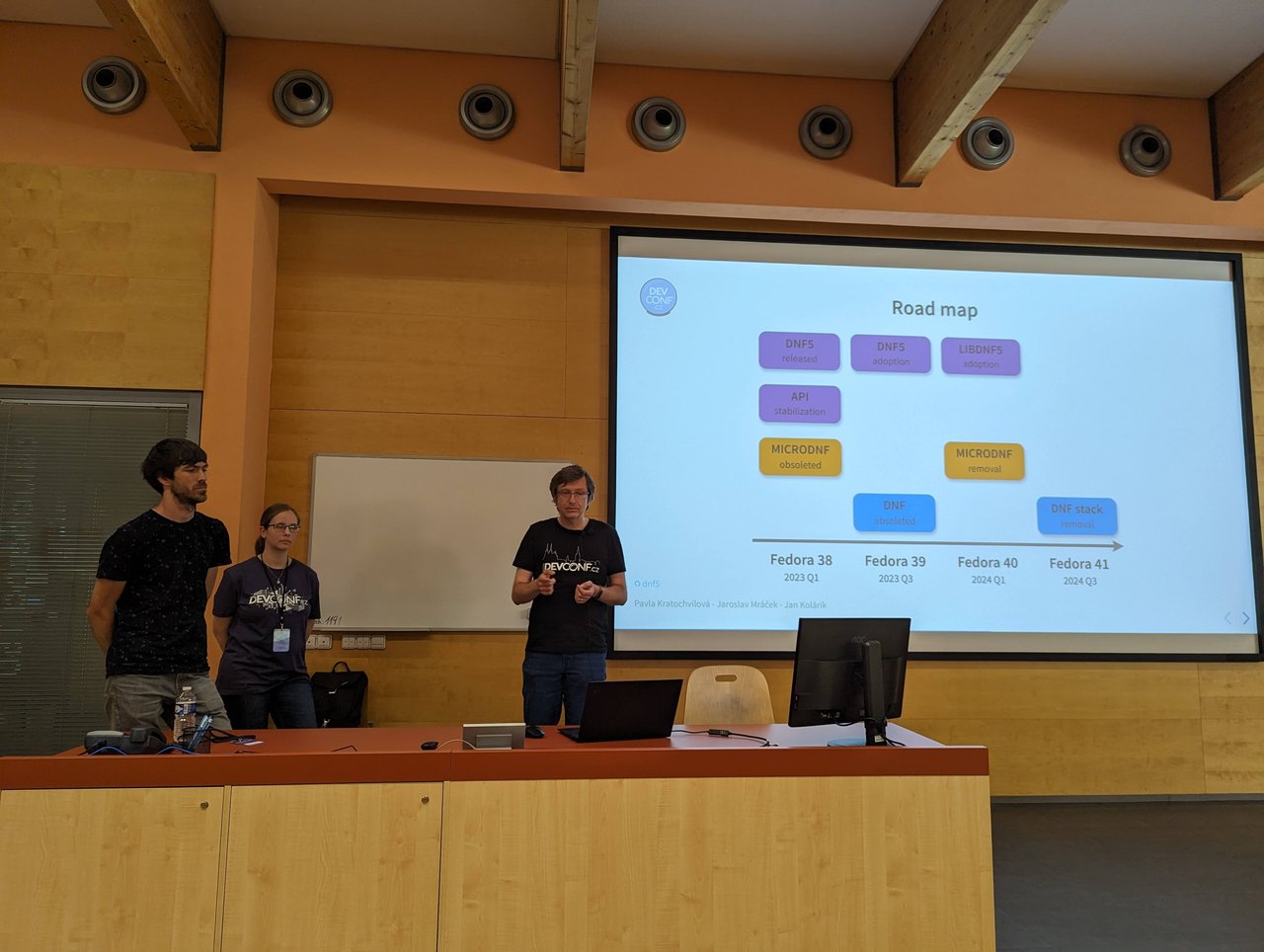
The road map from Fedora 38 to Fedora 41.
The road map put the DNF5 release, API stabilisation and microdnf being obsoleted in Fedora 38 (2023 Q1). DNF5 adoption and DNF being obsoleted followed in Fedora 39 (2023 Q3), then LIBDNF5 adoption and microdnf removal in Fedora 40 (2024 Q1). Removal of the old DNF stack came last, in Fedora 41 (2024 Q3). For where things stand now, see Fedora 44: Cutting-Edge Linux for Developers.
SSSD: FIDO2 authentication for centrally managed users
Iker Pedrosa, Senior Software Engineer at Red Hat, presented FIDO2 support in SSSD for users managed centrally rather than on the local machine. His slides covered “Why FIDO2/WebAuthn?” and the workflow for remotely managed users: the key mapping data is stored in an LDAP attribute, and the user then authenticates with the FIDO2 key.
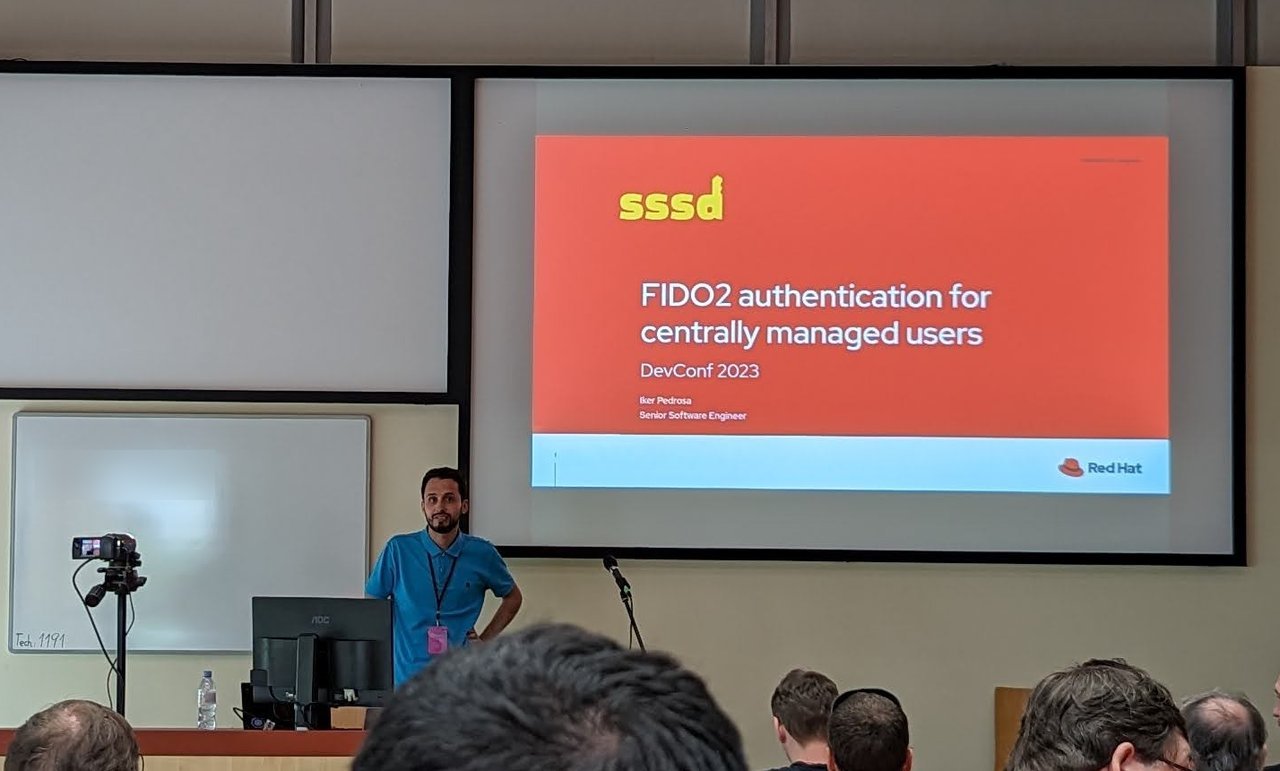
The SSSD FIDO2 talk about to start.
For the Windows side of phishing-resistant login, see Phishing-Resistant Auth: Windows Hello and FIDO2 Keys.
Highlight: Luca Berton’s Coverage
As an Ansible Automation Expert, Luca Berton brought a unique lens to DevConf.cz 2023 — focusing on:
- Real-time interviews with Red Hat leaders and innovators
- Tools shaping the future of Infrastructure as Code (IaC)
- Community-powered solutions in open source automation
- Practical challenges solved with Ansible, Spotter, and CI/CD integrations
Watch the Full Playlist
👉 YouTube Playlist – DevConf.cz 2023
Final Thoughts
From innovation in playbook validation to the growing synergy between Ansible and cloud-native platforms, DevConf.cz 2023 proved once again that open source is thriving — thanks to strong communities, bold contributors, and voices like Luca’s.
If you’re in DevOps, cloud, or automation — this is the content you can’t miss.