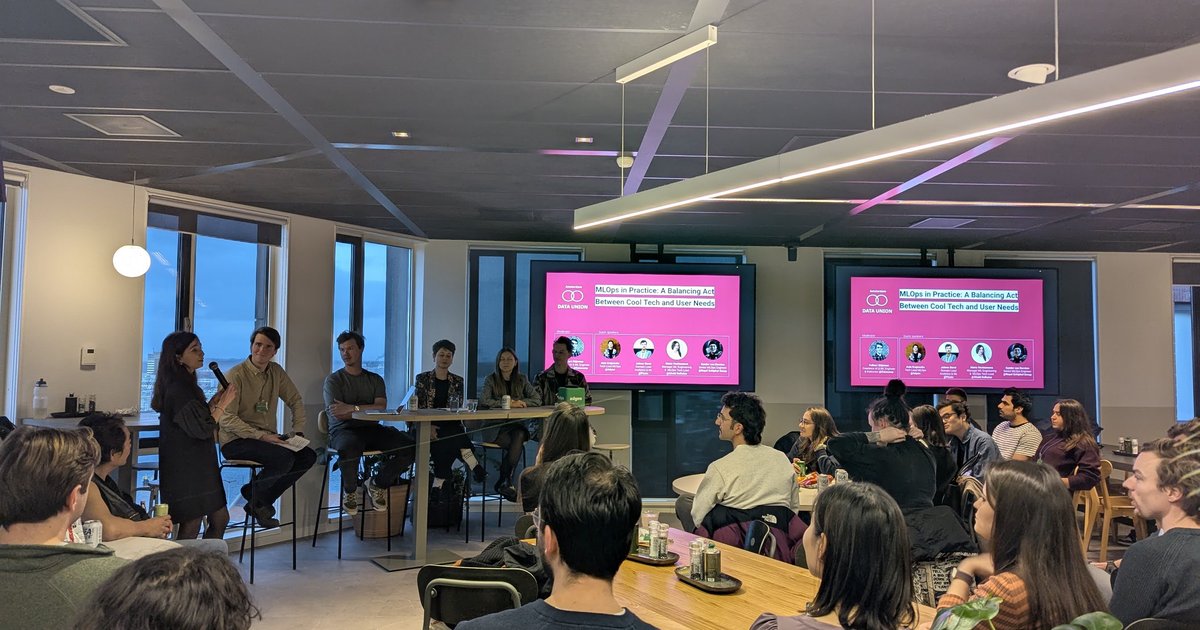
On Tuesday 11 March 2025 I went to a Data Union Amsterdam evening called “MLOps in Practice: A Balancing Act Between Cool Tech and User Needs”. It was a panel, not a series of talks: four practitioners from four very different Dutch companies on high stools behind one table, with a moderator and slides shared from their own platforms. That format suits MLOps well. Comparing how four organisations split responsibilities is more useful than one polished vendor story.
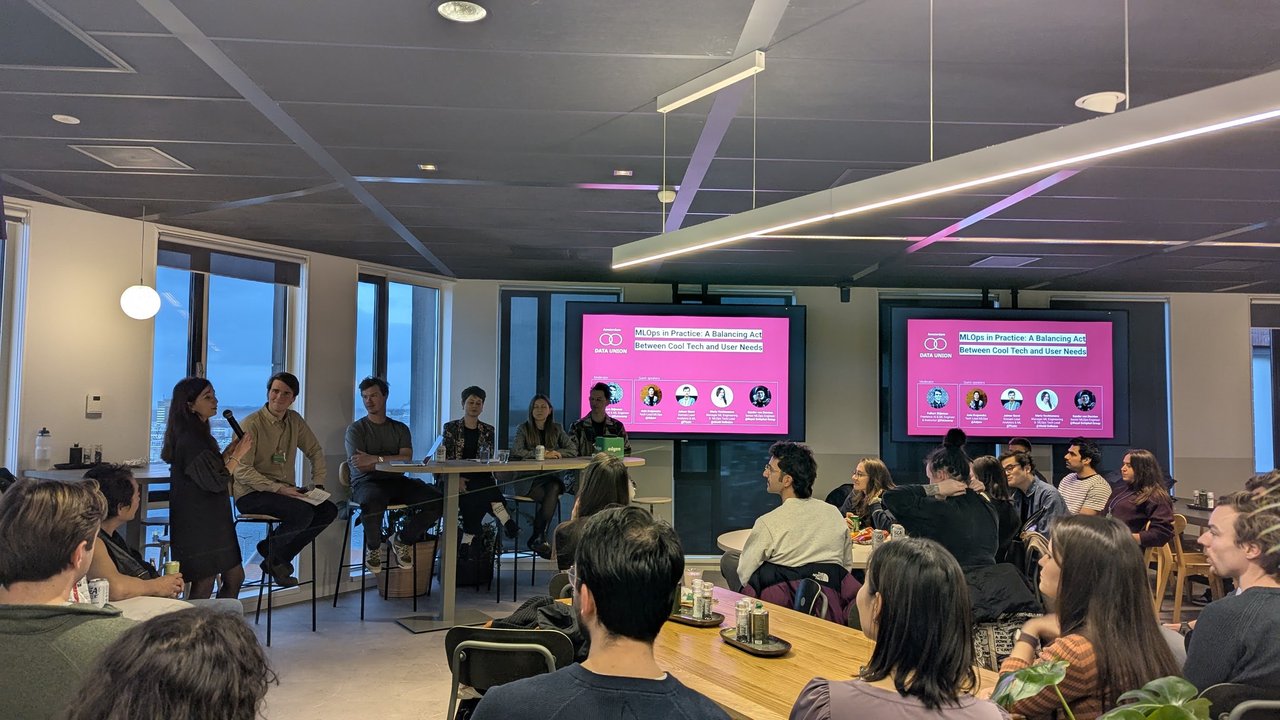
The title slide listed the moderator and the four guest speakers.
The panel
The title slide and the calendar invite listed the line-up:
- Folkert Stijnman (moderator), Freelance AI & ML Engineer and Instructor
- Asia Krajewska, Tech Lead MLOps at Adyen
- Jelmer Borst, Domain Lead Analytics & ML at Picnic
- Maria Vechtomova, Manager ML Engineering & MLOps Tech Lead at Ahold Delhaize
- Sander van Dorsten, Senior MLOps Engineer at Royal Schiphol Group
Early on, the organisers ran a live poll asking “What do you hope to gain or learn from this panel session?” The word cloud was a fair snapshot of the room: How other companies do MLOps, MLOps best practices, New best practices, Insights, Networking, Organisational setups, User Adoption, MLflow, MLOps culture, Ways of working, Some lessons learned, pitfalls, What is MLOps, and, honestly, Food. One answer stood out to me: “Whether to switch my job to MLOps engineer”.
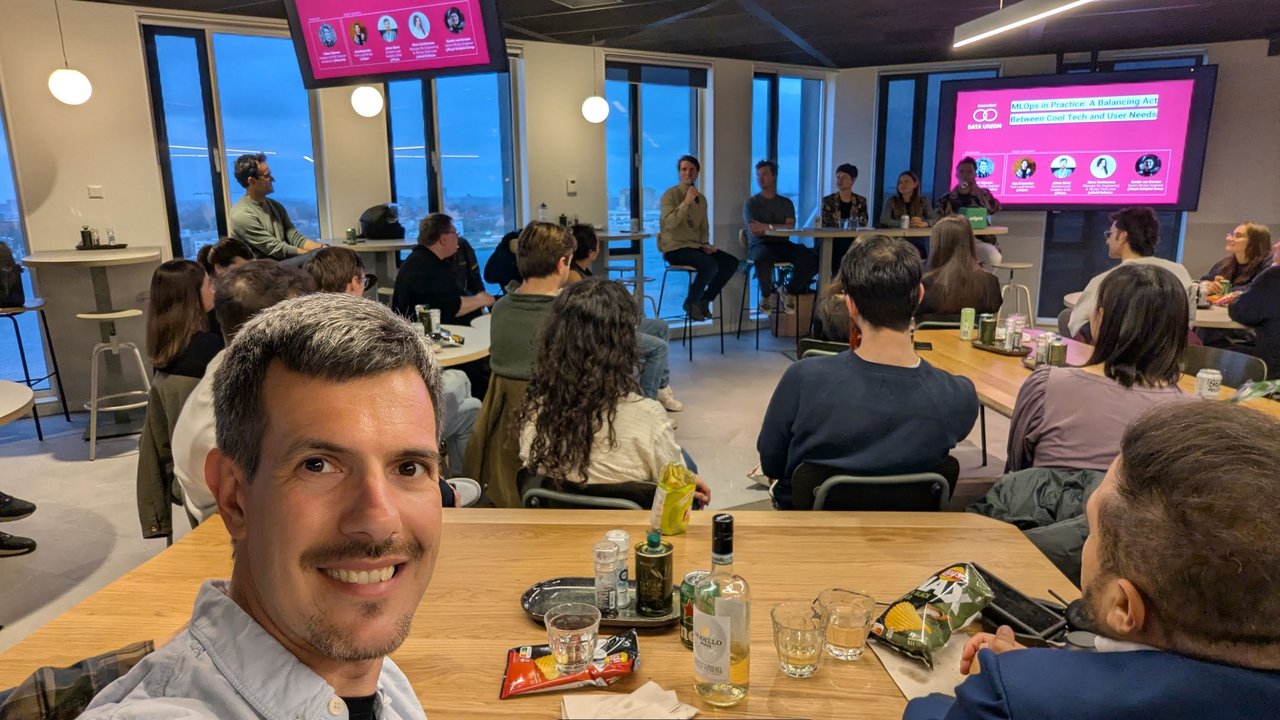
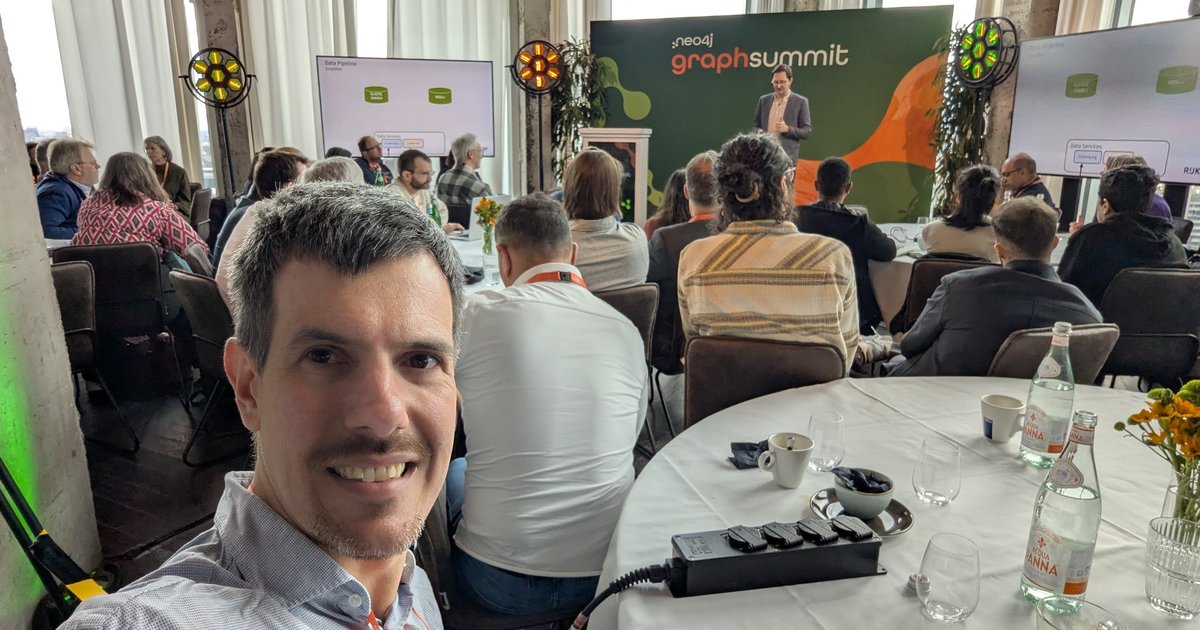
My seat for the evening, a few tables back from the panel.
Schiphol: “We are Hermes”
The part of the evening I photographed most was Schiphol’s. The slide was titled “We are Hermes”, with the subtitle “Centralized MLOps Team” and the mission line “[a u]niform way to develop and deploy Machine Learning products”. It introduced two people: Sander van Dorsten (Senior MLOps Engineer) and Kiki van Rongen (MLOps Engineer).
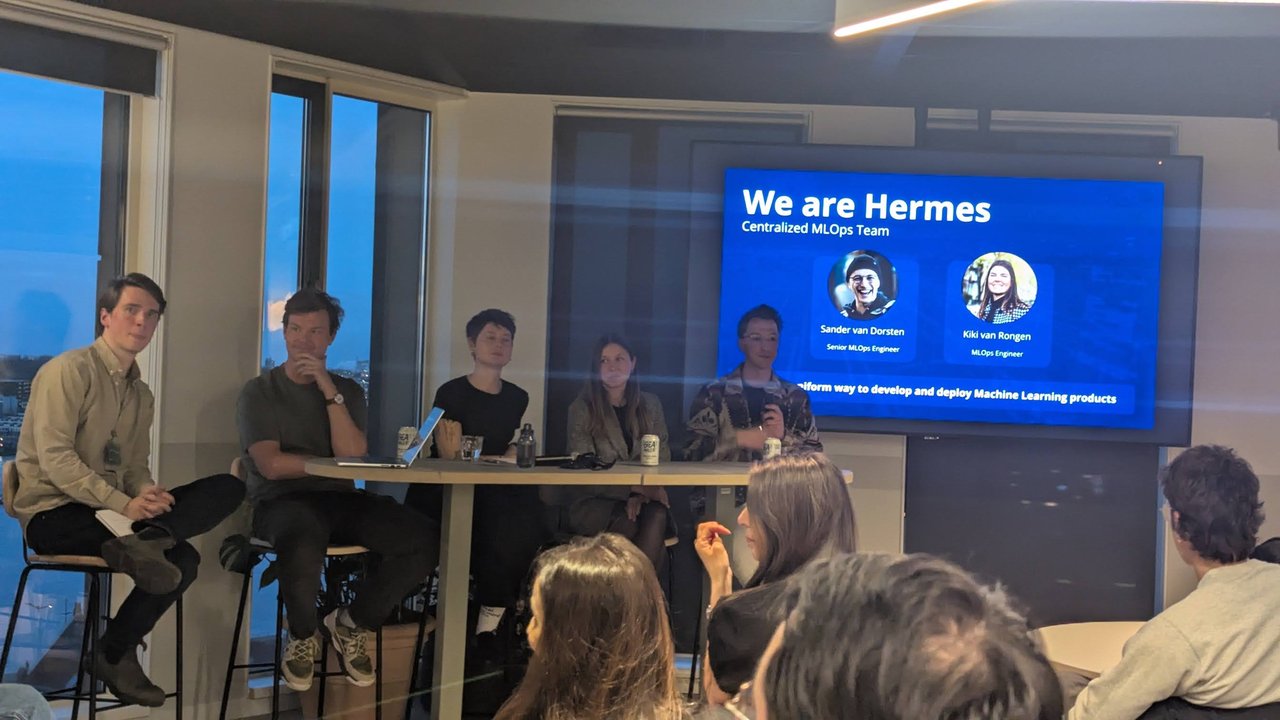
“We are Hermes”: Schiphol’s centralised MLOps team.
Next came an hourglass diagram, the clearest picture of the team’s leverage I saw all evening:
- Upstream: 900 IT professionals and 180 data professionals
- MLOps team: the two people from the previous slide
- Target audience: 20 data scientists and 10 machine learning engineers
A follow-up slide broke the audience down by role: MLOps engineers at the top, then machine learning engineers (10 FTE), data scientists (20 FTE), and a row for data analysts, UX and other roles.
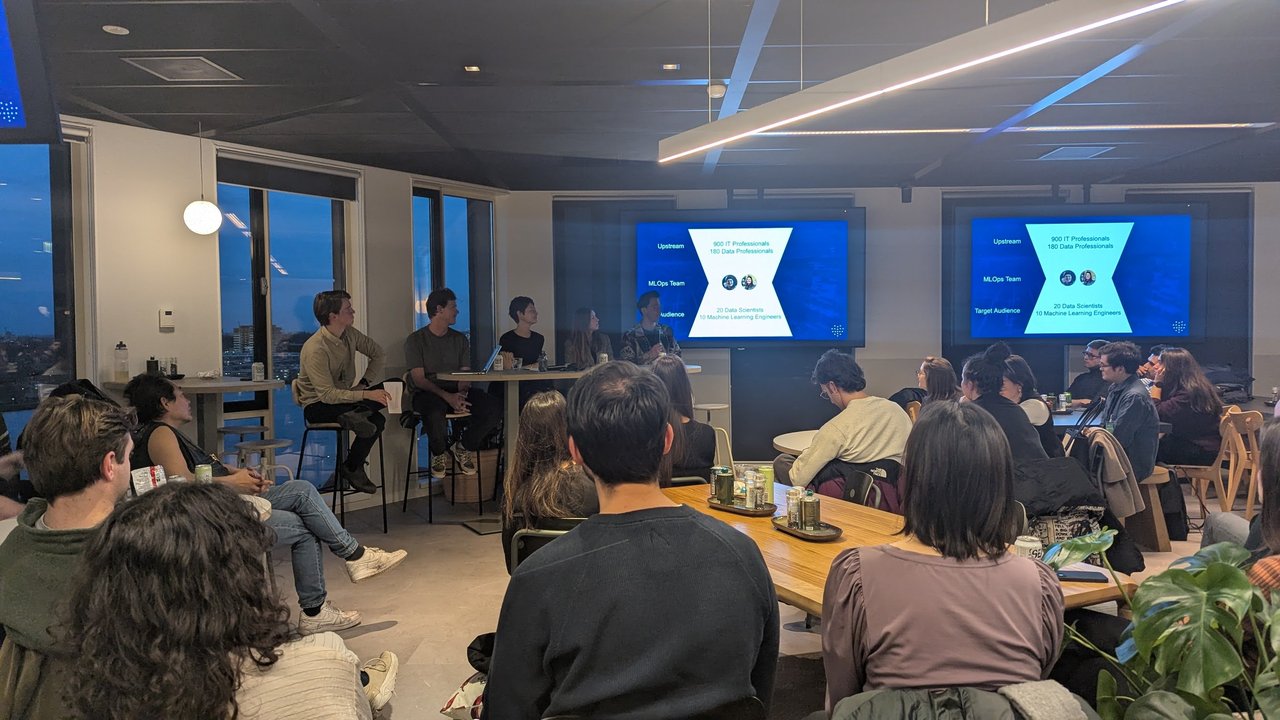
Two MLOps engineers in the middle, serving around 30 ML practitioners.
The Schiphol AI Techstack
Later, the “Schiphol AI Techstack” slide split the platform into six boxes. These are the names and logos I could read in my photos:
- Development: Databricks, Jupyter, GitHub and one more tool
- Data / ML Platform: Databricks, MLflow, Unity Catalog, Airflow and Kubernetes
- Monitoring: OpenTelemetry and Slack, plus two other tools
- Deployment: Argo, GitHub and Helm
- LLM Platform: Azure, OpenAI, FastAPI and LangChain
- Serving: Kubernetes, Databricks, Streamlit and FastAPI
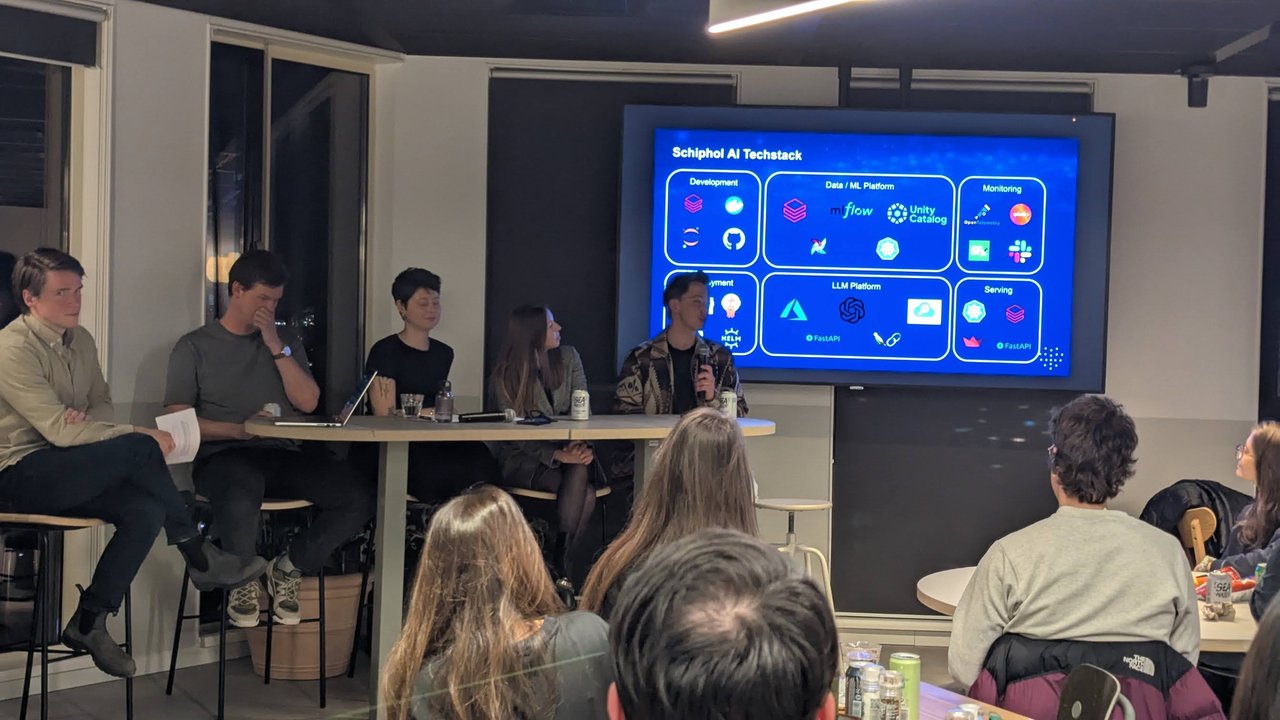
Six boxes, with a separate LLM platform alongside the classic ML platform.
My take: what I like here is that the LLM platform is its own box, but it reuses the same building blocks (FastAPI, Kubernetes) as classic serving. For a team of two, sharing serving and deployment patterns across ML and LLM workloads is the only way to stay sane.
Adyen and Picnic: the same problem, different shapes
Adyen and Picnic shared slides too. Adyen showed an organisation map: an MLOps team in the middle, linked to several ML teams, next to a Feature Platform, an Experimentation Platform and Data Platform Development. A second Adyen slide traced the model lifecycle: Getting Data → ML experiment & iterate → Train for production → Deploy & Serve → A/B Testing. Jupyter, Airflow, the Feature Platform, Backoffice and the Experimentation Platform sat above it. Inside a “Machine Learning Platform” area, marked as the MLOps team’s scope, were components such as ArgoYEET, MLFlow and a real-time Serving layer.
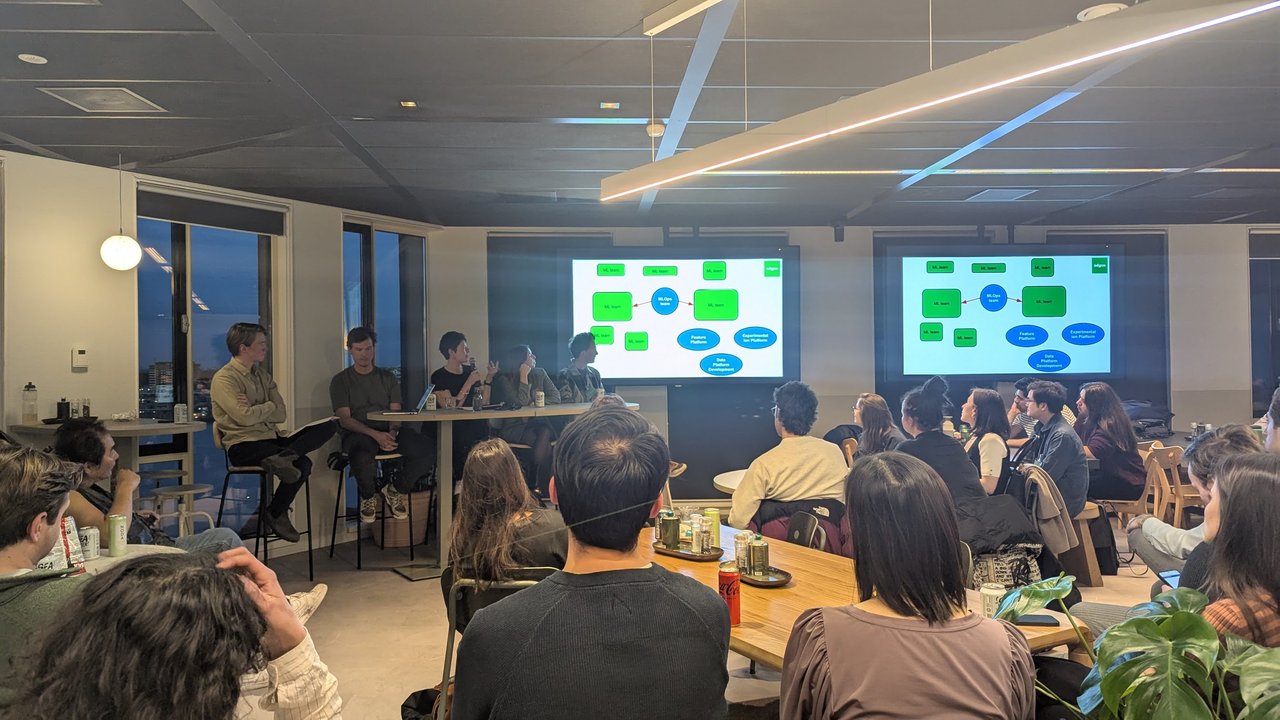
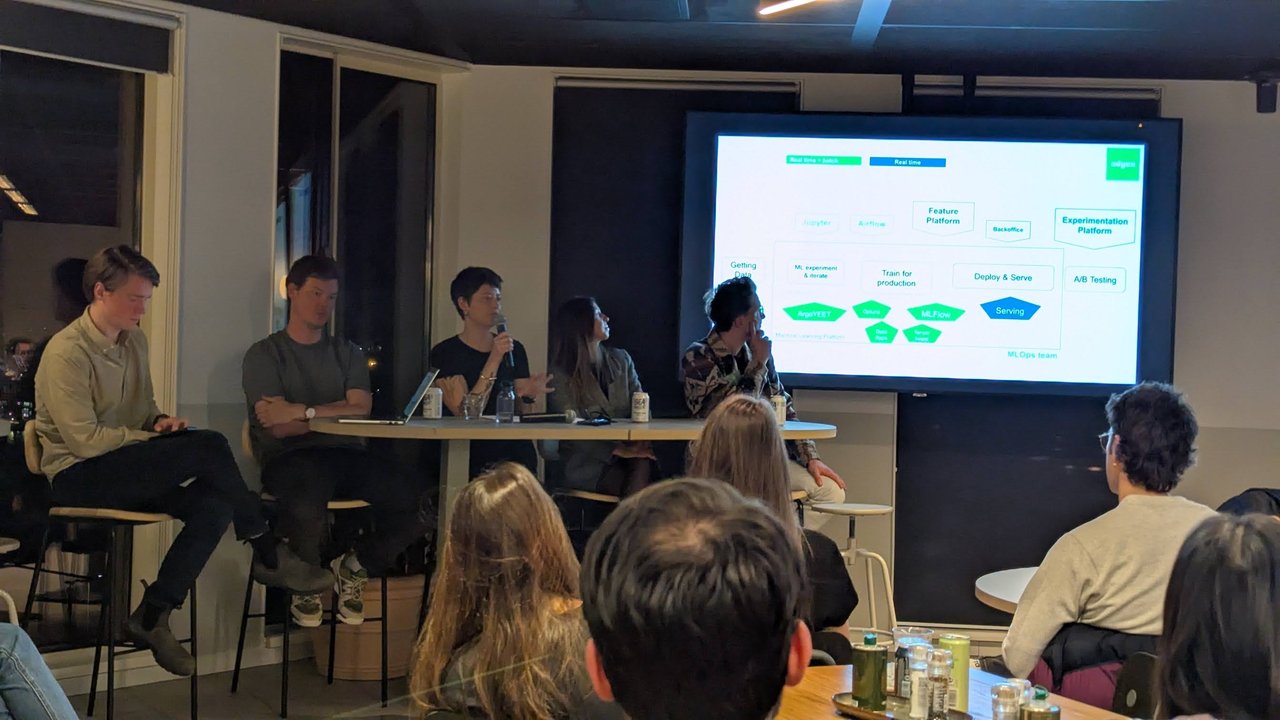
Adyen: one MLOps team serving many ML teams, and the lifecycle its platform covers.
Picnic’s slide was titled “The blueprint for our platform”. Its boxes were Feature Store, Experimentation Environment, Code Repository, Deployment Environment, Model Registry and Monitoring. Logos I could make out included Snowflake, Jupyter, MLflow, GitHub, Argo, FastAPI, Kubernetes, dbt, PagerDuty and Slack.
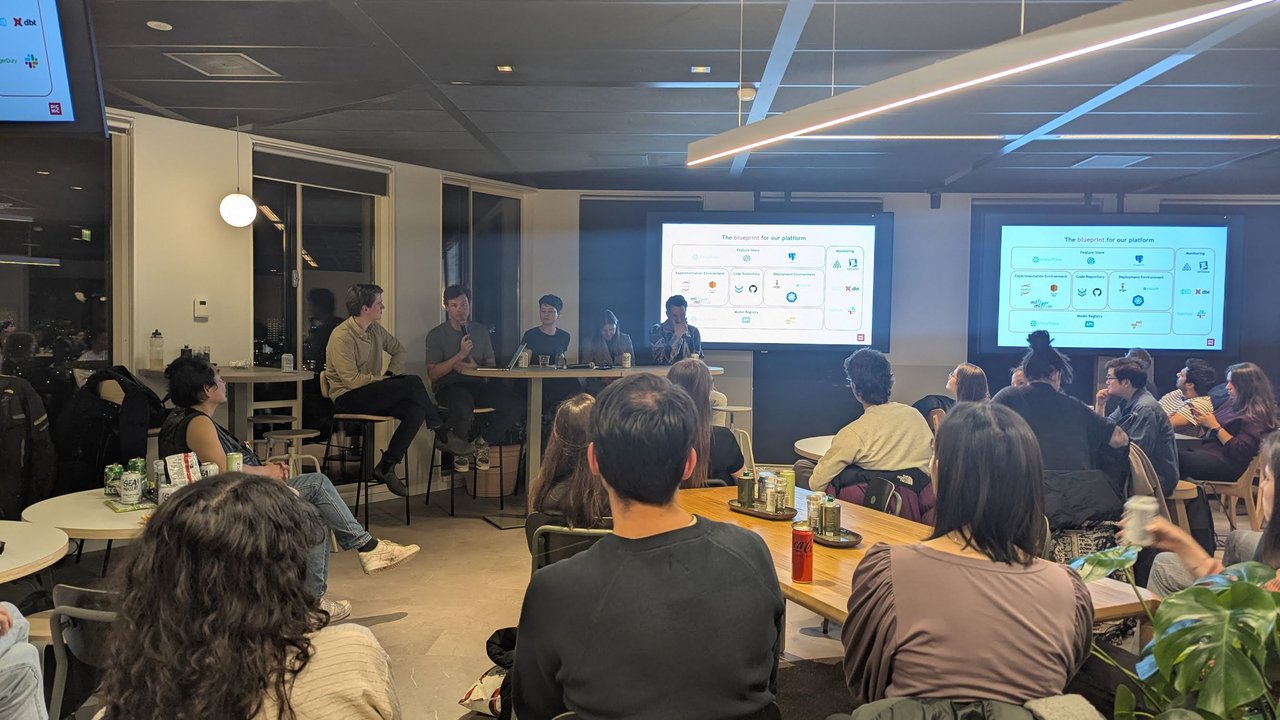
Picnic’s blueprint: a feature store and model registry framing the experiment-to-deploy path.
What I took home
- The org chart comes first. Schiphol’s hourglass and Adyen’s team map were both about who the MLOps team serves before what it runs. That matches the room’s own poll, where “Organisational setups” and “Ways of working” sat next to the tooling questions.
- The stacks converge. Three companies and three slides, yet MLflow, Argo, Kubernetes, FastAPI and Jupyter kept coming back. The differences were in the data layer (Databricks and Unity Catalog versus Snowflake) and in how much each team builds itself.
- Small central teams need paved roads. Two MLOps engineers for around 30 ML practitioners only works if there is one uniform way to develop and deploy, which is exactly what the Hermes slide promised. This is the same platform-engineering logic I apply to Kubernetes platforms.
Thanks to Data Union Amsterdam and the panellists for an evening of real platform diagrams rather than marketing slides.