Why I speak at conferences
Conference speaking is not about being on stage. It is about giving back to the community that taught me everything I know. Every tool I use, every pattern I apply, every solution I build — it all came from someone who shared their knowledge at a meetup, a blog post, or a conference talk.
Here is my speaking journey over the past few years.
Ansible Berlin 2023
My first major community talk was at Ansible Community Day Berlin 2023, held at c-base. Berlin has one of the most active Ansible communities in Europe, and presenting there was a turning point.
The talk was “From Zero to Hero: How to Build the Ansible Pilot Community”: how I built the community around Ansible Pilot, my YouTube channel. I gave a talk with the same title at Cloud Native London in December 2023.
What I learned: the Ansible community is incredibly welcoming. The questions after the talk were not gotchas — they were genuine curiosity from people solving real problems. Several conversations continued for months afterward.
This experience led directly to my Ansible content and deeper involvement with the automation community.
CfgMgmtCamp 2025
Config Management Camp in Ghent, Belgium is one of the most respected infrastructure conferences in Europe. It brings together the people who actually manage production systems — not vendor evangelists, but practitioners.
Speaking at CfgMgmtCamp 2025 was special because the audience genuinely understands infrastructure automation. When you talk about Ansible at scale or Terraform state management to this crowd, they have opinions. They challenge your assumptions. They share their own war stories.
The hallway track at CfgMgmtCamp is legendary. Some of my best professional connections came from conversations between sessions — people who are solving the same problems in different ways, at different scales, in different industries.

On stage at CfgMgmtCamp 2025 in Ghent.
Cloud Native London
Cloud Native London is one of the UK’s premier Cloud Native meetups, consistently attracting engineers from across the Kubernetes and CNCF ecosystem.
Presenting there gave me the opportunity to share my work on Kubernetes platform engineering with an audience that lives and breathes cloud native. London’s tech scene is incredibly diverse — engineers from fintech, media, government, and startups, all bringing different perspectives to the same Kubernetes challenges.
The energy of the London cloud native community is infectious. If you are ever in the UK and working with Kubernetes, this meetup is a must-attend.
FOSDEM 2025
FOSDEM in Brussels is the largest free and open-source developer conference in the world. Thousands of developers descend on the ULB campus every February for two days of talks, hallway conversations, and the legendary beer event.
I went to FOSDEM 2025 as an attendee, not as a speaker, and spent much of it on the hallway track, recording interviews and a live episode with La Brigata dei Geek Estinti. The open-source community at FOSDEM is different from any other conference — these are the people who build the tools everyone else uses. The audience includes kernel developers, package maintainers, language designers, and infrastructure engineers.
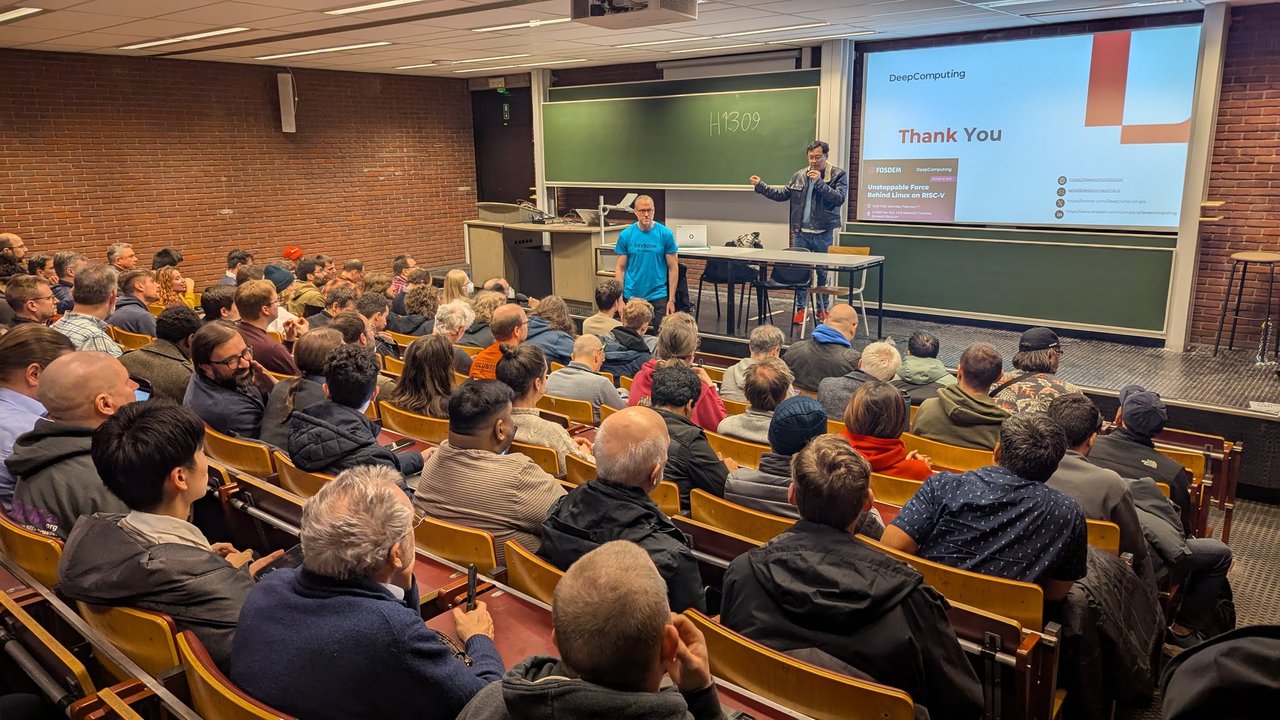
A full lecture hall at FOSDEM 2025.
FOSDEM 2026
Returning to FOSDEM in 2026 felt like coming home. The conference continues to grow, and the energy is unmatched.
I attended again in 2026 and spent most of my time on the hallway track: RISC-V, edge AI and open silicon, with DeepComputing and RISC-V International.
FOSDEM remains my favorite conference for pure technical depth and community spirit. No badges, no expo halls, no vendor pitches — just developers sharing knowledge.
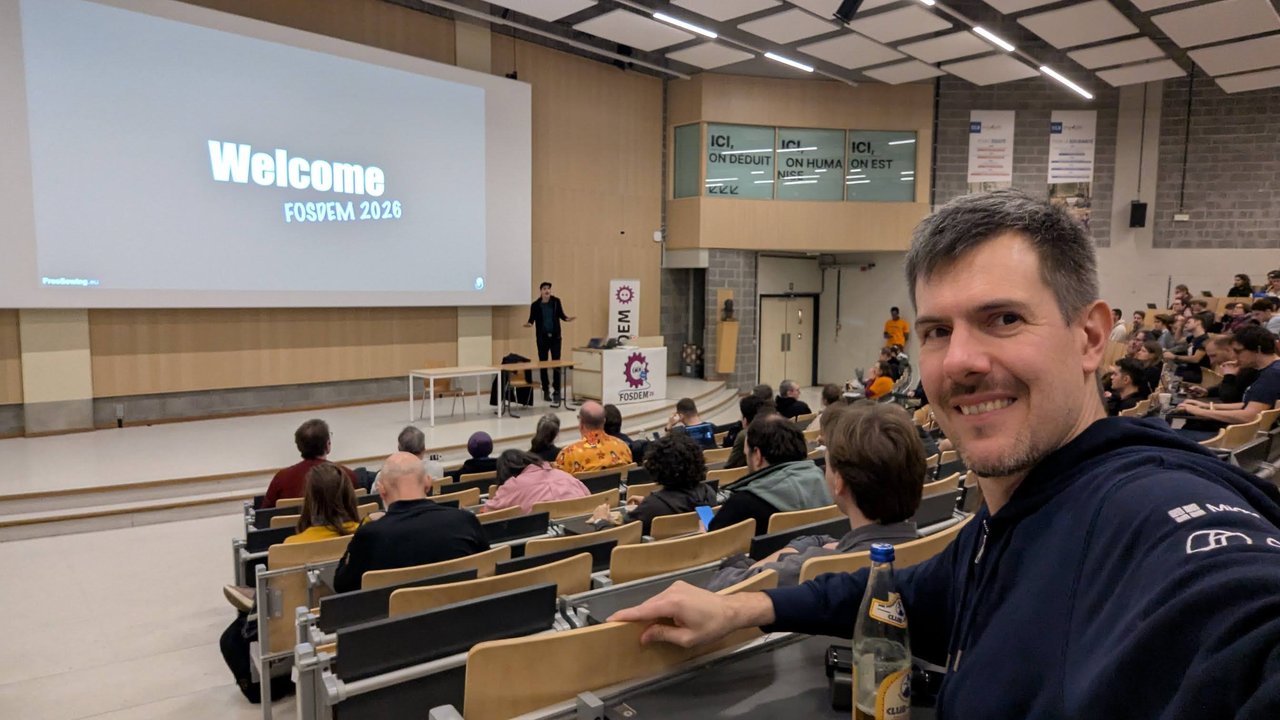
Back at FOSDEM in 2026.
Open Source Summit 2025
The Linux Foundation Open Source Summit is where industry meets community. It brings together enterprise leaders, open-source maintainers, and the organizations that depend on open-source infrastructure.
I attended the 2025 edition in Amsterdam rather than speaking, and it showed me a different audience: decision-makers and architects who are evaluating how to adopt open-source solutions at enterprise scale. The conversation is different from a pure community event: it is about governance, security, compliance, and the EU Cyber Resilience Act’s impact on open source.
It reinforced my belief that open source needs advocates who can speak both languages: the technical depth of a FOSDEM talk and the business context of an enterprise summit.
I wrote up the Amsterdam 2025 edition, with photos from the keynotes, the booths and the Embedded Linux Conference, in my Open Source Summit Europe 2025 recap.
KubeCon EU 2026 — Amsterdam
And now, this week: KubeCon + CloudNativeCon Europe 2026 in Amsterdam. More than 13,500 attendees, according to CNCF: the largest KubeCon + CloudNativeCon so far.
I am speaking about Multi-tenant GPUs on Bare Metal OpenShift AI — a topic that sits right at the intersection of everything I have been working on: Kubernetes, AI infrastructure, multi-tenancy, and platform engineering.
The journey from Ansible Berlin to KubeCon has been incredible. Each conference taught me something different:
- Ansible Berlin taught me that community talks matter
- CfgMgmtCamp taught me that practitioners want depth, not demos
- Cloud Native London taught me that diversity of perspective makes talks better
- FOSDEM taught me that open source is about people, not code
- Open Source Summit taught me that enterprises need open-source advocates
- KubeCon is teaching me that the Cloud Native ecosystem is ready for AI at scale
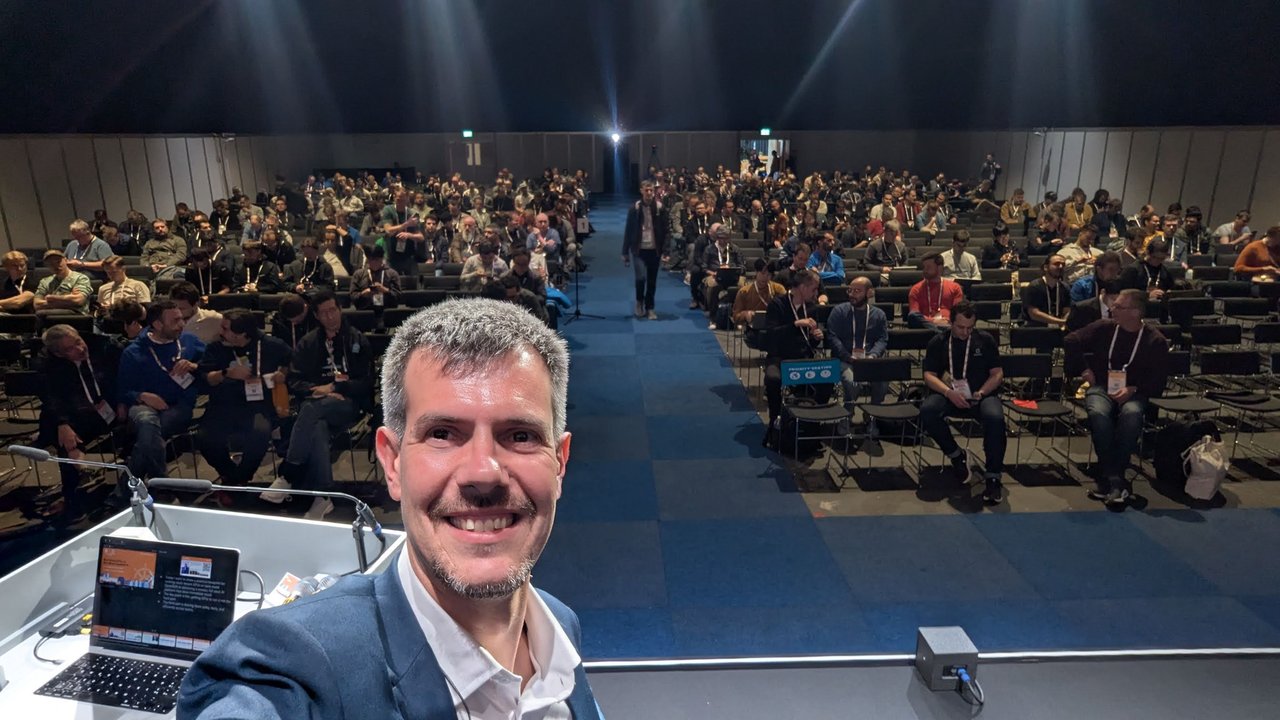
Minutes before my KubeCon Europe 2026 talk. The whole week is in my KubeCon Europe 2026 recap in photos.
What I have learned about speaking
For anyone considering submitting their first CFP:
Start local. Meetups are the best training ground. Ansible Community Day Berlin, Cloud Native London — these communities are welcoming and the feedback is genuine.
Share what you know, not what sounds impressive. The best talks come from real experience. If you spent three months debugging a Kubernetes networking issue, that is a talk. If you migrated 500 servers with Ansible, that is a talk.
The hallway track is the real conference. The conversations between sessions — with people like Artem Lajko, Pepijn Oomen, and Lian Li — are where ideas become collaborations.
Give back more than you take. The open-source community runs on generosity. Share your knowledge, support other speakers, and the community will support you.
What is next
After KubeCon, I am looking at speaking opportunities around AI infrastructure, digital sovereignty, and the evolving platform engineering landscape. If you are organizing an event and these topics resonate, let us talk.
Check out my KubeCon EU 2026 talk on Multi-tenant GPUs, the Cloud Native Rejekts 2026 recap where I co-hosted as MC, and the KubeCon 2026 Leaders shaping the ecosystem.