On Wednesday 25 March 2015 I went to Community Days 2015, the Italian community conference about Microsoft technologies. That edition ran from 24 to 26 March at Microsoft Italia’s offices in Peschiera Borromeo, just outside Milan, according to the archived event page. The archived home page describes it as an event founded in 2006 by ASPItalia.com and UGIdotNET, organised by Italian user groups and free to attend, with 3 days, 15 tracks, 104 sessions and 92 speakers. All the sessions and slides I saw were in Italian.
This post is about 2015, written in October 2026. I took a handful of photos of IoT slides that day. Eleven years later, I wanted to check what happened to each technology on them. I’ve linked a source for every “what it became” claim, and kept my own opinions short and marked as such.
Getting there
The day started at Vicenza station just before 8am. An hour later, the train passed a station with Gardaland billboards on the platform, and at 10am I took a selfie on board.

On the train, 25 March 2015.
From an upper floor of the building, I photographed the giant Microsoft lettering on the lawn in front of the building. From that side it reads backwards.
The lawn in front of Microsoft Italia, seen from inside, March 2015.
The Azure keynote: Event Hubs and Stream Analytics
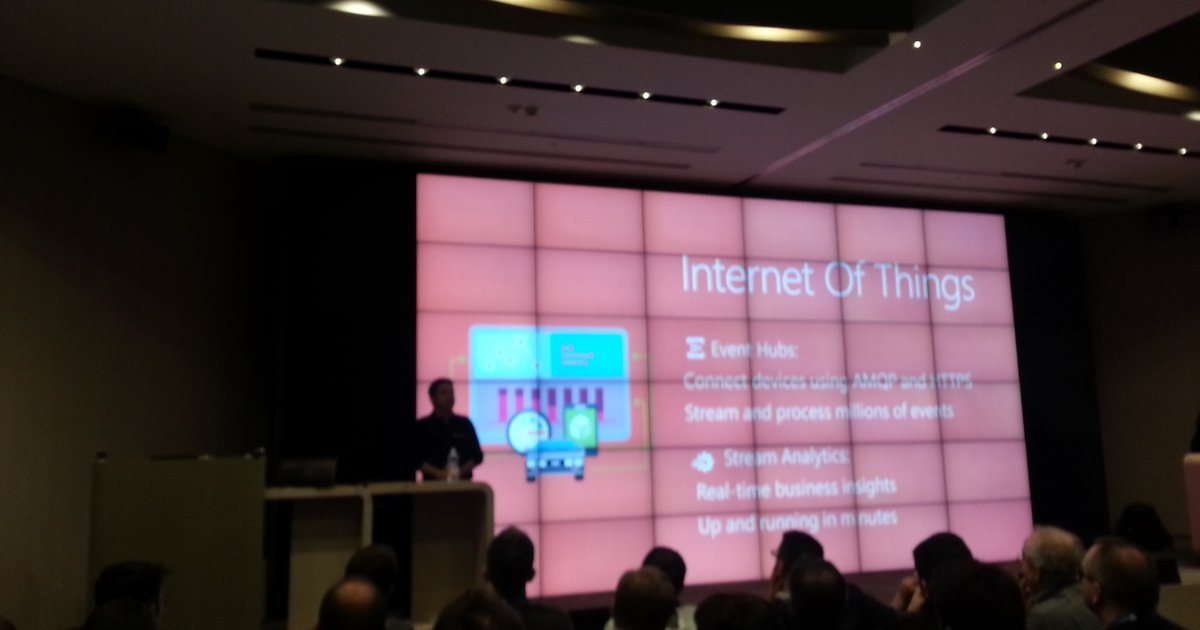
The agenda for 25 March opened with a Microsoft Azure keynote from 10:00 to 11:30. My photo of the IoT slide was taken at 11:11. On the video wall:
- Event Hubs: “Connect devices using AMQP and HTTPS”, “Stream and process millions of events”
- Stream Analytics: “Real-time business insights”, “Up and running in minutes”
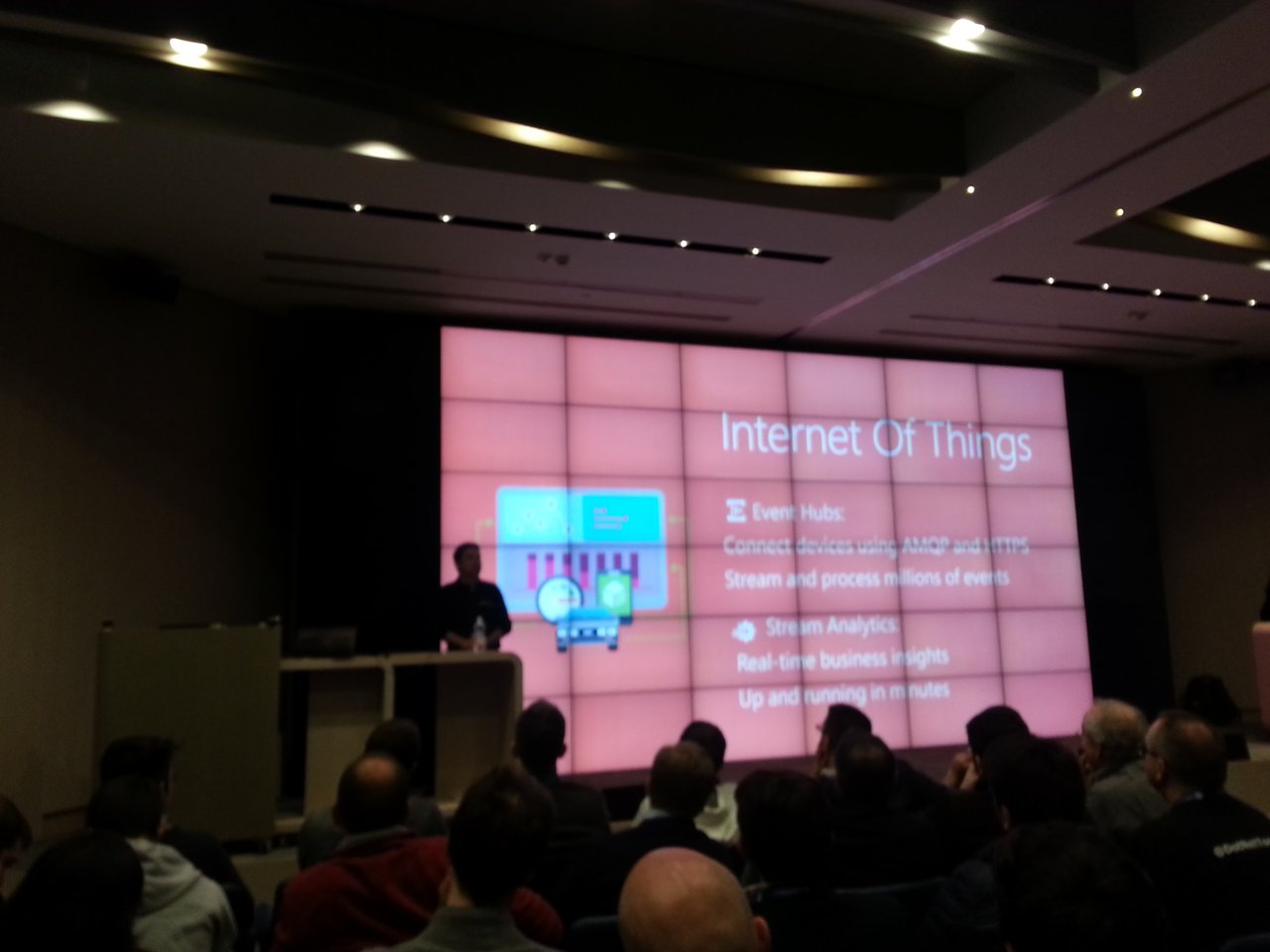
The “Internet Of Things” slide in the Azure keynote: Event Hubs for ingestion, Stream Analytics for real-time insights.
The timing fits the news back then. Nine days earlier, Microsoft had announced the Azure IoT Suite (16 March 2015). It was built on existing services, including Event Hubs, DocumentDB, Stream Analytics, Notification Hubs, Machine Learning, HDInsight and Power BI, and was due as a preview “in the coming months”.
What Event Hubs became
Event Hubs still exists, and the ingestion part of its pitch hasn’t changed much. Microsoft’s Event Hubs overview (updated January 2026) calls it “a fully managed, real-time data streaming platform that can ingest millions of events per second”. It lists IoT telemetry ingestion as a main use case. The protocol list has grown since that slide. In 2015 it said AMQP and HTTPS. Today the overview lists Apache Kafka, AMQP 1.0 and HTTPS, and Microsoft says existing Kafka workloads run “without code changes”.
What Stream Analytics became
Stream Analytics also still exists. The current introduction (February 2026) describes a fully managed engine with a SQL-based query language that reads from Event Hubs and IoT Hub. It can also run on the Azure IoT Edge runtime. I found no retirement notice on that page.
Microsoft now has a second option for “real-time business insights”. Real-Time Intelligence in Microsoft Fabric, which includes:
- Eventstreams to collect and transform streams, with connectors for Kafka, MQTT and Azure Event Hubs
- Eventhouses queried with KQL
- Real-Time dashboards
- Activator to trigger actions
The Azure IoT introduction (April 2026) now calls Fabric “the shared data plane for Azure IoT”.
The IoT session: the Windows Embedded family
In the afternoon I was in a smaller room with rows of desks and PCs. My photos were taken at 14:15 and 14:40. That time slot matches the agenda’s IOT04, “Internet Of Things: dalla teoria alla pratica” (“from theory to practice”), from 14:00 to 15:00 in the Training room. It was one of several IoT sessions that day. Others on the agenda were “Windows for IoT e Galileo”, “Pinguini addomesticati per l’IoT” (“tamed penguins for IoT”) and “Internet of Your Things”.
The first slide I photographed was “La famiglia Windows Embedded”:
| Edition (slide) | Description on the slide (translated) |
|---|---|
| Compact | Real-time OS, ARM, MIPS, x86 |
| Handheld | Windows 8.1 platform for mobile ARM devices |
| Standard | Componentised Windows plus embedded, x86/x64 |
| Industry | Windows 8.1 for POS and industry, x86/x64 |
| Enterprise | ”BIG-Win” (full Windows) with an embedded licence, x86/x64 |
| Server & SQL | Windows Server with an embedded licence, x64 |
Under the table were two more bullets: ”.NET MicroFramework – Open Source – Microsoft” and “Windows Developer Program for IoT (Intel Galileo)”.
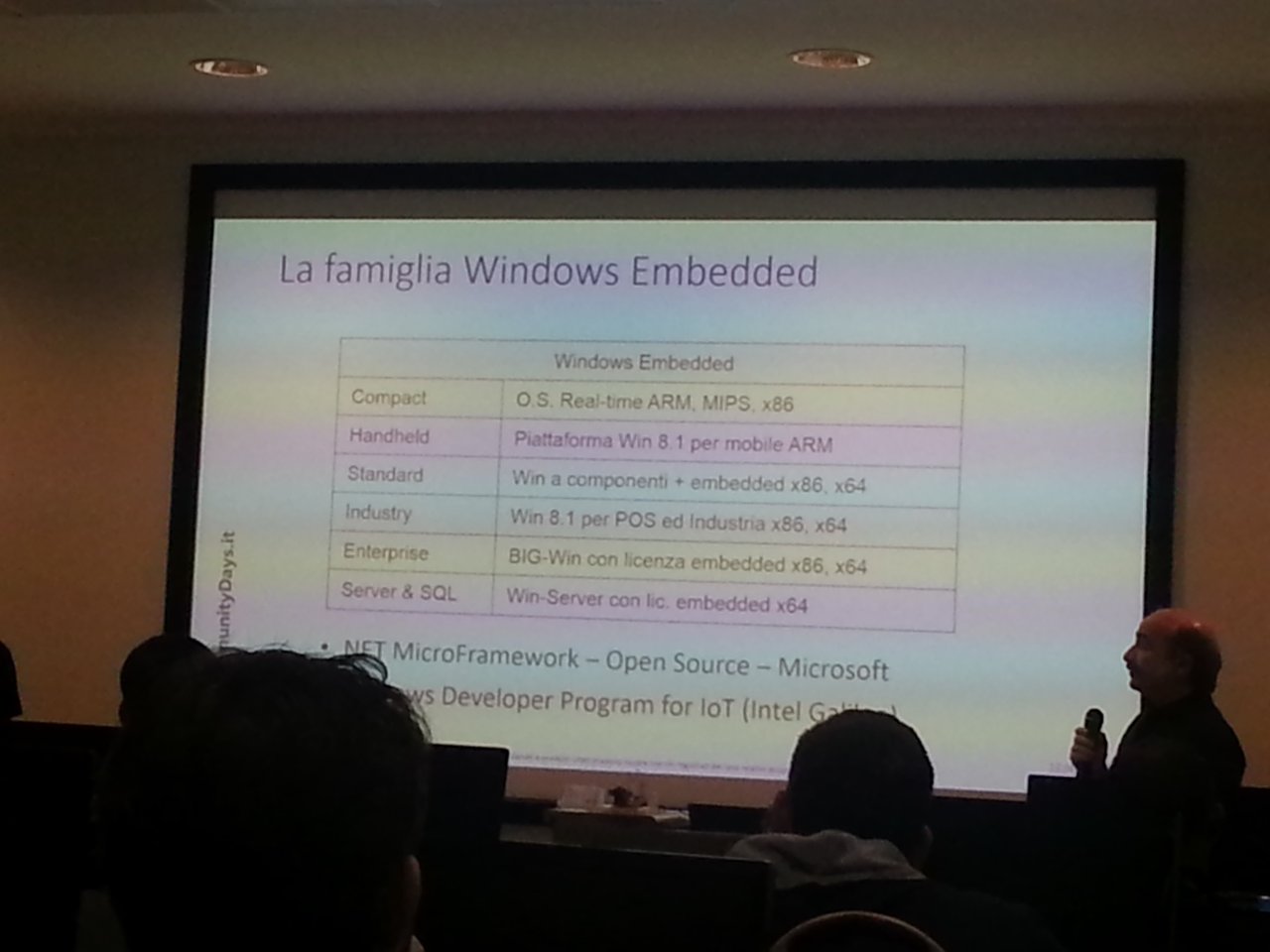
“La famiglia Windows Embedded”: six editions in one table, with .NET Micro Framework and Galileo below.
What Windows Embedded became
The editions in that table are now out of support:
- Windows Embedded Compact 2013: extended support ended in October 2023.
- Windows Embedded 8.1 Industry: extended support ended in July 2023.
The Enterprise row, full Windows with an embedded licence, is the one that continued. It’s now called Windows IoT Enterprise, which Microsoft describes as “a binary equivalent to Windows Enterprise”, licensed for fixed-purpose devices such as ATMs, POS terminals, kiosks and industrial PCs. Its LTSC releases come out roughly every three years and get 10 years of support. Windows 11 IoT Enterprise LTSC 2024 is one example.
Windows 10 IoT Core wasn’t on the slide, because it didn’t exist yet. Its lifecycle page gives a start date of 29 April 2015, five weeks after this session, and says it “retired on November 10, 2020”. The LTSC variant has extended support until January 2029.
What .NET Micro Framework became
The slide described .NET Micro Framework as “Open Source – Microsoft”. Its interpreter repository, NETMF/netmf-interpreter, was archived in 2019 and is now read-only. The community project .NET nanoFramework took over the idea. It says it “took the core principles of .NET Micro Framework and brought it to the 21st century”, is part of the .NET Foundation, and runs C# on microcontrollers such as ESP32 and STM32 boards. Its interpreter is MIT-licensed and still gets commits in 2026.
What happened to Intel Galileo
The Galileo bullet aged the fastest. In November 2015, eight months after this session, PCWorld reported that Microsoft would end support for Windows 8.1 on Galileo Gen1 and Gen2 on 30 November, because the board didn’t meet Windows 10 IoT Core’s minimum hardware requirements. The article’s editor’s note adds that Windows 10 IoT Core never supported Galileo. Intel then issued end-of-life notices for the Galileo boards in June 2017. The last order date was 16 September 2017 and the last shipment date was 16 December 2017.
”Le prime soluzioni architetturali”
Later in the same session, a slide showed the first architectures (“le prime soluzioni architetturali”). It’s a whiteboard-style diagram:
- a Windows Azure cloud containing a Backend Website, Service Bus and Storage
- an Update Uploader feeding updates into Storage
- an Embedded Device at the bottom, with arrows up to the cloud
An overlay pointed to a Pluralsight course, “Building an Intelligent System: from Embedded to Cloud”.
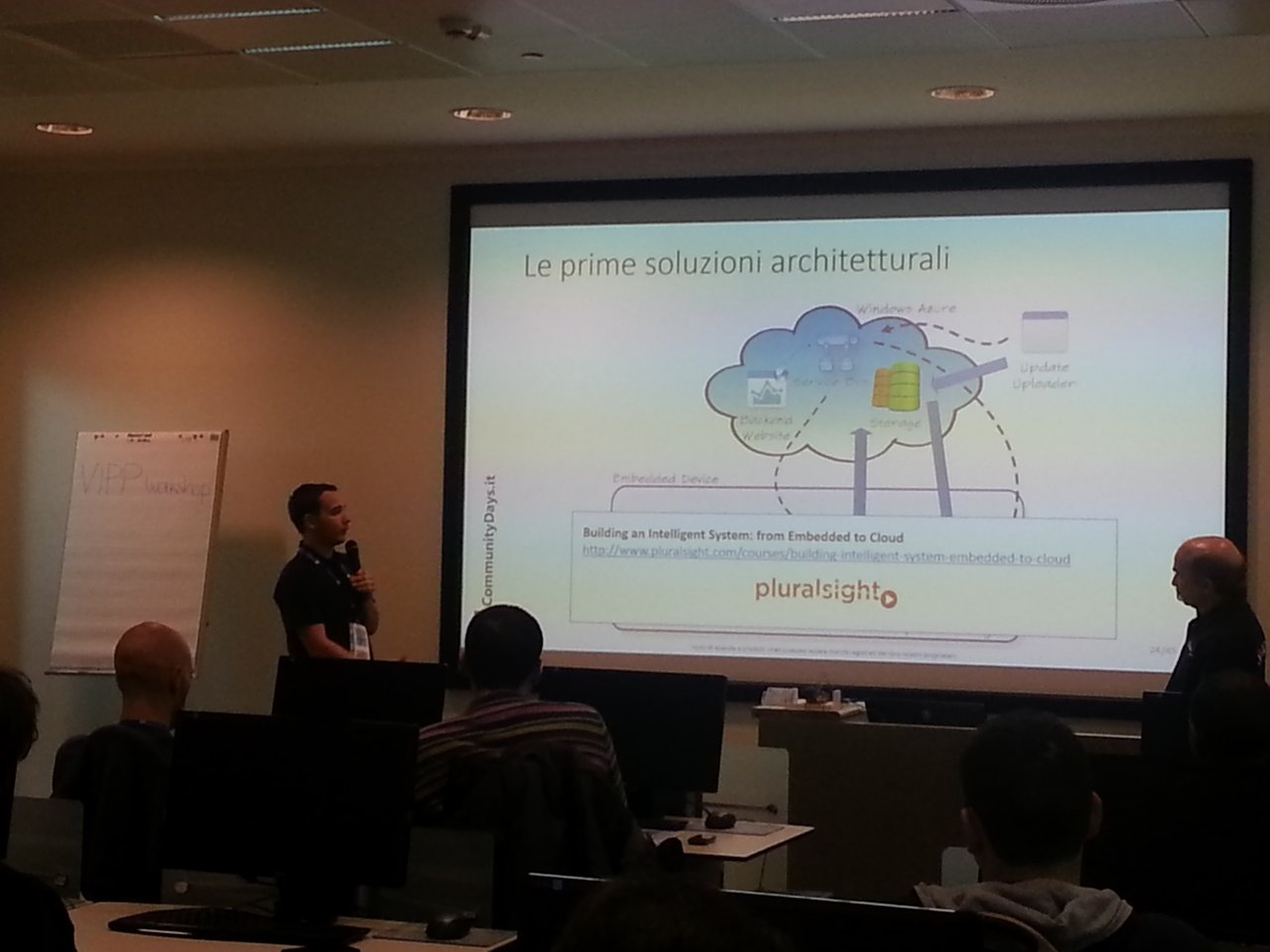
“Le prime soluzioni architetturali”: an embedded device talking to a Windows Azure backend, with a course reference on Pluralsight.
Even the label on that diagram was already out of date in March 2015. Microsoft had renamed Windows Azure to Microsoft Azure on 3 April 2014, almost a year earlier.
What the same diagram looks like in 2026
Microsoft’s Azure IoT introduction now splits IoT into two patterns:
- Cloud-connected: devices talk directly to IoT Hub over MQTT, AMQP or HTTP. IoT Hub can route messages to Event Hubs, Service Bus, Storage and Cosmos DB.
- Edge-connected: devices talk to Azure IoT Operations, which Microsoft calls its “primary recommendation for new edge-connected solutions”.
Azure IoT Operations runs on Azure Arc-enabled Kubernetes. It includes an MQTT broker, Akri connectors (OPC UA, REST and others) and data flows. Those data flows can send data to Event Grid, Event Hubs or Kafka, Fabric OneLake and Azure Data Explorer. Its deployment overview lists several GA Kubernetes targets:
- K3s on Ubuntu 24.04 (x86_64 and ARM64) or RHEL 9
- AKS Edge Essentials
- AKS on Azure Local
- RKE2
- Red Hat OpenShift
- vSphere Kubernetes Service
There’s also a cloud MQTT option: the MQTT broker in Azure Event Grid supports MQTT v3.1.1 and v5. It can route messages through Event Grid topics to services such as Event Hubs, or to Fabric eventstreams, and it can be bridged to the Azure IoT Operations broker at the edge.
Here’s how each part of the 2015 slides maps to what’s documented today:
| 2015 (on the slides) | 2026 (documented today) |
|---|---|
| Embedded device on Windows Embedded, .NET Micro Framework or Galileo | Windows IoT Enterprise LTSC for fixed-purpose PCs; MCUs with nanoFramework or any MQTT client |
| Event Hubs over AMQP/HTTPS | IoT Hub (MQTT/AMQP/HTTP), Event Grid MQTT broker (v3.1.1/v5), Event Hubs with a Kafka endpoint |
| No edge layer on the slide | Azure IoT Operations on Arc-enabled Kubernetes, including K3s |
| Stream Analytics | Stream Analytics, or Fabric Eventstreams + Eventhouse (KQL) + Activator |
| Azure IoT Suite | IoT Hub, Azure IoT Operations, Azure Device Registry, with Fabric as the data plane |
On IoT Central: Microsoft posted a retirement notice in February 2024 with a date of 31 March 2027, then withdrew it as erroneous. The IoT Central overview on Learn still documents it as an aPaaS and shows no retirement banner. I found no current retirement date.
My take: the cloud half of these 2015 slides held up better than the device half. Event Hubs and Stream Analytics are still current services, and Event Hubs added a Kafka endpoint. Meanwhile, every Windows Embedded edition in that table has reached end of support, .NET Micro Framework is archived, and Galileo was discontinued. The biggest change is the edge: what was an “embedded device” box in 2015 is now, in Microsoft’s own reference model, a Kubernetes cluster with an MQTT broker on it. If you already run K3s and Kafka, a lot of this will look familiar.