Your Ansible playbook reported changed=0 failures=0. Your Terraform apply said “Apply complete! Resources: 0 added, 0 changed, 0 destroyed.” The infrastructure is, by every visible signal, exactly as you intended. And the data inside it is still wrong.
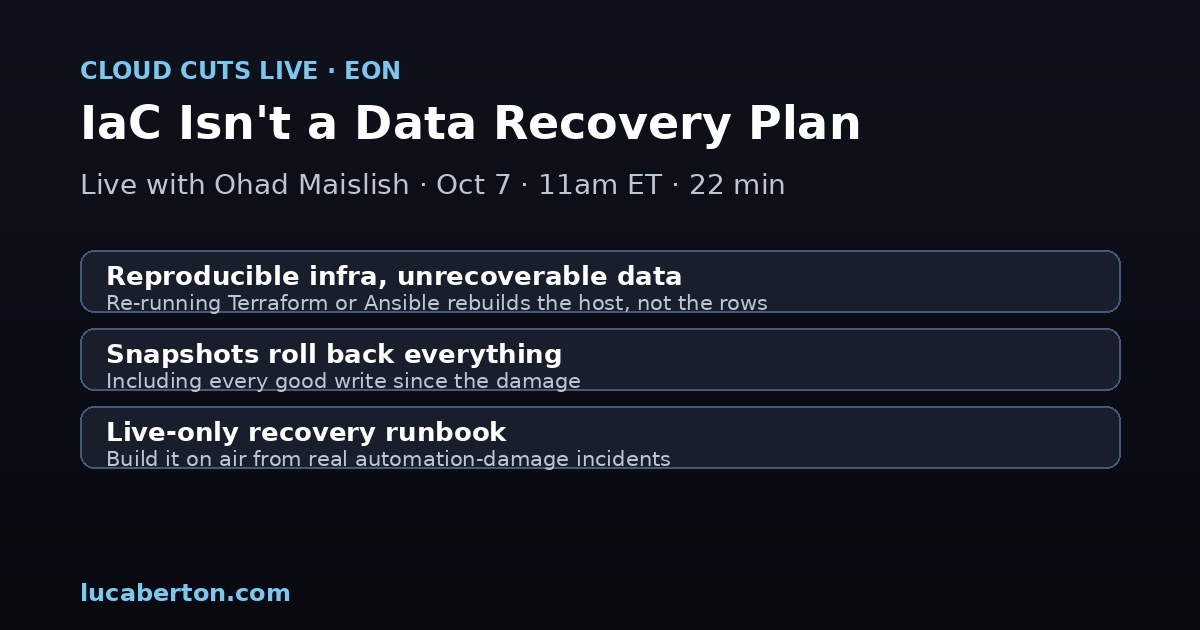
That gap — between “the automation succeeded” and “the data is safe” — is the entire subject of a live Cloud Cuts session I’m doing with Ohad Maislish from Eon on October 7 at 11am ET (22 minutes, virtual). Eon has been building the Cloud Cuts series around the failure modes that don’t show up in your dashboards until something is already broken, and this one sits right at the edge of where infrastructure-as-code stops being the safety net people assume it is.
The spine: automation that “passes” and still corrupts
The hardest incidents aren’t the ones that fail loudly. They’re the ones where every gate is green and production is quietly wrong.
- An AI agent gets a loose cleanup instruction and runs a destroy that takes years of records with it.
- A Terraform rename touches no values — it just renames a resource — and deletes a database nobody intended to touch.
- A bad migration lands, the pipeline is green, and corrupted rows sit in a table that re-running the playbook will never fix.
Each time, the team assumed a snapshot would cover them. Each time, they found out too late that it wouldn’t — at least, not the way they needed.
What IaC actually protects (and what it doesn’t)
Infrastructure-as-code recreates your infrastructure, not the data inside it. Re-running a playbook rebuilds the host and leaves the corrupted rows exactly where they are. A Terraform apply brings the resource graph back to the declared state; it does nothing for the row-level state the application wrote after the resource was created.
A snapshot can take you back — but it rolls the whole resource to a past moment, and every good write since goes with it. Nothing in that toolchain recovers only the damage. That’s the uncomfortable part: the tools that make your infrastructure reproducible were never written to make your data recoverable, and a green pipeline can’t tell the difference.
What we’ll do live
Ohad and I are going to take automation-damage incidents — the public cases above, plus one or two from the audience — and build the recovery each team wished they’d had, one step at a time. Ohad has built infrastructure-as-code tooling himself, so his pressure-testing digs into why the IaC behaved the way it did, not just what it did. You leave with a reusable recovery runbook you can adapt to your own stack.
The incident teardown and the runbook-building segment are live-only — they won’t be in the recording.
What you’ll walk away understanding
- Why reproducible infrastructure doesn’t mean recoverable data, and where teams bet on the wrong safety net
- The automated-write failures that pass every gate: bad migrations and over-scoped agents whose corruption never trips an alert
- Full restore versus surgical recovery: what a whole-resource rollback costs in good data and downtime, and how to scope recovery to what actually changed
- What to check first when nothing alerted, and what belongs in the runbook before the next automated job runs
Ask us questions in the chat throughout the session.
Join the session
October 7 · 11am ET · 22 minutes · Live (virtual).
Register even if you can’t make it — the recording lands in your inbox by the next morning. Bring your own automation-damage story; the best ones go on air.