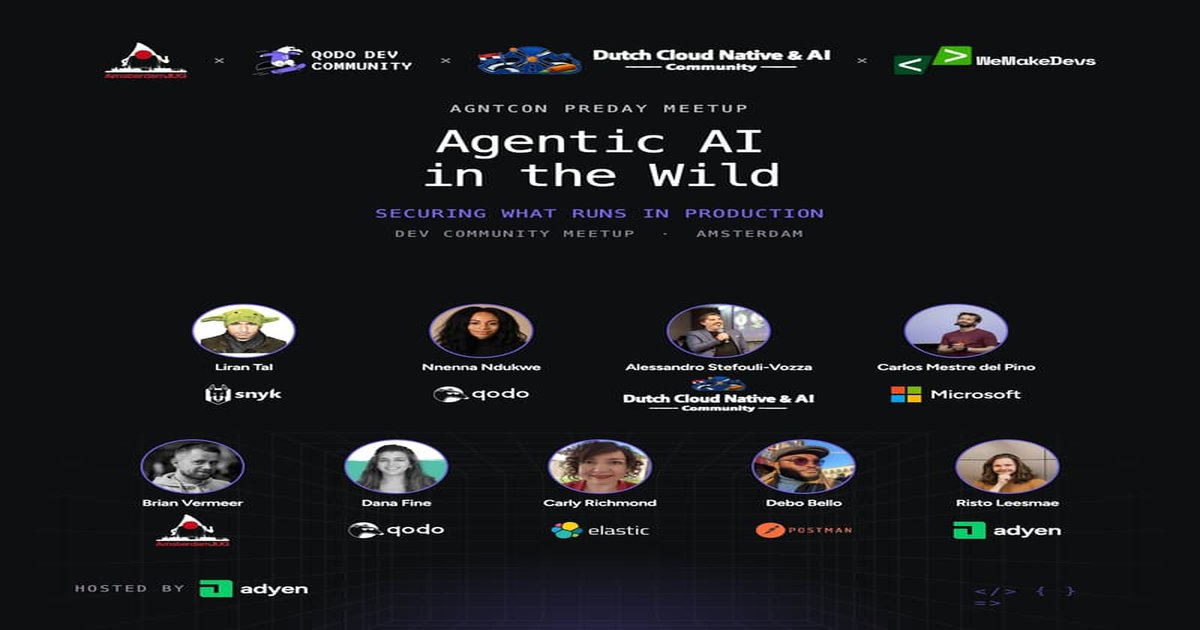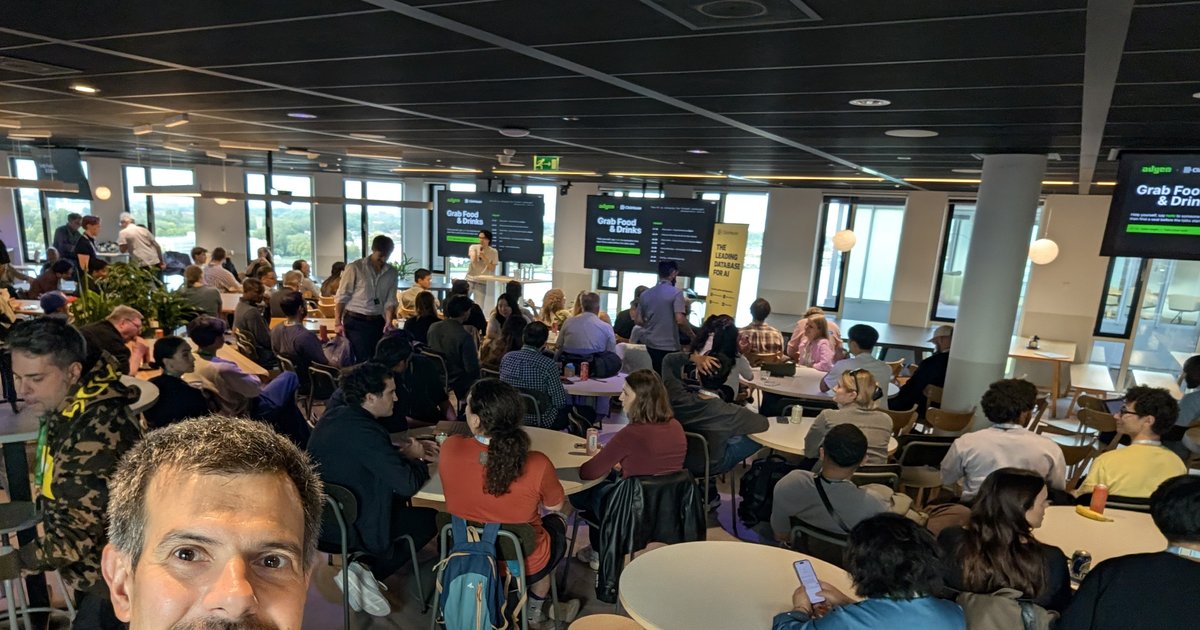
Last night I attended the ClickHouse Amsterdam Meetup @ Adyen, hosted at Adyen’s Amsterdam office. The evening was dedicated to one of the most fascinating intersections in tech right now: how AI is changing the fintech landscape — from autonomous agentic copilots in production to what’s next for the world’s fastest analytical database.
About 236 attendees turned out for the event, which brought together engineers, data practitioners, and fintech builders. The meetup was co-hosted by Kwok He Chu (Developer Relations @ Adyen) and Tyler Hannan (Global Advocate @ ClickHouse), with food and drinks provided by Adyen.
The Theme: AI Meets Real-Time Analytics in Fintech
The central question driving the evening was simple but profound: how do you build AI systems that operate reliably in production environments where correctness matters more than creativity? From agentic copilots that handle financial transactions to analytical databases that power real-time fraud detection, the answers span architecture, engineering discipline, and a healthy dose of pragmatism.
Talk 1: Skills First — Shipping an Autonomous Fee Agent Before Writing an Agent Harness
Iftach Arbel, Senior AI Research Engineer at Adyen, kicked things off with a grounded, no-nonsense talk about building autonomous agents for production — specifically, an autonomous fee calculation agent.
“We built an autonomous agent for a task where reliability mattered most. We will describe agent design patterns to explain our decisions: deterministic vs. agentic behavior, predictability vs. flexibility, auditability vs. adaptiveness, and routing vs. parallelization.”
Iftach’s core insight is one I’ve been advocating for in enterprise settings: not everything in your agent should be left to the model. The four patterns he laid out are worth bookmarking:
- Deterministic vs. agentic behavior — Wherever a decision is fixed by business logic or compliance requirements, encode it in code. Let the model handle ambiguity.
- Predictability vs. flexibility — In fintech, predictability is a feature, not a bug. You want the same input to produce the same output (within known variance), not creative reinterpretations.
- Auditability vs. adaptiveness — Financial systems need paper trails. Every agent decision must be traceable for compliance, even when the agent took an unexpected path.
- Routing vs. parallelization — Domain knowledge routing (which expert model/sub-agent handles which case) vs. parallel execution of independent subtasks. Confusing the two leads to either bottlenecks or hallucinated handoffs.
The key architectural decision: the surrounding structure — the flow, its guardrails, and the routing between pieces of domain knowledge — all moved into deterministic code. The core reasoning stayed agentic: “the model’s calls remained open-ended wherever that flexibility earned better results.”
For practitioners building agents in regulated domains, this talk is essential viewing. You can’t ship agents the way you ship chatbots.
Talk 2: ClickHouse for Analytical Workloads with Vector Embeddings
Alexey Milovidov, co-founder and CTO of ClickHouse, Inc., took the stage next to discuss how vector embeddings are reshaping analytical workloads — and what it means for fintech specifically.
Alexey has 17 years of experience designing, developing, and operating data-intensive applications. Before ClickHouse, he created the data processing engine of the world’s 2nd largest web analytics system. His area of interest is data processing algorithms and technologies.
While the talk details are still being finalized (TBA), the direction is clear: ClickHouse is positioning itself not just as an analytics database, but as a unified platform for real-time analytics + AI/ML embeddings. For fintech teams that need to join transactional data with vector search results — fraud pattern matching, anomaly detection, recommendation engines — the ability to do both in a single query is a significant architectural simplification.
The Venue: Adyen’s Amsterdam Office
The evening took place at Adyen’s Amsterdam office at Simon Carmiggeltstraat 6-50, 1011 DK Amsterdam. Adyen provided food and drinks, and the space had exactly the right atmosphere for technical conversation — open, well-lit, and designed for people who’d rather be coding than small-talking.
Important note for international visitors: Adyen requires all visitors to bring a valid photo ID (passport/ID card) to enter the building. Show it at reception and you’ll be escorted to the top floor.
On AI in Fintech
What struck me most about the evening — and what I think the broader industry needs to hear — is that AI in fintech is moving from experimentation to production, and the rules of engagement have changed.
In the chatbot world, you can afford to be conversational and creative. In fintech, every agent decision has a dollar value attached. The autonomous fee agent Iftach described isn’t “nice to have” — it directly impacts revenue and customer trust. A hallucinated fee calculation is a customer complaint, a compliance report, and a potential chargeback.
This is why the “skills first” approach matters. You don’t ship an agent harness and then figure out the guardrails. You start with the constraints — auditability, predictability, routing logic — and design the agent around what must be deterministic.
Why This Matters for Fintech Builders
The themes from this meetup echo across every fintech stack I work with:
- Determinism is a feature, not a limitation — The best AI systems know when to stop being creative and fall back to code.
- Observability can’t be bolted on — Agent decisions need traceable paths from input to output. In regulated environments, this isn’t optional.
- Vector + analytics = the new full-stack — Teams that can join traditional business intelligence with AI-powered similarity search are already a full architectural cycle ahead of competitors still running batch jobs.
- Production is not a research paper — The gap between “works on my laptop” and “handles 236 attendees’ worth of real-time transactions” is where agents either thrive or fail.