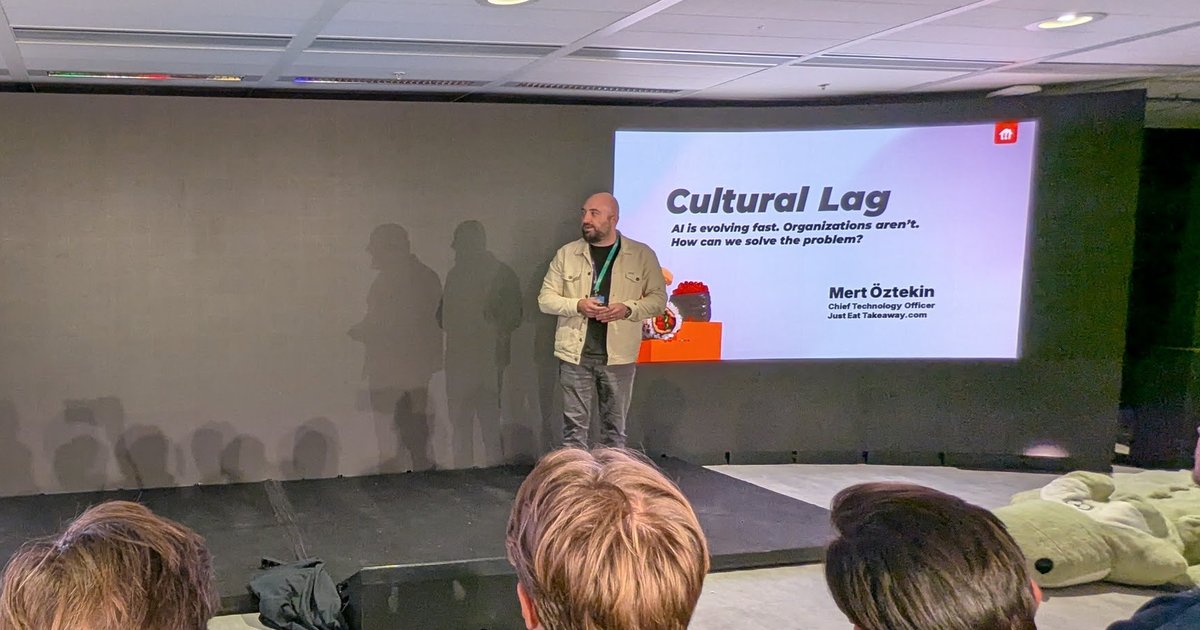
On Thursday evening I went to the Claude Community Amsterdam meetup at A’DAM Tower’s Press Room, titled “Introduction to Claude for Business.” Three practitioners who have rolled out Claude and Claude Code inside real organizations walked through where they started, who they gave it to first, how they got leadership behind it, and what broke along the way.
One slide stuck with me. It was titled “The roles a business will grow, in order” and it laid out an AI career ladder — but not the one you’d expect.
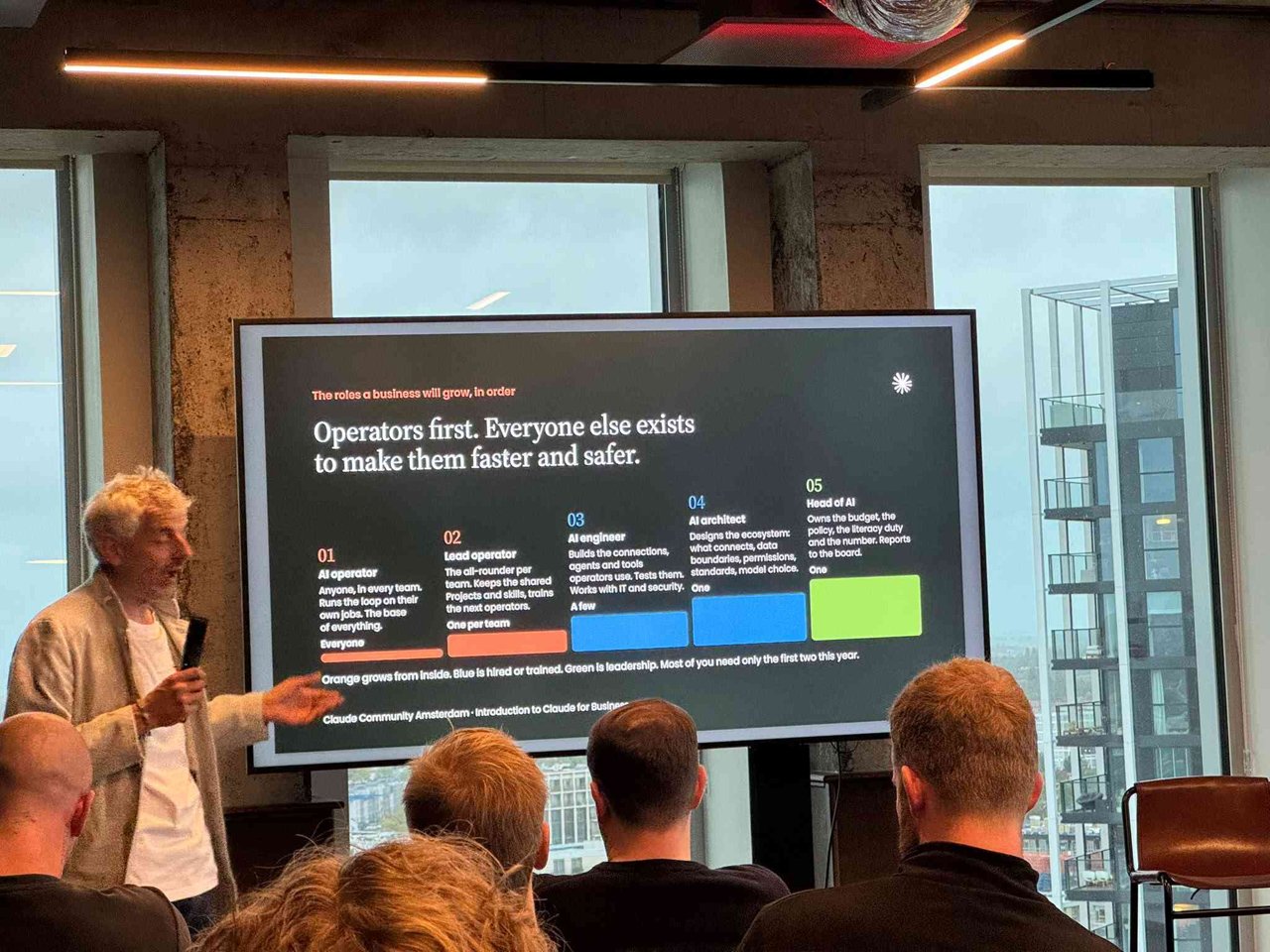
The slide that framed the evening. The headline reads: “Operators first. Everyone else exists to make them faster and safer.”
The five roles, in growth order
The bar chart read staffing levels from Everyone at the bottom down to One at the top. Each rung is a role a business grows, not a role it hires into:
1. AI Operator — Everyone
One in every team. Uses AI tools, tests them against standards and model choice. The base layer — every employee learns to work with AI, not just a central team.
2. Lead Operator — Many
Builds the connections between data and models. Keeps the shared operator workflows running, tests them against standards and model checkpoints. The glue layer.
3. AI Engineer — Some
Projects and fine-tunes. Works with data and security. Owns jobs. The base for the next set of operators.
4. AI Architect — Few
Designs the ecosystem: the policy, the budget, the guardrails. Owns the technical boundaries that keep operators fast and safe.
5. Head of AI — One
Owns the budget. Owns the board. Sets the literacy standard and the duty framework across the company.
The color key tells the real story
Each bar was color-coded:
- Orange = grows from inside. People promoted from within, upskilled on the job.
- Blue = hired or trained. Brought in or trained up to fill a level.
- Green = leadership. The strategic tier at the top.
Why “operators first” matters for production AI
This isn’t a hiring funnel. It’s a production philosophy — and it maps directly onto the gap between demo and production that I spend my time closing.
The AI demo is easy. Production is hard. And production starts with operators, not architects.
Every company rushes to appoint a Head of AI, write governance policies, and design the ecosystem. But if nobody is actually using AI tools day-to-day — if there are no operators to operate — that leadership tier has nothing to amplify. You end up with expensive structure and zero throughput.
The slide’s logic is simple: start by putting AI in the hands of everyone who can use it. Then build the layers above to make them faster (shared workflows, standards, connections, platforms) and safer (tests, guardrails, policy, budget). Each layer’s job is to multiply the operators below it, not replace them.
The staffing ratio is the punchline
The bar chart doesn’t just list roles — it shows the ratio. At the bottom, it’s everyone. At the top, it’s one. That means the base layer is the widest by design. The pyramid is inverted compared to traditional org charts: instead of many individual contributors reporting into a few managers, you have many operators supported by progressively fewer specialists above.
This is the same pattern I’ve seen work when helping enterprises move from demo to production — first with Kubernetes, now with AI. Put the tooling in the hands of the people doing the work. Build the guardrails around them. Don’t wait for the Head of AI to tell operators what to do — the operators are already doing it.