Claude Code PreToolUse hooks run your code before every tool call and can answer allow, deny or ask. That makes them the place for team rules an agent should follow without reminders: no rm, no package published last week, no commit before tests pass, no writes outside the repository. This post builds those four rules as working scripts, wires them up, centralises them for a team and tests them offline.
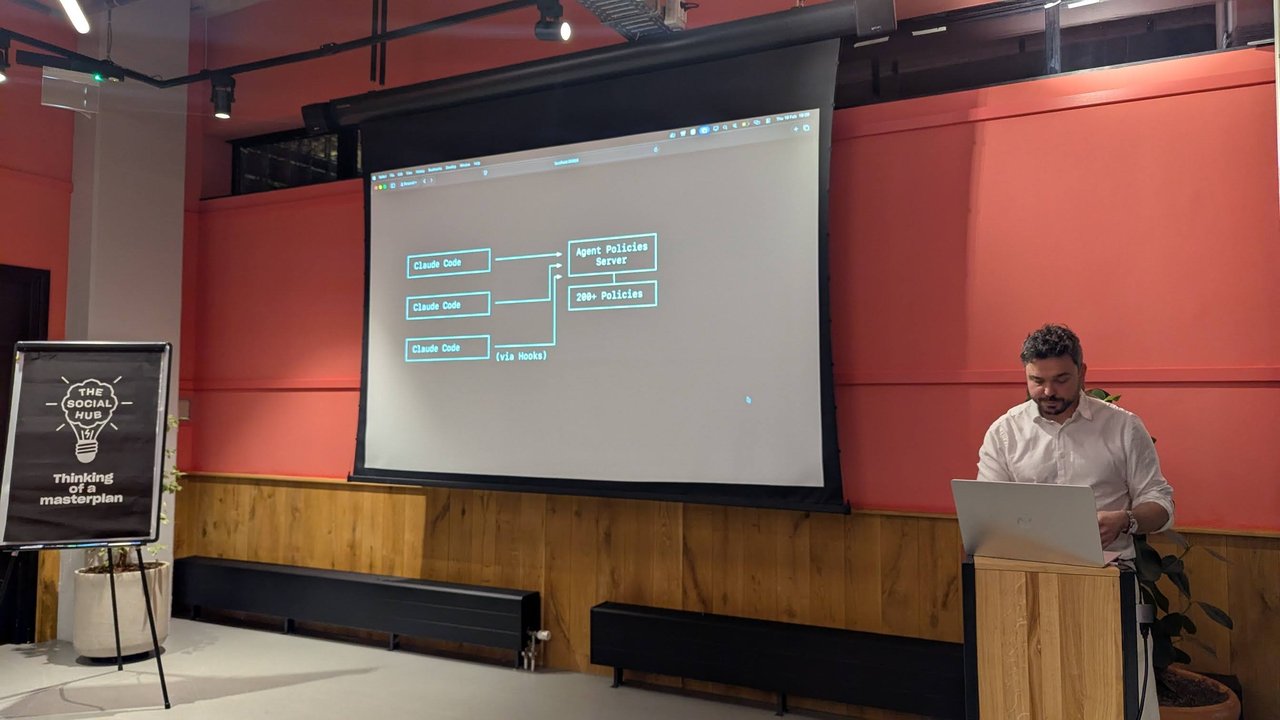
The first talk at Claude Code Meetup Amsterdam in February 2026 got me thinking about this. It showed an Agent Policies Server with 200+ policies, called from many Claude Code sessions via hooks, and a demo where the agent read each denial reason and changed course without a new prompt. I wanted the same behaviour, first without a server, then with one.
Versions: every field, event name and exit-code rule below comes from the official hooks reference and hooks guide as of 2 October 2026 (the reference cites behaviour up to Claude Code v2.1.274). I tested the scripts with Python 3.13, jq 1.7 and macOS’s bash 3.2 by piping sample hook JSON into them. I didn’t run them inside a live Claude Code session for this post.
What Claude Code PreToolUse hooks receive
A command hook gets one JSON object on stdin. For a Bash call it looks like this (from the reference):
{
  "session_id": "abc123",
  "transcript_path": "/home/user/.claude/projects/.../transcript.jsonl",
  "cwd": "/home/user/my-project",
  "permission_mode": "default",
  "hook_event_name": "PreToolUse",
  "tool_name": "Bash",
  "tool_input": { "command": "npm test", "description": "Run test suite", "timeout": 120000, "run_in_background": false },
  "tool_use_id": "toolu_01ABC123..."
}
tool_input depends on the tool: command for Bash, file_path for Read, Edit and Write, path for Glob and Grep, notebook_path for NotebookEdit. File-tool paths arrive absolute, with ~ and relative paths already expanded. Newer versions add prompt_id, scratchpad_dir and effort; subagent calls add agent_id and agent_type.
Exit codes and the JSON decision
There are two ways to answer, and the reference says to pick one per hook:
| Hook does | Result for PreToolUse |
|---|---|
| Exit 0, no output | No opinion. The normal permission flow decides |
Exit 0, JSON with permissionDecision | allow, deny, ask or defer |
| Exit 2 | Blocks the call. Stderr becomes the reason Claude sees |
| Any other exit code without valid JSON, including 1 | Non-blocking error. The tool call proceeds |
The JSON goes inside hookSpecificOutput:
{
  "hookSpecificOutput": {
    "hookEventName": "PreToolUse",
    "permissionDecision": "deny",
    "permissionDecisionReason": "rm is blocked by project policy. Use trash instead."
  }
}
A deny reason goes to Claude, which is how the agent learns the policy. An ask reason goes to the user. allow skips the prompt, but deny and ask rules in settings still apply: hooks tighten permissions, they don’t loosen them. Across several hooks the most restrictive answer wins, deny over defer over ask over allow. defer only works with -p, so I skip it. A hook deny also holds in bypassPermissions mode, which matters if your team uses YOLO mode.
Rule 1: deny rm, point at trash
This one is plain bash and jq. It splits the command on ;, &, |, parentheses and backticks, skips VAR=value and wrappers like sudo, and denies when the first word is rm, /bin/rm or \rm.
#!/usr/bin/env bash
# PreToolUse hook (matcher: Bash). Deny rm, point the agent at trash.
set -euo pipefail
cmd=$(jq -r '.tool_input.command // empty')

# Split on ; & | ( ) ` and newlines, then check the first word of each piece.
while read -r -a words; do
  [[ ${#words[@]} -eq 0 ]] && continue
  i=0
  # Skip VAR=value assignments and wrappers such as sudo or env.
  while [[ $i -lt ${#words[@]} && ${words[$i]} =~ ^([A-Za-z_][A-Za-z0-9_]*=.*|sudo|env|command|builtin|xargs|nohup|nice)$ ]]; do
    i=$((i + 1))
  done
  first=${words[$i]:-}
  first=${first#\\}            # \rm bypasses aliases
  if [[ ${first##*/} == rm ]]; then # also catches /bin/rm
    jq -n '{hookSpecificOutput: {
      hookEventName: "PreToolUse",
      permissionDecision: "deny",
      permissionDecisionReason: "rm is blocked by project policy. Use trash with a workspace-relative path instead, for example: trash build/old.log"
    }}'
    exit 0
  fi
done < <(printf '%s\n' "$cmd" | tr ';&|()`' '\n\n\n\n\n\n')

exit 0 # no opinion: the normal permission flow decides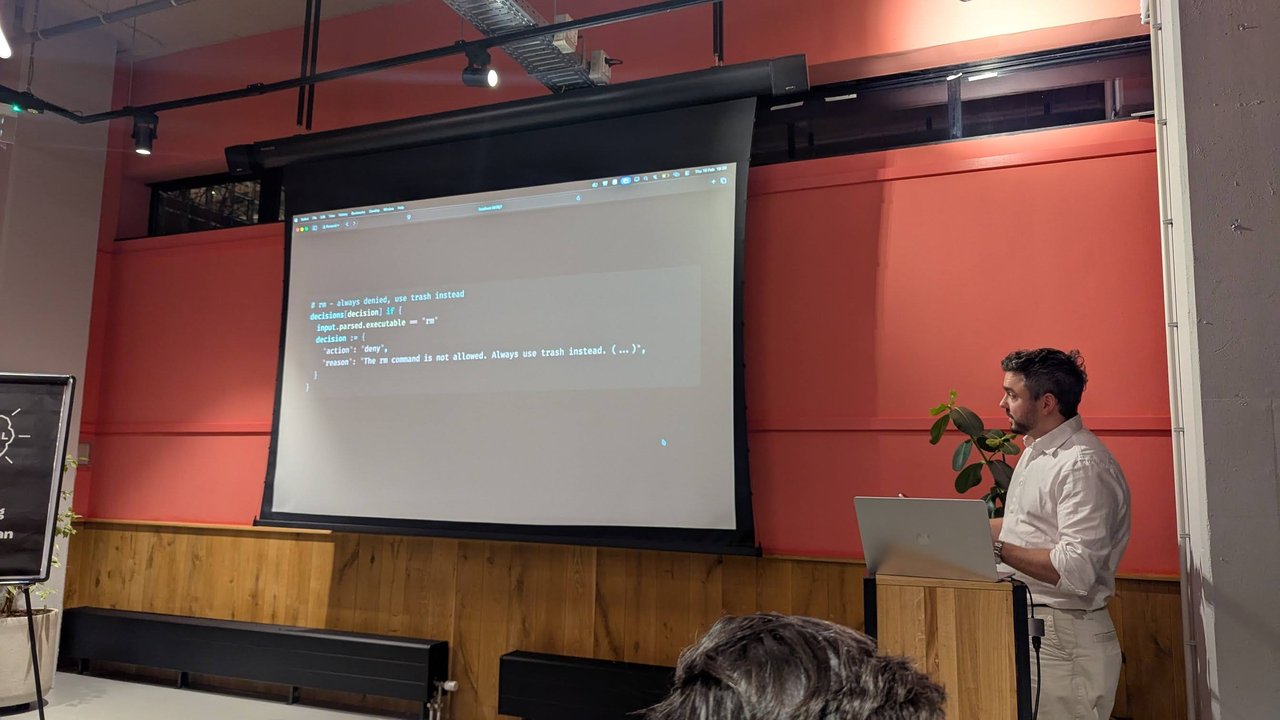
A slide from the agent policies talk at Claude Code Meetup Amsterdam: the rm rule, matching on the parsed executable and returning a deny with “Always use trash instead.”
I don’t set "if": "Bash(rm *)" here, though the reference uses it to avoid spawning the script. if uses permission-rule matching, and the permissions docs say Bash(rm *) doesn’t match /bin/rm -rf build/. For a deny rule I’d rather pay one extra process per Bash call.
A small shared helper
The other rules are standard-library Python sharing one helper. It splits a Bash string into simple commands and turns check(data) into the JSON decision. A crashing rule answers ask instead of exiting 1, because exit 1 fails open.
"""Shared helpers for Claude Code policy hooks (stdlib only)."""
import json, os, re, shlex, sys

WRAPPERS = {"sudo", "env", "command", "builtin", "xargs", "nohup", "nice", "time"}


def commands(command):
    """Yield argv for each simple command in a Bash string. Best effort, not a parser."""
    for part in re.split(r"&&|\|\||\$\(|[;&|\n()`]", command or ""):
        try:
            words = shlex.split(part)
        except ValueError:  # unbalanced quotes after splitting
            words = part.split()
        while words and (words[0] in WRAPPERS or re.match(r"^[A-Za-z_]\w*=", words[0])):
            words.pop(0)
        if words:
            words[0] = os.path.basename(words[0].lstrip("\\"))
            yield words


def project_root(data):
    return os.path.realpath(os.environ.get("CLAUDE_PROJECT_DIR") or data.get("cwd") or ".")


def emit(decision, reason):
    print(json.dumps({"hookSpecificOutput": {
        "hookEventName": "PreToolUse",
        "permissionDecision": decision,
        "permissionDecisionReason": reason,
    }}))


def run(check):
    """Read hook JSON from stdin, run check(data) -> (decision, reason) or None."""
    data = json.load(sys.stdin)
    try:
        result = check(data)
    except Exception as exc:  # a crashing policy should not fail open silently
        result = ("ask", f"Policy hook error: {exc}")
    if result and data.get("hook_event_name") == "PreToolUse":
        emit(*result)
    sys.exit(0)
Rule 2: deny packages younger than N days
In the talk, uv add was denied for packages under 365 days old. Mine covers pip, uv, npm, pnpm, yarn and bun, with a 30-day default in PKG_MIN_AGE_DAYS. For PyPI it asks the Index API (Accept: application/vnd.pypi.simple.v1+json) for the oldest file upload-time, since the JSON API’s releases key is deprecated. For npm it reads time.created from the package metadata.
#!/usr/bin/env python3
"""PreToolUse hook (matcher: Bash). Deny packages first published less than N days ago."""
import json, os, re, sys
from datetime import datetime, timezone

sys.path.insert(0, os.path.dirname(os.path.abspath(__file__)))
from policylib import commands, run

MIN_DAYS = int(os.environ.get("PKG_MIN_AGE_DAYS", "30"))
CACHE = os.path.expanduser(os.environ.get("PKG_AGE_CACHE", "~/.cache/claude-policy/package-age.json"))
INSTALLERS = {  # (command, subcommand) -> registry
    ("pip", "install"): "pypi", ("pip3", "install"): "pypi", ("uv", "add"): "pypi",
    ("npm", "install"): "npm", ("npm", "i"): "npm", ("npm", "add"): "npm",
    ("pnpm", "add"): "npm", ("yarn", "add"): "npm", ("bun", "add"): "npm",
}
VALUE_FLAGS = {"-r", "--requirement", "-c", "--constraint", "-e", "--editable",
               "-i", "--index-url", "--extra-index-url", "--registry"}


def packages(argv):
    """Turn 'uv add requests==2.32' or 'npm i @scope/pkg@1' into (registry, name) pairs."""
    if argv[:3] == ["python", "-m", "pip"] or argv[:3] == ["python3", "-m", "pip"]:
        argv = ["pip"] + argv[3:]
    if argv[:2] == ["uv", "pip"]:
        argv = ["pip"] + argv[2:]
    registry = INSTALLERS.get(tuple(argv[:2]))
    if not registry:
        return
    skip = False
    for arg in argv[2:]:
        if skip or arg in VALUE_FLAGS:
            skip = not skip  # skip the flag's value too (-r requirements.txt)
            continue
        if arg.startswith("-") or "://" in arg or arg.startswith((".", "/", "~")):
            continue  # flags, URLs and local paths are out of scope here
        if registry == "pypi":
            name = re.match(r"[A-Za-z0-9][A-Za-z0-9._-]*", arg)
        else:
            name = re.match(r"(@[^/@\s]+/)?[^/@\s]+", arg)
        if name:
            yield registry, name.group(0)


def first_release(registry, name):
    import urllib.parse, urllib.request  # slow import: only on the install path
    if registry == "pypi":  # PyPI Index API (JSON); each file has an upload-time
        req = urllib.request.Request(f"https://pypi.org/simple/{name}/",
                                     headers={"Accept": "application/vnd.pypi.simple.v1+json"})
        files = json.load(urllib.request.urlopen(req, timeout=5))["files"]
        created = min((f["upload-time"] for f in files if f.get("upload-time")), default=None)
    else:  # npm packument: time.created
        url = "https://registry.npmjs.org/" + urllib.parse.quote(name, safe="@")
        created = json.load(urllib.request.urlopen(url, timeout=5))["time"]["created"]
    return datetime.fromisoformat(created.replace("Z", "+00:00")) if created else None


def check(data):
    found = [p for argv in commands(data["tool_input"].get("command", "")) for p in packages(argv)]
    if not found:
        return None  # fast path: not an install command
    import urllib.error
    try:
        cache = json.load(open(CACHE))
    except (OSError, ValueError):
        cache = {}
    for registry, name in found:
        key = f"{registry}:{name.lower()}"
        if key not in cache:
            try:
                created = first_release(registry, name)
            except urllib.error.HTTPError as err:
                if err.code == 404:
                    return "deny", f"Package '{name}' does not exist on {registry}. Check the spelling."
                return "ask", f"Could not check the age of '{name}' ({err})."
            except (urllib.error.URLError, TimeoutError) as err:
                return "ask", f"Could not check the age of '{name}' ({err})."
            if created is None:
                return "ask", f"'{name}' has no published files on {registry}."
            cache[key] = created.isoformat()
        created = datetime.fromisoformat(cache[key])
        age = (datetime.now(timezone.utc) - created).days
        if age < MIN_DAYS:
            return "deny", (f"Package '{name}' is only {age} days old (first released "
                            f"{created:%Y-%m-%d}). Policy requires {MIN_DAYS} days. "
                            "Pick an established alternative or ask the user.")
    os.makedirs(os.path.dirname(CACHE), exist_ok=True)
    with open(CACHE, "w") as f:
        json.dump(cache, f)  # first-release dates never change, so cache them
    return None


if __name__ == "__main__":
    run(check)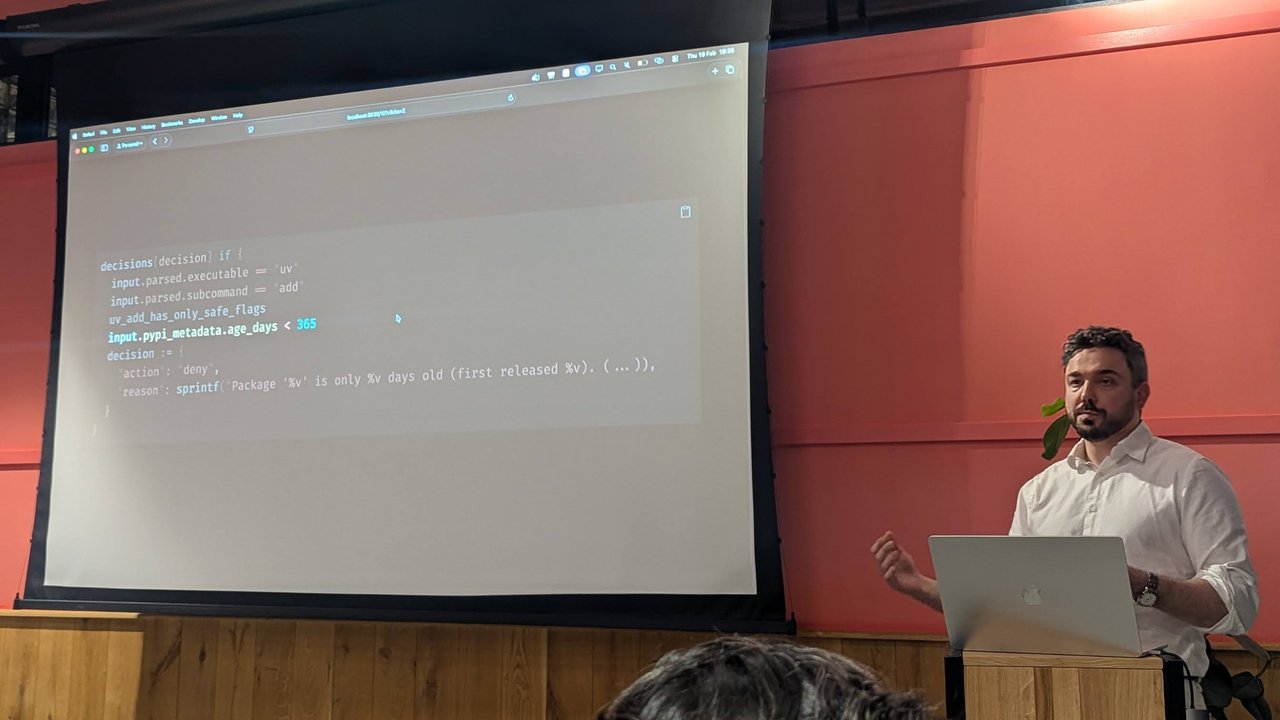
A slide from the agent policies talk at Claude Code Meetup Amsterdam: deny uv add when the package’s PyPI age is under 365 days, with the age and first release date in the reason.
A 404 is denied too: that’s a typo or a hallucinated package. An unreachable registry gets ask, so a human decides. To see a real denial, raise the threshold:
echo '{"hook_event_name":"PreToolUse","tool_name":"Bash","tool_input":{"command":"uv add httpx"}}' \
  | PKG_MIN_AGE_DAYS=99999 .claude/hooks/package_age.py
# {"hookSpecificOutput": {..., "permissionDecision": "deny", "permissionDecisionReason":
#  "Package 'httpx' is only 2632 days old (first released 2019-07-19). Policy requires 99999 days. ..."}}
Rule 3: require tests before git commit
This rule needs state, like the talk’s ran_tests flag. PostToolUse fires only after a tool succeeds; PostToolUseFailure fires when it fails, including a Bash non-zero exit. So a passing pytest sets the flag, a failing one or a .py edit clears it, and git commit is denied unless it’s true. The state file is keyed by session_id.
#!/usr/bin/env python3
"""Pre/PostToolUse(Failure) hook: deny git commit until pytest has passed since the last .py edit."""
import json, os, re, sys

sys.path.insert(0, os.path.dirname(os.path.abspath(__file__)))
from policylib import commands, project_root, run


def state_file(data):
    session = re.sub(r"[^A-Za-z0-9_-]", "", data.get("session_id", "default"))
    return os.path.join(project_root(data), ".claude", "state", f"{session}.json")


def set_flag(data, value):
    path = state_file(data)
    os.makedirs(os.path.dirname(path), exist_ok=True)
    with open(path, "w") as f:
        json.dump({"ran_tests": value}, f)


def ran_tests(data):
    try:
        return json.load(open(state_file(data))).get("ran_tests") is True
    except (OSError, ValueError):
        return False


def is_pytest(argv):
    return argv[0] == "pytest" or argv[1:3] == ["-m", "pytest"] or argv[1:3] == ["run", "pytest"]


def is_commit(argv):
    if argv[0] != "git":
        return False
    rest = argv[1:]
    while rest and rest[0] in ("-C", "-c"):  # git -C dir / -c key=value
        rest = rest[2:]
    return bool(rest) and rest[0] == "commit"


def check(data):
    event, tool, tin = data["hook_event_name"], data["tool_name"], data["tool_input"]
    if tool in ("Edit", "Write") and tin.get("file_path", "").endswith(".py"):
        set_flag(data, False)
        return None
    argvs = list(commands(tin.get("command", ""))) if tool == "Bash" else []
    if any(is_pytest(a) for a in argvs):
        if event == "PostToolUse":
            set_flag(data, True)
        elif event == "PostToolUseFailure":
            set_flag(data, False)
    if event == "PreToolUse" and any(is_commit(a) for a in argvs) and not ran_tests(data):
        return "deny", "Please run tests before committing: run pytest, fix any failures, then commit."
    return None


if __name__ == "__main__":
    run(check)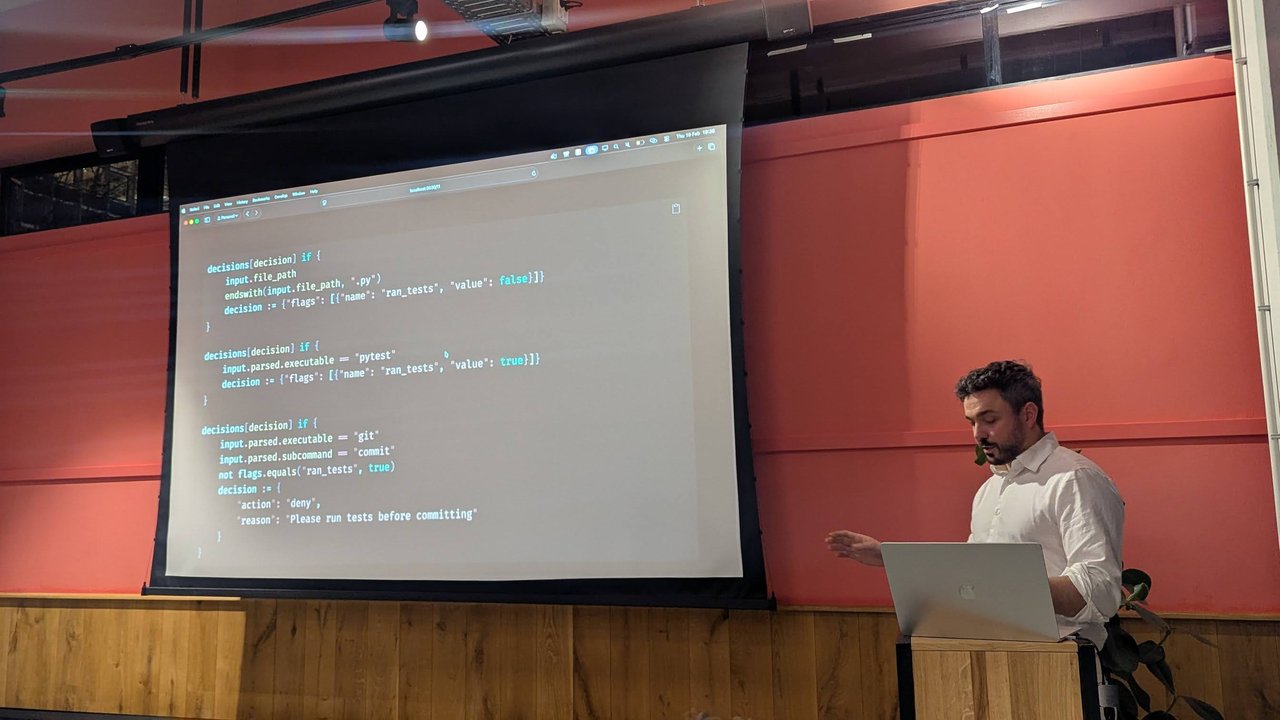
A slide from the agent policies talk at Claude Code Meetup Amsterdam: flags set on .py edits and pytest runs, and a git commit rule that reads them.
Rule 4: keep file paths inside the workspace
Writes outside the project are denied; reads get ask, since reading ~/.gitconfig can be legitimate. os.path.realpath resolves symlinks and ../, so a symlink to /etc inside the repo doesn’t help. The session’s scratchpad_dir is allowed. For Bash it mirrors the demo’s second policy: trash takes workspace-relative paths only.
#!/usr/bin/env python3
"""PreToolUse hook. Keep file tools inside the project; trash takes relative paths only."""
import os, sys

sys.path.insert(0, os.path.dirname(os.path.abspath(__file__)))
from policylib import commands, project_root, run

WRITE_TOOLS = {"Edit": "file_path", "Write": "file_path", "NotebookEdit": "notebook_path"}
READ_TOOLS = {"Read": "file_path", "Glob": "path", "Grep": "path"}


def inside(path, roots):
    real = os.path.realpath(path)  # resolves symlinks and ../
    return any(os.path.commonpath([real, r]) == r for r in roots)


def check(data):
    tool, tin = data["tool_name"], data["tool_input"]
    roots = [project_root(data)]
    if data.get("scratchpad_dir"):
        roots.append(os.path.realpath(data["scratchpad_dir"]))
    field = WRITE_TOOLS.get(tool) or READ_TOOLS.get(tool)
    path = tin.get(field) if field else None
    if path and not inside(path, roots):
        if tool in WRITE_TOOLS:
            return "deny", f"{tool} outside the workspace is not allowed: {path}"
        return "ask", f"{tool} wants to read outside the workspace: {path}"
    if tool == "Bash":
        for argv in commands(tin.get("command", "")):
            if argv[0] != "trash":
                continue
            for arg in argv[1:]:
                if arg.startswith(("/", "~")) or ".." in arg.split("/"):
                    return "deny", ("trash: only workspace-relative paths are allowed "
                                    "(no absolute paths, no ../, no /tmp)")
    return None


if __name__ == "__main__":
    run(check)
Wire the hooks with matchers
.claude/settings.json registers each script. A matcher of only letters, digits, _, -, spaces, , and | is an exact name or list of names; anything else is an unanchored JavaScript regex, so Edit.* also matches NotebookEdit. Matchers are case-sensitive. "args": [] selects exec form: no shell, and ${CLAUDE_PROJECT_DIR} needs no quoting.
{
  "hooks": {
    "PreToolUse": [
      {
        "matcher": "Bash",
        "hooks": [
          { "type": "command", "command": "${CLAUDE_PROJECT_DIR}/.claude/hooks/deny-rm.sh", "args": [] },
          { "type": "command", "command": "${CLAUDE_PROJECT_DIR}/.claude/hooks/package_age.py", "args": [], "timeout": 15 },
          { "type": "command", "command": "${CLAUDE_PROJECT_DIR}/.claude/hooks/test_gate.py", "args": [] }
        ]
      },
      {
        "matcher": "Bash|Read|Edit|Write|NotebookEdit|Glob|Grep",
        "hooks": [
          { "type": "command", "command": "${CLAUDE_PROJECT_DIR}/.claude/hooks/workspace_paths.py", "args": [] }
        ]
      }
    ],
    "PostToolUse": [
      {
        "matcher": "Bash|Edit|Write",
        "hooks": [
          { "type": "command", "command": "${CLAUDE_PROJECT_DIR}/.claude/hooks/test_gate.py", "args": [] }
        ]
      }
    ],
    "PostToolUseFailure": [
      {
        "matcher": "Bash",
        "hooks": [
          { "type": "command", "command": "${CLAUDE_PROJECT_DIR}/.claude/hooks/test_gate.py", "args": [] }
        ]
      }
    ]
  }
}
On Windows, use Bash|PowerShell, or the hook never fires for PowerShell commands. Matching handlers run in parallel, and one deny doesn’t stop the others running.
Project, user or managed settings
| Location | Scope |
|---|---|
~/.claude/settings.json | All your projects, your machine only |
.claude/settings.json | This project, committed for the team |
.claude/settings.local.json | This project, just you |
| Managed policy settings | Organisation-wide, admin-controlled |
Plugin hooks/hooks.json | While the plugin is enabled |
Hooks merge across levels instead of replacing each other. disableAllHooks in user or project settings can’t switch off managed hooks, and allowManagedHooksOnly in managed settings blocks user, project, local and plugin hooks. To ship the rules as a plugin instead, see Claude Code skills and plugins.
Centralise the rules for a team
Copies of four scripts in every repository drift. Put the rules in one place. Option one is a dispatcher: one process per tool call, most restrictive answer wins.
#!/usr/bin/env python3
"""One entry point for every rule: one process per tool call, most restrictive answer wins."""
import os, sys

sys.path.insert(0, os.path.dirname(os.path.abspath(__file__)))
import package_age, test_gate, workspace_paths
from policylib import commands, run


def deny_rm(data):
    if any(argv[0] == "rm" for argv in commands(data["tool_input"].get("command", ""))):
        return "deny", "rm is blocked by project policy. Use trash with a workspace-relative path."


RULES = [deny_rm, workspace_paths.check, test_gate.check, package_age.check]
RANK = {"deny": 3, "ask": 2, "allow": 1}


def check(data):
    rules = RULES if data["hook_event_name"] == "PreToolUse" else [test_gate.check]
    results = [r for r in (rule(data) for rule in rules) if r]
    if not results:
        return None
    top = max(results, key=lambda r: RANK[r[0]])[0]
    return top, " ".join(reason for decision, reason in results if decision == top)


if __name__ == "__main__":
    run(check)
Install it at a fixed path and register it in managed settings, for example /Library/Application Support/ClaudeCode/managed-settings.json on macOS or /etc/claude-code/managed-settings.json on Linux, with "command": "/opt/claude-policy/policy.py", "args": [] under PreToolUse, PostToolUse and PostToolUseFailure.
Option two is the talk’s architecture, an HTTP hook. Claude Code POSTs the same JSON and reads the same output format from the response body. My test service was a 25-line http.server wrapper around the dispatcher’s check(), registered like this:
{
  "type": "http",
  "url": "https://policy.example.com/hooks",
  "timeout": 5,
  "headers": { "Authorization": "Bearer $POLICY_TOKEN" },
  "allowedEnvVars": ["POLICY_TOKEN"]
}
A non-2xx status, connection failure or timeout is a non-blocking error: the call goes ahead. To block, return 2xx with the deny JSON. My take: keep the critical rules (rm, workspace writes) local or as permission deny rules, so a policy-service outage doesn’t switch them off. allowedHttpHookUrls pins which URLs HTTP hooks may call.
Test hooks offline
No Claude session needed: pipe JSON in, read stdout, check the exit code, as the hooks guide suggests.
export CLAUDE_PROJECT_DIR=$PWD
gate=.claude/hooks/test_gate.py
j() { jq -nc --arg c "$1" --arg e "$2" '{session_id:"t1",hook_event_name:$e,tool_name:"Bash",tool_input:{command:$c}}'; }

j 'git commit -m wip' PreToolUse  | $gate   # deny: Please run tests before committing...
j 'uv run pytest -q'  PostToolUse | $gate   # no output, state file now {"ran_tests": true}
j 'git commit -m ok'  PreToolUse  | $gate   # no output: allowed
echo $?                                     # 0
I keep a file of tricky commands next to the hooks and replay it after every change. In a real session, claude --debug-file /tmp/claude.log records which hooks matched, their exit codes and output. Watch for a hook error notice on first run: a mistyped path in settings.json silently disables the gate.
Pitfalls
- Exit 1 fails open. Only exit 2 or a JSON
denyblocks. A missing script, a traceback or a hook that hits itstimeoutlets the call through. Hencerun()turning crashes intoask, and a 15-second timeout on the network hook instead of the 600-second default. - Performance. Every Bash call spawns every matching handler. Importing
urllib.requestat module load added about 150 ms per call on my laptop; importing it only on the install path brought the dispatcher to about 50 ms. Cache lookups too: npm’s docs note some full metadata documents exceed 10 MB. - Shell-quoting bypasses. The Python rm check catches
r''m -rf buildand"rm" -rf buildbecauseshlexstrips the quotes; the bash one doesn’t. Neither catchesbash -c 'rm -rf build',eval "rm -rf build",$(printf rm) -rf build,find build -delete,python3 -c "import shutil; shutil.rmtree('build')"orgit clean -fdx. - State is only as good as its signals.
sed -ion a.pyfile fires no Edit or Write hook, soran_testsstays true.pytest | tailexits withtail’s status, so a failing run looks like a pass. @file references skip PreToolUse. Use aReaddeny rule for paths that must never reach the model.- Hooks are not a security boundary. They run with your user permissions, and with
-pa repository’s own.claude/settings.jsonhooks run without a trust prompt. They steer a cooperative agent. For hard limits, use permission deny rules, managed settings and the sandbox.
My take: write the reason for the agent. “Use trash with a workspace-relative path” fixes the next tool call; “Blocked” invites a workaround. For the wider hook lifecycle, see my complete guide to hooks, MCP and the SDK; for guardrails beyond coding agents, AI agent guardrails in production.