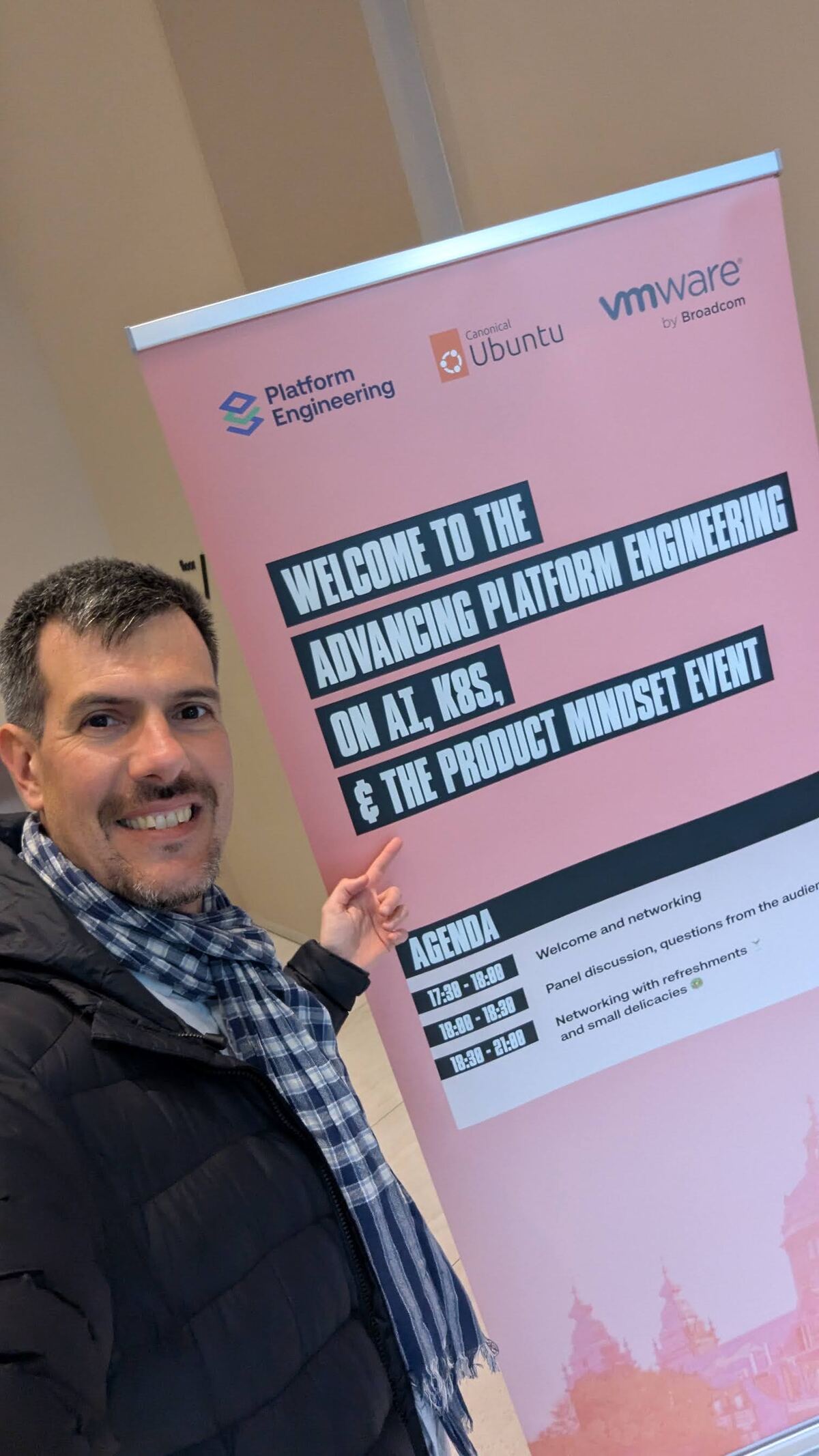
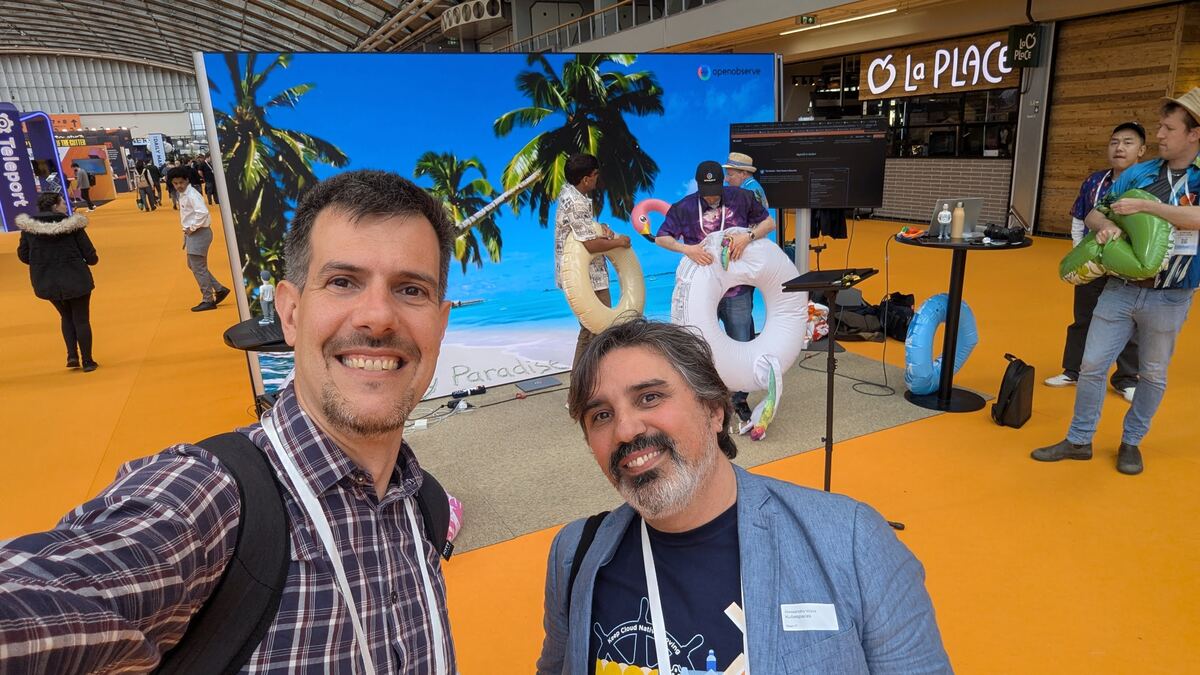
AI is everywhere right now, but the real magic happens when you see teams making it accessible and easy to deploy. I had a great time stopping by the Ubuntu booth at KubeCon EU 2026 Amsterdam to catch up with Emre, Field Engineering Manager at Canonical, and see firsthand how they are bridging the gap between AI and Kubernetes.
The Demo: Single-Command Inference
We dove into a fantastic demo running on a Lenovo box with a built-in GPU. What really stood out was the sheer simplicity of their approach: getting an inference snap up and running requires just a single command line.
From there, Emre showed me how you can use an AI agent to control a full workflow of Kubernetes workloads seamlessly. Instead of writing YAML manifests and kubectl commands, you describe what you want in natural language and the agent handles the orchestration.
This is a significant shift from the traditional approach where deploying AI inference requires:
- Configuring GPU drivers and container runtime
- Setting up Kubernetes with GPU operator
- Writing deployment manifests with resource limits
- Managing model serving frameworks
- Handling scaling and load balancing
With Canonical’s approach, steps 1 through 5 collapse into a single snap installation.
Edge AI with NVIDIA Ubuntu OS
It is incredibly exciting to see these edge boxes shipping with a customized Ubuntu OS from NVIDIA, allowing developers to get started immediately with tools that are fully open-source and license-free.
For teams evaluating edge AI deployment, this matters because:
- No licensing friction — everything is open source, no per-node or per-GPU fees
- Pre-configured GPU stack — the NVIDIA-customized Ubuntu includes drivers, CUDA, and container runtime out of the box
- Snap-based deployment — inference workloads are packaged as snaps, making updates and rollbacks trivial
- Kubernetes-native — the edge box integrates directly into your existing K8s cluster
This pairs well with what I have been writing about NVIDIA NIM for inference and GPU operator deployment. Canonical is solving the infrastructure layer so that the model serving layer can focus on what it does best.
Removing Friction for Builders
For me, this is where the industry needs to go. We need to remove the friction of infrastructure and complex setups so that builders can focus on what actually matters: innovating and solving real problems.
The traditional path to running AI on Kubernetes involves weeks of setup, GPU driver debugging, and YAML wrangling. When that collapses to a single command on a box that arrives ready to go, you fundamentally change who can build with AI and how fast they can iterate.
Learn More
Always inspiring to connect with the people who are actively lowering the barrier to entry for developers.
- Ubuntu: ubuntu.com
- Canonical: canonical.com
Related Posts
- NVIDIA NIM Support Matrix: Models, GPUs, and Profiles
- NVIDIA GPU Operator Setup Guide
- AI on Kubernetes: The First 90 Days
- KubeCon Europe 2026 in Numbers
- OpenObserve at KubeCon Europe 2026
About the Author
I am Luca Berton, AI and Cloud Advisor. I help enterprises deploy AI infrastructure from edge to cloud. Book a consultation.