Supporting Bazel multiple Python versions in one monorepo means one service can move to a new interpreter while another stays where it is, in the same build, with the same bazel test //.... In this tutorial I register Python 3.12 and 3.13 as hermetic toolchains with rules_python and Bzlmod, give each version its own pip lock file behind one hub, pin targets with the python_version attribute, run the same py_test under both interpreters, and check the result with bazel query, bazel cquery and bazel config. At the end I list the pitfalls I hit while building the demo.
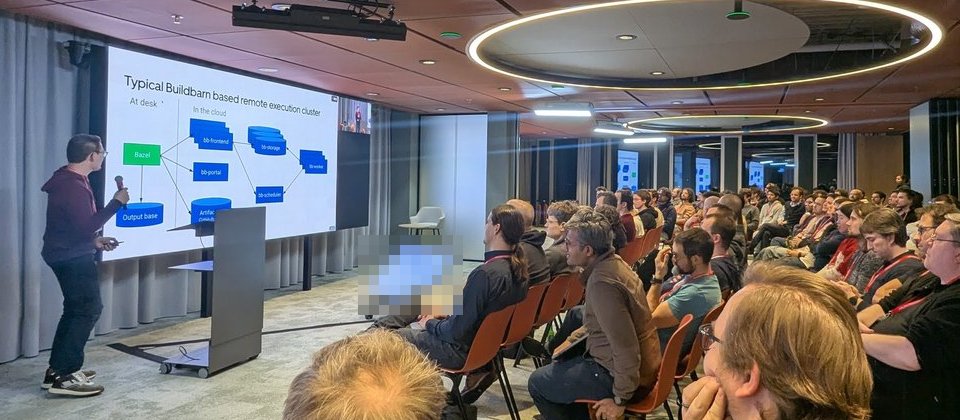
At the Uber x EngFlow Build Meetup in Amsterdam on 28 January 2026, the first talk was “Into the python-verse: supporting multiple python versions in a bazel monorepo” by Alex Preobrazhenskiy from Uber. I only photographed the title slide, so I can’t tell you how Uber does it. The title stayed with me, though, and this post is my own lab built from the rules_python documentation, not a summary of the talk.

The title slide of the Python-verse talk at the Build Meetup Amsterdam, the only photo I have of it.
Versions. Everything below ran on macOS (Apple silicon) with Bazel 9.2.0 started through Bazelisk 1.29.0, rules_python 2.3.4 (released 21 September 2026), the python-build-standalone interpreters 3.12.13 and 3.13.13 that rules_python 2.3.4 maps 3.12 and 3.13 to, and packaging 24.2 and 25.0 as the one PyPI dependency. The rules_python API for this has changed several times since 1.0, so check the version you install against the notes below.
How rules_python handles multiple Python versions
Three pieces work together:
- Toolchains. Each
python.toolchain(python_version = "X.Y")call inMODULE.bazelregisters a hermetic interpreter for that version. rules_python downloads it only when a target needs it. - A build setting.
@rules_python//python/config_settings:python_versiondecides which toolchain Bazel picks. The default comes frompython.defaults. - A transition. When a
py_binaryorpy_testsetspython_version, rules_python changes that build setting for the target and everything it depends on. Libraries don’t need their own version, they follow the binary or test that uses them.
The pip hub joins in through select(): one hub can hold a different wheel set per Python version and picks the one that matches the current setting.
Register two toolchains in MODULE.bazel
module(name = "pyverse_demo")

bazel_dep(name = "rules_python", version = "2.3.4")

python = use_extension("@rules_python//python/extensions:python.bzl", "python")

# The default for every target that doesn't ask for a version.
python.defaults(
    python_version = "3.12",
    python_version_env = "BAZEL_PYTHON_VERSION",
)

python.toolchain(python_version = "3.12")
python.toolchain(python_version = "3.13")
Line by line:
python.defaults(python_version = "3.12")sets the default version for the whole build. Thedefaultstag arrived in rules_python 1.3.0, and since 1.4.0 the olderis_default = Trueonpython.toolchainis ignored whendefaultsis set. The docs calldefaultsthe encouraged option, so I don’t useis_defaultat all.python_version_env = "BAZEL_PYTHON_VERSION"lets an environment variable override that default. I come back to this below.- Each
python.toolchainregisters one interpreter.3.12is amajor.minorversion, and rules_python resolves it to the patch release it knows about (3.12.13 in 2.3.4). You can pin a full3.12.13instead if you want the patch level inMODULE.bazeltoo.
Each toolchain also creates a repository named python_X_Y (@python_3_13), which you only need to bring in with use_repo if you reference the interpreter directly.
Per-version pip dependencies in one hub
Each Python version gets its own lock file. I generated them with uv so the demo needs no extra Bazel targets:
printf 'packaging==24.2\n' > req_3_12.in
printf 'packaging==25.0\n' > req_3_13.in
uv pip compile --python-version 3.12 --generate-hashes req_3_12.in -o requirements_3_12.txt
uv pip compile --python-version 3.13 --generate-hashes req_3_13.in -o requirements_3_13.txt
I pinned different packaging versions on purpose, so the test output shows which lock file a target got. Then both files go to the same hub:
pip = use_extension("@rules_python//python/extensions:pip.bzl", "pip")

# One hub, one lock file per Python version.
pip.parse(
    hub_name = "pip_deps",
    python_version = "3.12",
    requirements_lock = "//:requirements_3_12.txt",
)
pip.parse(
    hub_name = "pip_deps",
    python_version = "3.13",
    requirements_lock = "//:requirements_3_13.txt",
)
use_repo(pip, "pip_deps")
The hub_name docs spell out the rule: within a module, repeating the same hub_name with different python_version values groups those versions under one repository name, “the correct version will be automatically selected”. Your BUILD files say @pip_deps//packaging and never mention a version. python_version on pip.parse needs a matching python.toolchain() unless you give an interpreter explicitly.
Two naming notes from the 2.x docs. Don’t call a hub pypi: since 2.2.0 that name is reserved for the automatically generated unified hub, which routes between different hubs (for example, two teams with two resolutions) through the --@rules_python//python/config_settings:venv flag. That’s a different problem from multiple Python versions. And if your module isn’t always the root module, the docs recommend including the module name in the hub name.
Bazel generates the hub’s BUILD file. Here is what @pip_deps//packaging turned into:
pkg_aliases(
    name = "packaging",
    actual = {
        whl_config_setting(
            target_platforms = ("cp312_osx_aarch64",),
            version = "3.12",
        ): "pip_deps_312_packaging_py3_none_any_09abb1bc",
        whl_config_setting(
            target_platforms = ("cp313_osx_aarch64",),
            version = "3.13",
        ): "pip_deps_313_packaging_py3_none_any_29572ef2",
    },
)
One wheel repository per version, selected by Python version and platform.
Pin targets with python_version
Bazel 9 no longer ships native Python rules, so every BUILD file loads them from rules_python. In app/BUILD.bazel:
load("@rules_python//python:py_library.bzl", "py_library")
load("@rules_python//python:py_test.bzl", "py_test")

py_library(
    name = "versioninfo",
    srcs = [
        "__init__.py",
        "versioninfo.py",
    ],
    deps = ["@pip_deps//packaging"],
)

# Same source, same deps, two interpreters.
[
    py_test(
        name = "versioninfo_test_" + v.replace(".", "_"),
        srcs = ["versioninfo_test.py"],
        main = "versioninfo_test.py",
        python_version = v,
        env = {"EXPECTED_PYTHON": v},
        deps = [":versioninfo"],
    )
    for v in ["3.12", "3.13"]
]

# Not pinned: follows the default or the python_version flag.
py_test(
    name = "versioninfo_test_default",
    srcs = ["versioninfo_test.py"],
    main = "versioninfo_test.py",
    deps = [":versioninfo"],
)
The library has no version. The list comprehension creates versioninfo_test_3_12 and versioninfo_test_3_13 from one source file, which is the simplest way to run the same test under two interpreters. In a real repo I’d wrap it in a small macro.
If you find older examples, two styles are deprecated since rules_python 1.1.0: loading py_test from @python_versions//3.11:defs.bzl, and the wrappers in //python/config_settings:transitions.bzl. Both are now aliases of the regular rules. Load the regular rules and set python_version.
versioninfo.py reports what it runs on:
import sys

import packaging
from packaging.version import Version


def describe():
    return {
        "python": "%d.%d.%d" % sys.version_info[:3],
        "packaging": packaging.__version__,
        "executable": sys.executable,
        "base_prefix": sys.base_prefix,
    }


def at_least(minimum):
    return Version("%d.%d" % sys.version_info[:2]) >= Version(minimum)
The test prints describe() and asserts that the interpreter matches EXPECTED_PYTHON, defaulting to 3.12 when the variable isn’t set.
Run the same py_test under two interpreters
bazel test //app:all --test_output=allTrimmed output:
{'python': '3.12.13', 'packaging': '24.2', 'executable': '.../bazel-out/darwin_arm64-fastbuild/bin/app/versioninfo_test_3_12.runfiles/_main/app/_versioninfo_test_3_12.venv/bin/python3', ...}
{'python': '3.13.13', 'packaging': '25.0', 'executable': '.../bazel-out/darwin_arm64-fastbuild-ST-9d3588d462b9/bin/app/versioninfo_test_3_13.runfiles/_main/app/_versioninfo_test_3_13.venv/bin/python3', ...}
{'python': '3.12.13', 'packaging': '24.2', 'executable': '.../bazel-out/darwin_arm64-fastbuild/bin/app/versioninfo_test_default.runfiles/_main/app/_versioninfo_test_default.venv/bin/python3', ...}
//app:versioninfo_test_3_12                                              PASSED in 0.8s
//app:versioninfo_test_3_13                                              PASSED in 0.8s
//app:versioninfo_test_default                                           PASSED in 0.7s

Executed 3 out of 3 tests: 3 tests pass.
Each test got the interpreter and the packaging version from its own lock file. Look at the output paths: the 3.13 test lives under darwin_arm64-fastbuild-ST-9d3588d462b9, a separate output directory created by the transition. The 3.12 test asks for the default version, so it stays in the normal darwin_arm64-fastbuild directory. Every extra version you pin means a second copy of the libraries that test depends on in the action graph, built and cached separately.
Switch the default with a flag or an environment variable
Unpinned targets follow the build setting, so you can run them under another version from the command line:
bazel test //app:versioninfo_test_default //app:versioninfo_test_3_12 \
  --@rules_python//python/config_settings:python_version=3.13 \
  --test_env=EXPECTED_PYTHON=3.13 --test_output=all
The unpinned test ran on 3.13.13 with packaging 25.0. The pinned versioninfo_test_3_12 still ran on 3.12.13: the attribute on the target wins over the flag. That’s what you want for a gradual migration, where a CI job can test everything unpinned against the next version while pinned services stay put.
python_version_env does the same through the environment, which is handy in a CI matrix:
BAZEL_PYTHON_VERSION=3.13 bazel test //app:versioninfo_test_default \
  --test_env=EXPECTED_PYTHON=3.13
Either way, switching back and forth has a cost. Bazel printed this when I dropped the flag again:
WARNING: Build option --@@rules_python+//python/config_settings:python_version has changed, discarding analysis cacheOn a large repo, give each Python version its own CI job (or its own output base) instead of alternating in one Bazel server.
What bazel query and cquery show
bazel query works on the unconfigured graph, so it’s good for inventories:
$ bazel query 'attr(python_version, "3.13", //...)'
//app:versioninfo_test_3_13

$ bazel query 'labels(deps, //app:versioninfo)'
@pip_deps//packaging:packaging
The first is the list of targets already pinned to 3.13, which is useful for tracking a migration. The second shows the limit of query: it sees only the version-agnostic hub alias, not which wheel will be used.
bazel cquery resolves the select() per configuration:
$ bazel cquery 'kind("py_library", deps(//app:all))'
//app:versioninfo (276a5bd)
//app:versioninfo (2d89340)
@@rules_python++pip+pip_deps_313_packaging_py3_none_any_29572ef2//:pkg (276a5bd)
@@rules_python++pip+pip_deps_312_packaging_py3_none_any_09abb1bc//:pkg (2d89340)
...
The same library appears twice, once per configuration, each with its own wheel. To see what differs between the two configurations, pass both IDs to bazel config:
$ bazel config 2d89340 276a5bd
Displaying diff between configs 2d89340 and 276a5bd
FragmentOptions user-defined {
  @@rules_python+//python/config_settings:python_version: null, 3.13
}
null is the default (3.12 here). To confirm which interpreter a target resolved to, ask toolchain resolution:
$ bazel cquery //app:versioninfo_test_3_13 \
    --toolchain_resolution_debug='@@bazel_tools//tools/python:toolchain_type'
...
ToolchainResolution:   Selected @@rules_python++python+python_3_13_aarch64-apple-darwin//:python_runtimes to run on execution platform @@platforms//host:host
Hermeticity: which interpreter actually ran
My laptop has Python 3.13.3 from pyenv on its PATH. The 3.13 test ran 3.13.13, so it didn’t touch the host interpreter. Two details from the output above:
sys.executableis apython3inside a.venvin the test’s runfiles. Since rules_python 2.0.0, binaries (and tests, as the paths show) are venv-based by default on Linux and macOS with Bazel 8 or later.sys.base_prefixpointed into Bazel’s repository cache, at the same directory thatexternal/rules_python++python+python_3_13_aarch64-apple-darwinlinks to. That’s the python-build-standalone runtime rules_python downloaded and checked against its known SHA-256.
The wheels are pinned by hash in the lock files, and Bazel writes the module resolution to MODULE.bazel.lock. Commit that file along with the requirements files.
Pitfalls I hit
A version you never registered can still work. I pinned a throwaway py_binary to 3.11 without a 3.11 toolchain in my MODULE.bazel, expecting an error. It built and printed 3.11.15. rules_python’s own MODULE.bazel registers 3.11 as its default, so that toolchain is visible to the whole module graph. A target pinned to 3.14, which nobody registered, failed as expected:
ERROR: ... While resolving toolchains for target //pitfall:hello_314 (705eaeb): No matching toolchains found for types:
  @@bazel_tools//tools/python:toolchain_type
Restricting the versions broke the build. The documented fix for unexpected versions is python.override(available_python_versions = [...]). With only ["3.12.13", "3.13.13"], every target failed, including my own:
module extension @@rules_python+//python/extensions:python.bzl%python does not generate repository "python_3_11", yet it is imported as "python_3_11" in the usage at https://bcr.bazel.build/modules/rules_python/2.3.4/MODULE.bazel:41:23With rules_python 2.3.4 you have to keep its default version in that list. I removed the override and use the bazel query 'attr(python_version, ...)' inventory as a CI check instead.
The pip hub fails before the toolchain does. With the 3.11 pin on a target that depends on @pip_deps//packaging, analysis stopped at the hub, because no lock file exists for 3.11:
The current build configuration's Python version doesn't match any of the Python
wheels available for this distribution. This distribution supports the following Python
configuration settings:
    //_config:is_cp312_osx_aarch64
    //_config:is_cp313_osx_aarch64
Adding a version means a toolchain and a pip.parse entry for every hub the target uses.
No load(), no rule. Without the load line, Bazel 9 fails with name 'py_binary' is not defined (did you mean 'cc_binary'?).
The implicit __init__.py warning. My first run printed a long warning per target: rules_python still creates missing __init__.py files, calls that behaviour deprecated and will disable it by default. I added an empty app/__init__.py to srcs and opted in to the new behaviour:
rules_python_config = use_extension("@rules_python//python/extensions:config.bzl", "config")
rules_python_config.explicit_init_py(default = True)
Disk usage. On my machine the Bazel install base, the two interpreters, the wheels and the toolchain repositories took about 530 MB under the output user root (177 MB of it the Bazel install base), plus 58 MB for the Bazel binary that Bazelisk downloaded. Each extra Python version adds an interpreter download and another set of configured targets. bazel clean --expunge removes the output base. The repository cache under the output user root survives that, so delete it yourself when you’re done.
My take
Pinning per target with python_version is the right default for a monorepo upgrade: the library code stays version-agnostic, the binaries and tests choose, and bazel query gives you a migration tracker for free. I’d keep the list of supported versions short, two at a time if you can, because every version adds another configured copy of each shared library to analysis and the cache, and the pip hub must stay complete for each of them. I’d also make “which versions are allowed” a reviewed file in the platform team’s hands, since a dependency can make an extra version available without anyone noticing.