BASE in Amsterdam ran another edition of its “Let’s Touch BASE” series: “Get Your Taxes Right as a Small Business Owner.” Running a business gives you freedom, but VAT, income tax, deductions, compliance, and financial planning are exactly the parts of that freedom nobody enjoys figuring out alone — which is the entire premise of BASE’s small, workshop-format events over the larger BASE Conference format.
The Numbers Behind the Advice
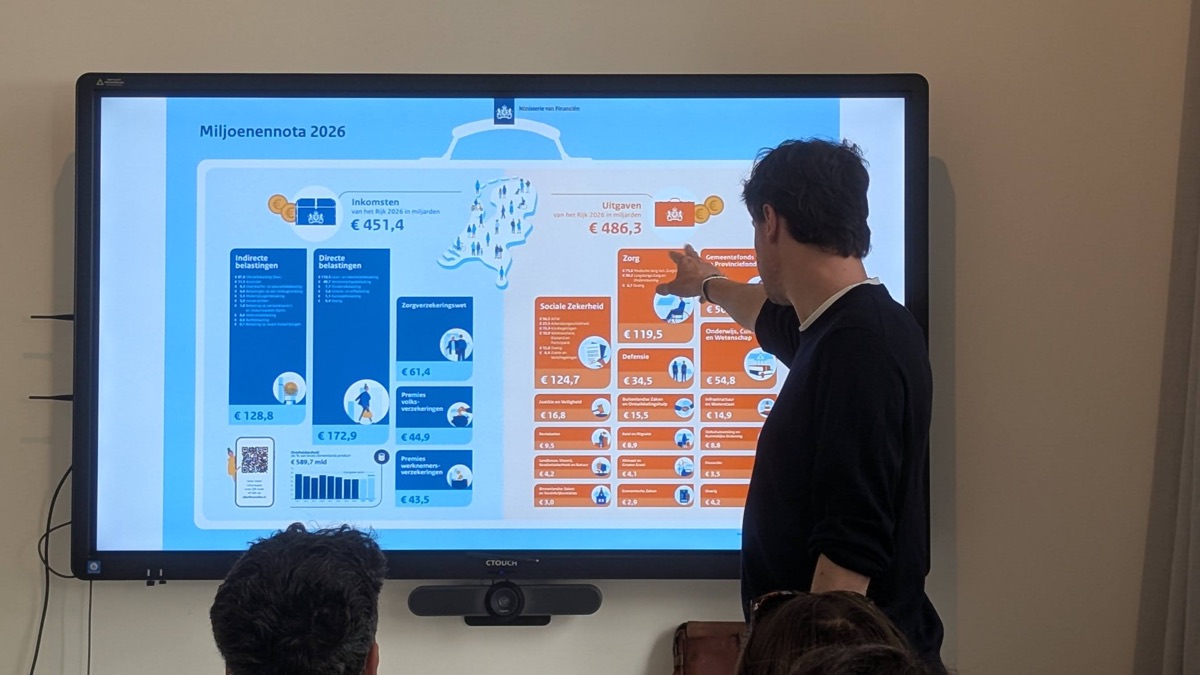
Mark Bastiaans opened with context most tax workshops skip entirely: the Dutch government’s own Miljoenennota 2026 (the annual budget memorandum) — €451.4 billion in income against €486.3 billion in spending, broken down by category. Starting there, rather than jumping straight to VAT mechanics, reframes the rest of the session correctly: your quarterly BTW return is not an arbitrary hassle, it is one small piece of a system whose inputs and outputs are entirely public and auditable. Understanding the shape of that system makes the specific rules easier to reason about, not just memorize.
Workshop: Smarter Tax Decisions for Small Business Owners
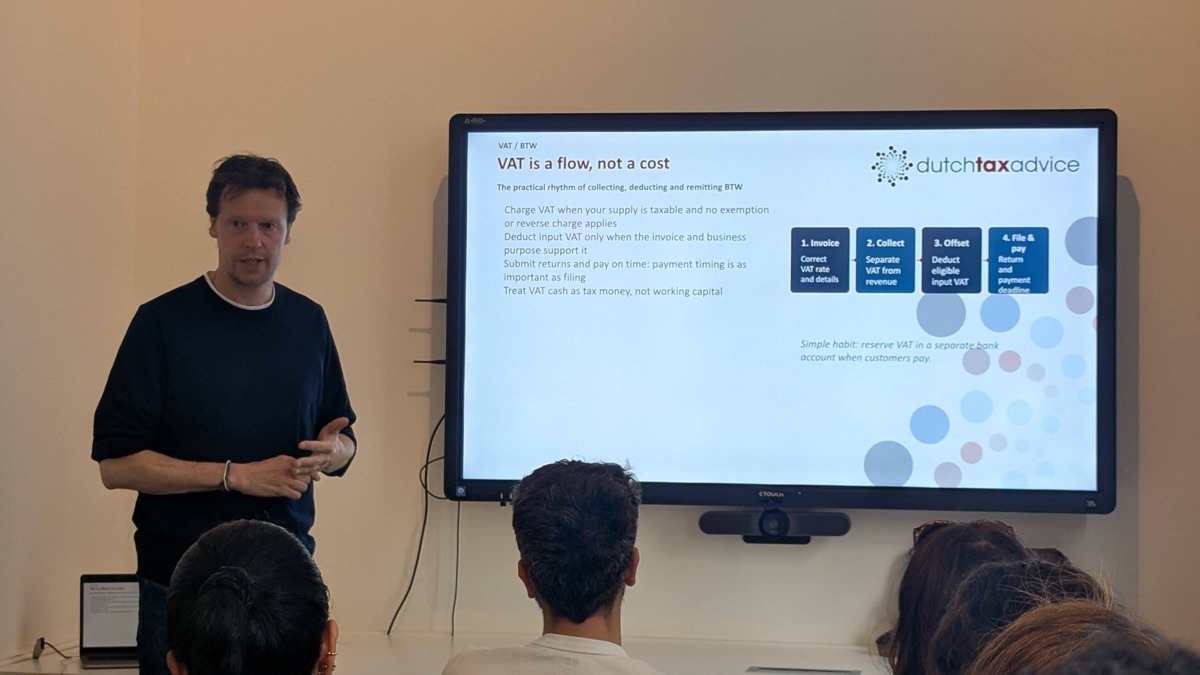
Mark Bastiaans and Dutchtaxadvice.nl led the core workshop, and the single reframing that mattered most was right there on the slide: VAT is a flow, not a cost. The practical rhythm broken down into four steps:
- Invoice — charge VAT at the correct rate, with the correct details, whenever a supply is taxable and no exemption or reverse charge applies.
- Collect — separate VAT from revenue the moment it arrives, not at filing time.
- Offset — deduct input VAT only when the invoice and the business purpose actually support it.
- File and pay — submission and payment timing both matter; a correct return filed late is still a problem.
The simple habit that ties it together: reserve VAT in a separate bank account the moment a customer pays. Treating VAT cash as tax money rather than working capital is the single biggest mindset shift that prevents a Q4 cash crunch caused by spending money that was never really yours.
Beyond VAT mechanics, the session covered the broader territory small business owners consistently get wrong: common tax and compliance mistakes, deductions that go unclaimed simply because nobody flagged them, and how to structure business finances so tax obligations do not become a surprise every quarter.
Profit Is Not the Same as Cash
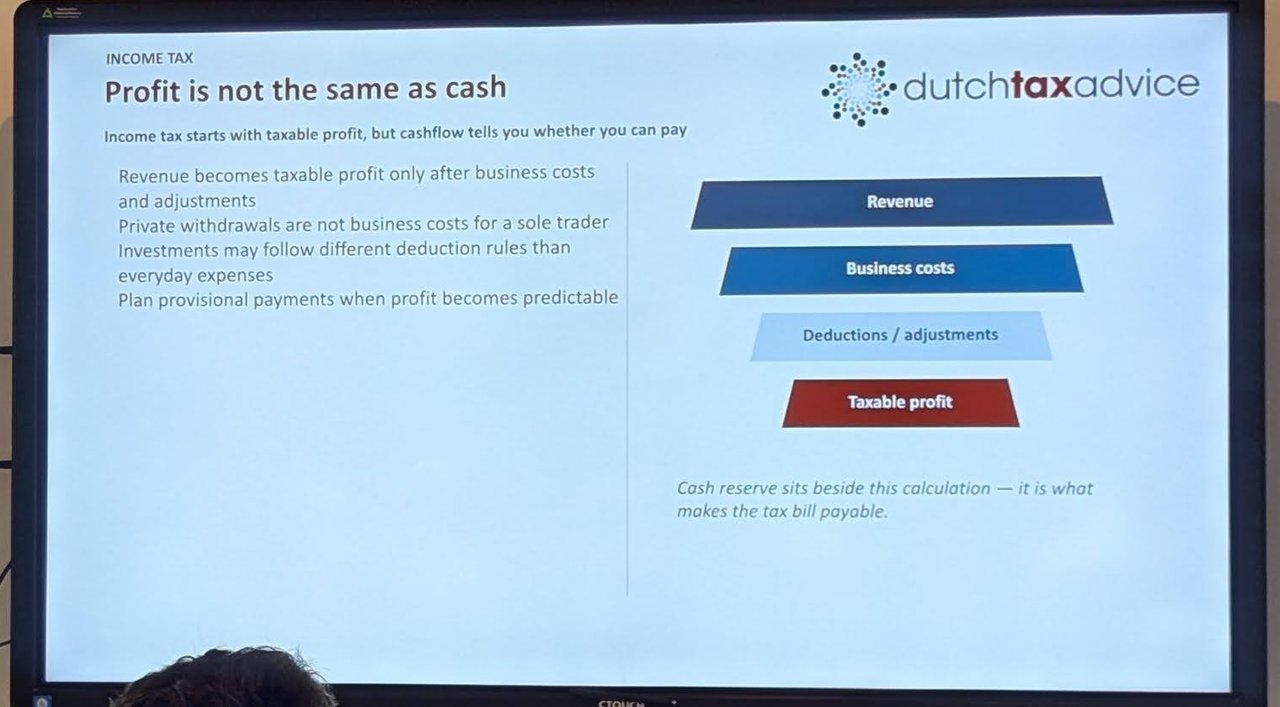
The income tax slide: revenue, business costs and deductions or adjustments lead to taxable profit, with a cash reserve beside the calculation.
On the income tax side, the slide made the same point as the VAT one from a different angle: income tax starts with taxable profit, but cashflow tells you whether you can pay. Revenue becomes taxable profit only after business costs and adjustments, private withdrawals are not business costs for a sole trader, investments may follow different deduction rules than everyday expenses, and provisional payments should be planned once profit becomes predictable.
Deductible, Private or Mixed
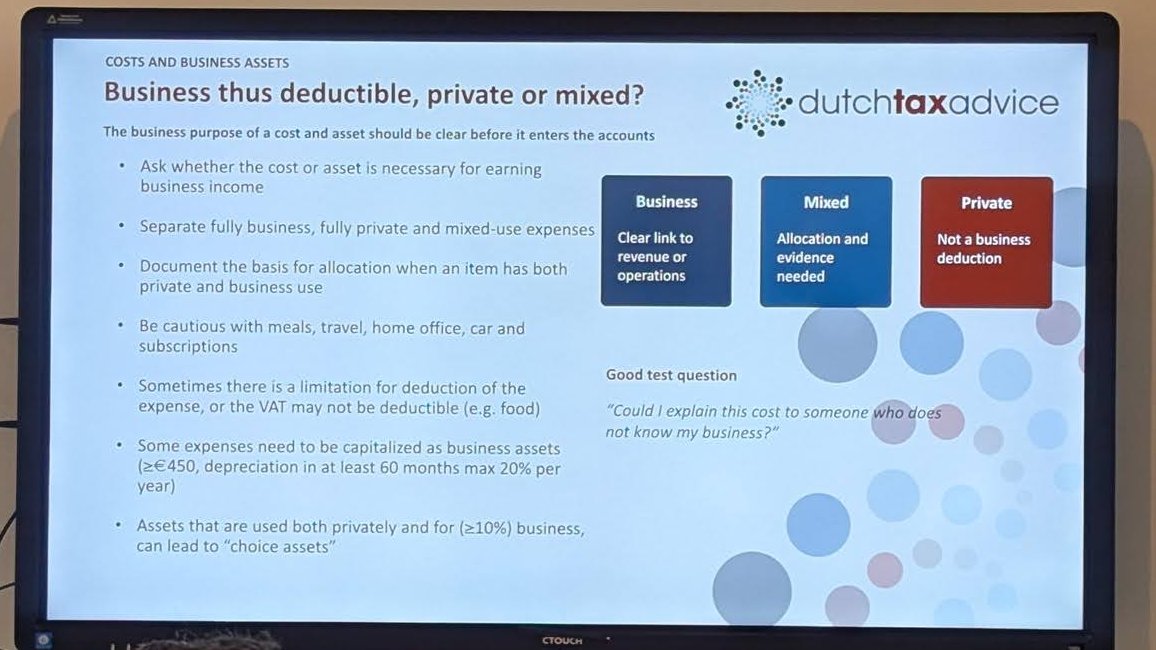
The deductions slide: business, mixed and private, plus a test question.
This slide gave a useful test question: “Could I explain this cost to someone who does not know my business?” It also listed specifics: be cautious with meals, travel, home office, car and subscriptions; some expenses must be capitalised as business assets (from €450, depreciated over at least 60 months at a maximum of 20% per year); and assets used both privately and for at least 10% for business can lead to “choice assets”.
International Clients and VAT
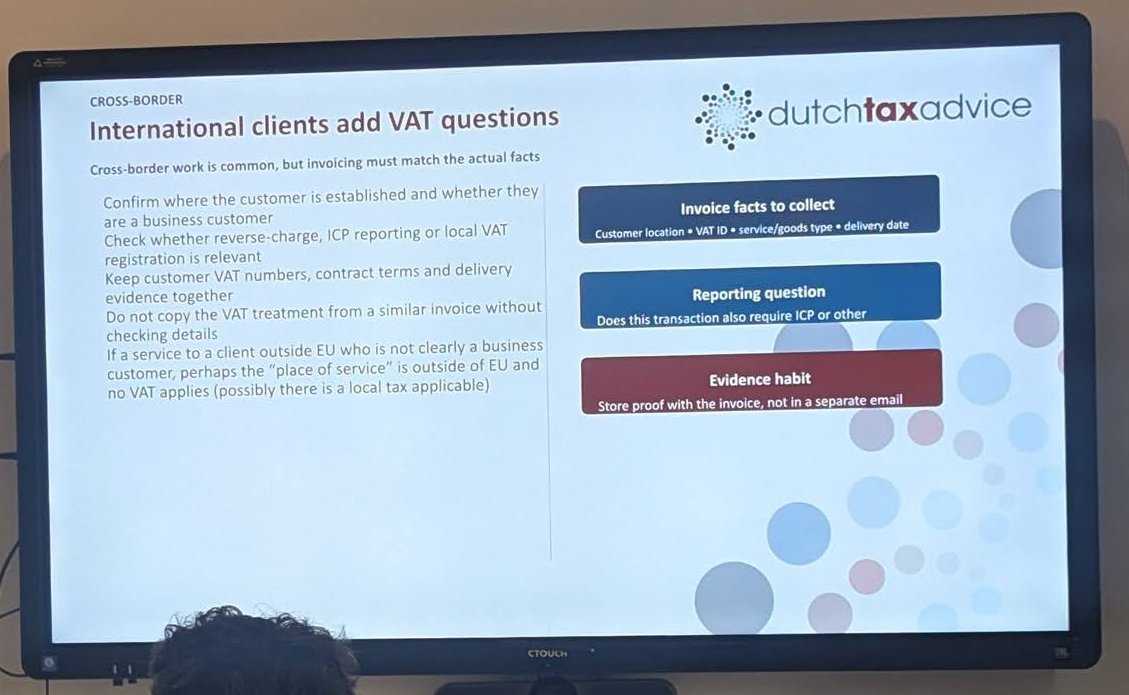
The cross-border slide: invoice facts, the reporting question and the evidence habit.
For freelancers with clients abroad, the invoice facts to collect were customer location, VAT ID, type of service or goods and delivery date. The slide’s checks: confirm where the customer is established and whether they are a business, check whether reverse-charge, ICP reporting or local VAT registration is relevant, and never copy the VAT treatment from a similar invoice without checking details. For a service to a client outside the EU who is not clearly a business customer, the “place of service” may be outside the EU so no VAT applies (possibly with a local tax instead). The evidence habit: store proof with the invoice, not in a separate email.
Fireside Chat: Building Through Change, Curiosity, and Co-Creation
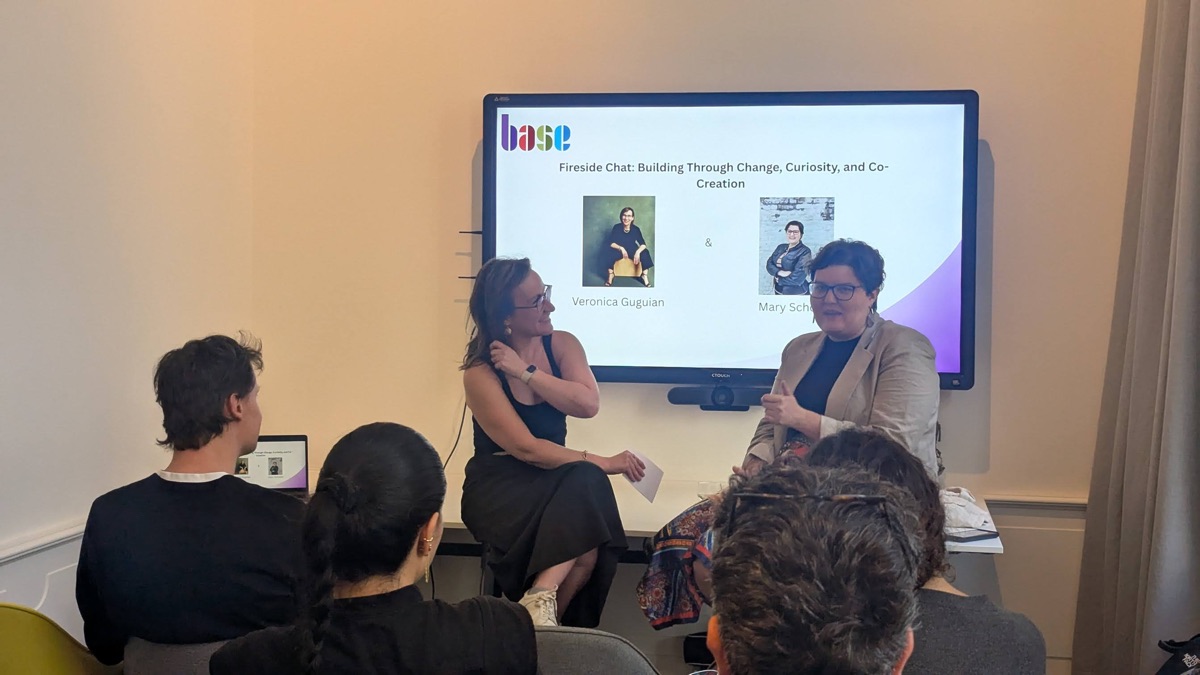
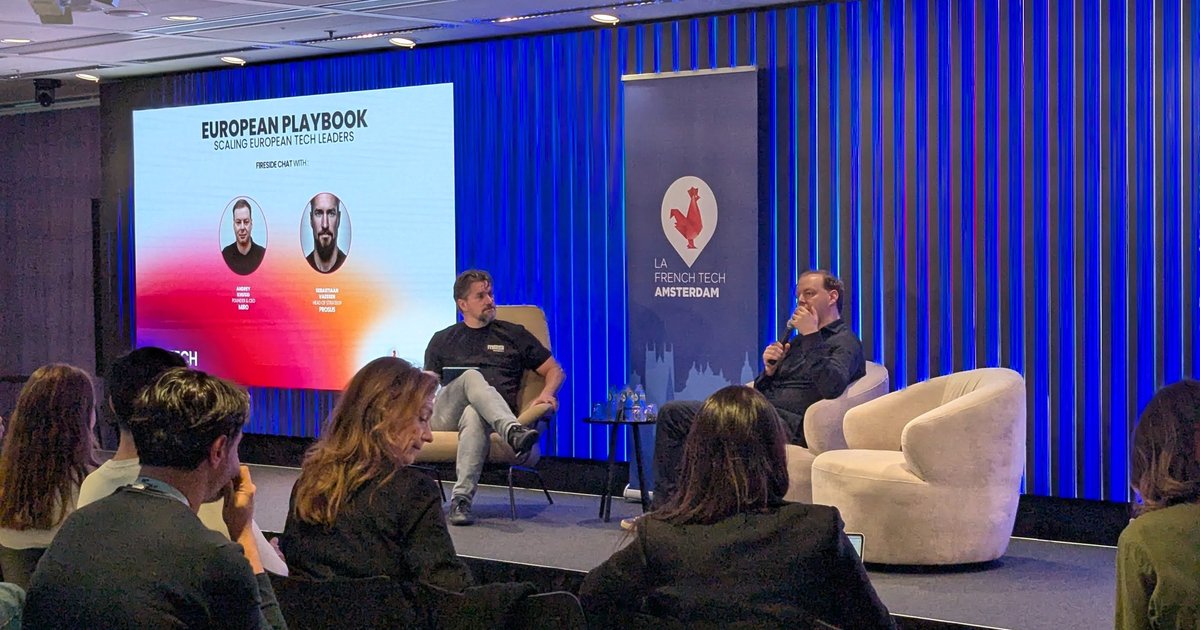
The evening closed with a fireside conversation between Veronica Guguian and Mary Schooler — a deliberate contrast to the structured workshop that preceded it. Mary’s path ran from launching a side business in the United States, to studying Global Health in China, to leading technology and implementation projects for a hospital system, to building a freelance career in Belgium. Today she works with Stickydot, a participatory co-creation consultancy built around a distinction worth sitting with: helping organizations build solutions with people, rather than simply for them.
The throughline of the conversation was that entrepreneurship rarely follows the linear path job postings imply. Moving between countries and industries is not a detour from a “real” career — for a lot of founders and freelancers, it is the actual mechanism by which new opportunities and collaborations show up. Curiosity and community did more for Mary’s trajectory than any single deliberate five-year plan could have.
Why the Combination Works
Pairing a hard compliance workshop with a fireside chat about nonlinear careers is a better format than either alone. The tax session gives you something you can act on the next morning — open a separate VAT account, review last quarter’s deductions. The fireside chat gives you the longer-horizon reminder that the structure you build around your finances is in service of a business path that is allowed to look nothing like anyone else’s.
Thanks to BASE, Dutchtaxadvice.nl, Mark Bastiaans, Veronica Guguian, Mary Schooler, and Stickydot for putting together an evening that was equal parts practical and genuinely useful for anyone running a small business, freelancing, or navigating the Dutch system as an expat entrepreneur.
Related Reading
- BASE Conference 2024: AI and Digital Equity
- CRA for Startups and SMEs: Compliance Guide
- Meeting JT Foxx: Lessons on Scaling a Tech Business
About the Author
I am Luca Berton, AI and Cloud Advisor. I work with founders, freelancers, and enterprises on technology strategy and platform engineering. Book a consultation.