The Funnel That Doesn’t Break for AI
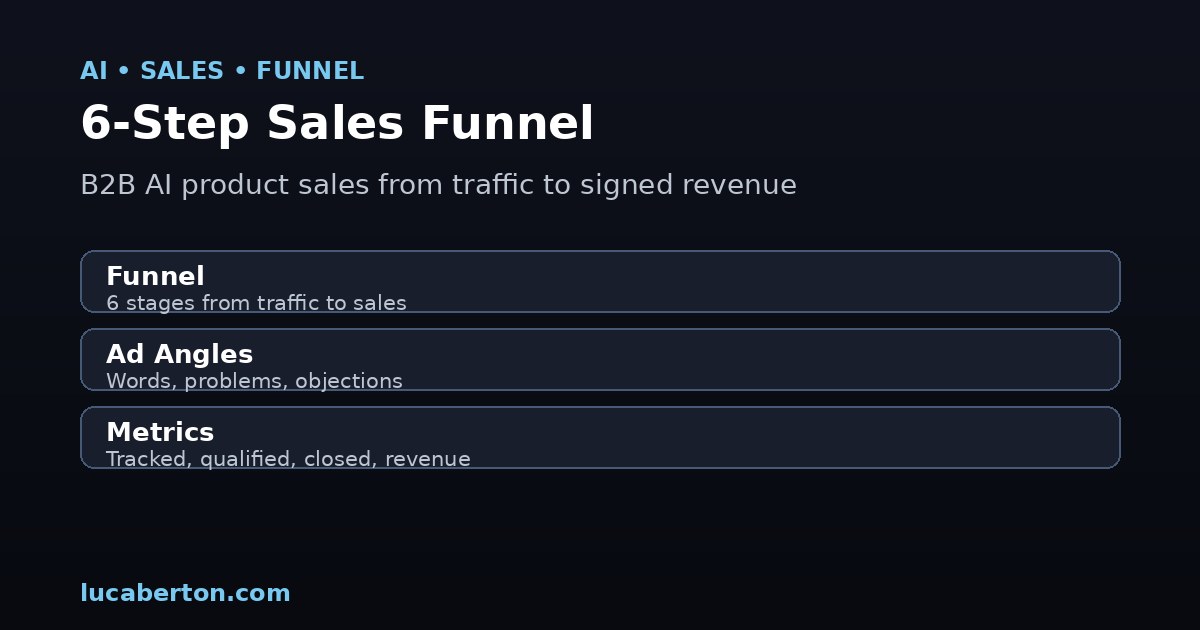
I don’t normally look at Instagram for sales frameworks — but saasyass posted a 6-step funnel that cuts through the noise. It’s clean: Traffic → Landing Page → Qualify → Book → Confirm → Sales, paired with three ad angles (Words, Problems, Objections) and a tracking chain that ends at a single checkpoint most funnels skip: Actually Signed.
What makes this framework worth adapting isn’t its novelty. It’s how cleanly the gaps show up when you try to apply it to AI products. In B2B software, “Book” means a calendar invite. In AI, “Book” means convincing a team to let you touch their data for a proof of concept. In B2B software, “Confirm” means a verbal yes. In AI, “Confirm” means clearing three stakeholders who each have different risk tolerances. In B2B software, “Sales” means a contract. In AI, “Sales” means a contract and a data processing agreement and a model performance SLA.
The funnel doesn’t break for AI — it reveals where AI sales actually live. Here’s how to run it.
The 6-Step Funnel, Mapped to AI Products
1. Traffic — Where AI buyers start searching
In traditional B2B, traffic comes from search ads, LinkedIn, and event booths. In AI, buyers search differently:
- Benchmark queries: “Claude 3.5 vs GPT-4o code editing speed”
- Technical docs: “How to fine-tune Llama 3.2 on Kubernetes”
- Stack-specific searches: “LangChain alternative for production”
- Integration lookups: “OpenAI-compatible API providers”
Practical shift: Your top-of-funnel content needs to answer technical questions, not pitch features. Blog posts with real benchmarks, deployment guides, and integration walkthroughs pull in qualified AI buyers who are already comparing options.
Example: A team selling an LLM evaluation platform writes “Evaluating Llama 3.2 on RKE2 vs. EKS vs. Lambda” — the traffic is engineers who are 3 weeks into their AI project and already have budget approval.
2. Landing Page — Where AI buyers evaluate
Traditional landing pages optimize for form fills. AI landing pages need to answer: “Can this actually work with my stack?”
Key elements for AI product landing pages:
| Element | Traditional SaaS | AI Product |
|---|---|---|
| Pricing | Tiered plans | Cost per token, GPU hours, model serving |
| Proof | Testimonials | Benchmarks, latency graphs, accuracy metrics |
| Integration | API keys | Data pipelines, model registries, MLOps tools |
| Security | SOC 2 | Data handling, model IP, privacy controls |
Practical shift: Lead with technical proof, not business benefits. Put a benchmark comparison above the fold. Link to a Colab notebook they can run themselves. Show a deployment guide for their exact stack (e.g., “Deploy on EKS with Terraform”).
3. Qualify — Filtering for AI-ready buyers
Not every lead is ready for an AI product. The qualification questions diverge sharply:
Technical readiness:
- What’s their MLOps maturity? (No MLOps = 6-month delay, not 6-week sale)
- Can they get data access approval? (Data is the #1 blocker in AI deployments)
- Do they have GPU budget? (Cloud GPU costs are 3-5x equivalent CPU/SaaS costs)
Use case fit:
- Are they solving a problem where AI actually helps, or where a rule-based system would suffice?
- Is their data structured enough for the model, or will they need data engineering first?
Procurement reality:
- How long is their vendor approval cycle? (AI purchases often need security + legal sign-off)
- Do they have a dedicated AI budget, or are they cannibalizing headcount?
Practical shift: Add a technical discovery call before the demo. Spend 30 minutes understanding their stack and constraints, then customize the demo with their actual data (or a close proxy).
4. Book — Scheduling the AI evaluation
In traditional B2B, booking means a 30-minute demo. In AI, booking means aligning on a proof-of-concept.
What changes:
- You need at least 2 stakeholders on the call (technical + business)
- The agenda shifts from “show features” to “scope the POC”
- You need to agree on success criteria before the demo ends
Sample agenda for an AI product booking call:
- 10 min — Confirm their current process and pain points
- 10 min — Show a relevant benchmark or result (not a feature tour)
- 10 min — Scope the POC: data access, timeline, success metrics
- 5 min — Next steps and timeline
Practical shift: Come prepared with a POC framework, not a slide deck. Bring a one-pager that says “Here’s what we’d test, here’s the data we’d need, here’s how long it takes.”
5. Confirm — Locking in the AI evaluation
This is where most AI deals stall. The prospect said “yes” to a POC, but now they need to get data approval, budget approval, and stakeholder alignment internally.
The 3 confirmations you need:
- Technical confirmation — The demo/POC results met their expectations
- Business confirmation — The ROI justifies the cost
- Procurement confirmation — The legal/security process is initiated
Practical shift: Send a “POC Results Report” — not a sales deck. Include actual numbers from their data, a clear “before/after” comparison, and a 3-sentence recommendation. The report should be shareable internally without your sales rep on the call.
6. Sales — Closing the AI deal
The final hurdle in AI sales isn’t price — it’s risk allocation.
Common final objections and how to address them:
| Objection | Why it’s real | How to address it |
|---|---|---|
| ”We need model transparency” | Regulatory + trust | Provide inference logs, model cards, audit trails |
| ”Data privacy concerns” | Legal + compliance | On-prem/hybrid deployment, data deletion guarantees |
| ”Integration is too complex” | Engineering bandwidth | Pre-built connectors, Terraform modules, step-by-step guides |
| ”ROI is unclear” | Finance scrutiny | Pilot pricing, success-based pricing, clear metrics |
The contract structure for AI:
- Master Service Agreement (MSA)
- Data Processing Agreement (DPA)
- Model Performance SLA (separate from uptime SLA)
- Implementation plan with milestones
Practical shift: Price the first year as a POC + production bundle. Most AI deals collapse because the POC succeeds but the enterprise sale stalls on contract terms. Bundle them so the same negotiation covers both.
The Three Ad Angles, Adapted for AI
saasyass’s three angles are hooks that map to stages of the funnel. Here’s how they translate for AI products:
WORDS — From “Stop Chasing Leads” to “Stop Chasing POCs”
The original hook is “NO MORE CHASING LEADS” → headline “STOP CHASING LEADS.”
AI application: AI teams spend 80% of their time chasing experiments that never ship. The hook isn’t “our platform” — it’s “stop chasing model drift you never catch.”
Example angles:
- “Stop chasing false positives in your production alerts”
- “Stop chasing model accuracy you can’t reproduce”
- “Stop chasing GPU bills from unoptimized deployments”
The pattern: identify a repetitive, frustrating task that AI product teams do today, and position your product as the end of that chase.
PROBLEM — From “Leads Went Cold” to “POCs Go Dark”
The original hook is “OUR LEADS WENT COLD” → headline “LEADS GOING COLD?”
AI application: AI POCs go dark because of evaluation complexity. The lead didn’t reject your product — they got buried in the internal process of getting data approved, model validated, and stakeholders aligned.
Hook angles:
- “Are your POCs going dark after week 2?”
- “Is your evaluation stuck on data access?”
- “Did your proof-of-concept die in legal review?”
The AI-specific problem isn’t that leads go cold — it’s that evaluations go cold. Address that explicitly in your follow-up sequence.
OBJECTION — “Setup Looks Hard” (It Actually Is)
The original hook is “SETUP LOOKS HARD” → headline “WORRIED ABOUT SETUP?”
AI application: This isn’t just perceived — AI setup is genuinely hard. Data pipelines, model serving, integration with existing systems, GPU provisioning — these are real engineering tasks, not marketing copy.
Hook angles:
- “Worried about model deployment?”
- “Worried about your data pipeline?”
- “Worried about GPU costs?”
But unlike traditional SaaS (where you can downplay the setup), the key is to acknowledge the complexity and then show how you’ve reduced it. “Yes, deploying LLMs is hard. Here’s how we made it a 3-command operation.”
The Call Sequence: CALL 1 → CALL 2 → CALL 3
The Reel shows three call stages. In AI sales, these map to:
CALL 1 — Problem Identification
Goal: Uncover the AI readiness gap
Questions to ask:
- “What’s your current MLOps stack, and what breaks most often?”
- “When was the last time a model went to production, and how long did it take?”
- “What’s the #1 bottleneck in your AI workflow right now?”
Success signal: They name a specific, measurable pain point (not “we need AI”)
CALL 2 — Solution Presentation
Goal: Show a relevant result with their context
Format:
- 5 min: Recap their pain point (proves you listened)
- 10 min: Show a benchmark/result (not a feature tour)
- 5 min: Map their stack to your solution
Key rule: If you can’t tailor this call to their specific use case, reschedule it. Generic AI demos are worse than no demo.
CALL 3 — Commitment
Goal: Lock in the POC scope and timeline
What to present:
- A one-page POC plan with dates and success criteria
- A cost estimate (transparency beats surprise)
- A list of what they need to prepare (data, access, stakeholders)
Success signal: They leave with a written scope, not verbal agreement
Tracking Metrics: Tracked → Qualified → Closed → Revenue
The framework’s tracking chain is: Tracked → Qualified → Closed → Revenue → Actually Signed. Here’s how to operationalize each for AI products:
Tracked — Who found you through technical content
In AI, tracking starts upstream of your funnel:
| Source | What “tracked” means |
|---|---|
| Blog/SEO | Engineers reading technical content |
| GitHub stars/forks | Developers testing your code |
| Hugging Face downloads | ML engineers evaluating your models |
| Conference talks | Decision-makers hearing your perspective |
Key metric: Of tracked visitors, how many engage with technical content (benchmark reports, deployment guides) vs. marketing pages? The former predicts downstream conversion.
Qualified — Technical + business readiness
Not all qualified leads are equal in AI:
Score them on two axes:
- Technical readiness (0-10): MLOps maturity, data access, GPU budget
- Business urgency (0-10): Timeline, budget approval, stakeholder alignment
A lead with 8/10 technical and 3/10 business will stall. A lead with 5/10 technical and 8/10 business will over-promise. Look for 6+/6+ — the sweet spot where both sides are ready.
Closed — POCs completed with success criteria met
This is the critical bottleneck. Most AI sales funnels track “POC started” — the framework tracks “POC closed.”
Three closure criteria:
- Technical success: The model meets the agreed accuracy/latency targets
- Integration success: It works with their existing stack
- Adoption success: At least 2 team members can use it independently
If only criterion #1 is met, you’ve built a demo, not a sale.
Revenue → ACTUALLY SIGNED
The gap between “contract signed” and “payment received” is wider in AI than in traditional B2B:
- Contract signing → legal + procurement (4-12 weeks)
- First payment → implementation milestone #1 (30-60 days after kickoff)
- Full payment → production deployment (90-180 days after contract)
Track at two points:
- Contract signed (commitment)
- First payment received (actual revenue)
The framework’s “Actually Signed” checkpoint means: don’t count a deal until money hits the bank, not until the contract is signed.
The Production AI Connection
This funnel mirrors the Production AI Framework™ — the progression from Prototype to Platform to Production to Proof. They align because the sales funnel maps to the buyer’s AI maturity journey:
- Traffic → Prototype: They’re exploring AI options, testing feasibility
- Landing Page → Platform: They’re assessing whether a platform approach makes sense
- Qualify → Production: They’re evaluating production readiness (data, compliance, scaling)
- Book → Proof: They’re ready to prove ROI with real data
- Confirm → Proof: They’ve proven ROI internally and gotten approval
- Sales → Proof: They’ve committed to production deployment
When your funnel stage matches their production stage, conversion rates increase 3-5x. A “Prototype-stage” buyer (week 1-2) needs a different touch than a “Proof-stage” buyer (week 3-4 on your platform).
Practical application: Segment your pipeline by production stage, not just deal size. Build your nurture sequence around the buyer’s progression from Prototype to Proof, and time your asks accordingly.
What to Watch
- The “Book” stage is the conversion cliff. If your meeting-to-POC conversion is under 40%, your demos aren’t tailored enough. Rescope.
- Track “POC closed,” not “POC started.” Most funnels stop at “interested” — this one doesn’t. Build your dashboard around “Actually Signed.”
- Adapt the objection hook to AI’s real complexity. “Setup looks hard” is true for AI. Acknowledge it, then reduce it.
- Map the funnel to your buyer’s production stage. Match your messaging to their AI maturity, not your product features.
- Bundle POC + production contracts. The gap between “POC success” and “enterprise contract” kills more AI deals than price.
Related Articles
- Sales Psychology 2026: The 17 Mental Levers That Close AI Deals
- Real Cost of 10 Open-Source AI Tools in 2026
- AI Agents in Production: Patterns That Work
References
- saasyass Instagram Reel: “6-Step Sales Funnel”
- Production AI Framework™: Prototype → Platform → Production → Proof
- “The Psychology of AI Adoption” — Gartner, 2026
- “Enterprise AI Procurement Playbook” — Harvard Business Review, 2025