AWS Summit Amsterdam 2026 brought thousands of cloud practitioners together at the RAI Convention Centre. The theme was clear: AI is no longer experimental — it is solving real problems at scale.
Keynote: You Need the Right Tools
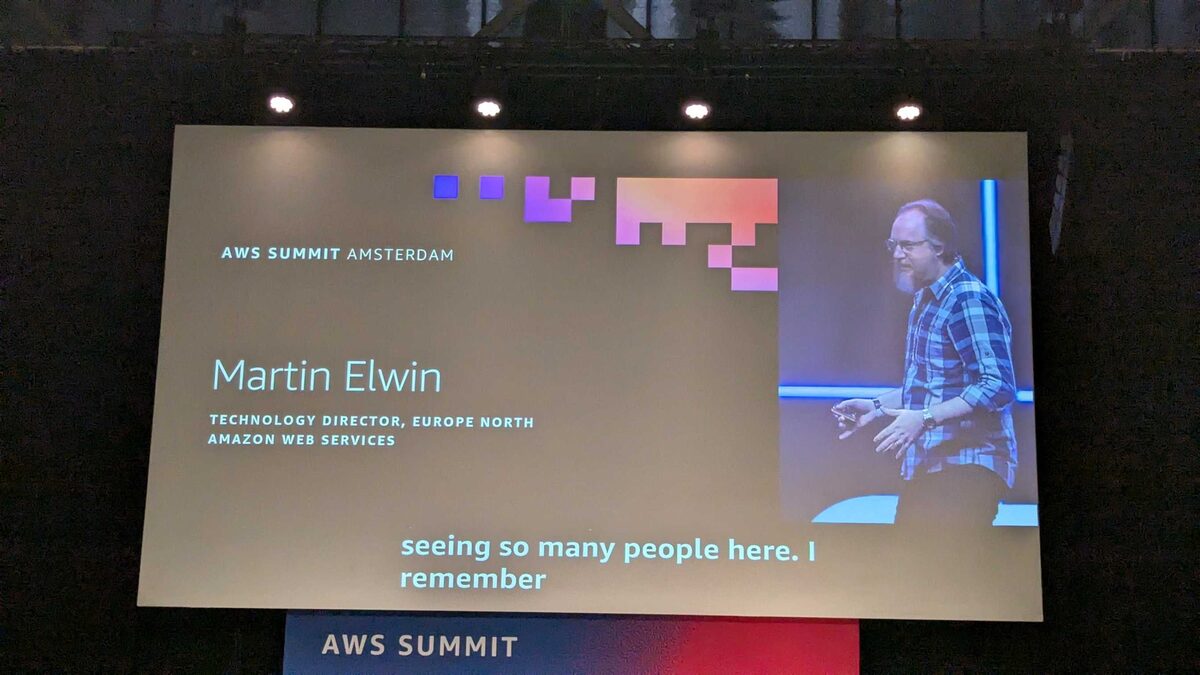
Martin Elwin, Technology Director for Europe North at Amazon Web Services, opened the keynote with a message that resonated throughout the day: “You need the right tools.”
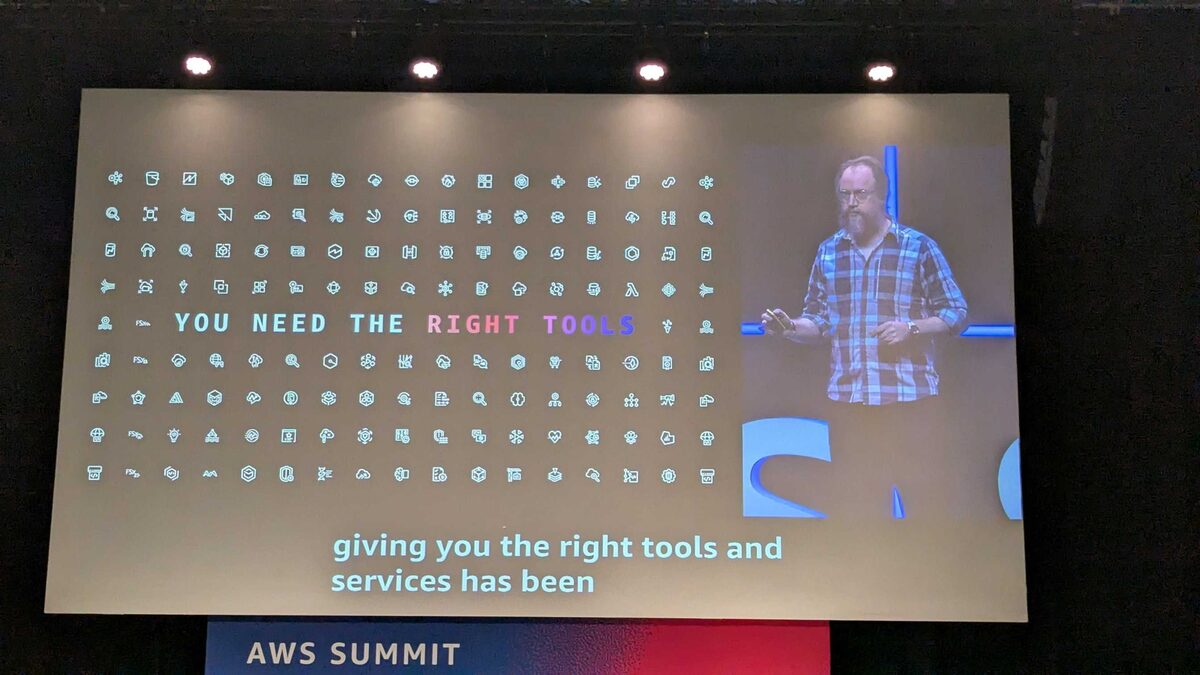
With over 200 AWS services available, the challenge is no longer whether the cloud can do something — it is choosing the right combination. Martin emphasized that AWS’s mission has always been giving builders the right tools and services to move fast without compromising on reliability or security.
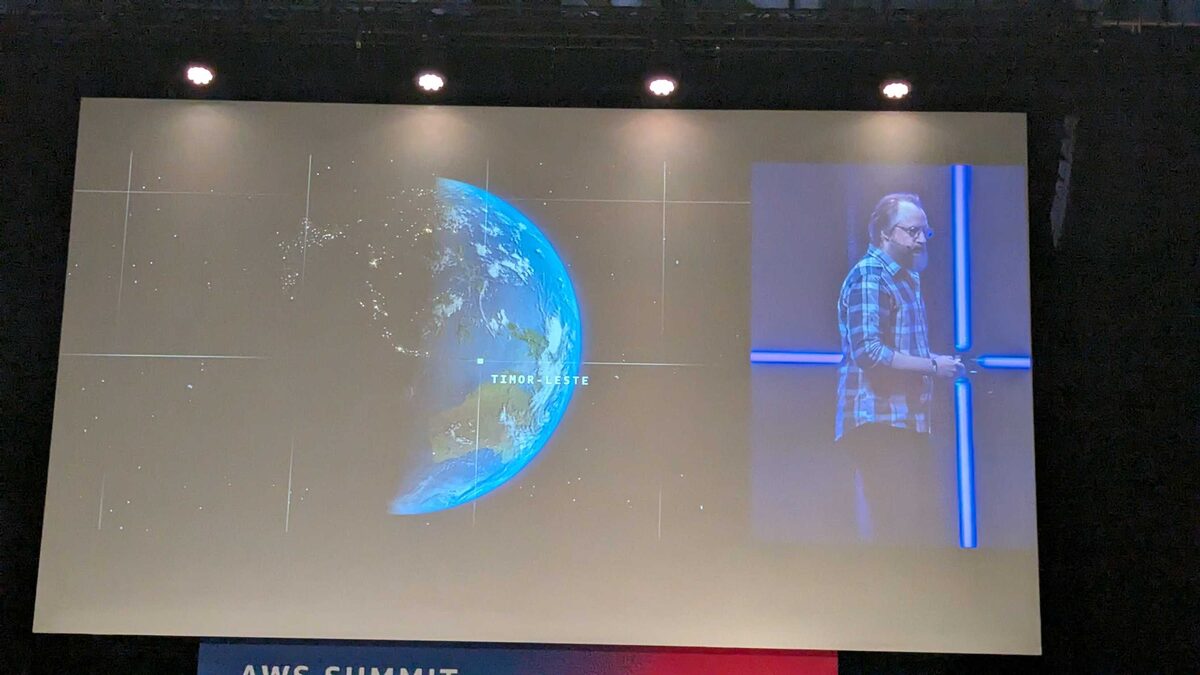
The keynote took an unexpected turn when the focus shifted from enterprise scale to social impact — zooming into Timor-Leste, one of the world’s youngest nations, to showcase how AWS infrastructure enables solutions where they matter most.
Ecolafaek: AI Solving a Real Crisis
The most compelling session was the Ecolafaek case study. The subtitle said it all: “This is not a prototype. It is solving a real crisis today.”
Ecolafaek is an AI-powered waste management platform built for Timor-Leste — a country facing a severe waste crisis with limited infrastructure. The platform uses machine learning to identify waste hotspots, empower citizens to report issues, and provide actionable data to local governments.
How It Works
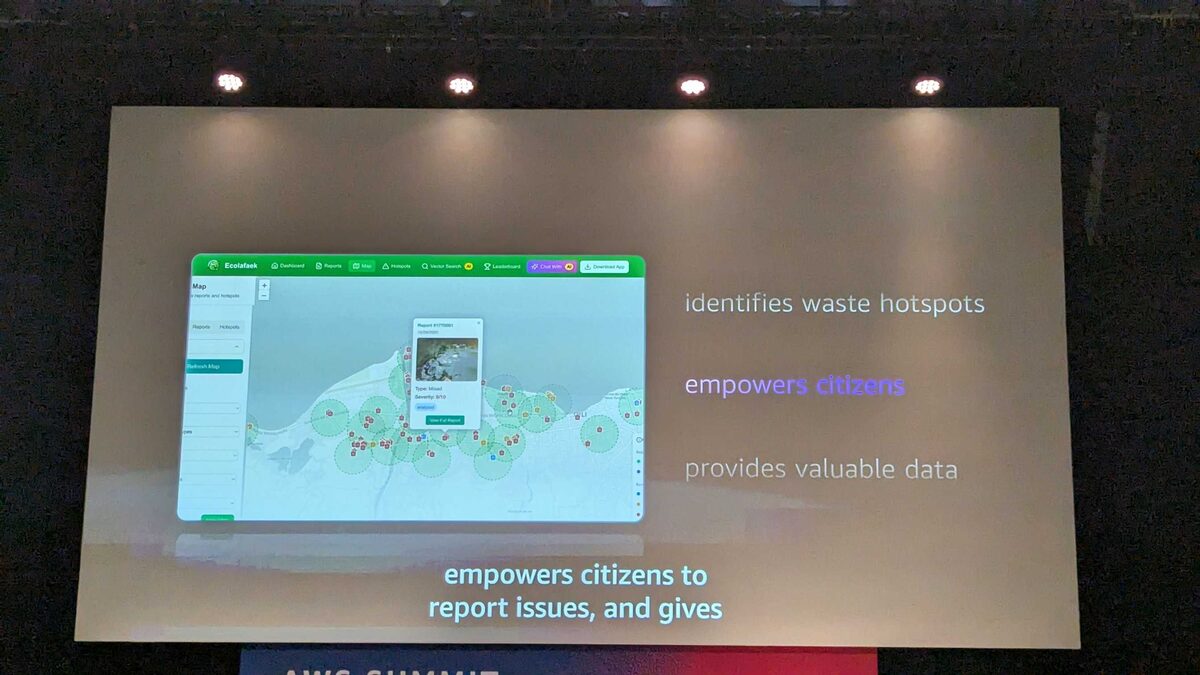
The platform has three core capabilities:
- Identifies waste hotspots using geospatial clustering and satellite imagery
- Empowers citizens to report waste through a mobile app with photo + GPS location
- Provides valuable data to municipalities for resource allocation
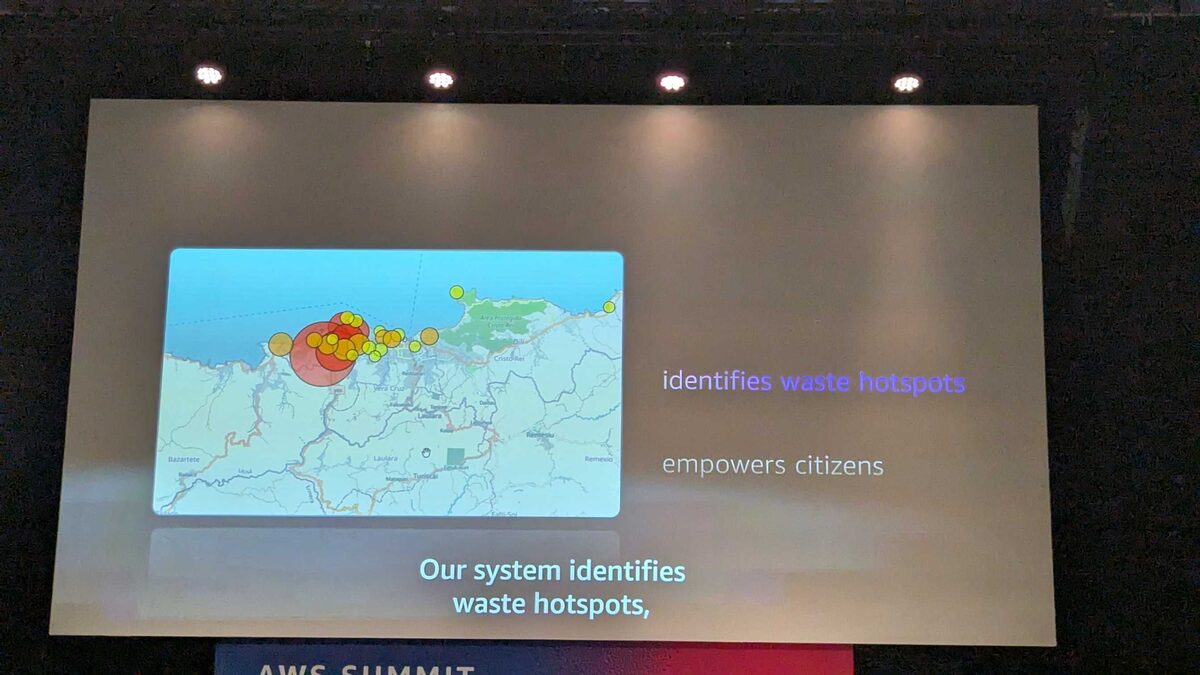
The heatmap visualization shows waste concentration zones across the northern coast of Timor-Leste, with the largest clusters near Dili, the capital. This data drives cleanup prioritization and budget allocation.
The Mobile Experience
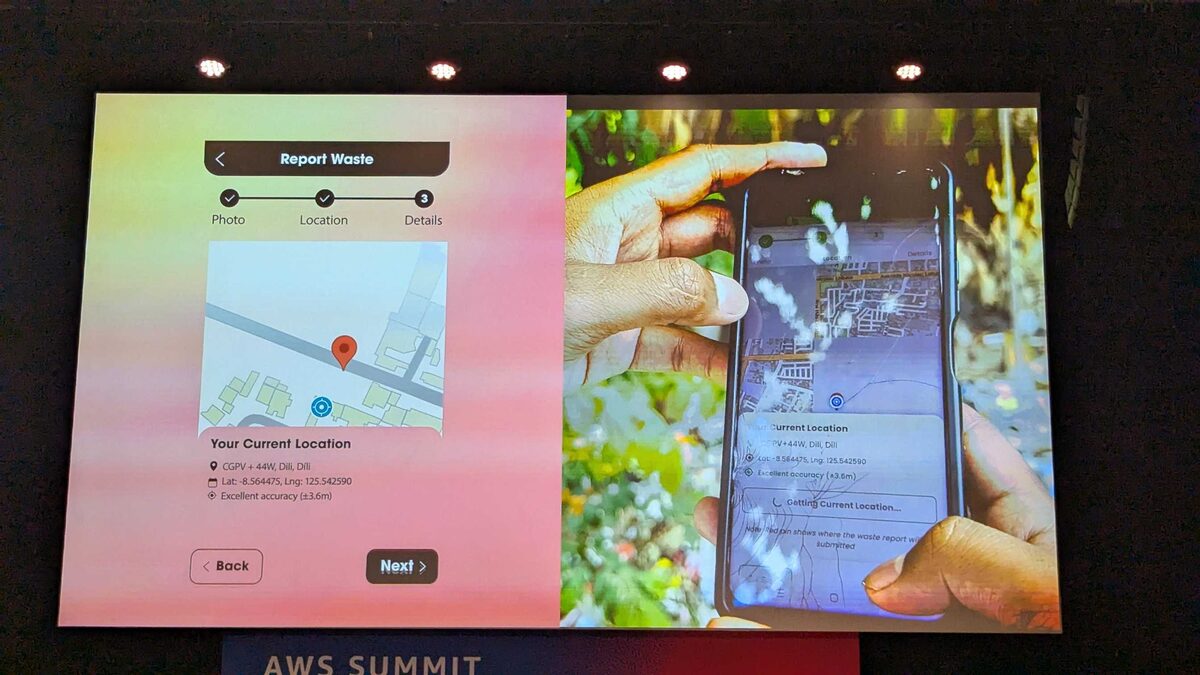
Citizens report waste in three steps: take a photo, confirm GPS location (with 3.6m accuracy), and add details. The app works offline and syncs when connectivity returns — critical for rural Timor-Leste.
Full-Stack Architecture
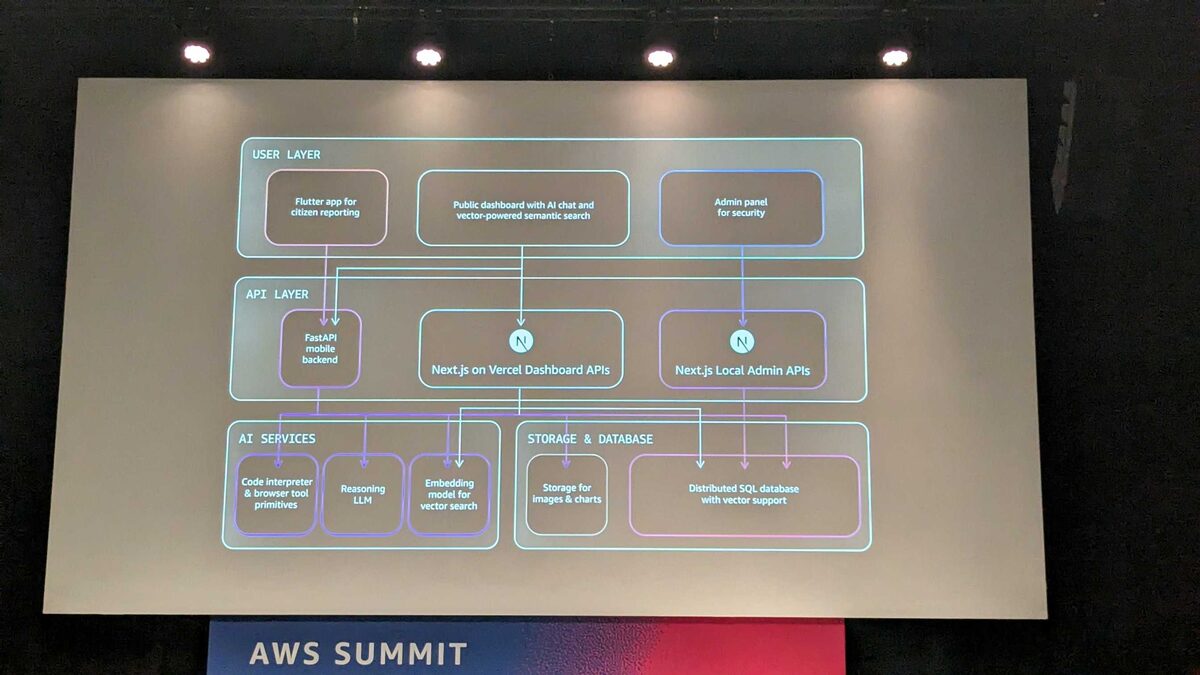
The architecture slide revealed a sophisticated modern stack:
User Layer:
- Flutter app for citizen reporting
- Public dashboard with AI chat and vector-powered semantic search
- Admin panel for security
API Layer:
- FastAPI mobile backend
- Next.js on Vercel for dashboard APIs
- Next.js local admin APIs
AI Services:
- Code interpreter and browser tool primitives
- Reasoning LLM for complex queries
- Embedding model for vector search
Storage and Database:
- Storage for images and charts
- Distributed SQL database with vector support
This is production-grade AI engineering — not a hackathon demo. The combination of reasoning LLMs, vector search, and geospatial data creates an intelligent platform that gets smarter with every citizen report.
The Builder: Ajito Nelson
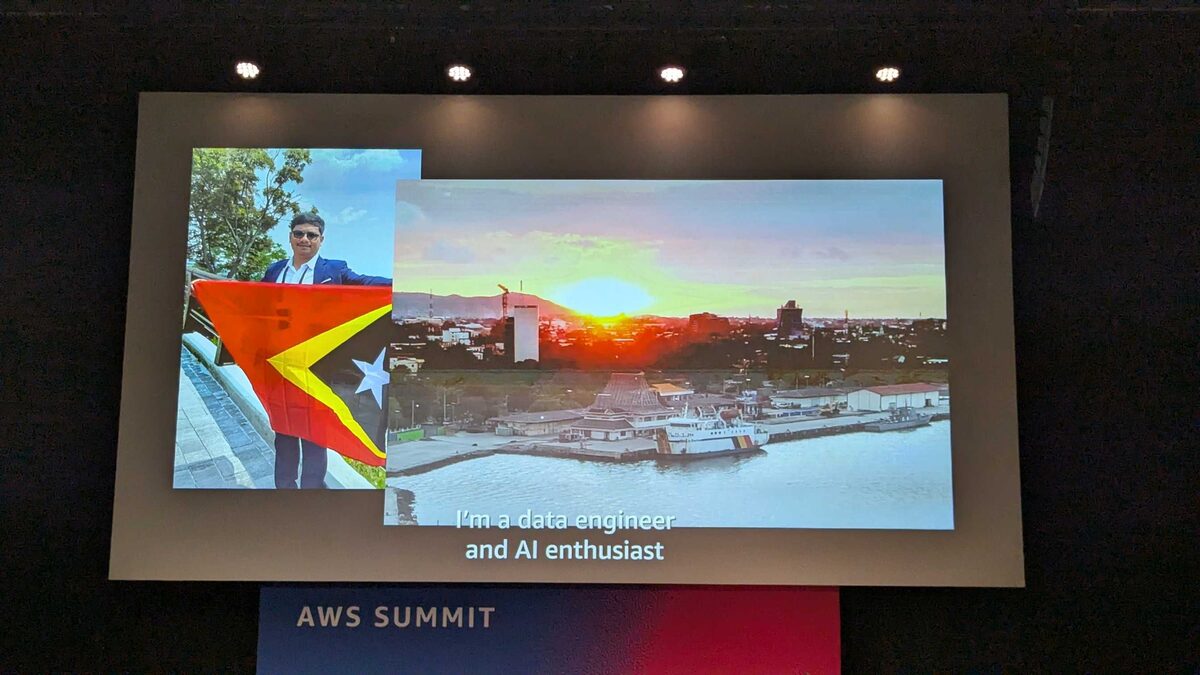
Ajito Nelson, a data engineer and AI enthusiast from Timor-Leste, built Ecolafaek. Standing on the AWS Summit stage with the Timorese flag — representing not just a project, but a country’s potential in the global tech ecosystem.
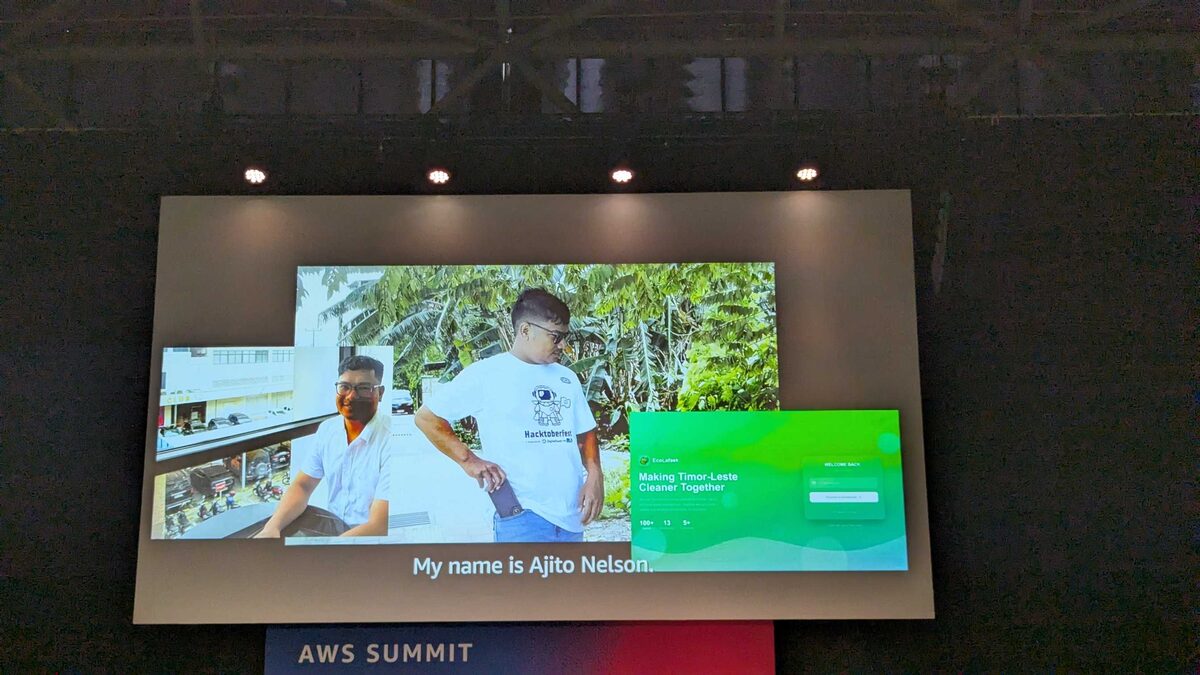
The platform’s tagline — “Making Timor-Leste Cleaner Together” — captures the community-driven approach. With 100+ reports, 13 hotspots identified, and 5+ active communities, this is grassroots tech solving infrastructure gaps.
AWS Transform: Agentic Legacy Modernization
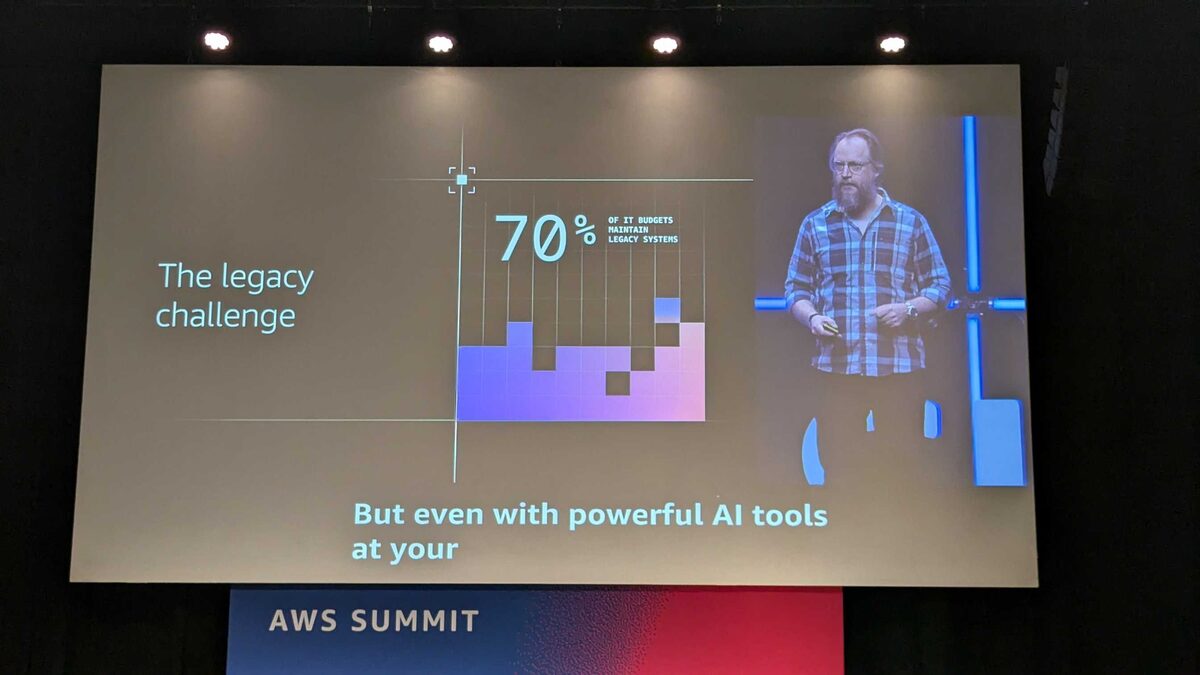
The elephant in the room: 70% of IT budgets still go to maintaining legacy systems. Even with powerful AI tools, organizations are trapped by billions of lines of mainframe and VMware code that cannot be easily rewritten.
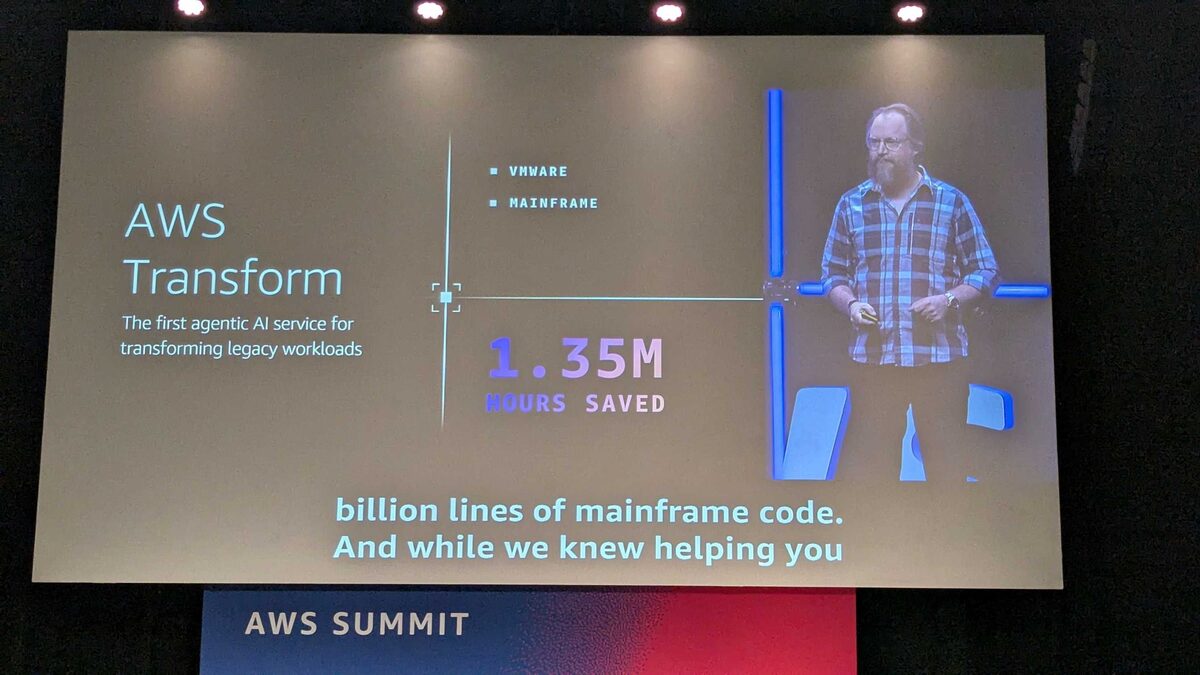
Enter AWS Transform — “the first agentic AI service for transforming legacy workloads.” The numbers are staggering: 1.35 million hours saved already, handling VMware and mainframe migrations at scale. AWS asked themselves: “We knew helping you with billions of lines of mainframe code was a pain point and an area where we knew AI could help.”
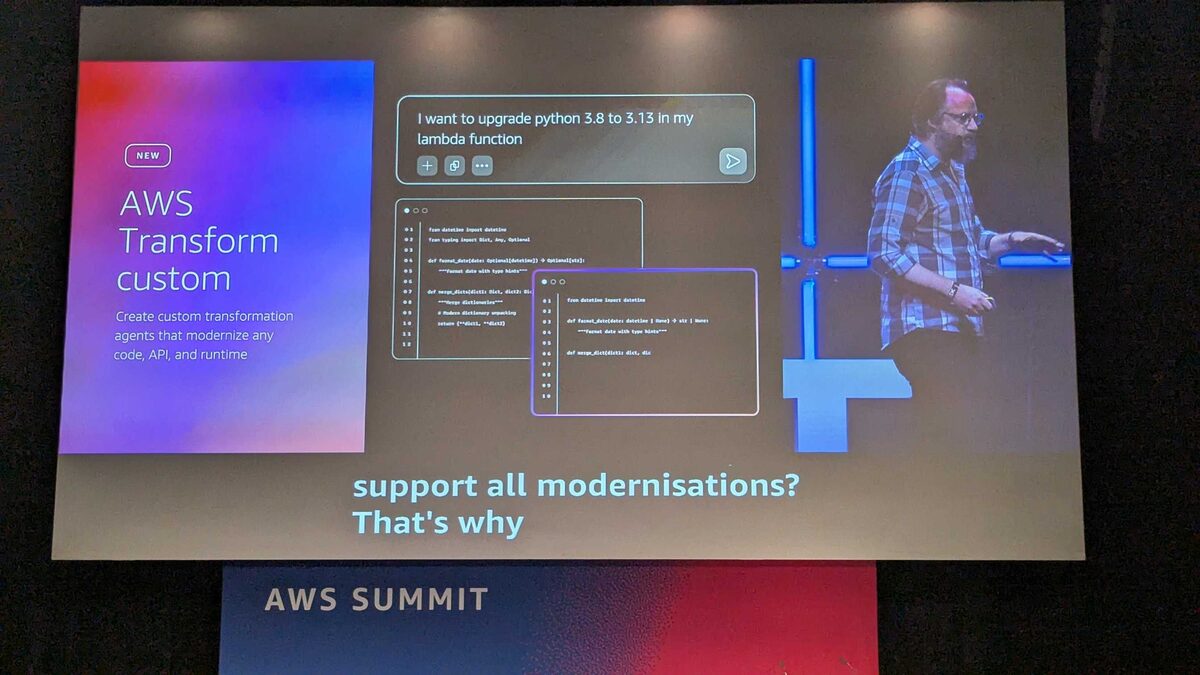
The new AWS Transform Custom capability lets you create custom transformation agents that modernize any code, API, and runtime. The demo showed upgrading a Python 3.8 Lambda function to Python 3.13 — the agent handles type hint updates, deprecated API replacements, and runtime compatibility changes automatically. The question they asked: “Why not support all modernisations?”
Bynder: Real-World Transform Custom in Action
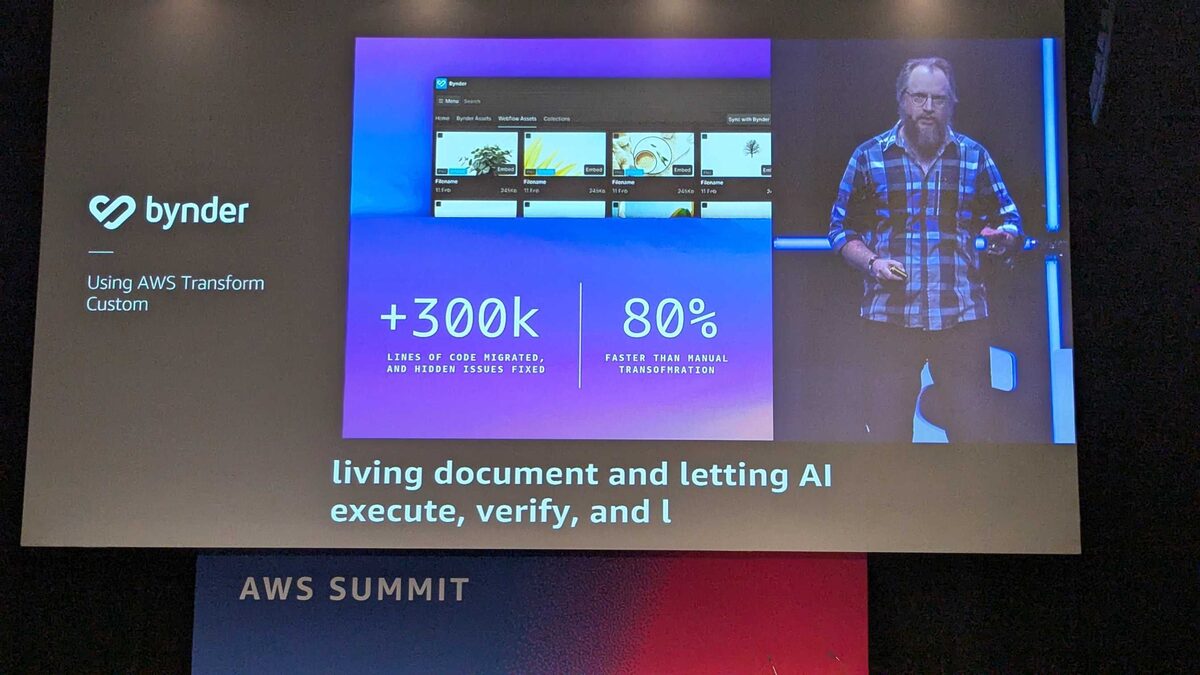
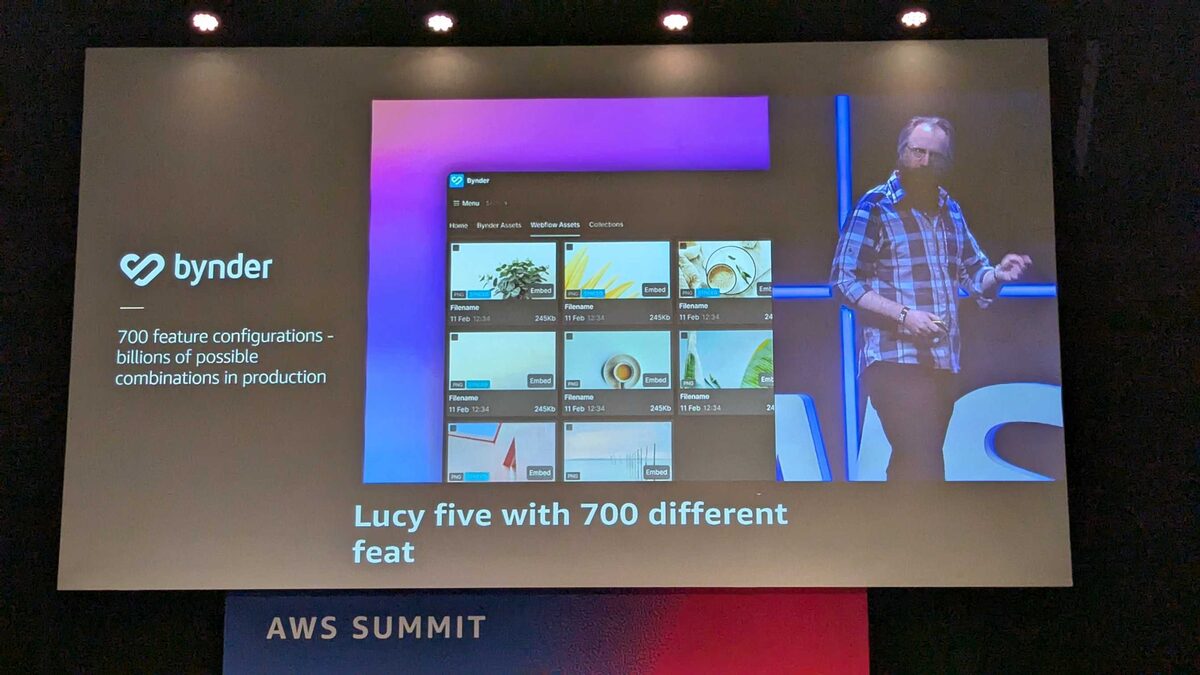
The customer story that brought Transform Custom to life: Bynder, the Dutch digital asset management platform powering 4,000 brands worldwide (Spotify, HelloFresh, Heineken). Their challenge? 700 feature configurations creating billions of possible combinations in production — behind their modern microservices sits a ColdFusion application running on legacy infrastructure that needed upgrading with stricter typing and new scoping rules.
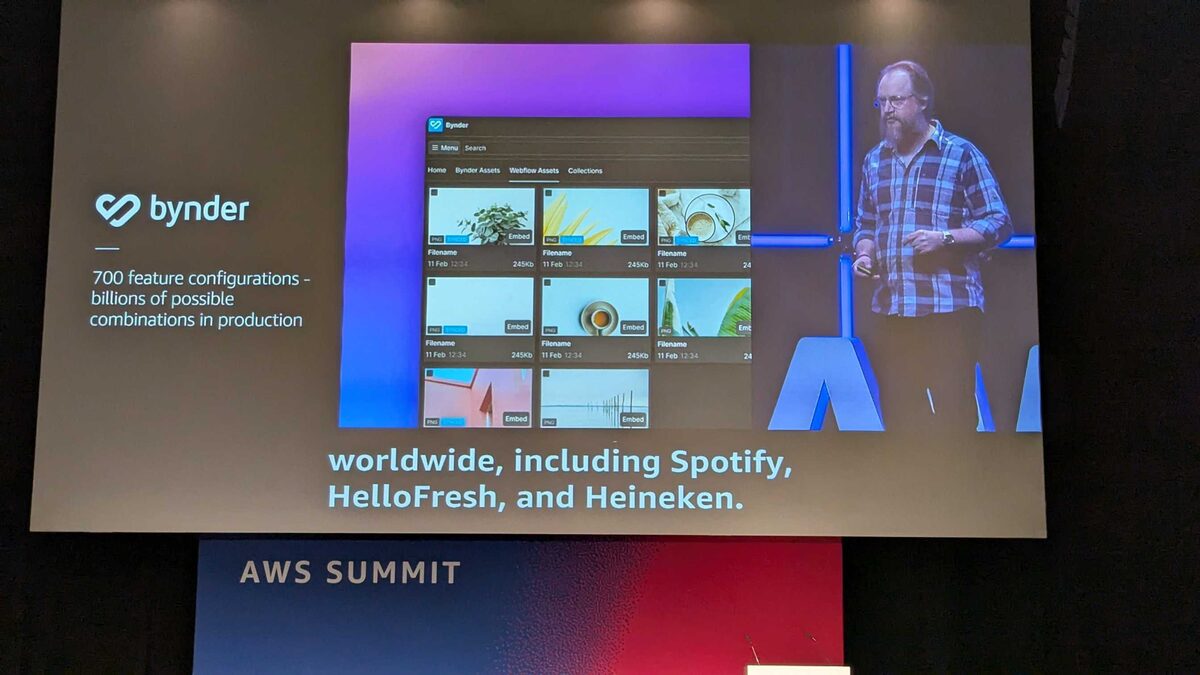
Using AWS Transform Custom, Bynder treated their migration rules as a living document, letting AI execute, verify, and learn. The results: +300K lines of code migrated with hidden issues fixed, 80% faster than manual transformation. A powerful proof point for enterprises sitting on legacy code they thought would take years to modernize.
Amazon Quick: The AI Work Assistant
Martin Elwin also unveiled Amazon Quick — “The AI assistant that changes how you work.” Unlike simple chatbots, Quick is a full productivity platform with seven capabilities:
- Research — Conduct deep research and get detailed analysis
- Sight — Analyze and visualize data to uncover insights
- Flows — Create workflows for everyday tasks
- Chat Agents — Chat with customizable agents
- Spaces — Build a custom knowledge center
- Automate — Automate end-to-end processes
- Pages — Connect documents to live data
The key insight: “Searching, summarising, context switching — the way we work is not working. Amazon Quick is built to give you that time back.”
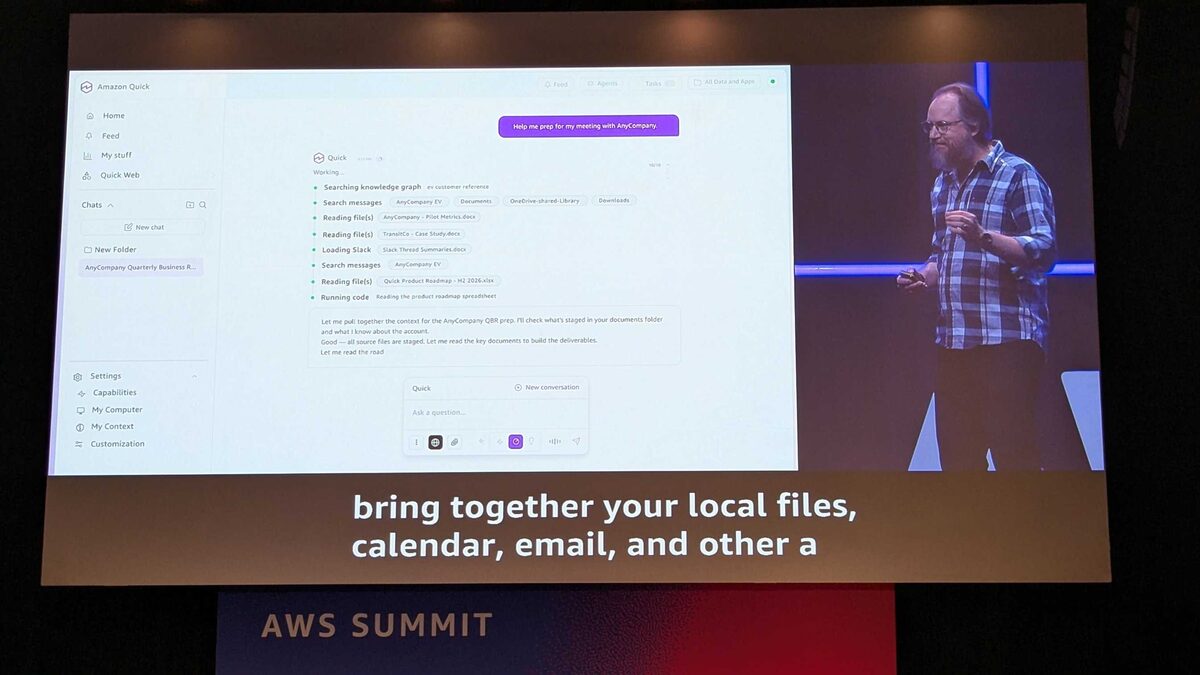
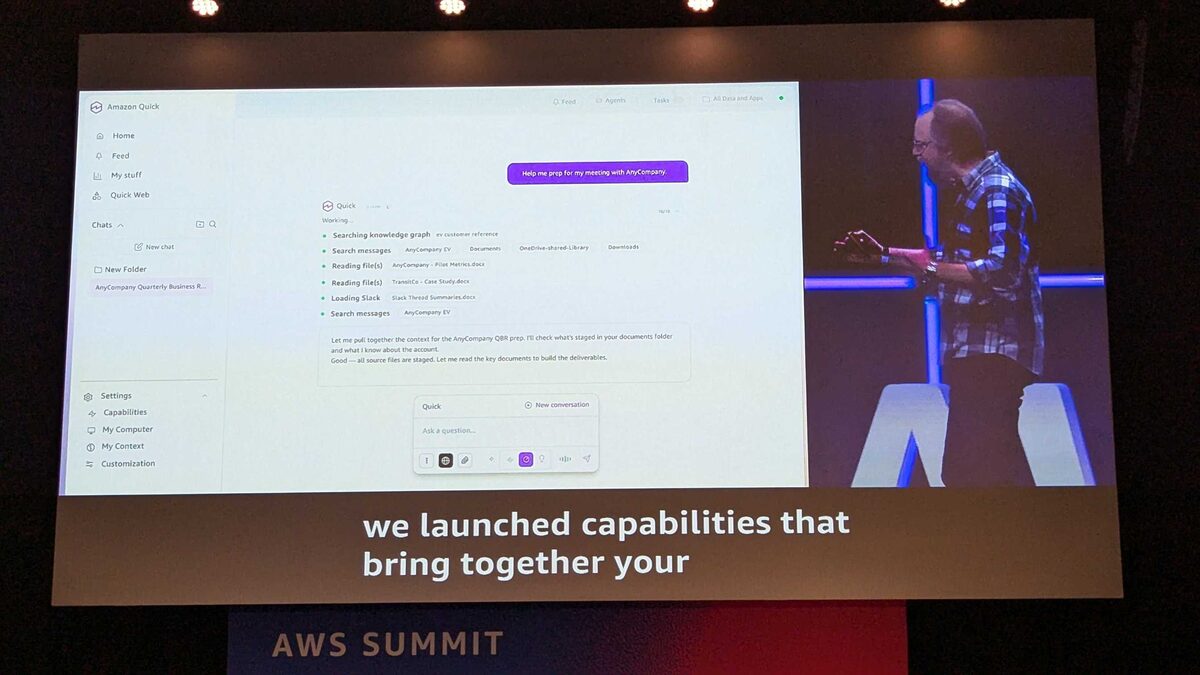
The live demo was impressive. Martin prompted: “Help me prep for my meeting with AnyCompany.” Quick immediately:
- Searched the knowledge graph for customer reference
- Pulled messages from AnyCompany EV across multiple channels
- Read local files (Pilot Metrics.docx, Case Study.docx)
- Loaded Slack thread summaries
- Read the product roadmap spreadsheet (H1 2026.xlsx)
- Running code to analyze the data
All from a single prompt — bringing together local files, calendar, email, Slack, and other applications into one contextual response.
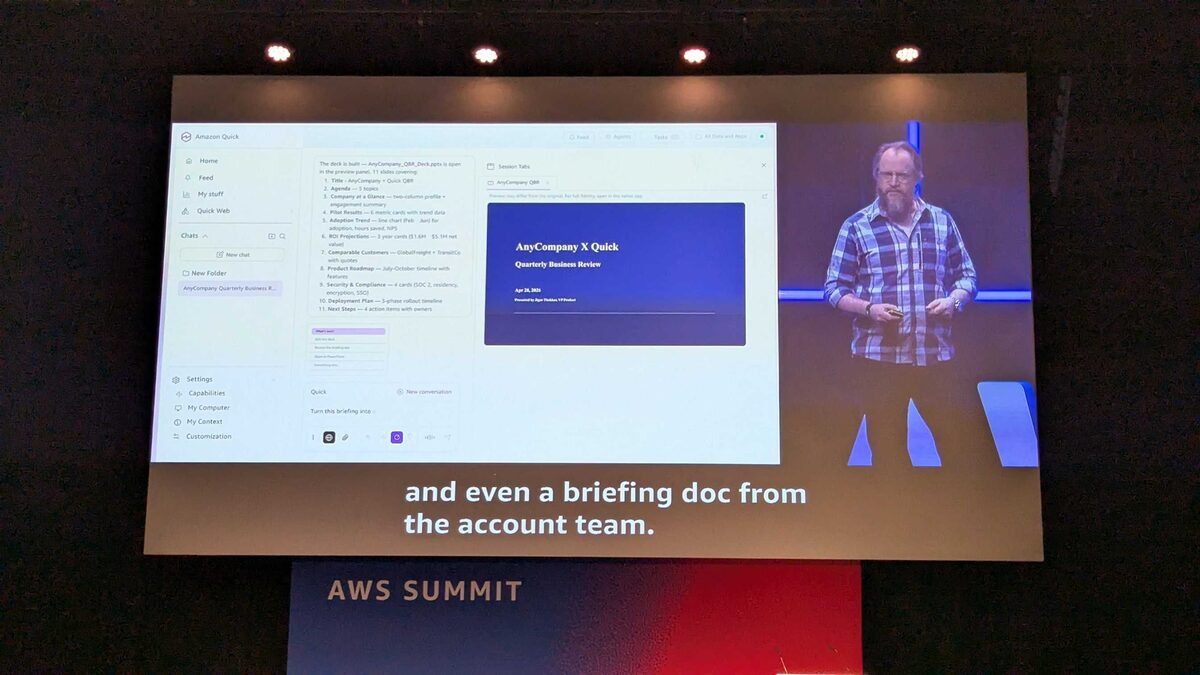
The output: a complete Quarterly Business Review deck with 11 slides covering company profile, pilot results, adoption trends, ROI projections, comparable customers, product roadmap, security and compliance, and deployment plan — all generated from scattered data sources. This is agentic AI doing real enterprise work.
For reference, AWS’s own Amazon Quick page describes it as an AI companion for work that connects to apps such as Slack, Salesforce, Jira, Notion and Microsoft 365, and that turns research and business-data questions into documents, presentations, spreadsheets and automated flows. That matches what the keynote demo showed: the value is less the chat box and more the connectors behind it.
AWS Kiro: Spec-Driven AI Development
The biggest product announcement was Kiro — AWS’s new AI-powered IDE that takes a fundamentally different approach from competitors. Instead of just autocompleting code, Kiro works with you by turning your prompts into detailed specs and those specs into working code.
“Honestly, Kiro is just [bleep] awesome.” The developer testimonials were enthusiastic. One user reported writing more code in the last five months than in the past ten years.
What makes Kiro different is the partnership model. It integrates MCP servers (git, fetch) and agent steering — giving AI the right context through structured specifications rather than hoping the model guesses correctly.
Ericsson: 150 Years of Context, 20K+ Developers
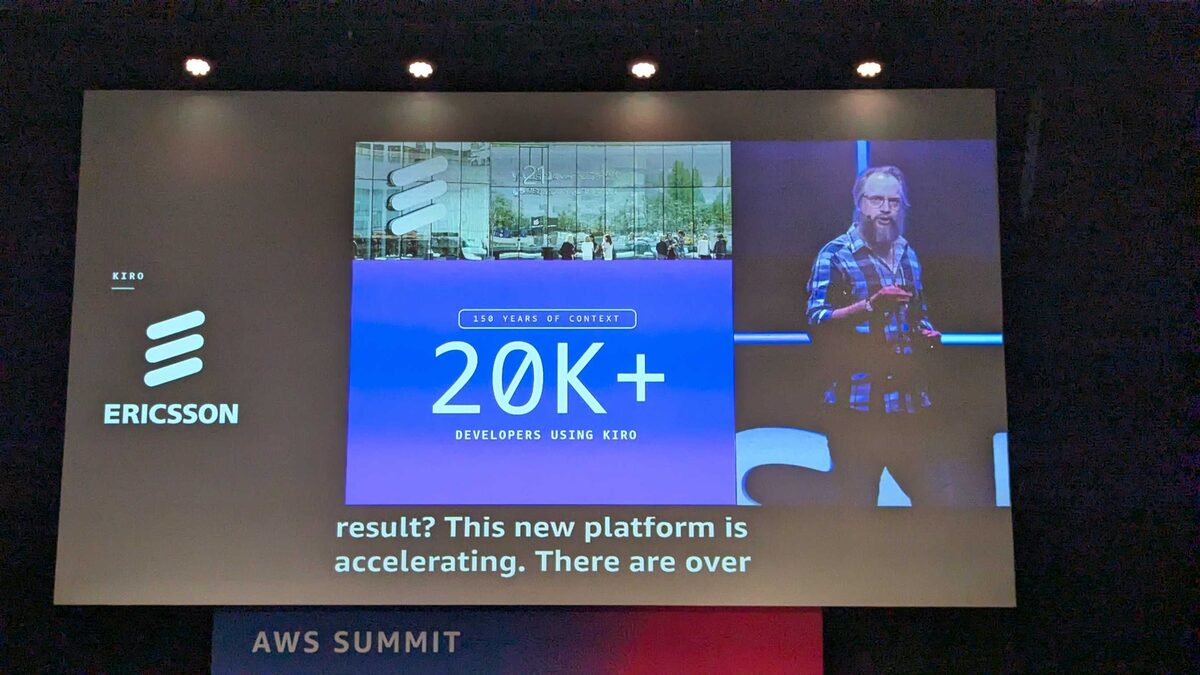
The headline customer story was Ericsson — a telecom leader serving 2 billion people. They are rolling out Kiro to 20,000+ developers across their organization, turning 150 years of telecom knowledge into an accessible, queryable asset. The result: this new platform is accelerating development across the organization.
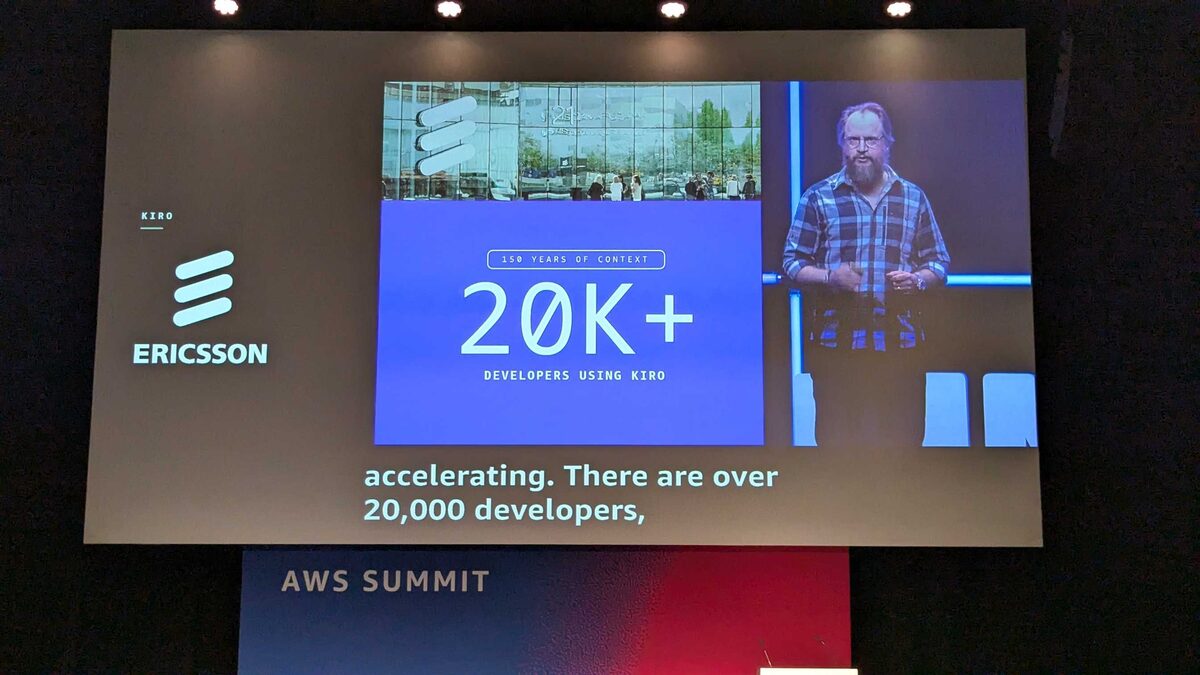
The key insight from Ericsson’s adoption: giving AI the right context matters more than the model itself. With 150 years of accumulated domain knowledge in telecom protocols, network architectures, and standards, context engineering is everything.
Lambda Durable Functions: Long-Running Workflows Without Servers
The keynote’s infrastructure section moved from instances and GPUs to serverless with a slide for AWS Lambda: “The fastest way to go from idea to production” for people who do not want to manage servers. The next slide set up the problem: a Lambda function that is waiting for hours or even days, which classic Lambda is not built for.
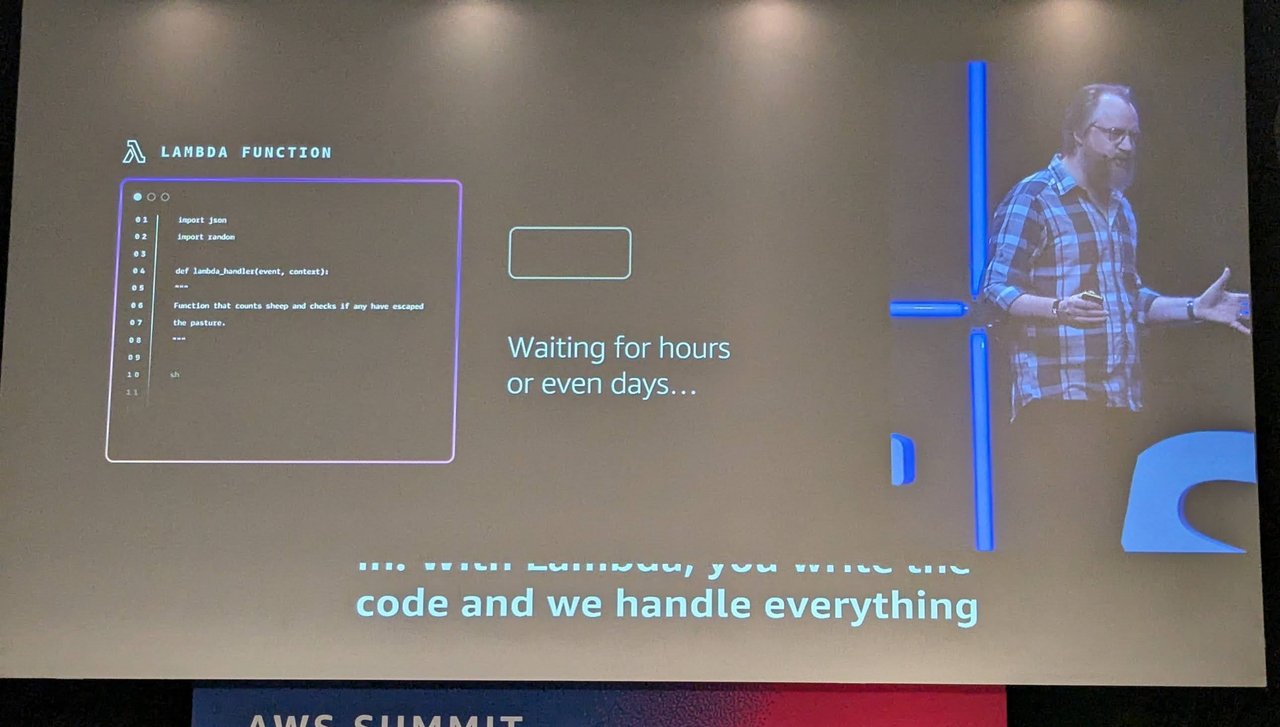
The keynote framed the gap: Lambda code that has to wait for hours or days.
The answer was marked NEW on the slide: AWS Lambda durable functions, “easily build long-running applications and AI workflows”. The slide listed three properties (no additional infrastructure, automatic retries, run workflows for up to 1 year) and three verbs along the bottom: execute and checkpoint, wait and suspend, resume and replay. The speaker tied it to agents: an agent working in the background for several hours or days.
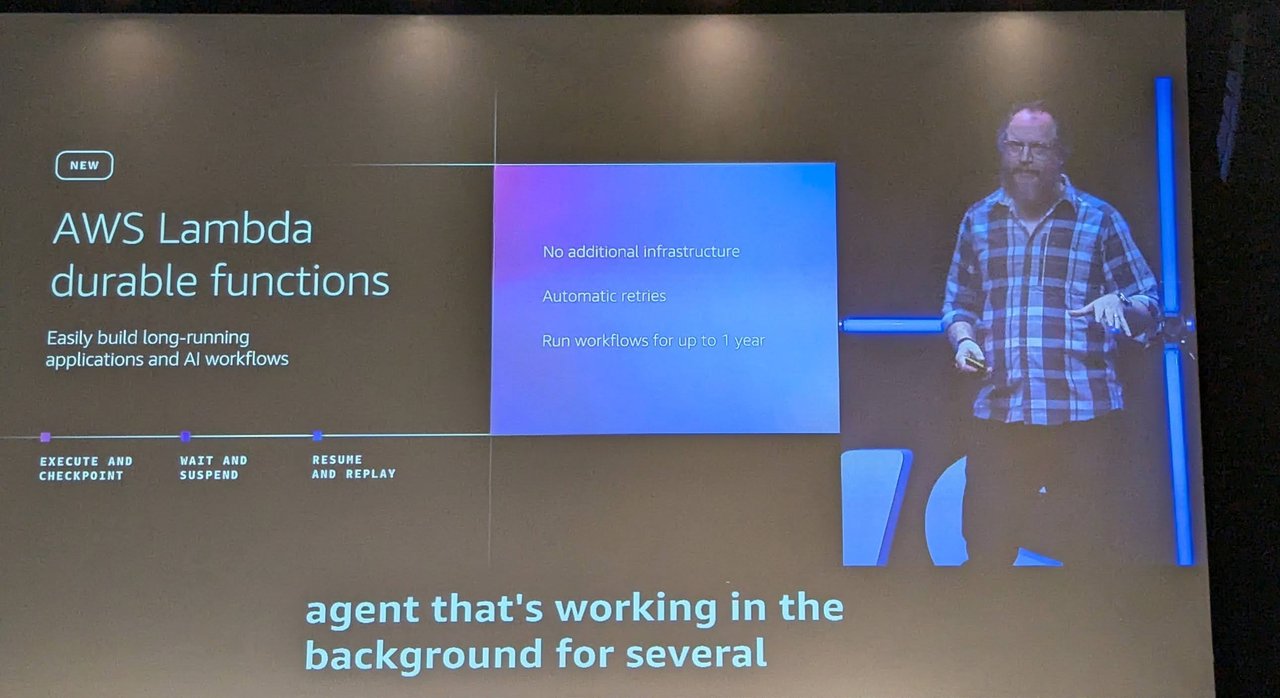
AWS Lambda durable functions: no additional infrastructure, automatic retries, workflows that run for up to a year.
The AWS Lambda documentation confirms the model. A durable function is a regular Lambda function that uses checkpoints and replay: after an interruption the code re-runs from the start but skips completed work using stored results. Steps run business logic with built-in retries, and waits suspend execution without incurring compute charges. The SDK is available for JavaScript, TypeScript, Python and Java. The docs also position durable functions against Step Functions: durable functions run inside Lambda in a normal programming language, while Step Functions is a separate service with a visual or graph-based definition.
My take: for agent workloads with a human approval in the middle, “wait without paying for compute” is the feature that matters. It makes a long-lived agent loop a plain function rather than a state machine you have to draw first.
Amazon S3 Files: Your Bucket as a File System
The data part of the keynote started with S3 as the foundation for object, tabular and vector data, then introduced another NEW item: Amazon S3 Files, “providing fully-featured, high-performance file system access to your S3 data”. The slide drew it connecting S3 to EC2, Lambda, ECS, EKS and Fargate, and the speaker said you can mount any S3 bucket inside those compute services.
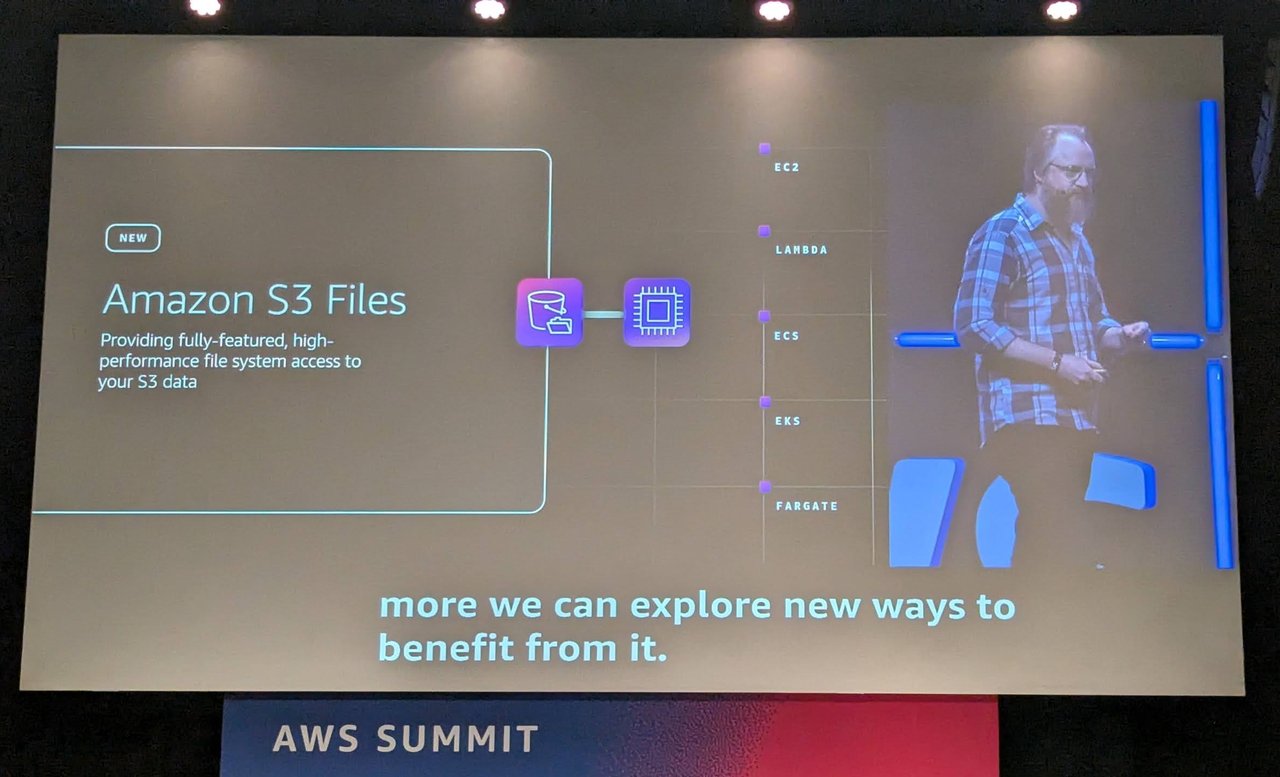
Amazon S3 Files: file system access to S3 data from EC2, Lambda, ECS, EKS and Fargate.
The S3 documentation describes S3 Files as a shared file system built on Amazon EFS that links to a bucket or a prefix. It supports NFS 4.1 and 4.2 with read-after-write consistency, file locking and POSIX permissions, and it synchronizes changes between file system and bucket in both directions. Only the active working set (small files by default) is copied onto high-performance storage; large reads stream straight from S3. The docs list EC2, Lambda, EKS and ECS as supported mount targets, so I would check Fargate support in the docs before relying on the slide’s list.
The practical point: tools and agents that expect a directory of files no longer need a copy step before they can work on S3 data.
AWS European Sovereign Cloud
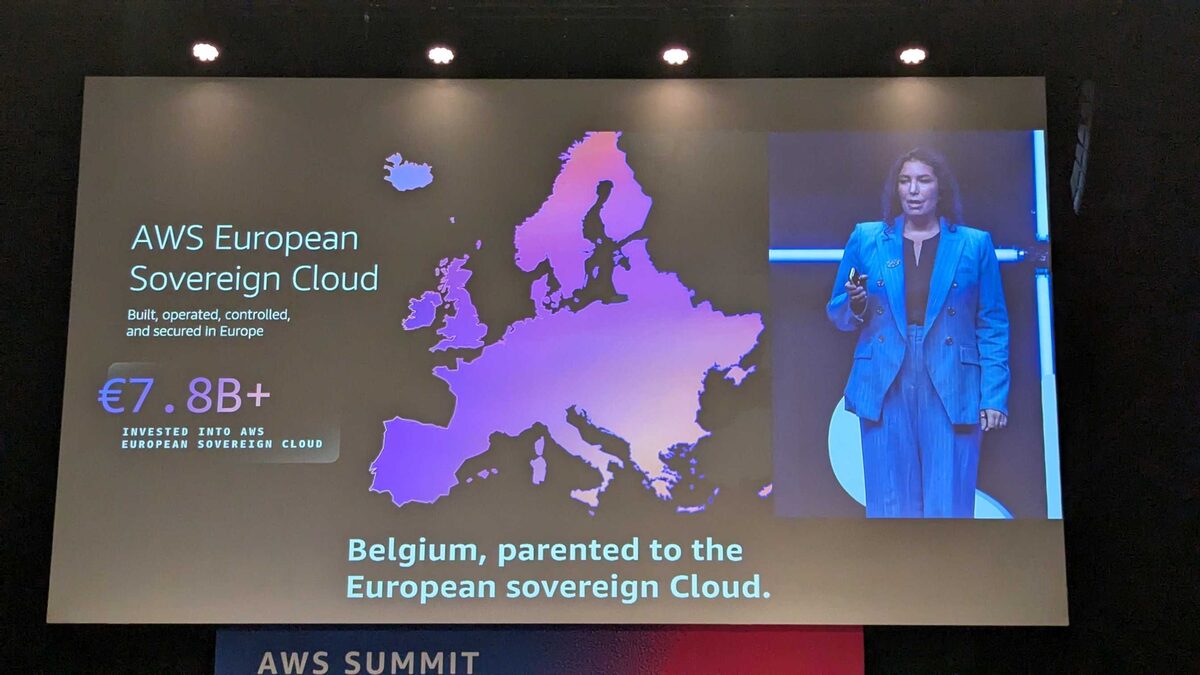
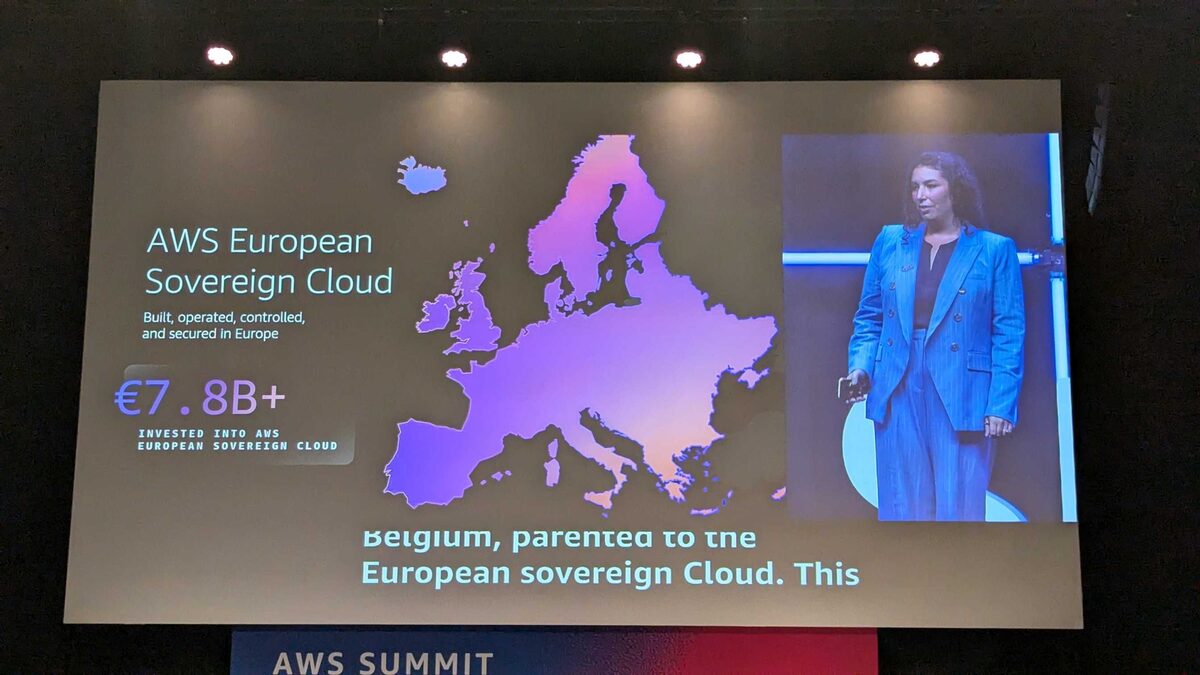
A major theme was digital sovereignty. AWS announced the European Sovereign Cloud — built, operated, controlled, and secured entirely in Europe, with a dedicated region in Belgium. The investment: over 7.8 billion euros.
This directly addresses European enterprises constrained by GDPR, NIS2, and sector-specific regulations who need guaranteed data residency without sacrificing AWS’s full service catalog.
The Numbers Are Clear
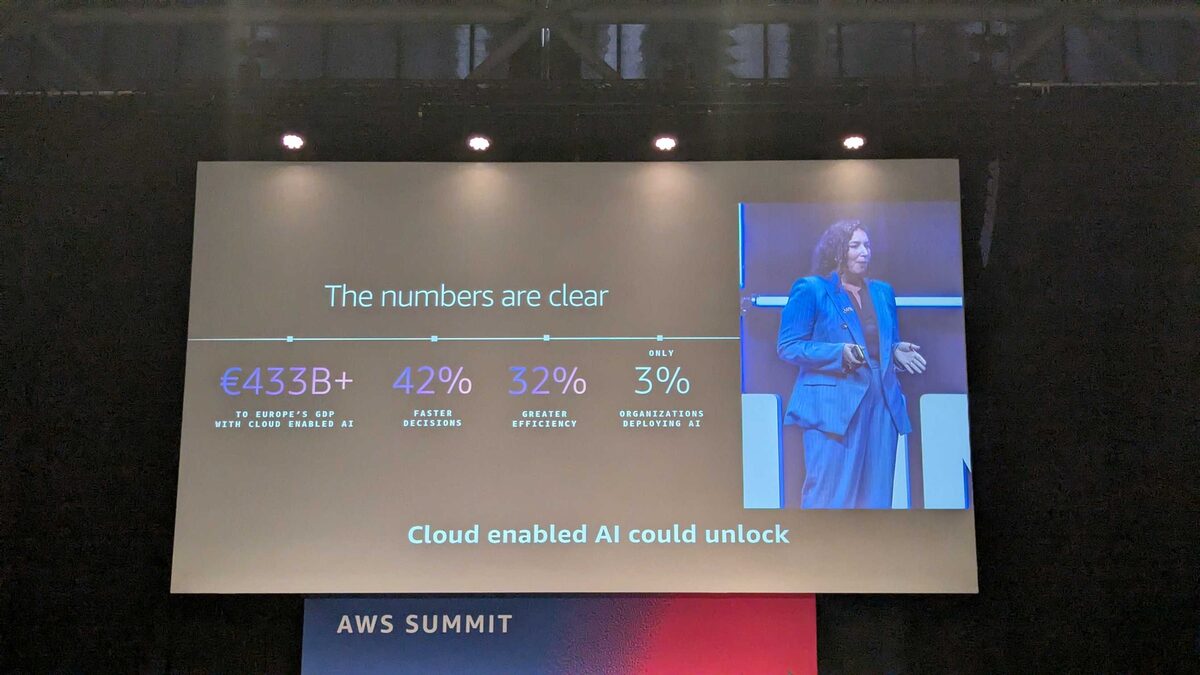
The keynote presenter shared compelling statistics:
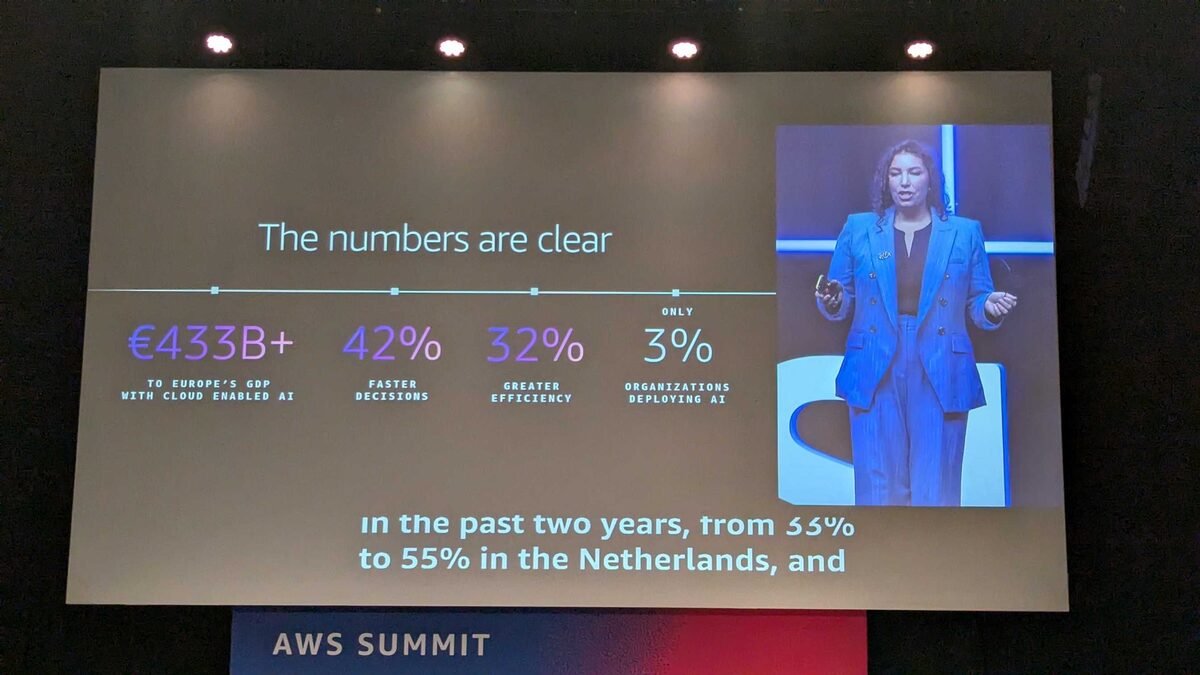
- 433B+ euros potential contribution to Europe’s GDP with cloud-enabled AI
- 42% faster decisions for organizations leveraging AI
- 32% greater efficiency in operations
- Only 3% of organizations actually deploying AI at scale
That last number is the opportunity gap. Cloud adoption in the Netherlands grew from 53% to 55% in the past two years — steady but incremental. The real growth will come from the 97% still figuring out how to operationalize AI.
Sponsors and Ecosystem
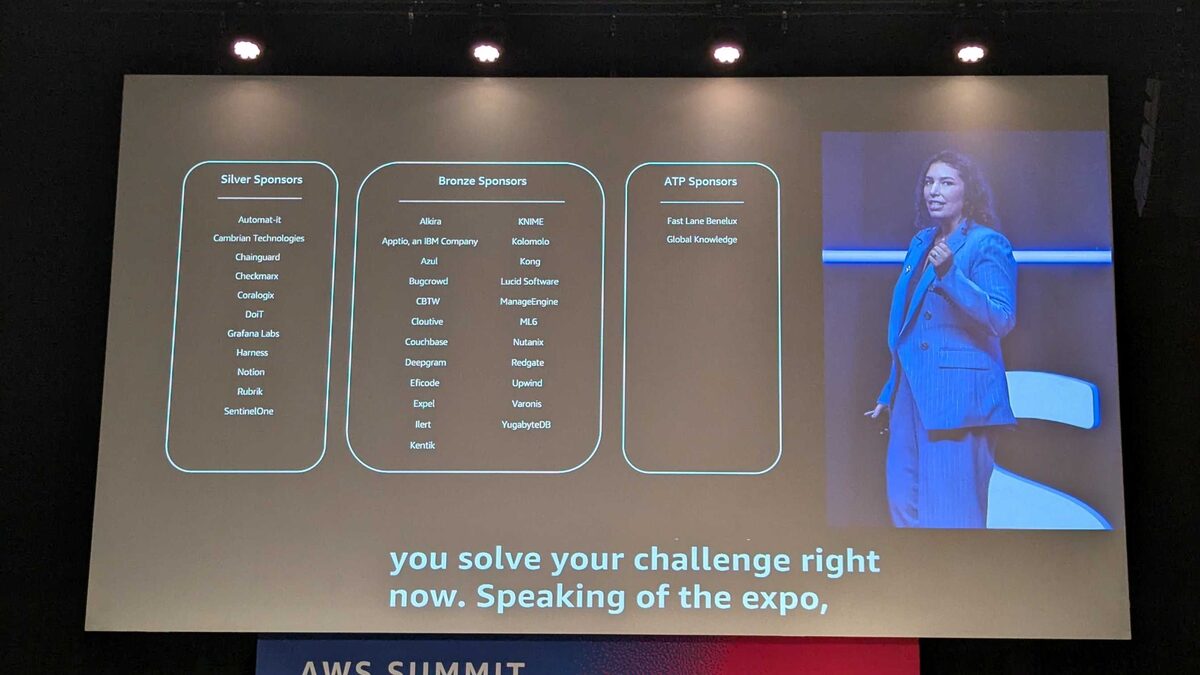
The expo featured a strong ecosystem of partners:
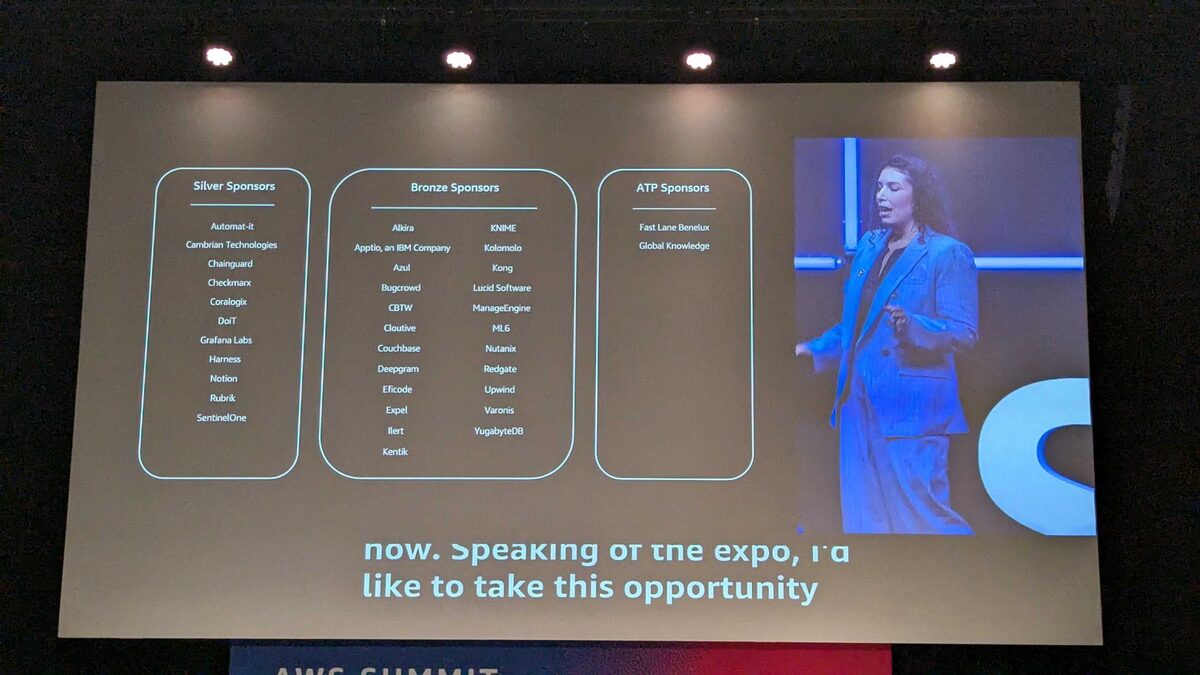
Silver Sponsors: Automat-it, Cambrian Technologies, Chainguard, Checkmarx, Coralogix, DoiT, Grafana Labs, Harness, Notion, Rubrik, SentinelOne
Bronze Sponsors: Alkira, Apptio (IBM), Azul, Bugcrowd, CBTW, Cloutive, Couchbase, Deepgram, Eficode, Expel, iLert, Kentik, KNIME, Kolomolo, Kong, Lucid Software, ManageEngine, ML6, Nutanix, Redgate, Upwind, Varonis, YugabyteDB
ATP Sponsors: Fast Lane Benelux, Global Knowledge
The closing message: “The future is not something that you wait for.”
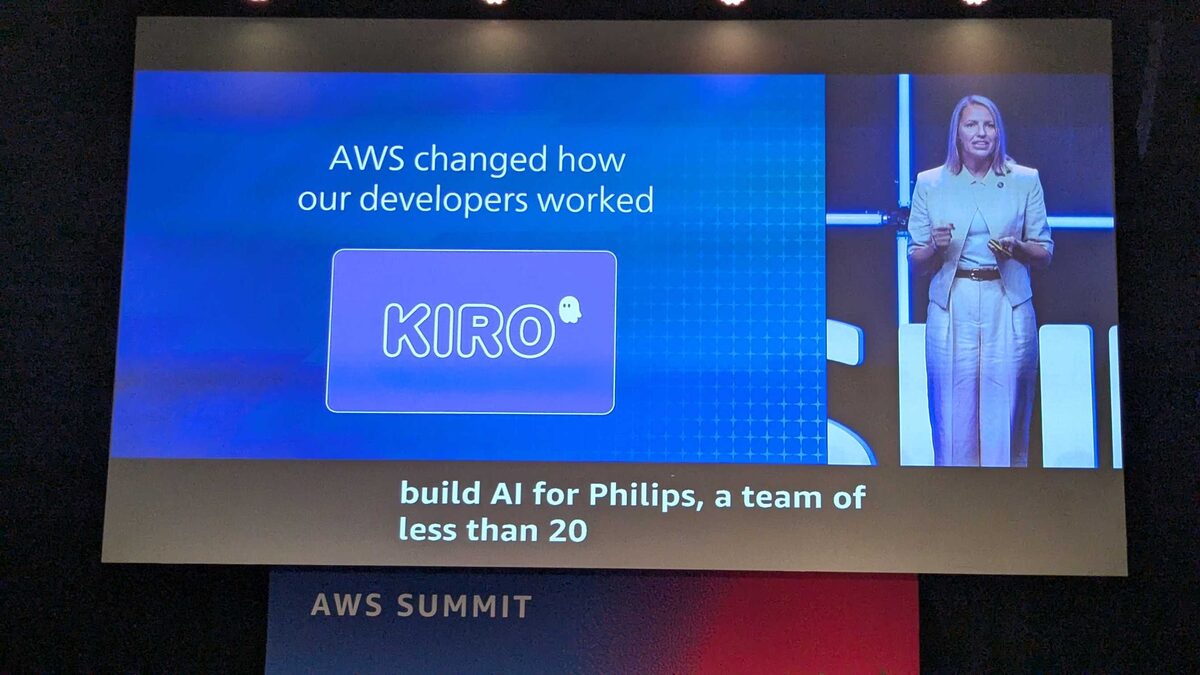
Philips: AI-First Development with Kiro
Christina Murphy, VP of AI & Business Operations at Philips, took the stage to share how the Dutch healthcare giant is transforming patient care through AI. The barrier to improving patient care, she argued, isn’t technology — it’s the speed at which you can ship software.
The problem was concrete: in their digital pathology business, getting a customer quote took 45 days to respond. Philips is now powering up their sellers with AI to collapse that timeline.
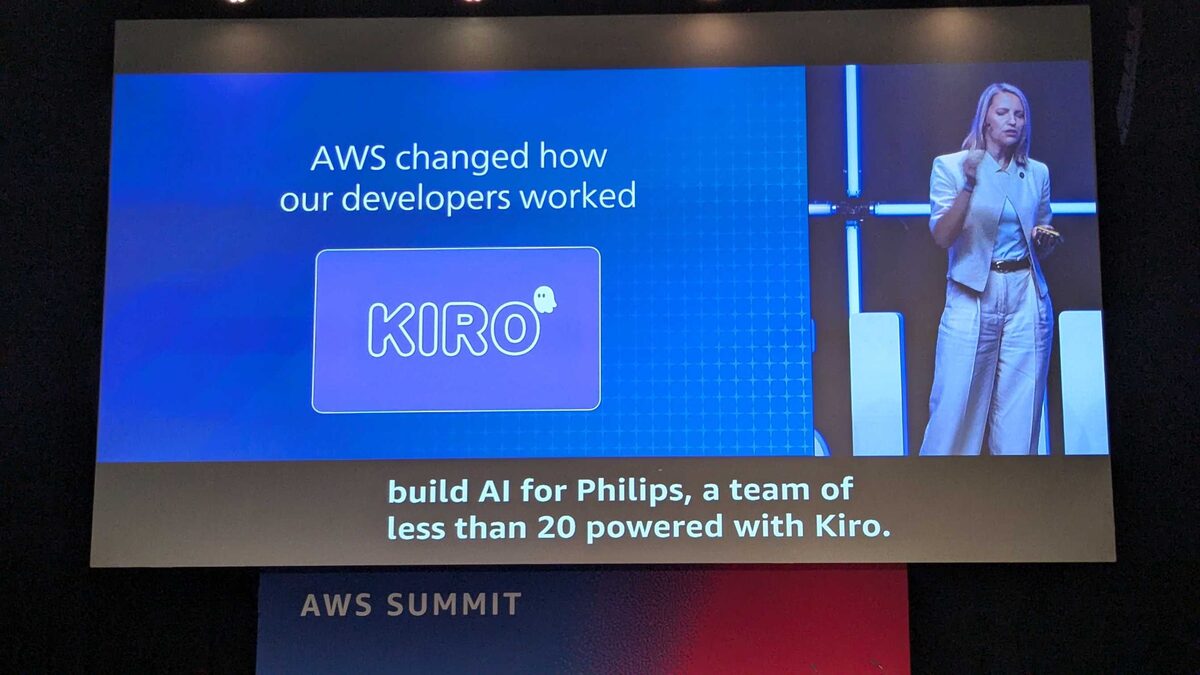
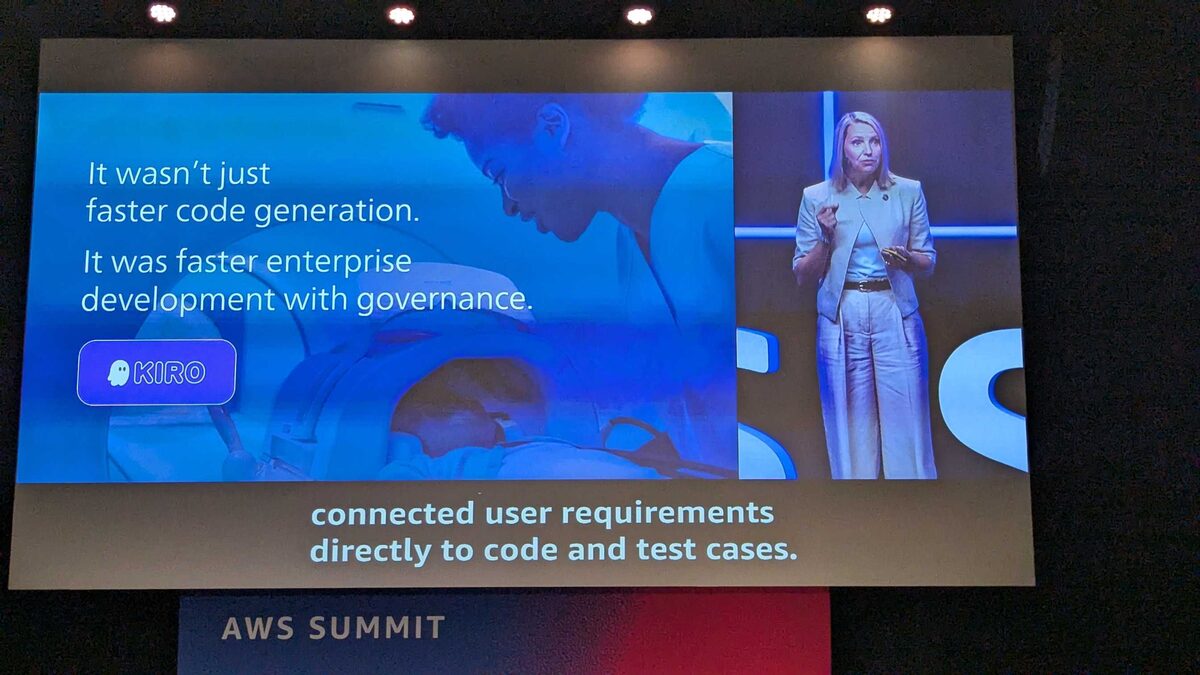
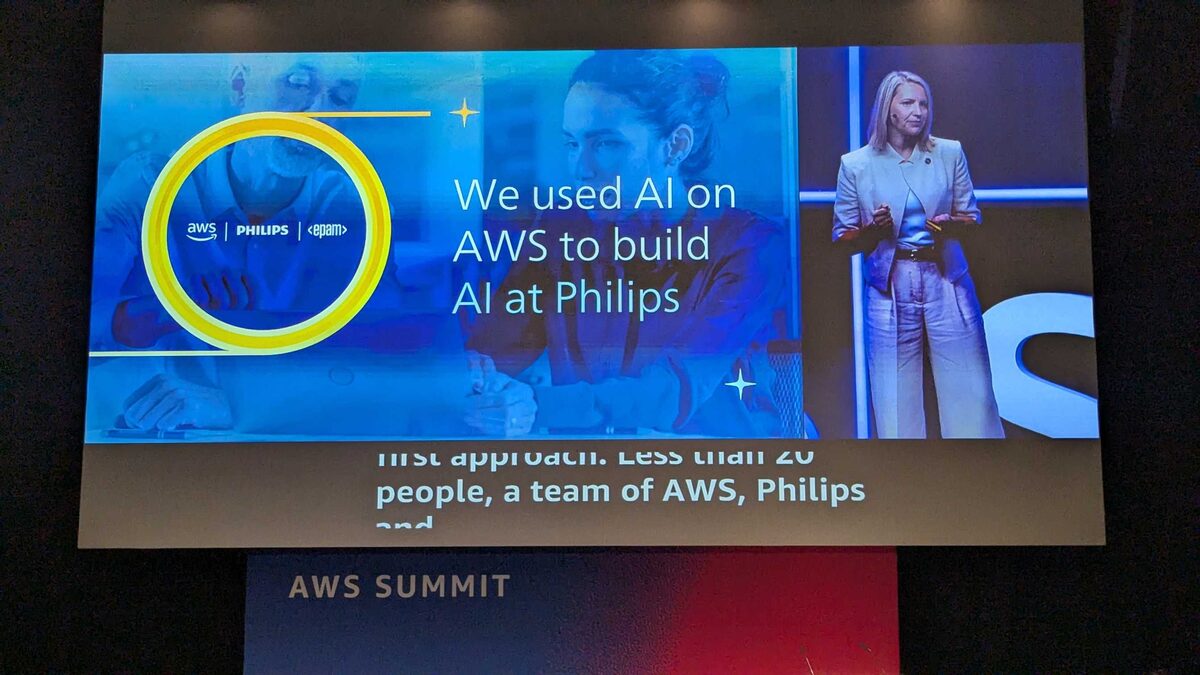
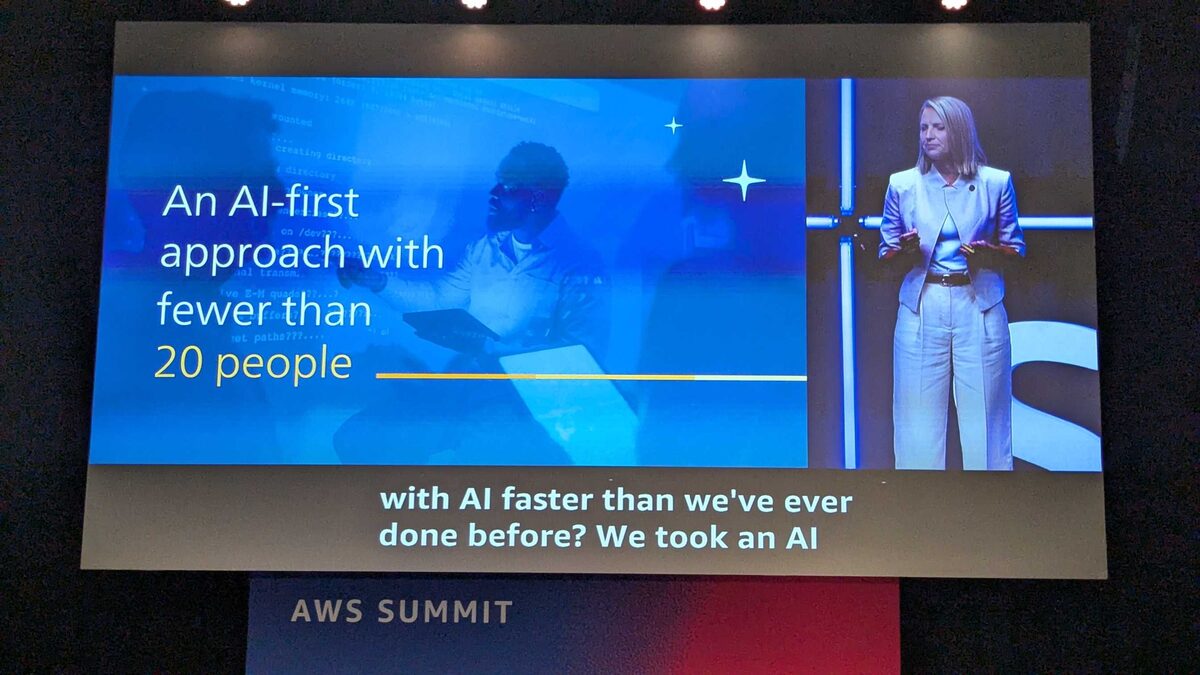
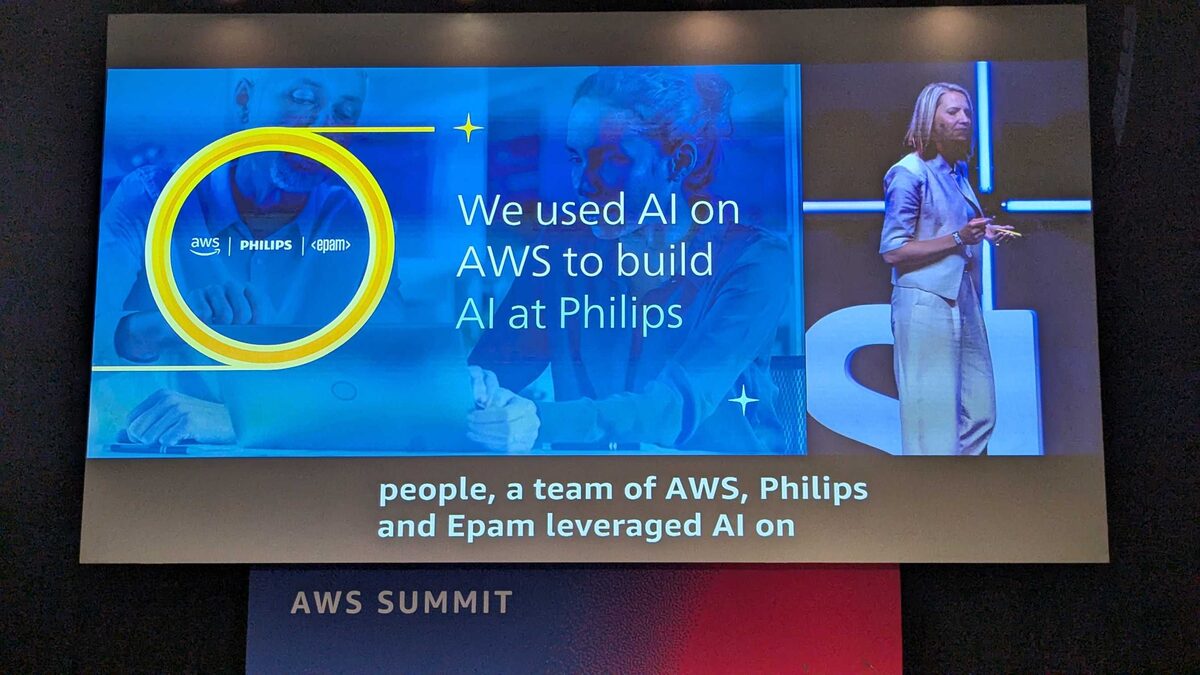
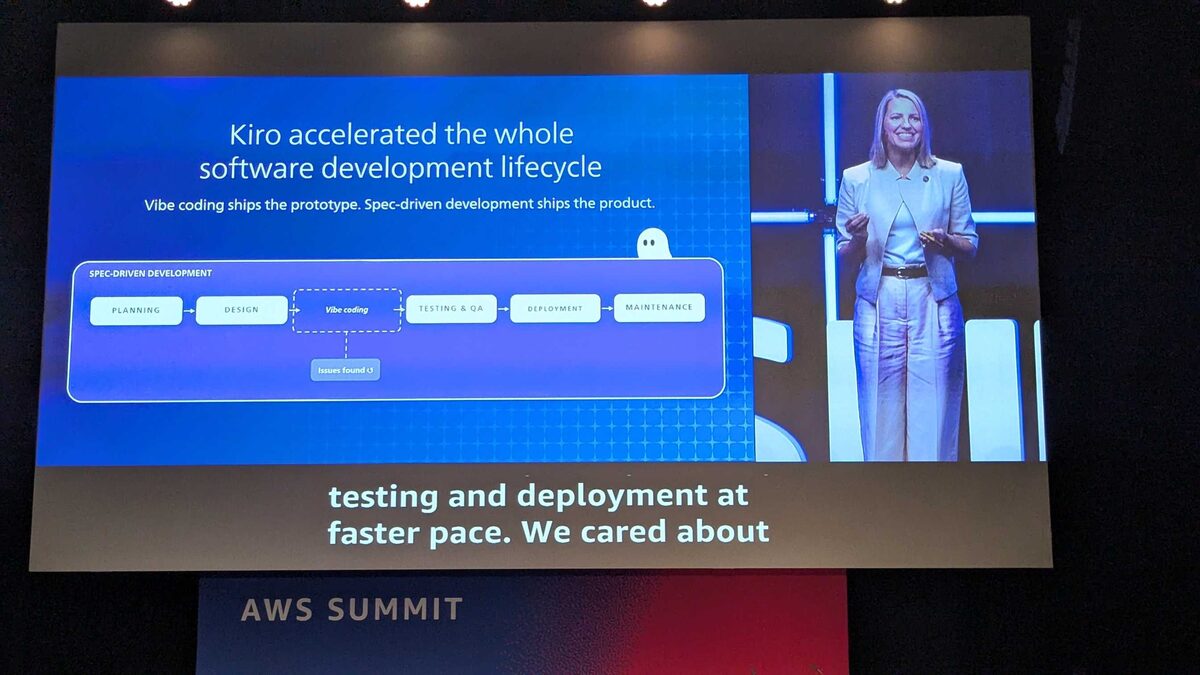
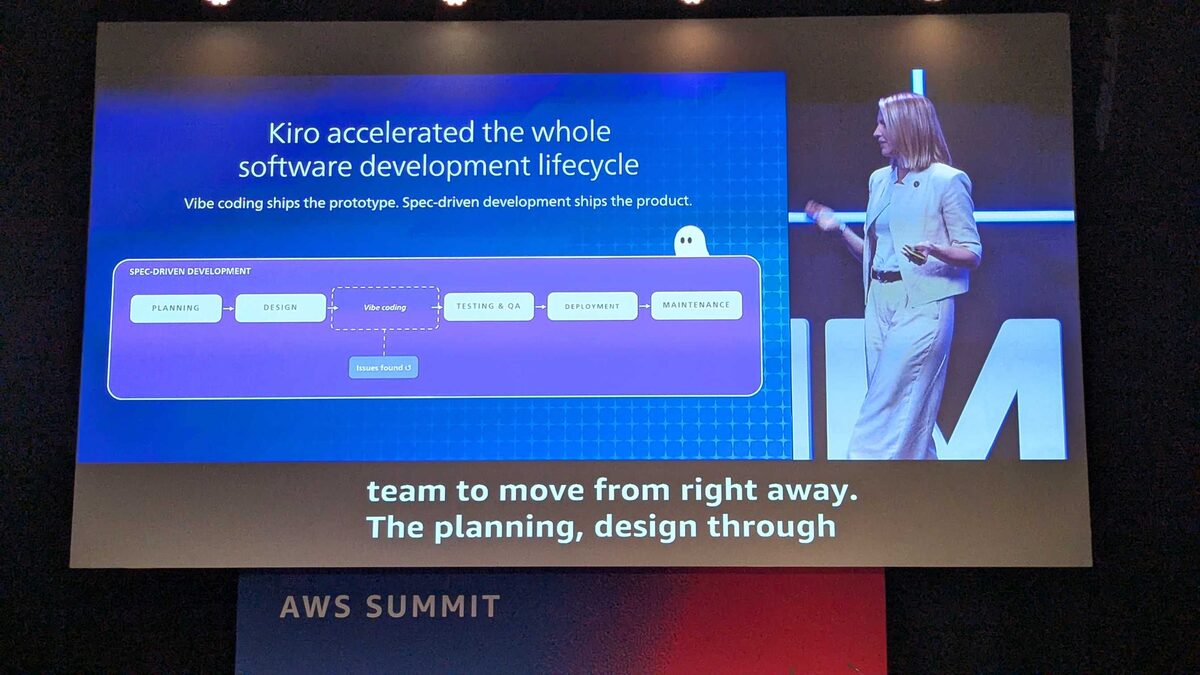
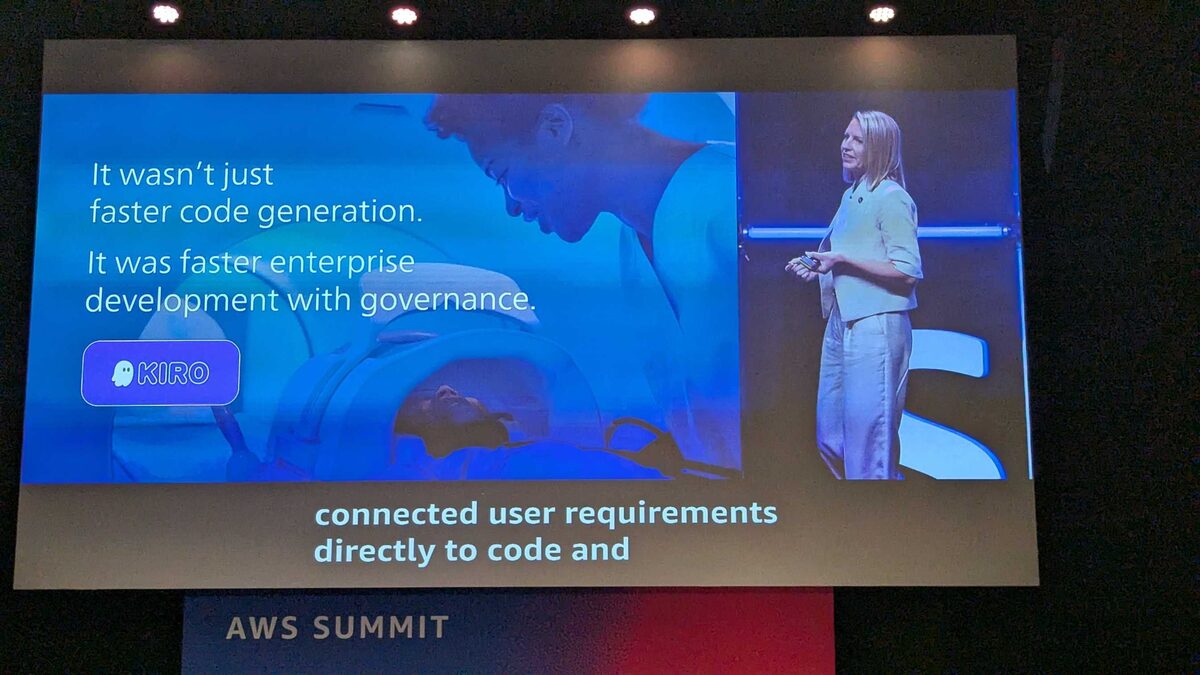
AWS introduced Kiro — their new spec-driven AI development IDE. For Philips, it changed everything. A team of AWS, Philips, and EPAM — fewer than 20 people — leveraged AI on AWS to build AI at Philips. It wasn’t just faster code generation; it was faster enterprise development with governance.
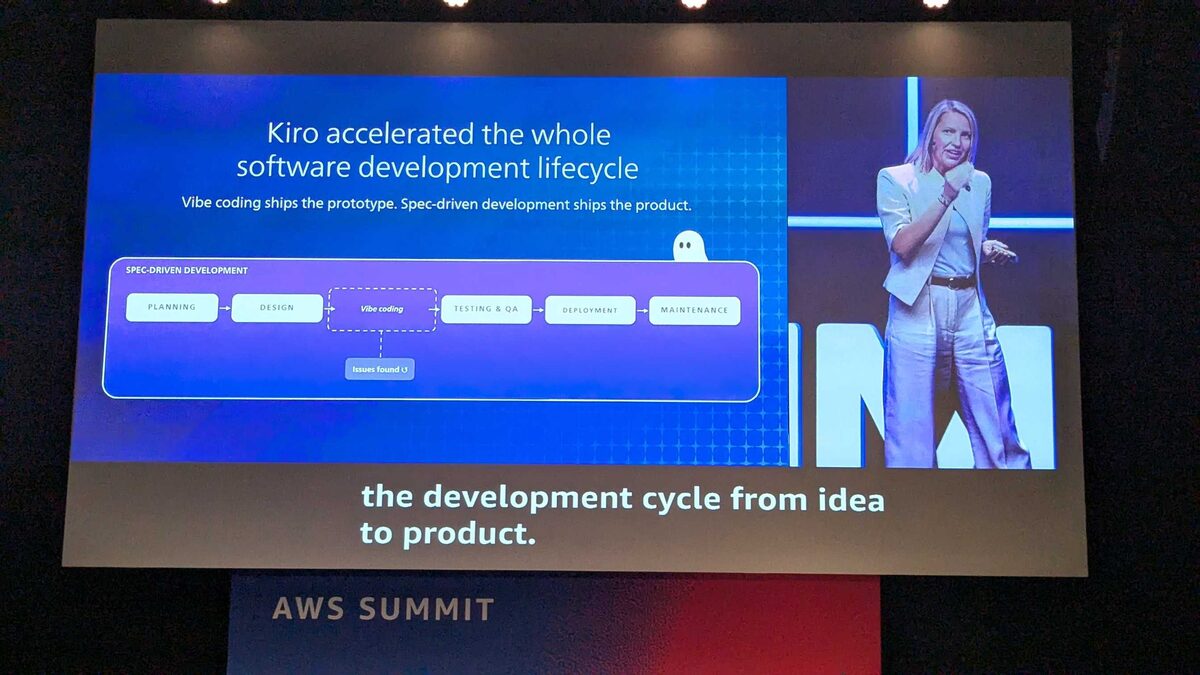
Kiro’s philosophy: “Vibe coding ships the prototype. Spec-driven development ships the product.” The full lifecycle — planning, design, vibe coding, testing & QA, deployment, maintenance — accelerated end-to-end. Connected user requirements directly to code and test cases, with the AI handling the development cycle from idea to product.
A powerful example of how healthcare regulation and enterprise governance don’t have to slow you down when your tooling is purpose-built for production.
On the Expo Floor
After the keynote, time to hit the expo floor. Great energy and packed booths across the RAI Amsterdam venue.
Stopped by Abnormal Security — behavioral AI for email security, 2x Gartner Magic Quadrant leader. Their API-first approach to detecting BEC and account takeover is impressive at enterprise scale.
Wiz had a packed booth showing their cloud security graph — attack path visualization connecting vulnerabilities, identities, and data exposure in real-time.
Great chat at the Vercel booth — always good to connect with the team behind our deployment platform!
The Xebia area was buzzing with their “Shaping with AI” messaging — Dutch consultancy making waves in the AI transformation space.
Notion and Grafana Labs side by side: “The connected AI workspace” meets “Full-stack observability with actually useful AI.” The AI messaging was everywhere this year.
And of course, the swag game was strong. AWS European Sovereign Cloud stickers with Dutch-themed designs — wooden clogs, bicycles, tulips, windmills, and unicorns. Data sovereignty never looked this cute! 🇳🇱
Key Takeaways
- AI for social good is production-ready — not just prototypes and research papers, but deployed solutions handling real data in challenging environments
- The right architecture matters — combining reasoning LLMs with vector search, geospatial clustering, and offline-first mobile creates platforms that work where infrastructure is limited
- Cloud democratizes access — a data engineer in Timor-Leste can build the same caliber system as a Silicon Valley startup, using AWS services
- Community-driven data collection scales — citizen reporting with AI classification creates a data flywheel that improves with usage
My Perspective
What struck me most was the architecture quality. This is not a simple CRUD app with an LLM bolted on. The Ecolafaek platform demonstrates:
- Proper separation of concerns (Flutter mobile, FastAPI backend, Next.js dashboards)
- AI-native design (vector search, reasoning LLM, embedding models as first-class services)
- Pragmatic technology choices (offline-first mobile, distributed SQL, Vercel for dashboard hosting)
This is exactly the kind of AI infrastructure I help enterprises build — but deployed for social impact instead of revenue optimization. The patterns are identical; the mission is different.
AWS Summit Amsterdam reminded me that the cloud infrastructure conversation has matured. We are past “should we use cloud?” and firmly into “how do we use cloud to solve problems that matter?”