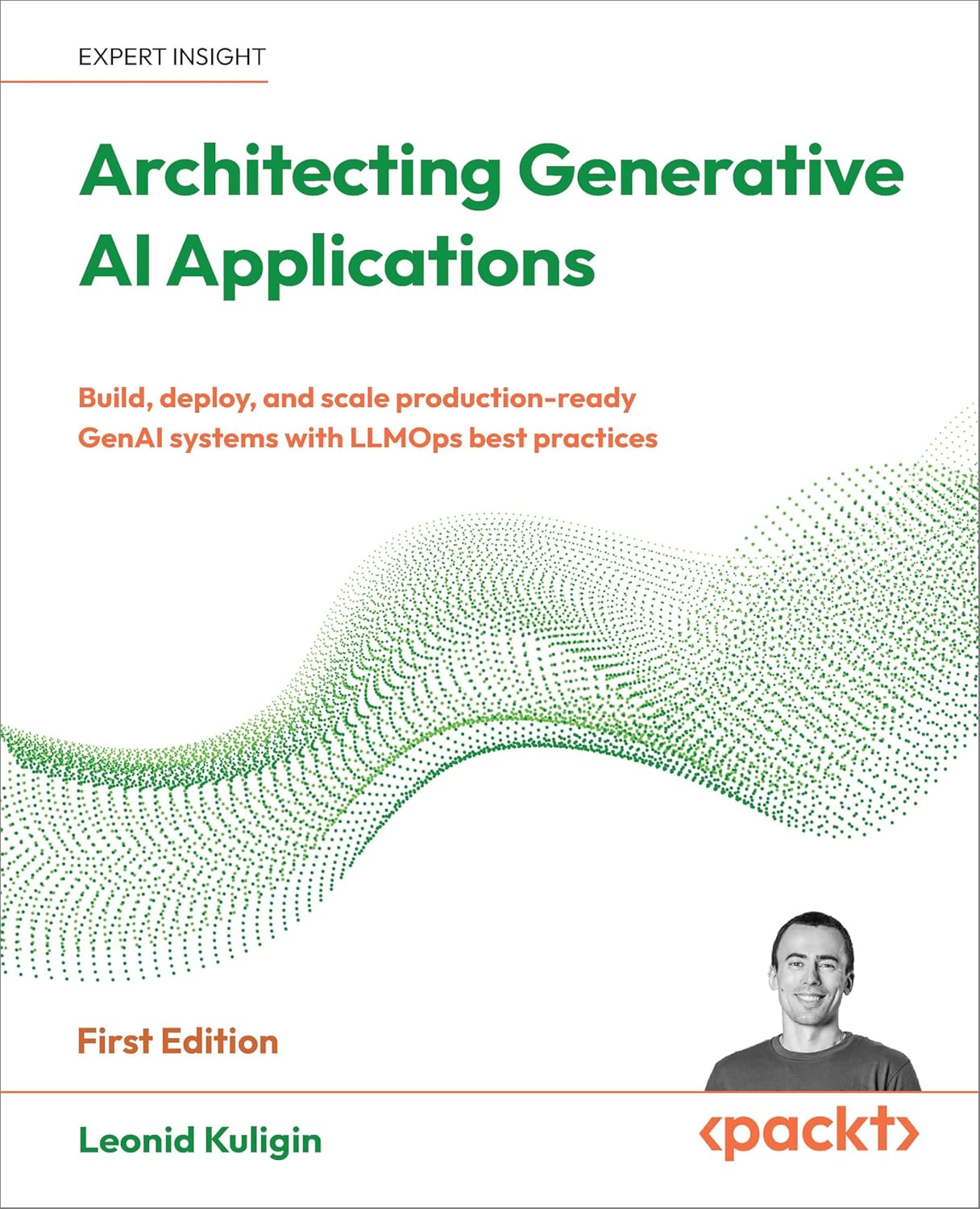
I have started reading Architecting Generative AI Applications by Leonid Kuligin, published by Packt — and it tackles one of the most important shifts in AI today: going from a GenAI prototype to a production-ready application.
📖 Book link: Architecting Generative AI Applications
Why This Book Matters
What I like about the book is the practical angle. It is not just about prompts or demos. It covers the engineering reality behind GenAI systems — the gap that most teams struggle with after the initial excitement of a working prototype fades.
This resonates strongly with what I see in enterprise environments: building with LLMs is easy to start, but hard to operationalize well. The real value comes when teams can make GenAI applications reliable, measurable, secure, and scalable — not just impressive in a demo.
Key Topics Covered
The book addresses the full lifecycle of production GenAI systems:
Evaluation of LLM Outputs
One of the hardest problems in production AI. How do you know your model’s responses are actually good? The book covers:
- Automated evaluation frameworks
- Human-in-the-loop assessment
- Regression testing for prompt changes
- Quality metrics beyond simple accuracy
RAG and Agentic Architectures
Retrieval-Augmented Generation has become the standard pattern for grounding LLM outputs in enterprise data. The book goes beyond basic RAG to cover:
- Advanced retrieval strategies (hybrid search, reranking)
- Agentic architectures where LLMs orchestrate multi-step workflows
- Tool use and function calling patterns
- Context architecture decisions that determine agent accuracy
From DevOps and MLOps to LLMOps
This is where platform engineering meets AI. The transition from traditional MLOps to LLMOps introduces new challenges:
- Model versioning is different when you are versioning prompts, not weights
- A/B testing LLM outputs requires different statistical approaches
- Cost management becomes a first-class concern (token economics)
- Latency budgets must account for multi-hop agent chains
For teams already practicing platform engineering, LLMOps extends the internal developer platform with AI-specific capabilities.
Kubernetes, Infrastructure as Code, and Deployment
Production GenAI applications need infrastructure that can:
- Scale inference endpoints based on token throughput
- Manage GPU resources efficiently across teams
- Deploy model updates without downtime
- Handle the memory requirements of large models
The book covers deployment patterns on Kubernetes, which aligns with real-world enterprise infrastructure where most AI workloads land.
Security, Privacy, and Observability
GenAI introduces unique security challenges:
- Prompt injection and OWASP Top 10 for LLMs
- Data leakage through model outputs
- PII handling in RAG pipelines
- Audit trails for AI-generated decisions
Observability for LLM applications goes beyond traditional metrics — you need to trace the reasoning chain, measure hallucination rates, and monitor cost per interaction.
A/B Testing and Online Experiments
Running experiments on LLM outputs is fundamentally different from testing button colors:
- Outputs are non-deterministic
- Quality is subjective and multi-dimensional
- Statistical significance requires different sample sizes
- User satisfaction doesn’t always correlate with output accuracy
Who Should Read This
For engineers, architects, platform teams, and technical leaders working on GenAI applications, this is a very relevant resource. Specifically:
- Platform engineers building internal AI platforms
- ML engineers transitioning from traditional ML to LLM-based systems
- Architects designing production GenAI at enterprise scale
- Engineering managers who need to understand operational complexity
The Production Gap
The book addresses what I call the “demo to production gap” — the 90% of engineering effort that happens after you get a prototype working:
| Prototype | Production |
|---|---|
| Single prompt | Prompt versioning + evaluation |
| Local model | Multi-region inference fleet |
| Manual testing | Automated regression suites |
| Ignore costs | Token budget management |
| Trust outputs | Guardrails + human review |
| Single user | Multi-tenant isolation |
This gap is where most GenAI projects fail. Having a structured reference for navigating it is valuable.
Related Reading
If you are working on production AI systems, these related articles cover specific aspects in depth:
- AI on Kubernetes: The First 90 Days — building your AI platform from scratch
- The Inference Economy — managing inference costs at scale
- NVIDIA NIM Deployment — production model serving
- LLM Quality vs Cost vs Safety — the three-way trade-off
- Context Architecture for AI Agents — from 0% to 92% accuracy
Thanks to Packt, Nimisha Dua, and Leonid Kuligin for sharing this release with the community.
📖 Get the book: Architecting Generative AI Applications