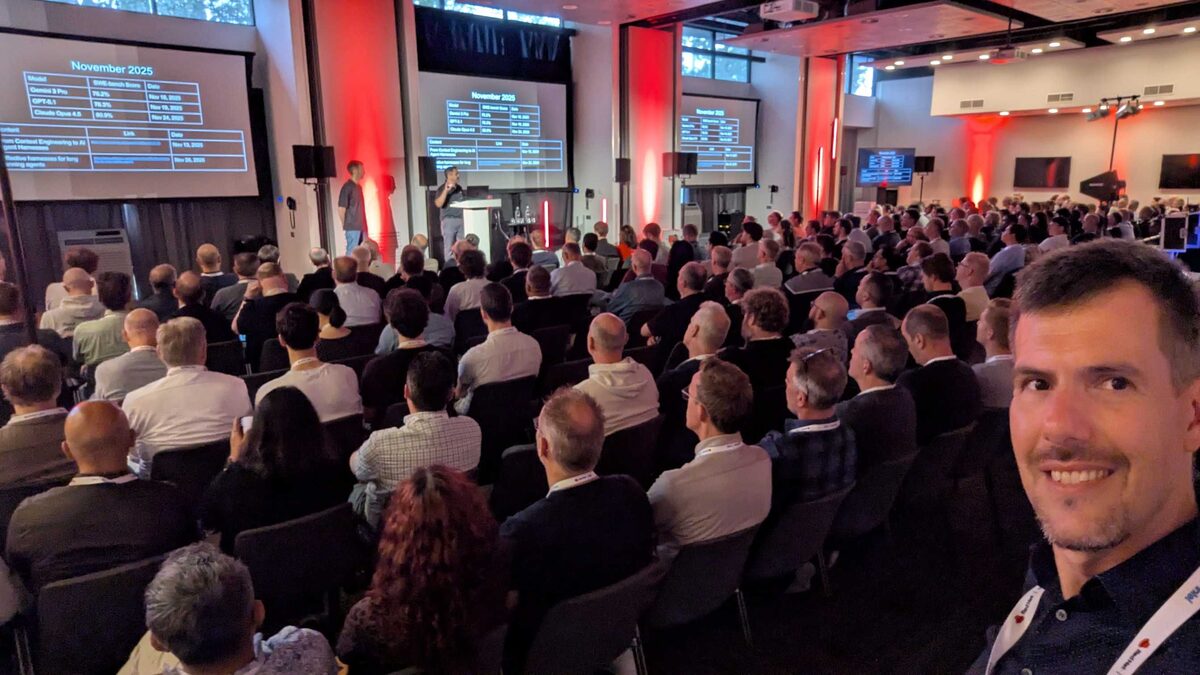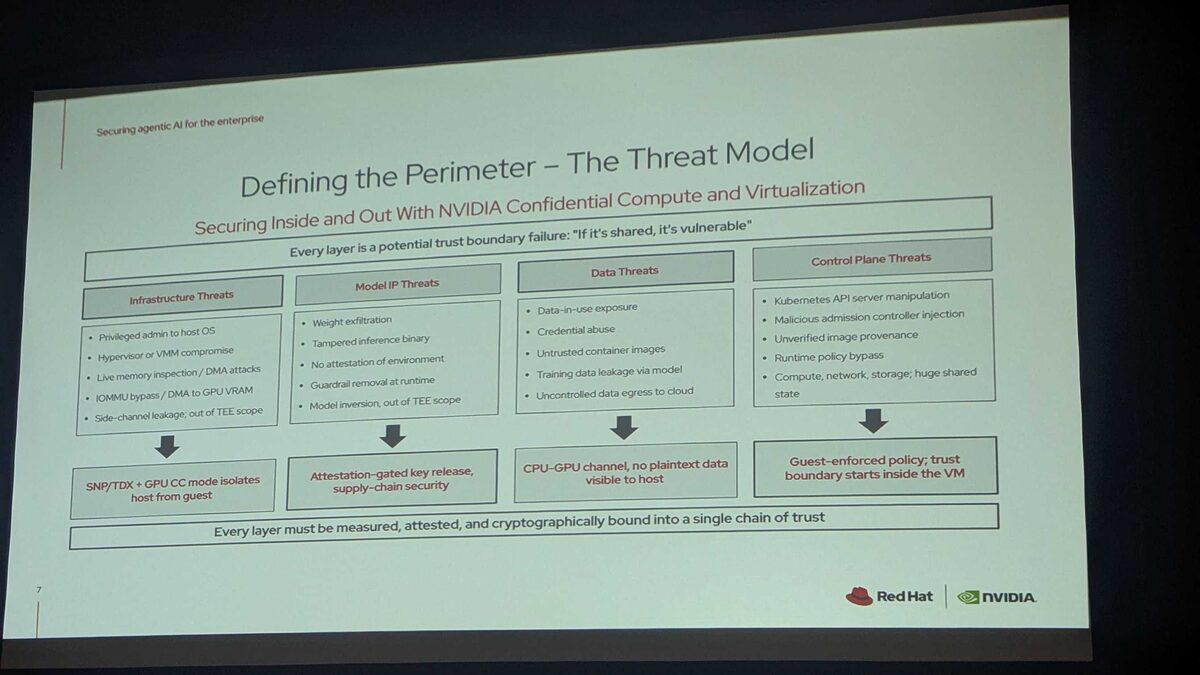
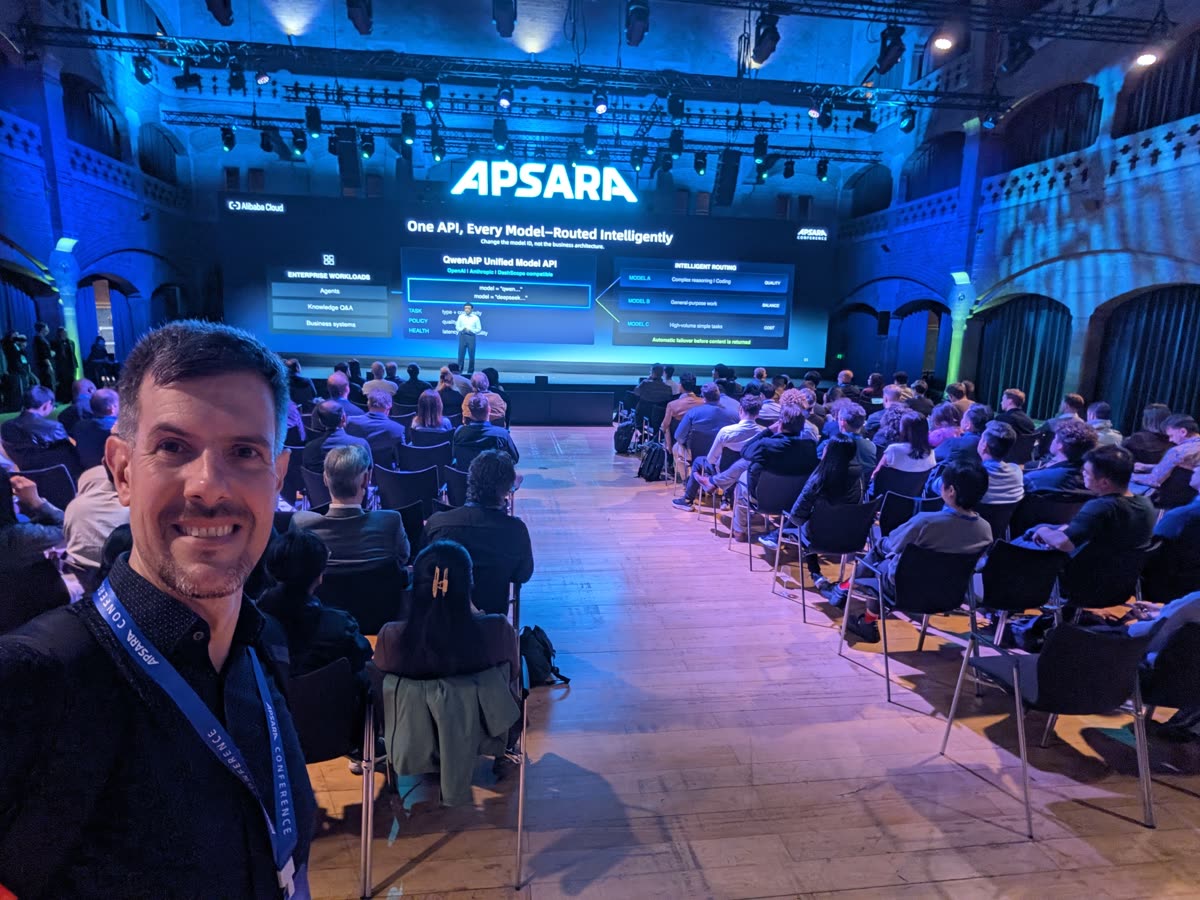
In the Beurs van Berlage, during the Qwen AI Platform session.
On 29 October 2026 Alibaba Cloud brought its Apsara Conference to Amsterdam, in the Beurs van Berlage. After the main 2026 edition in Hangzhou, this was the conference’s first European edition. The official page listed a keynote, two forums (Foundation Model & Applications, and Agentic Cloud), an invitation-only CXO forum, and an exhibition where you could try coding and e-commerce agents.
In the afternoon I sat in the Foundation Model & Applications Forum for two talks back to back: Zhao Xu on the Qwen AI Platform, and Harmke Alkemade of NVIDIA on enterprise AI agents. This post covers both, the news of the day, and a few stops in the exhibition. Everything below comes from the slides I photographed or from the sources linked at the end.
A cloud region in Amsterdam
The biggest news was not on a slide. In a press release issued the same day, Alibaba Cloud announced its first public cloud region in the Netherlands: Amsterdam, with two new data centres. It is Alibaba Cloud’s fourth region in Europe, after Frankfurt, London and Paris. Worldwide, that makes 109 availability zones in 32 regions.
Dr. Feifei Li, CTO and President of International Business at Alibaba Cloud Intelligence, called it “a direct response to the strong demand we see from local businesses.” The stated goals are lower latency, stronger disaster recovery and data that stays in the region.
More from the release:
- Services: elastic computing, storage, containers, networking, big data, security, databases and cloud-native services.
- Agentic services to follow: ACS Agent Sandbox, Agent Security Center, AI Security Guardrails 2.0, Agentic SOC and STAROps.
- Apsara Stack: a new generation of the hybrid cloud product, with more than 80 cloud and AI products. Alibaba reports 92.5% operational accuracy and a 70% automation rate for its AI-driven operations.
- Next in Europe: a first region in Finland and more data centre capacity in Germany and France within twelve months. This is part of the US$53 billion AI and cloud investment Alibaba announced earlier.
- Customers and partners: JetBrains is exploring Qwen models for its Junie AI coding assistant. orq.ai, Magnific and Idea.ai already use Alibaba’s models, and Monks is adding them to its Monks.Flow platform.
Qwen AI Platform: one API, every model
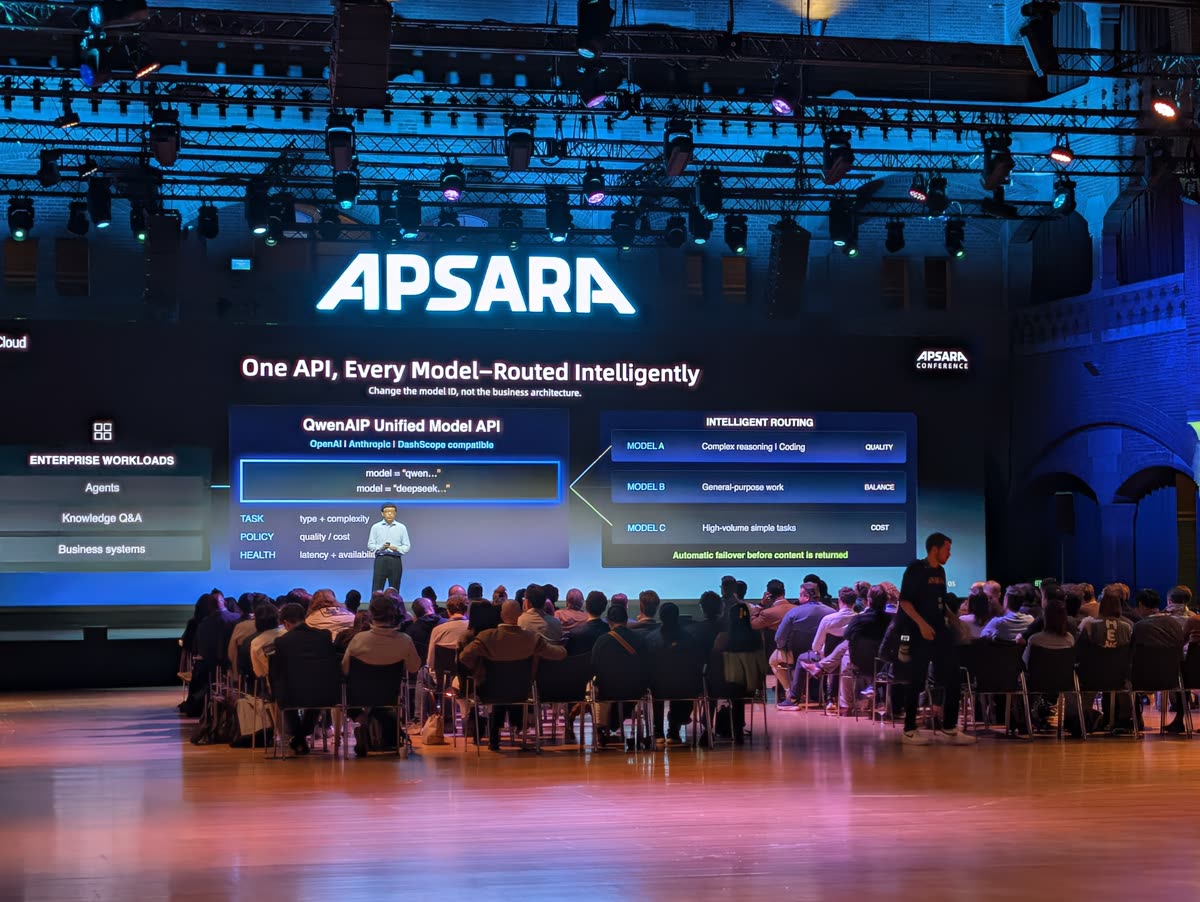
“Change the model ID, not the business architecture.”
Zhao Xu, Head of AI Application & Products for the MaaS Business Line at Alibaba Token Hub, gave “Qwen AI Platform: From Model API to Trusted AI Runtime”. He had also spoken in the morning keynote. The opening slide set the theme: one API, every model, routed intelligently.
The QwenAIP Unified Model API is compatible with OpenAI, Anthropic and DashScope. You pick a model by ID, such as qwen... or deepseek..., and the platform routes each request on three signals:
- Task: its type and complexity.
- Policy: your trade-off between quality and cost.
- Health: the latency and availability of each model.
The routing diagram had three tiers. One model for complex reasoning and coding (quality), one for general-purpose work (balance), and one for high-volume simple tasks (cost). The line that matters most in production was at the bottom: “Automatic failover before content is returned.” A failing model is swapped out before your client receives anything.
The product behind all this is Alibaba Cloud Model Studio, which closed the talk as the “one-stop shop for model services”.
From enterprise data to model assets
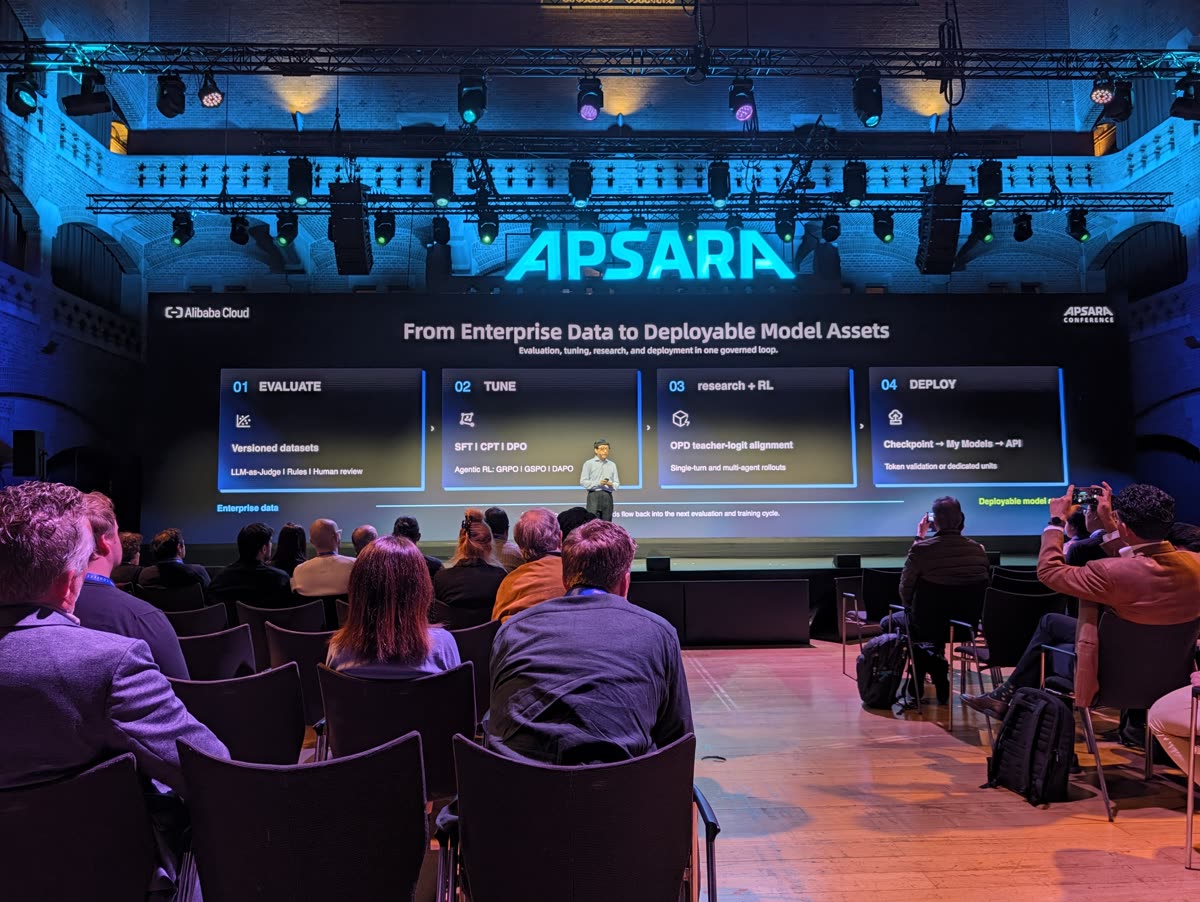
One governed loop from your data to a model you can call.
The second idea was that your data should become models you own, in one governed loop:
- Evaluate with versioned datasets, LLM-as-a-judge, rules and human review.
- Tune with SFT, CPT and DPO, plus agentic reinforcement learning with GRPO, GSPO and DAPO.
- Research and RL with OPD teacher-logit alignment, and single-turn or multi-agent rollouts.
- Deploy from checkpoint to “My Models” to an API, with “token validation or dedicated units”.
Pay for the workload you run
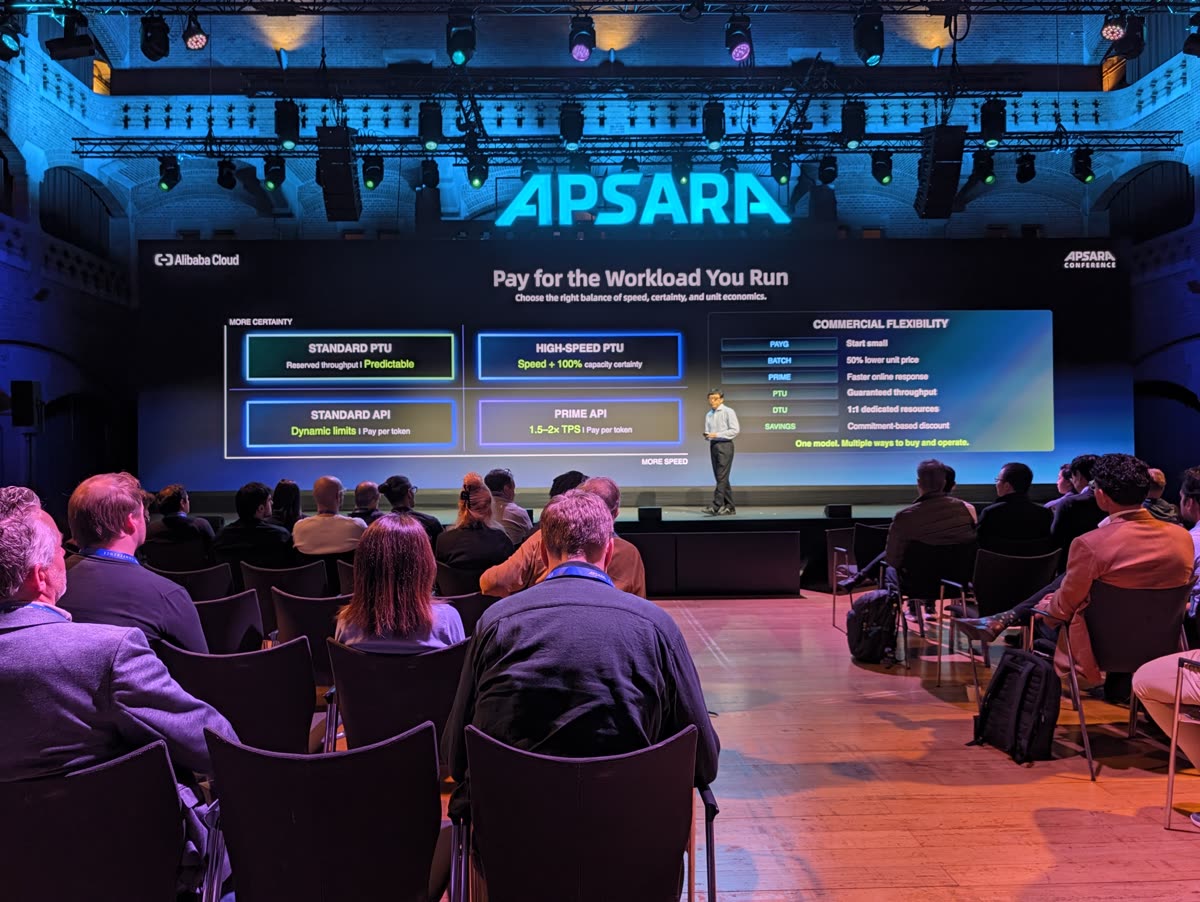
“One model. Multiple ways to buy and operate.”
Pricing got its own slide. The same model can be bought in several ways:
| Option | What you get |
|---|---|
| PAYG | Pay per token, start small |
| Batch | 50% lower unit price, results within 24 hours |
| Prime API | 1.5 to 2 times the tokens per second, still pay per token |
| Standard PTU | Reserved, predictable throughput |
| High-speed PTU | Speed plus 100% capacity certainty |
| DTU | 1:1 dedicated resources |
| Savings | A discount for a commitment |
Around it were the controls a FinOps team asks for. Dedicated workspace endpoints. AutoTPM soft limits that absorb bursts. Usage broken down by account, key and workspace. Budgets, alerts and traceable bills. Routing and savings recommendations. The slide called the APIs “agent-native”: the path goes from the console to the API and CLI, and then to Skills.
Global reach, regional control
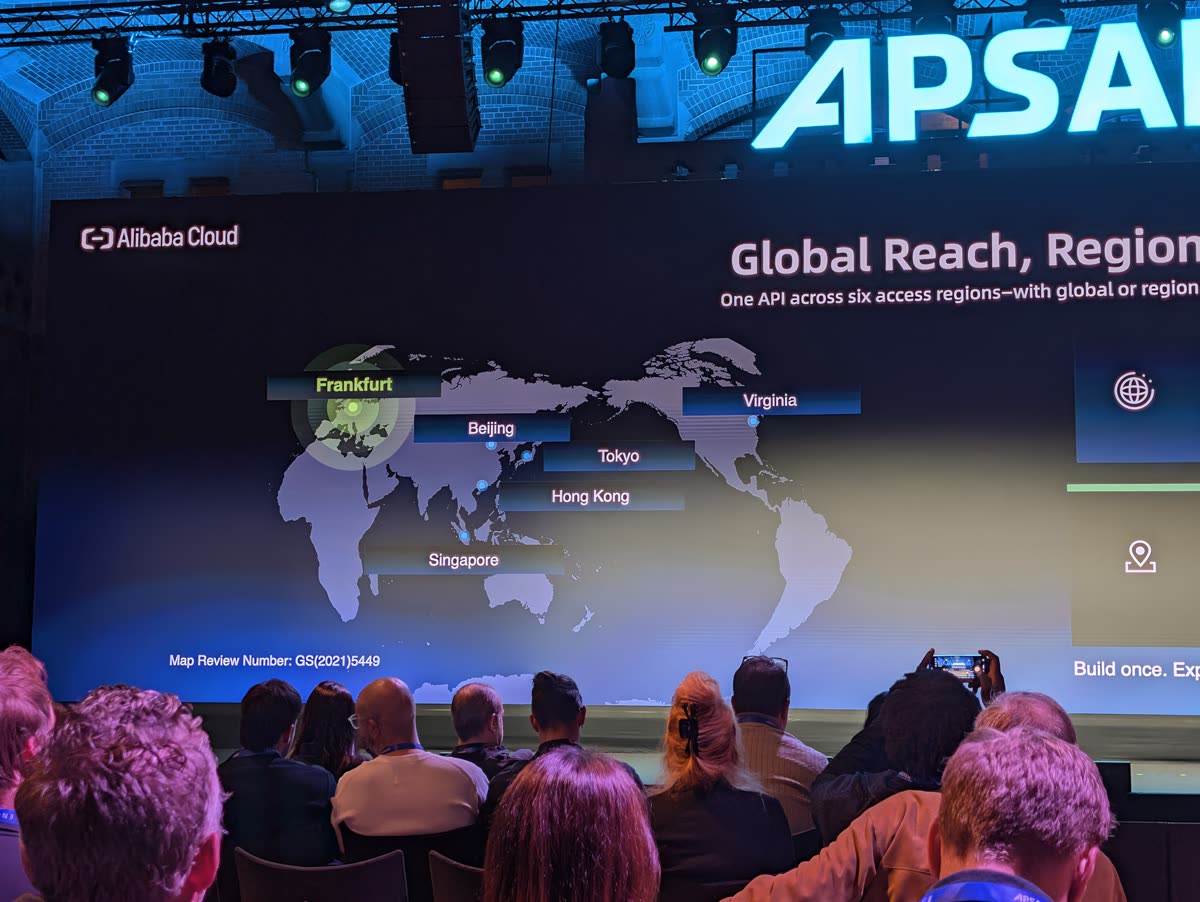
One API across six access regions.
The API is served from six access regions: Frankfurt, Beijing, Virginia, Tokyo, Hong Kong and Singapore, in a global or a regional mode. On this map, Frankfurt was the only access point in Europe. The new Amsterdam region launches with general cloud services, and the slide did not list it for the model API. If keeping model calls in the EU matters to you, check the Model Studio regions page for where your endpoint runs.
Trust you can verify
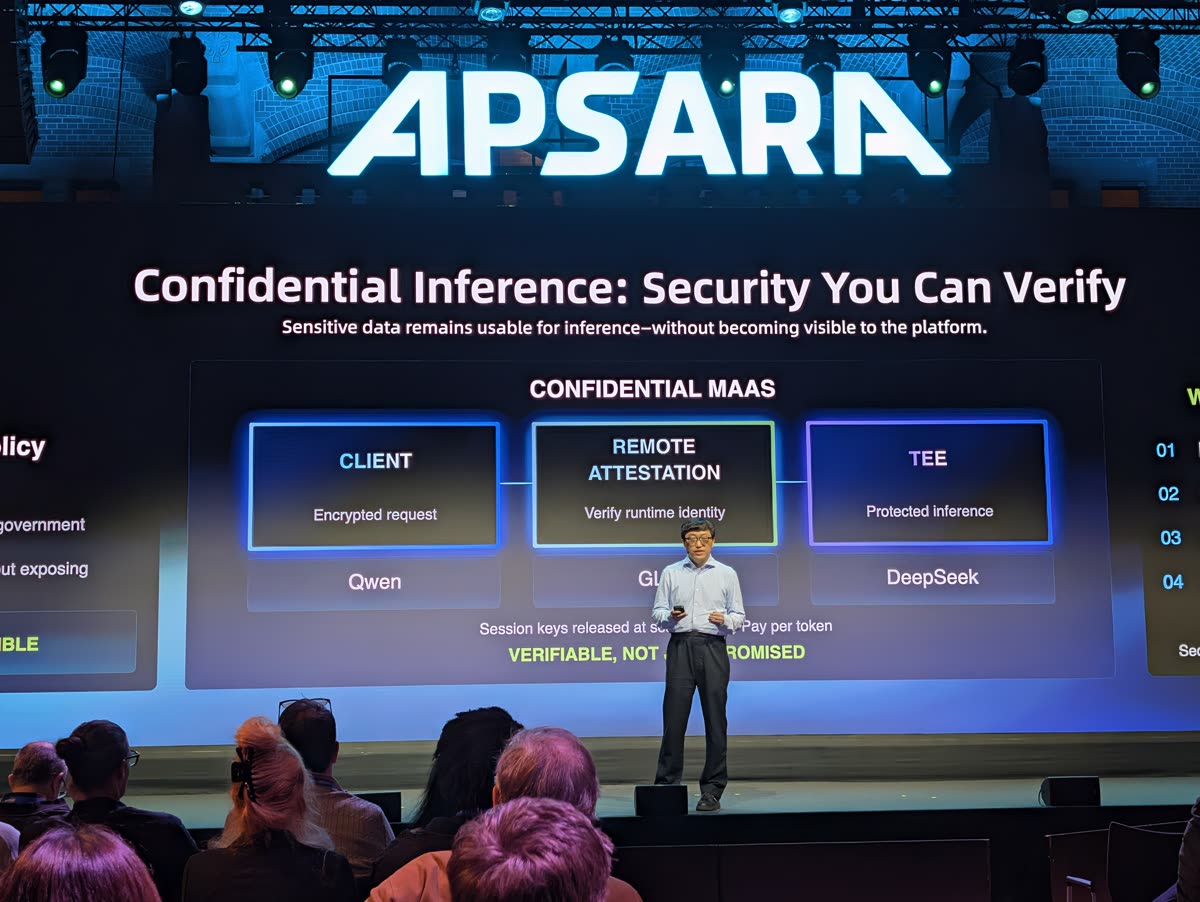
Confidential MaaS: an encrypted request, remote attestation, then inference inside a TEE.
Two slides covered security. The first, “Trust by Design”, followed data across five hops: customer, network, platform, inference and audit. At each hop there was a control. Private access over a dedicated line or VPC. Encryption, BYOB and zero data retention options. An isolated runtime with BYOM, sandboxes and confidential AI. Logs, content safety and an operations audit. One sentence stood on its own: “Your data is not used to train platform models.”
The second slide was about confidential inference: “Sensitive data remains usable for inference—without becoming visible to the platform.” The client sends an encrypted request. Remote attestation verifies the identity of the runtime. Inference runs inside a trusted execution environment (TEE). Qwen and DeepSeek were on the slide; a third model was hidden behind the speaker.
Remote attestation is what turns this from a promise into something you can check. I wrote about the building blocks in Confidential Computing for AI.
From model API to trusted AI runtime
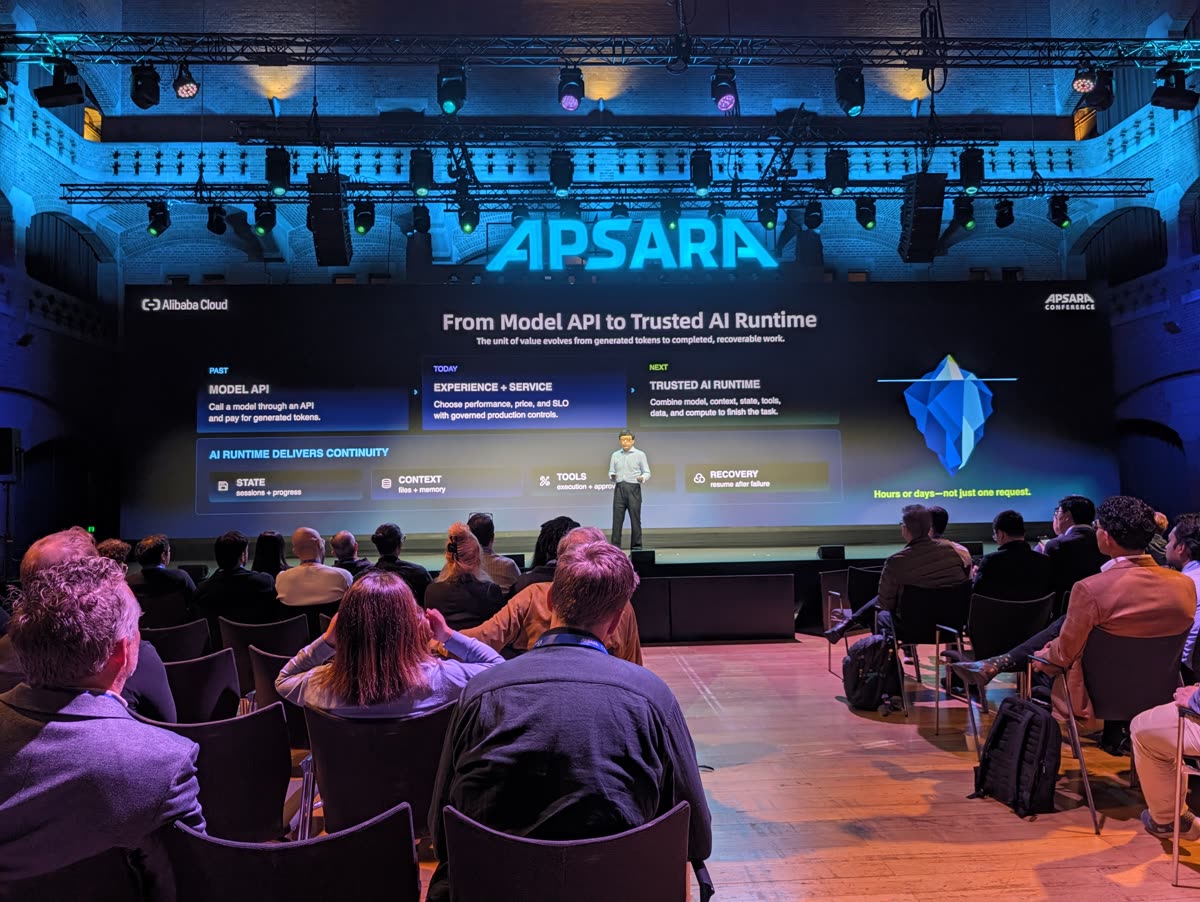
“The unit of value evolves from generated tokens to completed, recoverable work.”
The scale slide, “Engineered for 100× Scale”, claimed a 99.9% availability SLA, more than 20 service regions, more than 30 accelerator types and “100K+ request-level scheduling”. It named the building blocks: Global KVCache, DashMesh, DashScaler, and DashServing with Cells. Performance is measured in time to first token, user tokens per second, P95 and P99 latency, and task completion time. The model library has more than 200 curated models.
The last idea gave the session its title, and it was the one I found most interesting. The slide drew three stages: the model API of the past, today’s “experience + service”, and next a “trusted AI runtime”. That runtime keeps four things for the length of a job:
- State: sessions and progress.
- Context: files and memory.
- Tools: execution and approval.
- Recovery: resume after a failure.
The time scale on the slide: “Hours or days—not just one request.”
NVIDIA: harnesses, shells and routers
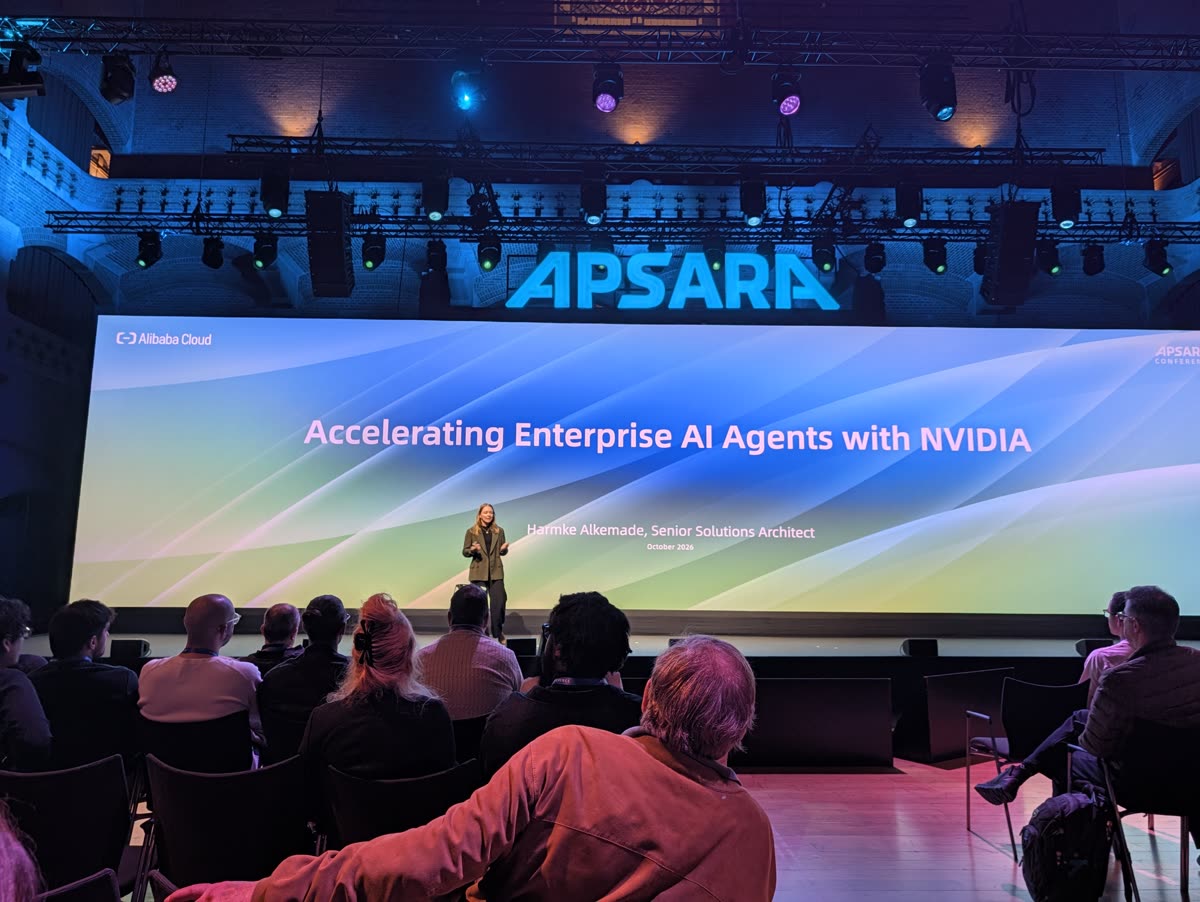
Harmke Alkemade, Senior Solutions Architect at NVIDIA.
Right after the Qwen session, Harmke Alkemade, Senior Solutions Architect at NVIDIA, gave “Accelerating Enterprise AI Agents with NVIDIA”.
Open weights are taking the tokens
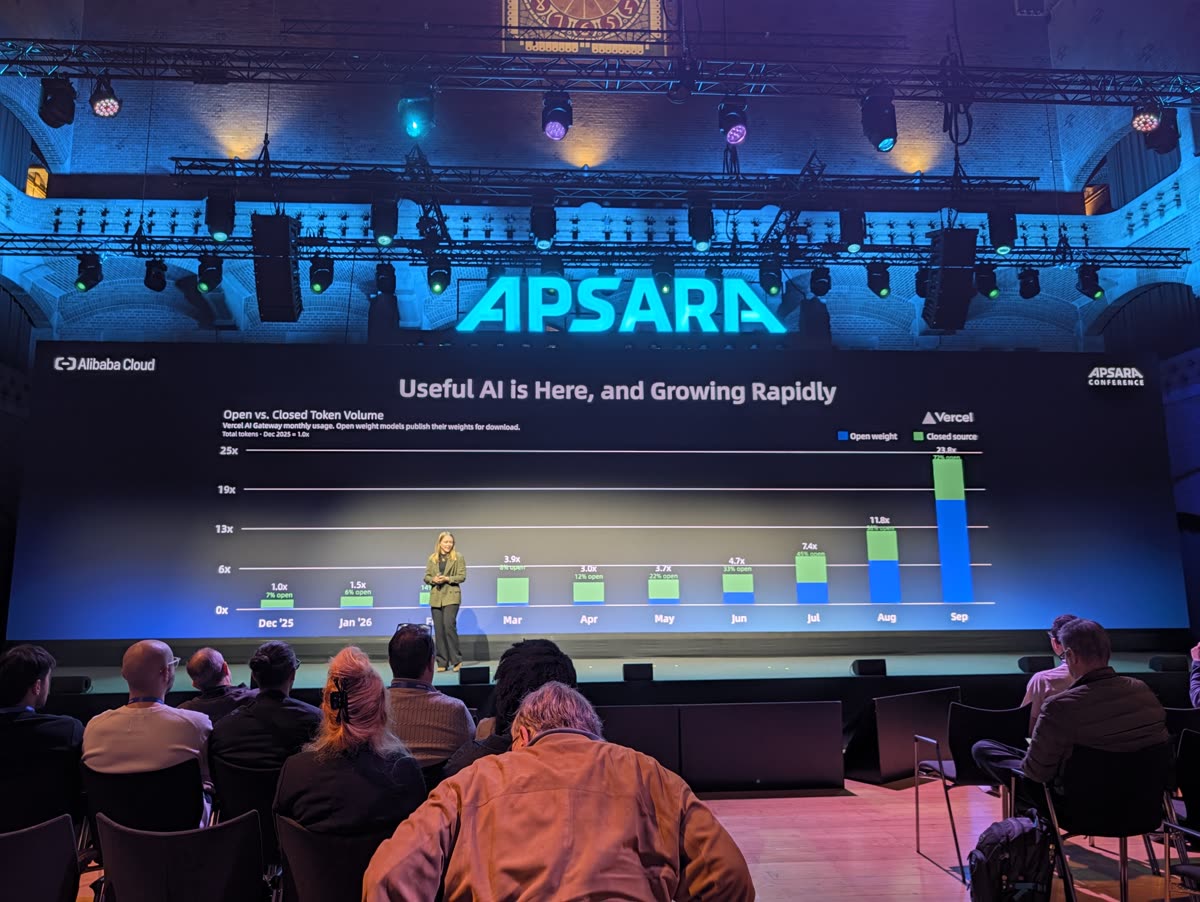
Monthly token volume on Vercel AI Gateway, open versus closed models.
Her first chart used Vercel AI Gateway’s monthly usage, indexed to December 2025. In December 2025, open-weight models had 7% of the tokens. By June 2026 total volume was 4.7 times higher, with 33% open-weight. By September 2026 it was 23.8 times higher, with 72% open-weight. That is one gateway’s traffic, not the whole market, but it is a big shift in nine months.
A harness for the agent, a shell around it
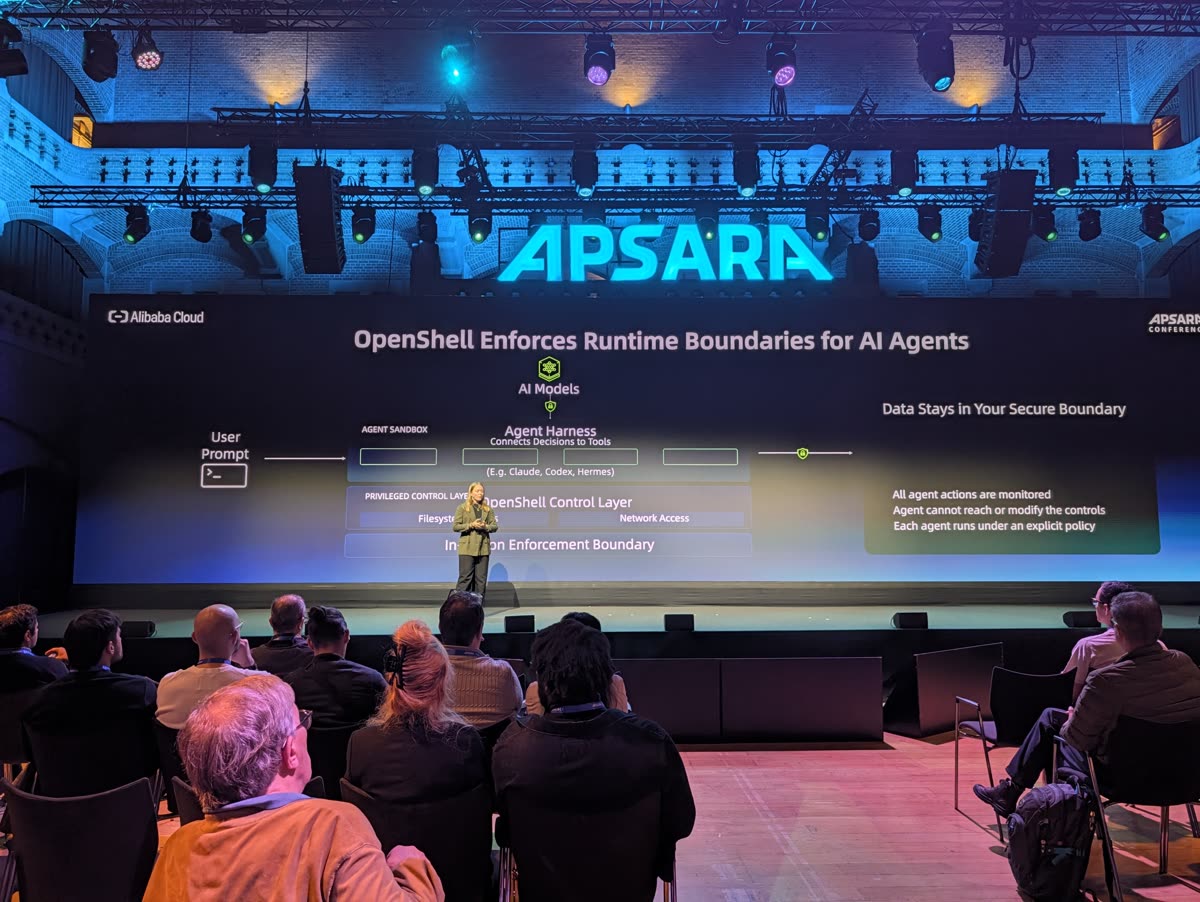
OpenShell sits between the agent harness and the filesystem and network.
NVIDIA described agents as a new computing platform built around a harness: context, state, tools, evaluation, loop orchestration, a sandbox and a policy. OpenShell is the part that enforces the limits. NVIDIA describes it as an open-source runtime that runs autonomous agents in sandboxes with kernel-level isolation, under declarative policies. The slide showed Claude, Codex and Hermes as example harnesses, and made four promises:
- all agent actions are monitored;
- the agent cannot reach or modify the controls;
- each agent runs under an explicit policy;
- data stays inside your secure boundary.
I agree with the design: limits belong outside the agent, where it cannot change them. More on that in Guardrails for AI Agents in Production.
Switchyard: a model for each step
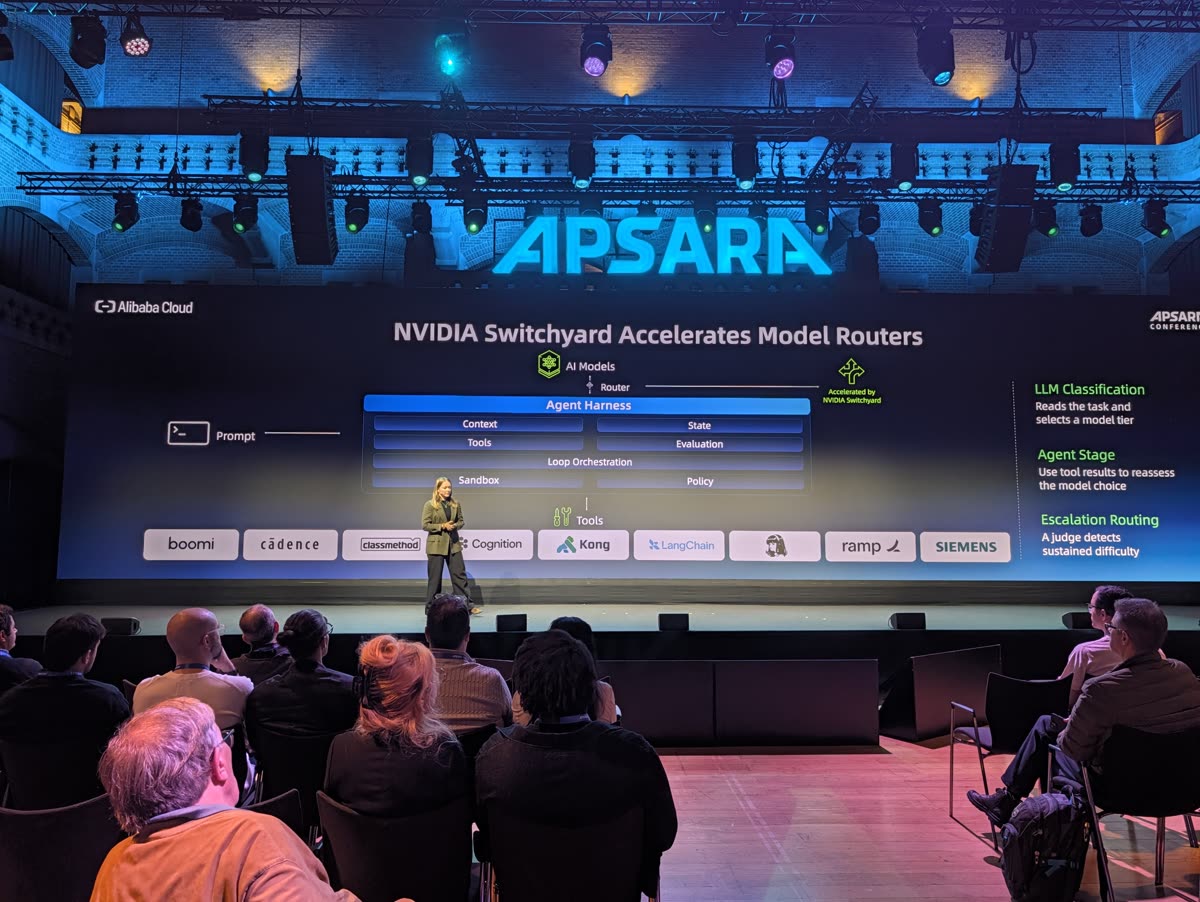
Three routers: LLM classification, agent stage and escalation.
Routing came back, this time across providers. NeMo Switchyard is NVIDIA’s open-source routing library, released in August 2026 together with Nemotron 3.5 Lightning. It picks a model for each step of an agent workflow. The slide showed three routers: an LLM classifier, an agent-stage router and an escalation router. Below them were the logos of Boomi, Cadence, Classmethod, Cognition, Kong, LangChain, Ramp and Siemens.
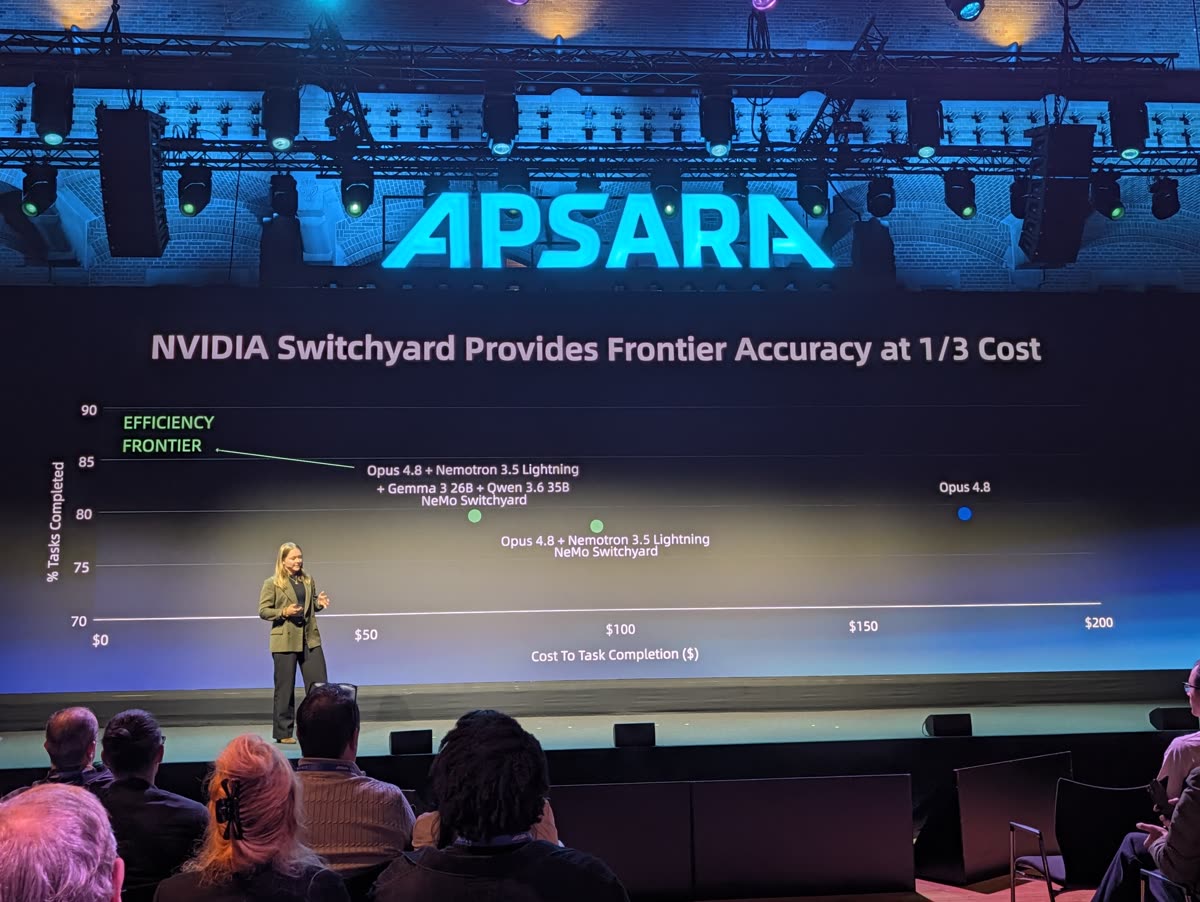
Two Switchyard mixes against Opus 4.8 on its own.
The headline chart plotted task completion against cost. Opus 4.8 on its own sat at the expensive end. Two Switchyard mixes reached about the same completion rate for much less money: Opus 4.8 with Nemotron 3.5 Lightning, and Opus 4.8 with Nemotron 3.5 Lightning, Gemma 3 26B and Qwen 3.6 35B. The frontier model takes the hard steps and smaller models take the rest.
Qwen on NVIDIA from day zero
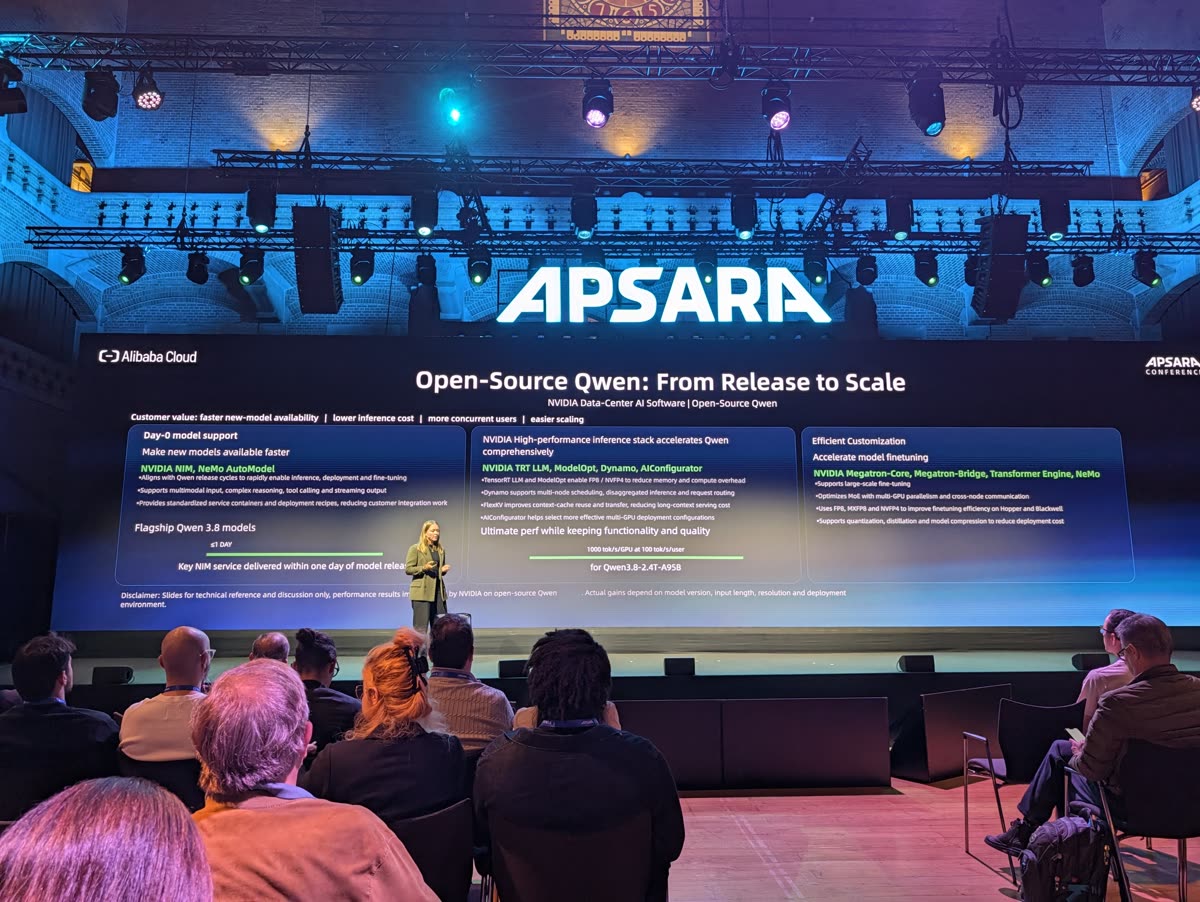
“Open-Source Qwen: From Release to Scale.”
One slide tied the two talks together. NVIDIA supports new Qwen releases from day 0 with NIM and NeMo AutoModel. For the flagship Qwen 3.8 models, a key NIM service was delivered within one day of release.
- Serving: TensorRT-LLM and ModelOpt (FP8 and NVFP4), Dynamo, FlexKV and AIConfigurator. The slide claimed 1,000 tokens per second per GPU at 100 tokens per second per user for Qwen3.8-2.4T-A95B.
- Fine-tuning: Megatron-Core, Megatron-Bridge, Transformer Engine and NeMo, with FP8, MXFP8 and NVFP4 on Hopper and Blackwell.
NVIDIA’s own footnote: actual gains depend on the deployment.
How Nemotron 3 Ultra was made
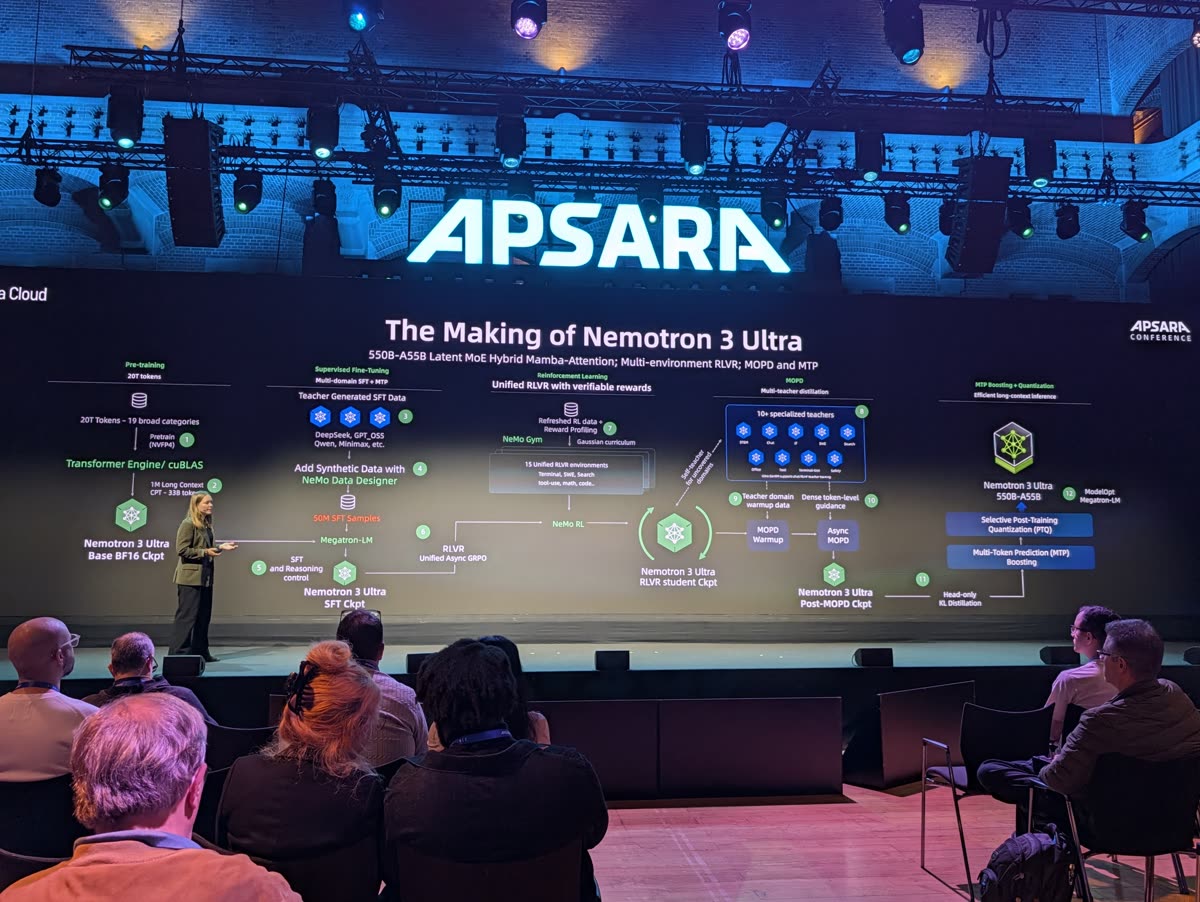
“The Making of Nemotron 3 Ultra”, from pre-training to quantization.
Then came NVIDIA’s own model. The slide described Nemotron 3 Ultra as a 550B-A55B latent mixture-of-experts with a hybrid Mamba-Attention architecture, and walked through how it was trained:
- Pre-training: 20T tokens across 19 broad categories, in NVFP4, then a 1M-token long-context CPT stage on 33B tokens.
- Supervised fine-tuning: teacher-generated data from DeepSeek, GPT-OSS, Qwen, MiniMax and others, plus synthetic data from NeMo Data Designer. That makes 50M SFT samples, trained with Megatron-LM.
- Reinforcement learning: unified RLVR (reinforcement learning with verifiable rewards) in 15 NeMo Gym environments covering terminal, SWE, search, tool use, math and code, with asynchronous GRPO in NeMo RL.
- Distillation: MOPD, multi-teacher distillation from more than ten specialized teachers.
- Inference: multi-token prediction (MTP) and selective post-training quantization with ModelOpt, for efficient long-context inference.
Qwen is in that teacher list. Open models now help train each other, across vendors.
On the exhibition floor
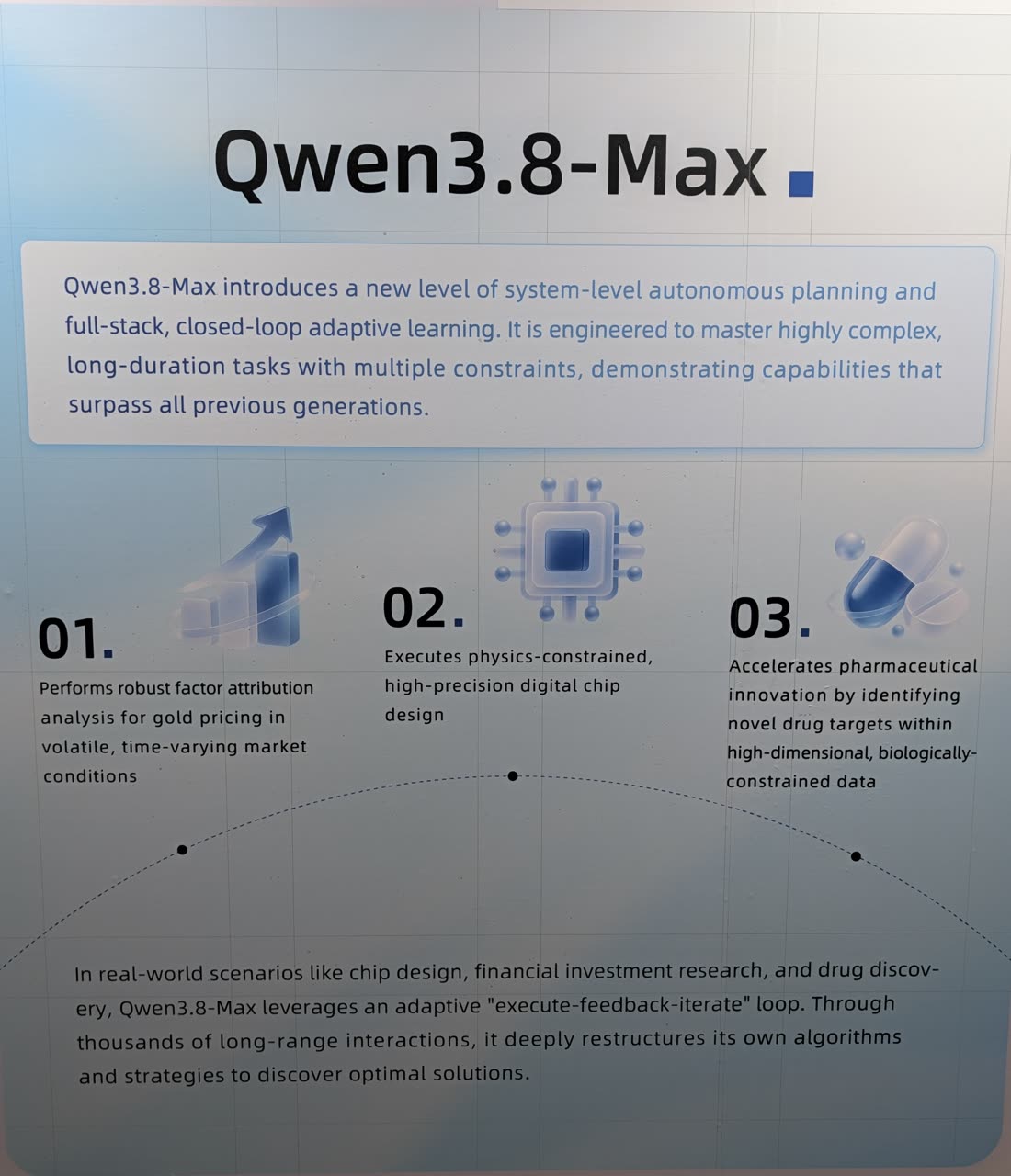
The Qwen3.8-Max panel in the exhibition area.
After the talks I walked the exhibition. One panel introduced Qwen3.8-Max as a model for “system-level autonomous planning and full-stack, closed-loop adaptive learning”, built for “highly complex, long-duration tasks with multiple constraints”. It gave three examples:
- factor attribution for gold pricing in volatile, time-varying markets;
- physics-constrained, high-precision digital chip design;
- new drug targets in high-dimensional, biologically constrained data.
The method it described is an “execute-feedback-iterate” loop over “thousands of long-range interactions”. It is the same theme as the trusted AI runtime: work that runs for a long time and corrects itself along the way.
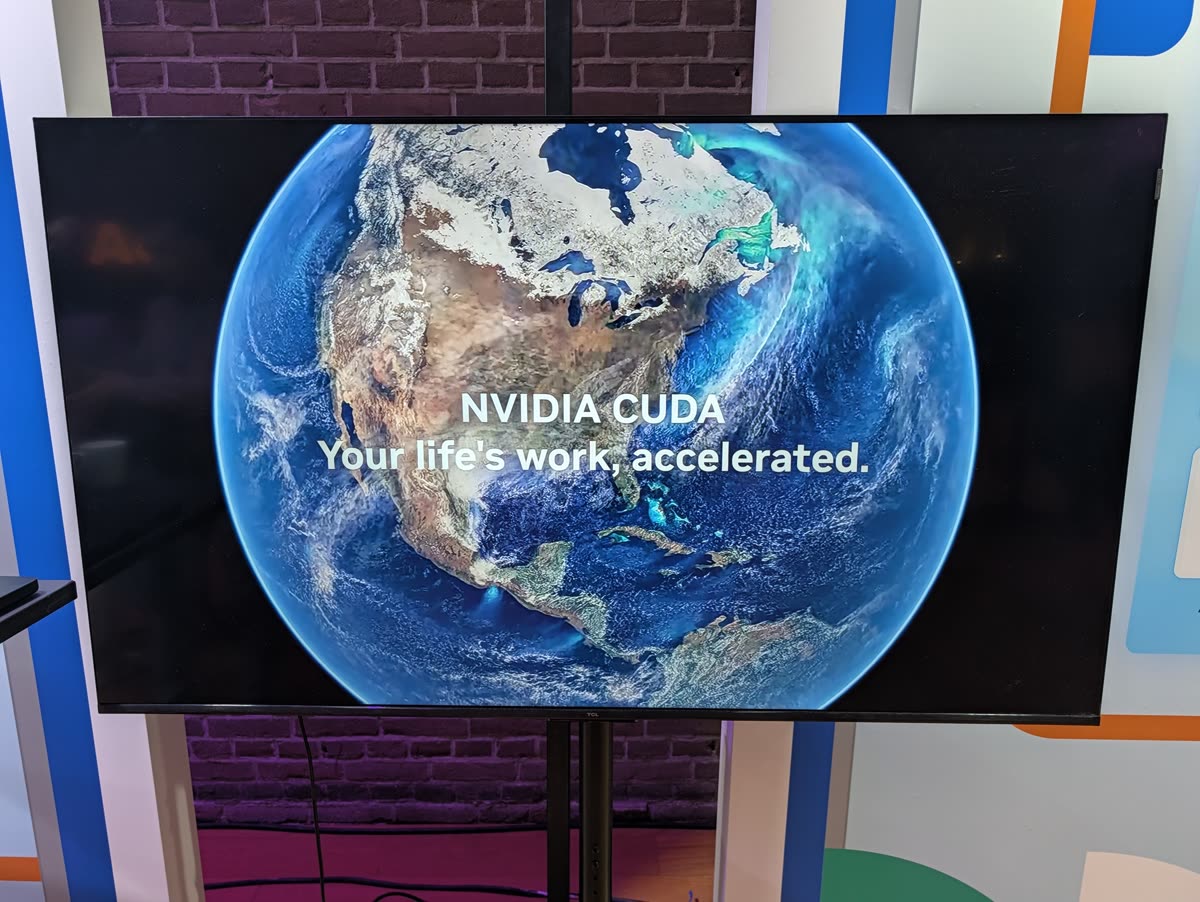
An NVIDIA CUDA video on a screen in the exhibition area.
Nearby, a screen looped an NVIDIA CUDA video with customer stories from G42, Foxconn, Argonne National Laboratory, Lawrence Livermore’s National Ignition Facility and Quantinuum. It ended on “NVIDIA CUDA. Your life’s work, accelerated.”
What I take home
- Routing is now a platform feature. Alibaba routes inside its API on task, policy and health. NVIDIA ships Switchyard so you can route across providers yourself. Either way, the model ID becomes configuration, not architecture.
- The unit of work is growing. Alibaba’s trusted AI runtime and NVIDIA’s harness with OpenShell describe the same thing: agents that run for hours, keep state, recover after failures and stay inside enforced limits.
- Verify, don’t trust. Confidential inference with remote attestation, zero data retention and a no-training statement are the right things to ask for with regulated data. Ask for the attestation evidence and the contract terms, not just the slide.
- Open models feed each other. Qwen is one of the teachers in Nemotron 3 Ultra’s training data, and NVIDIA says it delivered a NIM service for the flagship Qwen 3.8 models within a day of their release. Open weights are becoming shared infrastructure across vendors.
- Check where your tokens run. The Amsterdam region is good news for data residency. On the slide, though, the model API’s only European access point was Frankfurt.
Sources
- Apsara Conference 2026 Amsterdam, Alibaba Cloud: agenda and speakers.
- Alibaba Cloud Launches First Public Cloud Region in the Netherlands, press release, 29 October 2026.
- Alibaba Cloud Model Studio documentation and Model Studio regions.
- NVIDIA OpenShell overview, NVIDIA documentation.
- Route AI Agent Workloads Across Models with NVIDIA NeMo Switchyard, NVIDIA Technical Blog.
- The slides I photographed in the hall: the Qwen AI Platform session (Alibaba Cloud) and “Accelerating Enterprise AI Agents with NVIDIA” (Harmke Alkemade, NVIDIA).