At Red Hat Tech Day Netherlands (June 2026), the Ansible team unveiled three AI capabilities that fundamentally change how organizations interact with their automation platform:
- Automation Intelligent Assistant (AIA) — a chatbot embedded in AAP with BYOK RAG
- MCP Server for AAP — expose automation capabilities as declarative endpoints to any LLM
- BYOM Provider Matrix — flexible AI backend connectivity
Automation Intelligent Assistant (AIA)
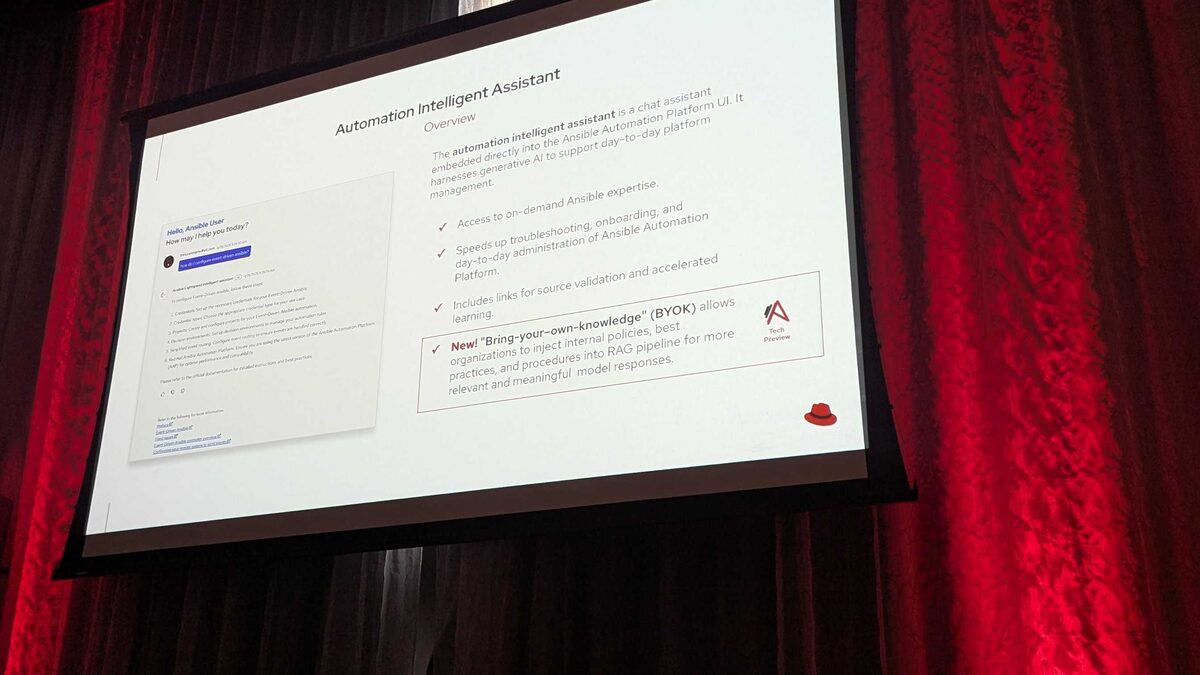
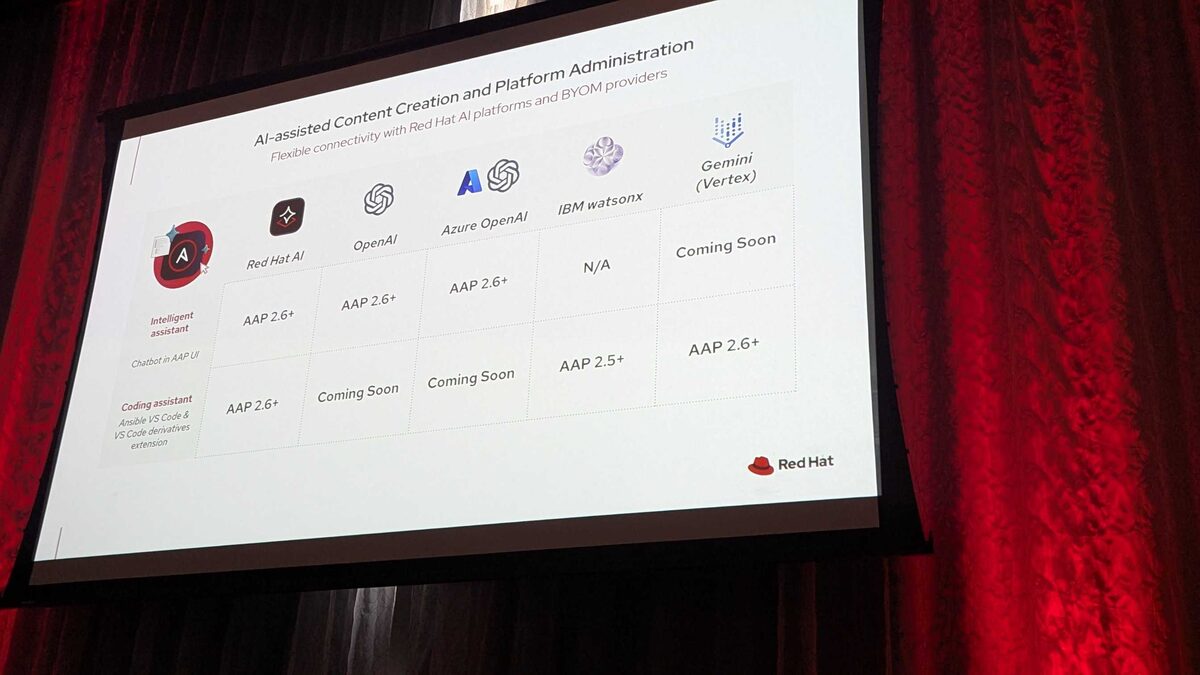
The Automation Intelligent Assistant is a chat assistant embedded directly into the Ansible Automation Platform UI. It harnesses generative AI to support day-to-day platform management.
Core Capabilities
- Access to on-demand Ansible expertise — ask questions, get answers with source links
- Speeds up troubleshooting, onboarding, and day-to-day administration of Ansible Automation Platform
- Includes links for source validation and accelerated learning — never blindly trust AI output
- New! “Bring-Your-Own-Knowledge” (BYOK) allows organizations to inject internal policies, best practices, and procedures into RAG pipeline for more relevant and meaningful model responses
BYOK: Why Your Knowledge Matters
The key insight from the talk: if you bring your own model (BYOM), you also need to bring your own knowledge (BYOK).
An LLM knows generic Ansible best practices. But it doesn’t know:
- Your company’s change management procedures
- Your specific network topology and naming conventions
- Your compliance requirements (PCI-DSS, HIPAA, SOC2)
- Your runbook for “what to do when the firewall team says no”
BYOK injects this organizational knowledge into the RAG pipeline so the assistant gives answers grounded in YOUR reality, not generic documentation.
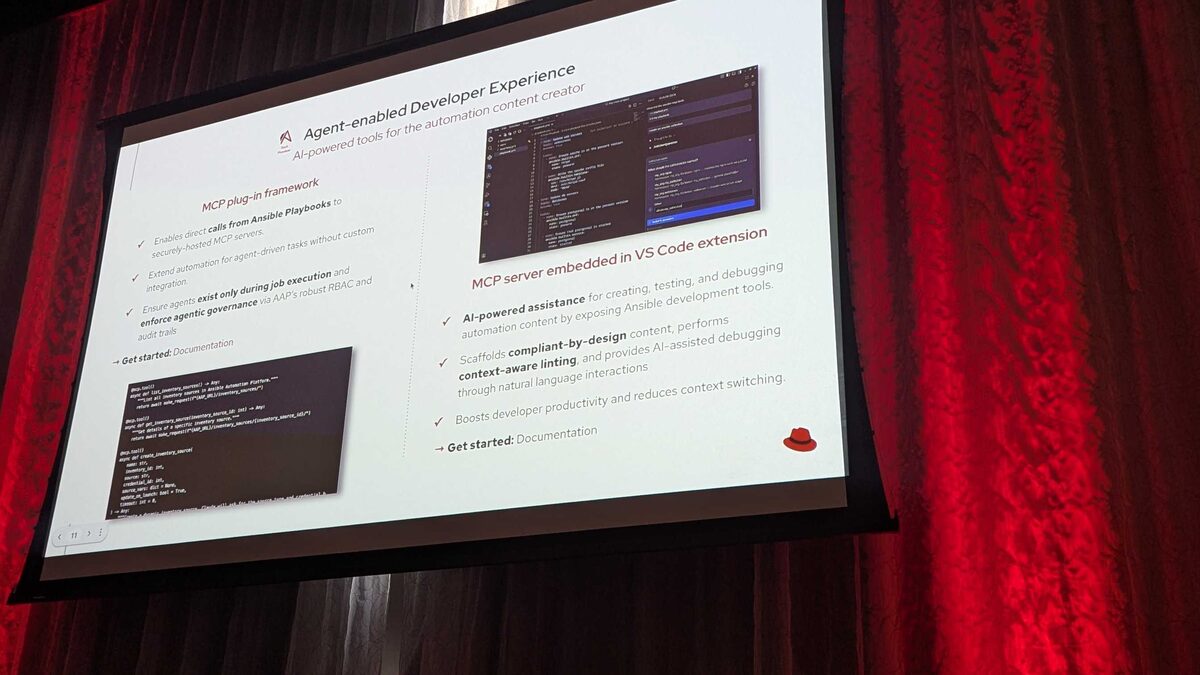
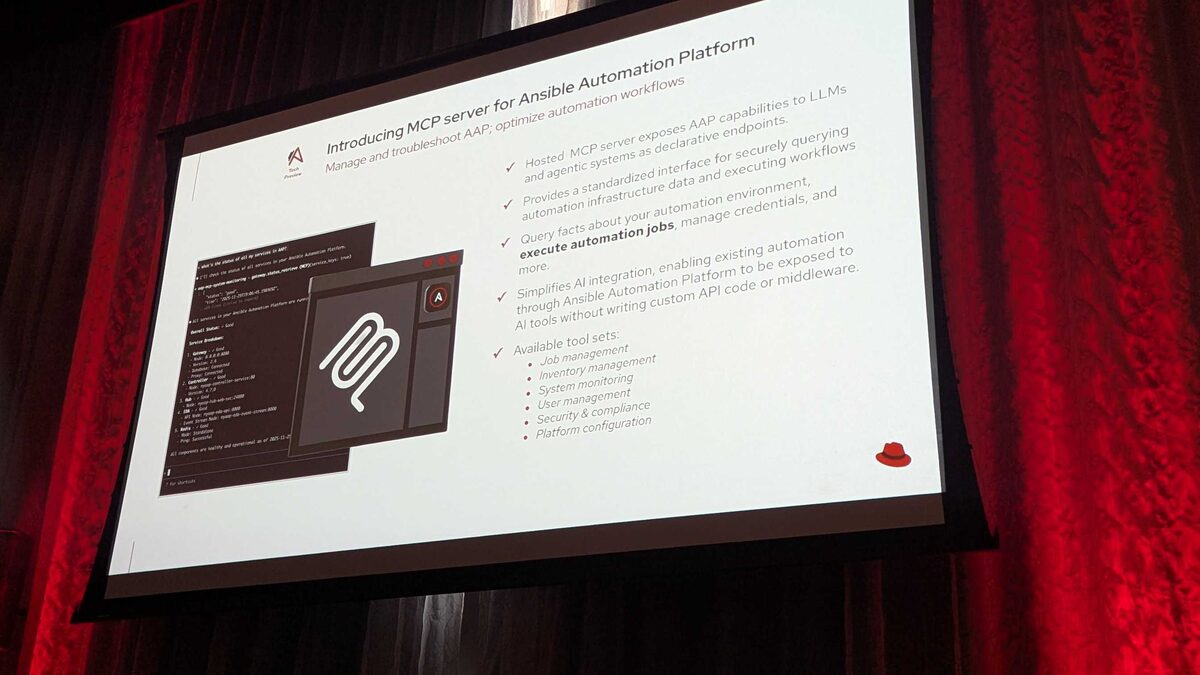
Introducing MCP Server for Ansible Automation Platform
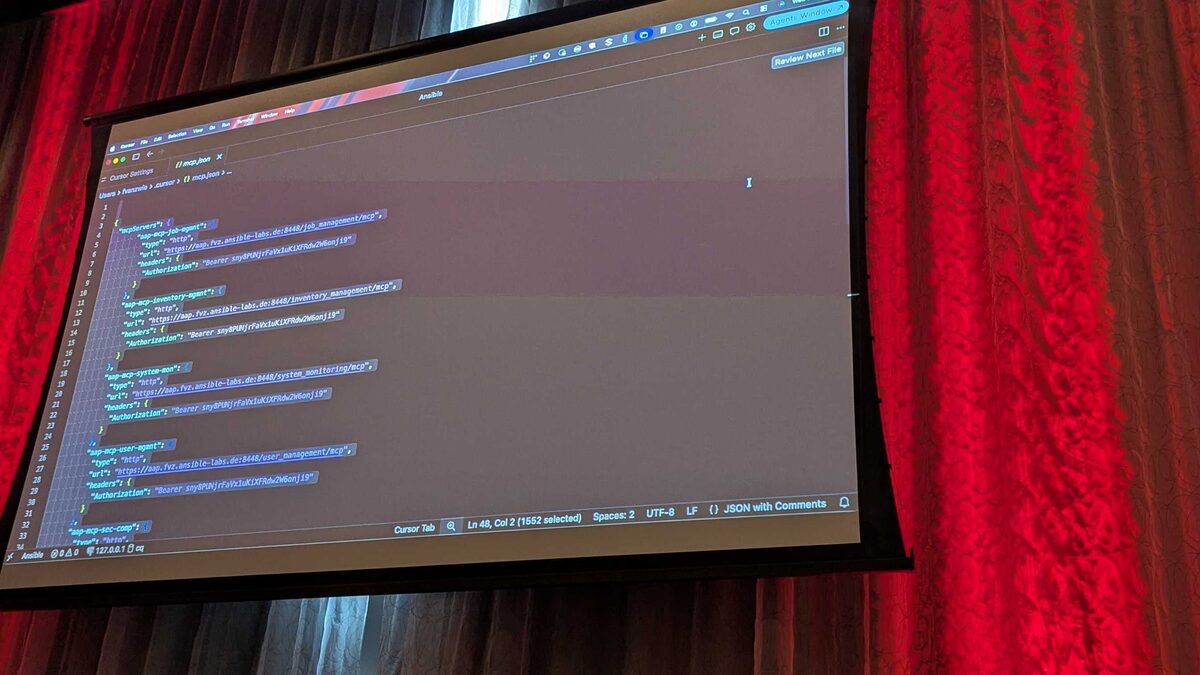
The hosted MCP server exposes AAP capabilities to LLMs and agentic systems as declarative endpoints:
- Provides a standardized interface for securely querying automation infrastructure data and executing workflows
- Query facts about your automation environment, execute automation jobs, manage credentials, and more
- Simplifies AI integration — enabling existing automation through AAP to be exposed to AI tools without writing custom API code or middleware
Available Tool Sets
| Tool Set | Capabilities |
|---|---|
| Job management | Launch, monitor, cancel jobs |
| Inventory management | Query hosts, groups, variables |
| System monitoring | Check service health, resource usage |
| User management | Query permissions, roles, teams |
| Security and compliance | Audit trails, policy checks |
| Platform configuration | Settings, credentials, integrations |
Traditional vs AI-Driven Automation
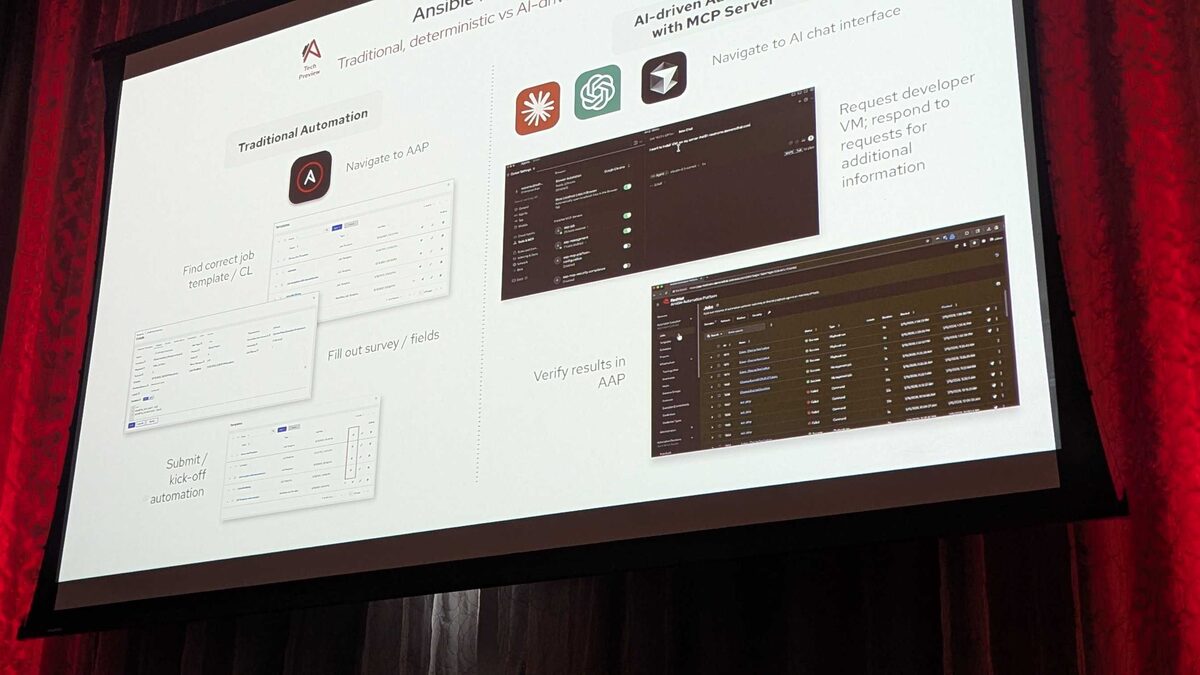
Traditional Automation (left side):
- Navigate to AAP
- Find correct job template / CL
- Fill out survey / fields
- Submit / kick-off automation
- Verify results in AAP
AI-Driven Automation with MCP Server (right side):
- Navigate to AI chat interface (Claude, ChatGPT, Gemini, etc.)
- Request developer VM; respond to requests for additional information
- Verify results in AAP
Same outcome. Dramatically different experience. The AI handles template selection, parameter filling, and execution — the human just describes what they need.
AI-Assisted Content Creation: BYOM Provider Matrix
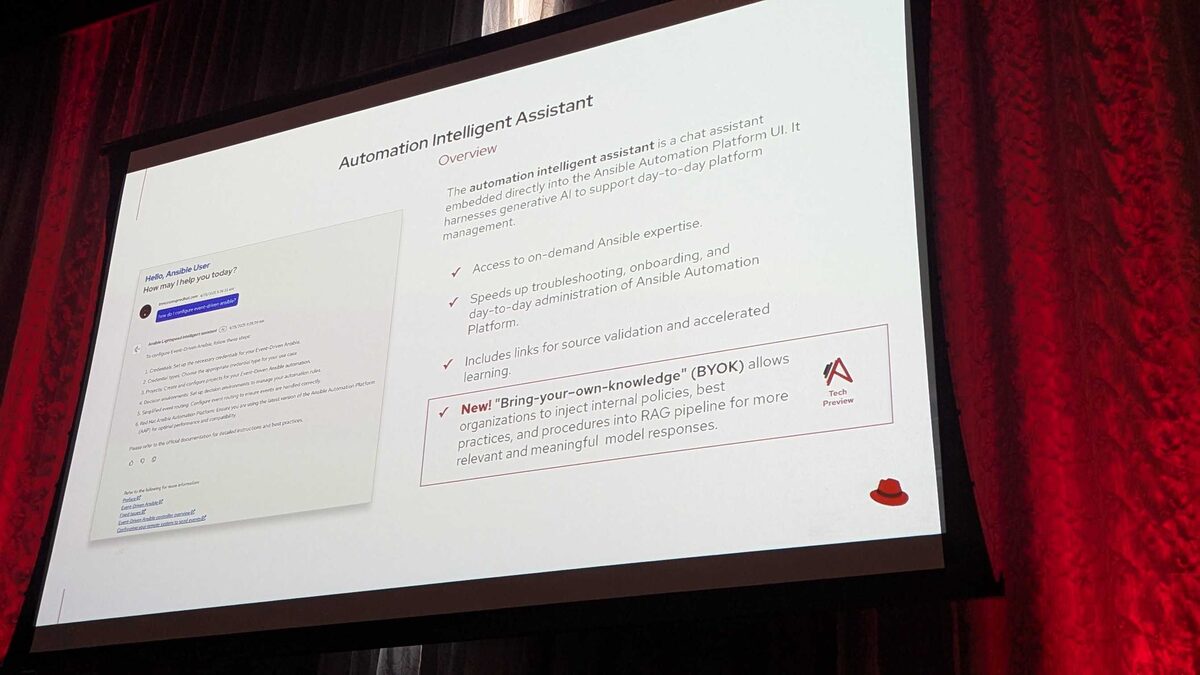
AAP supports flexible connectivity with Red Hat AI platforms and BYOM (Bring Your Own Model) providers:
Intelligent Assistant (Chatbot in AAP UI)
| Provider | Availability |
|---|---|
| Red Hat AI | AAP 2.6+ |
| OpenAI | AAP 2.6+ |
| Azure OpenAI | AAP 2.6+ |
| IBM watsonx | N/A |
| Gemini (Vertex) | Coming Soon |
Coding Assistant (Ansible VS Code Extension)
| Provider | Availability |
|---|---|
| Red Hat AI | AAP 2.6+ |
| OpenAI | Coming Soon |
| Azure OpenAI | Coming Soon |
| IBM watsonx | AAP 2.5+ |
| Gemini (Vertex) | AAP 2.6+ |
Key takeaway: IBM watsonx was the first external provider for the VS Code coding assistant (AAP 2.5+), while Red Hat AI and OpenAI lead on the intelligent assistant side.
EE Builder: Publish to Git and Auto-Build
The Automation Portal’s EE Builder integrates directly with source control:
- Publish to a Git repository (GitHub authenticated)
- Namespace:
test-rhaap-portal - Repository:
platform-ops-compliance-ee - Trigger a build of the Execution Environment after publishing — one checkbox enables full CI/CD
This means: define your EE in the visual builder → publish to GitHub → automatically build the container image and push to your registry. No manual ansible-builder CLI needed.
Requirements
- AAP 2.5+
- Automation portal installation (OpenShift Container Platform OR RHEL VM appliance)
- SCM (Git) access
Drive Automation Adoption and Scale
The overarching theme: make automation accessible to everyone in the organization, not just the Ansible experts. Through:
- Self-service templates
- AI-powered assistance
- Visual builders
- Natural language interfaces
Key Takeaways
- BYOK is essential — BYOM without BYOK gives you generic answers. Inject your procedures.
- MCP Server = zero-code AI integration — expose AAP to any LLM without middleware
- Traditional → AI-driven is additive — the MCP server doesn’t replace AAP UI, it adds a natural language layer
- Provider flexibility — not locked into one AI vendor; swap between Red Hat AI, OpenAI, Azure, watsonx, Gemini
- EE Builder → GitHub → Auto-build — complete CI/CD from visual wizard to container registry
AIOps Solution Guides: From Linear Rules to AI Inference
Red Hat also introduced the Ansible Automation Platform Solution Guides — detailed walkthroughs for production AIOps scenarios.
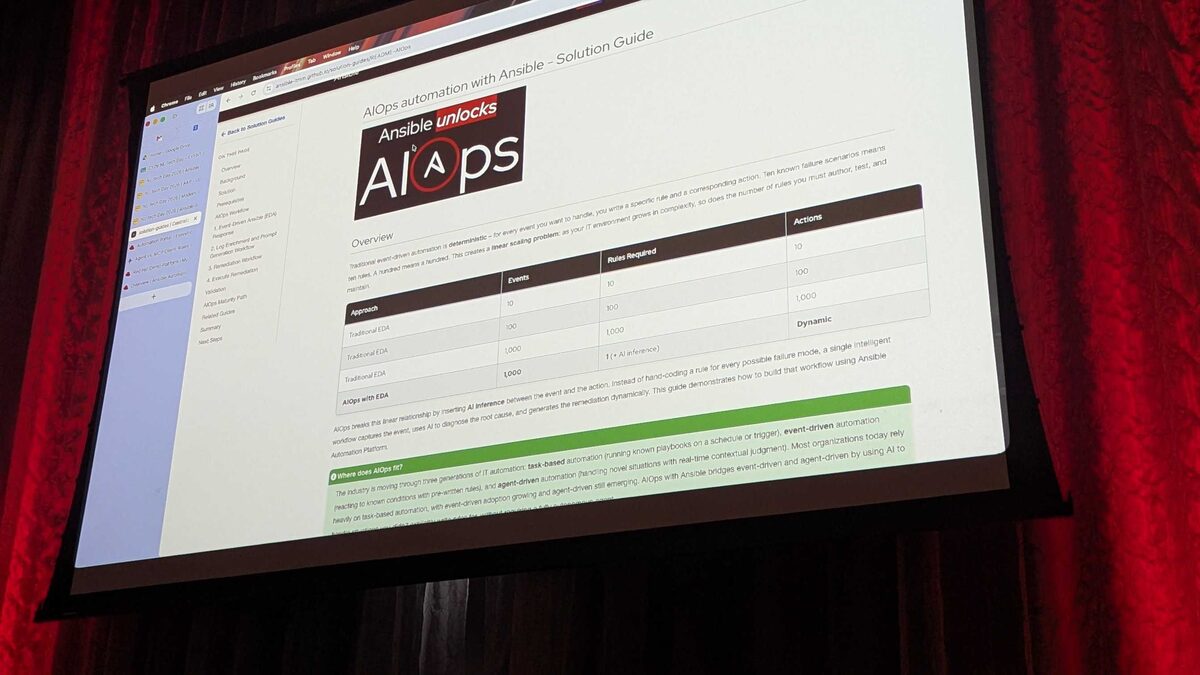
The Scaling Problem
Traditional event-driven automation (EDA) is deterministic — for every event you want to handle, you write a specific rule and a corresponding action:
| Approach | Events | Rules Required | Actions |
|---|---|---|---|
| Traditional EDA | 10 | 10 | 10 |
| Traditional EDA | 100 | 100 | 1,000 |
| Traditional EDA | 1,000 | 1,000 | — |
| AIOps with EDA | 1,000 | 1 (+ AI inference) | Dynamic |
AIOps breaks this linear relationship by inserting AI inference between the event and the action. Instead of hand-coding a rule for every possible failure mode, a single intelligent workflow captures the event, uses AI to diagnose the root cause, and generates the remediation dynamically.
Available Solution Guides
- AIOps automation with Ansible — self-healing infrastructure using Event-Driven Ansible, Lightspeed, and AI inference
- High-Availability AAP with EDB PostgreSQL DR — multi-datacenter active-passive disaster recovery
- Automated Incident Remediation with IBM Instana — closed-loop observability → auto-remediation
- Unlock AIOps with ServiceNow LEAP and Ansible MCP server — cut incident MTTR from hours to minutes
- AI infrastructure automation with Ansible — provision from GPU instances to serving models using
infra.aiandredhat.aicollections - Intelligent Assistant with Red Hat AI Inference Server — deploy self-hosted LLM on RHEL with GPU acceleration
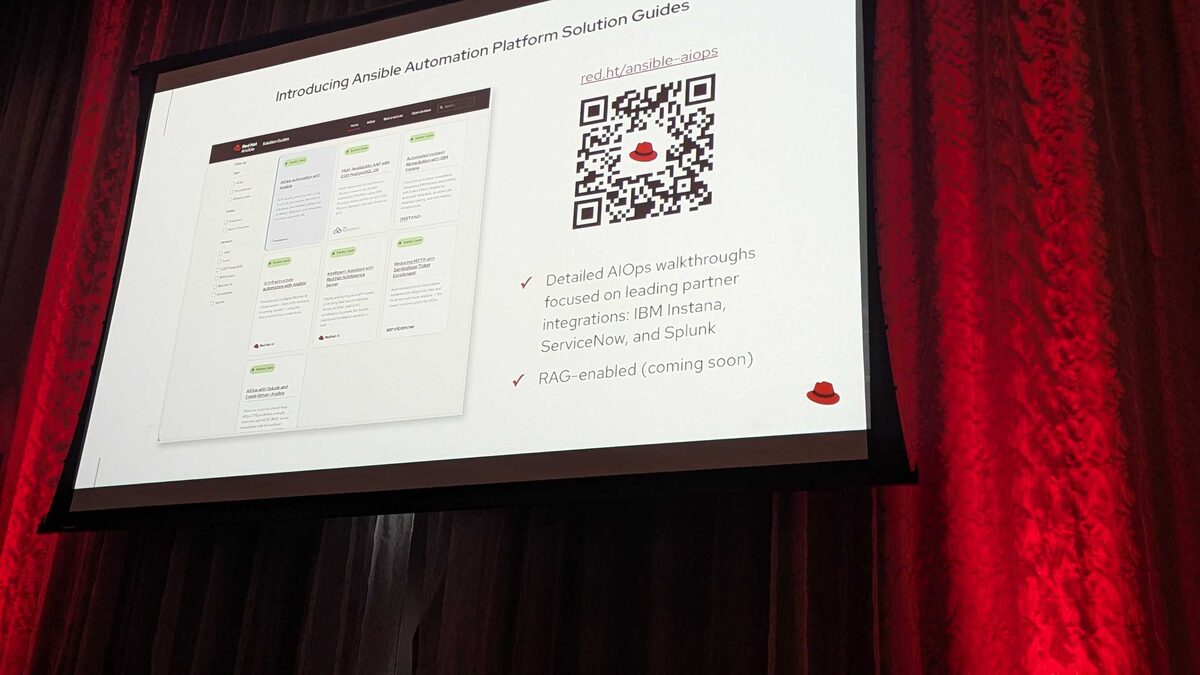
Introducing AAP Solution Guides Portal
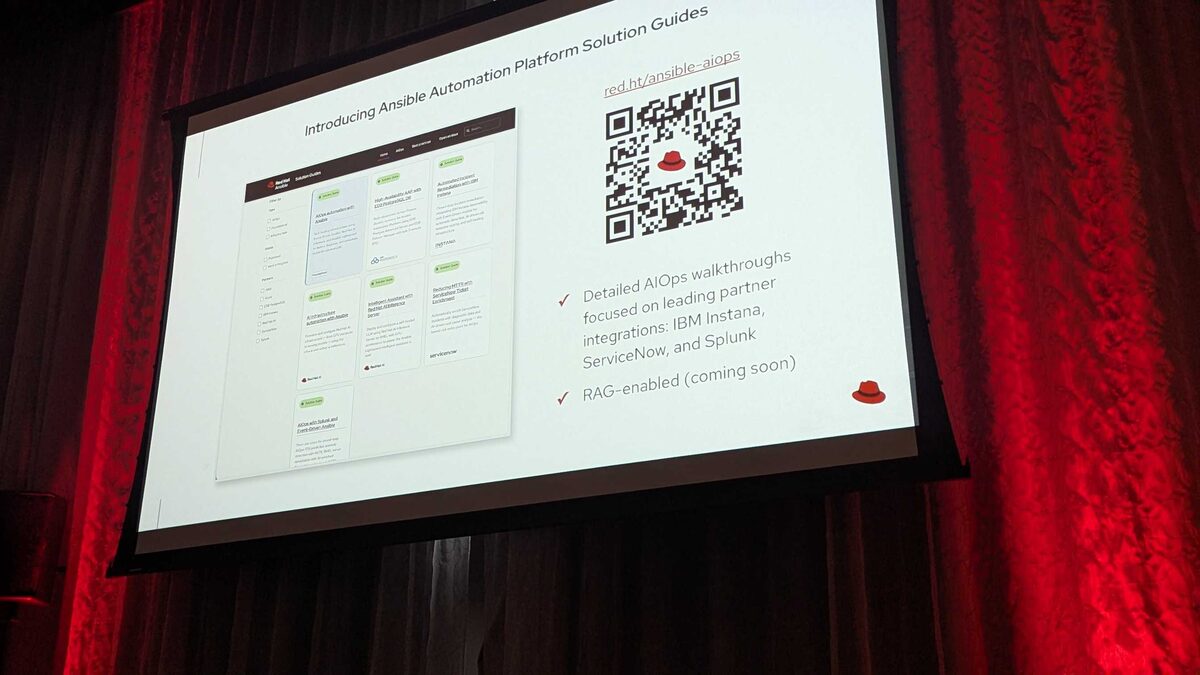
Access the guides at: red.ht/ansible-aiops
Key highlights:
- Detailed AIOps walkthroughs focused on leading partner integrations: IBM Instana, ServiceNow, and Splunk
- RAG-enabled (coming soon) — ask questions about the guides using AI