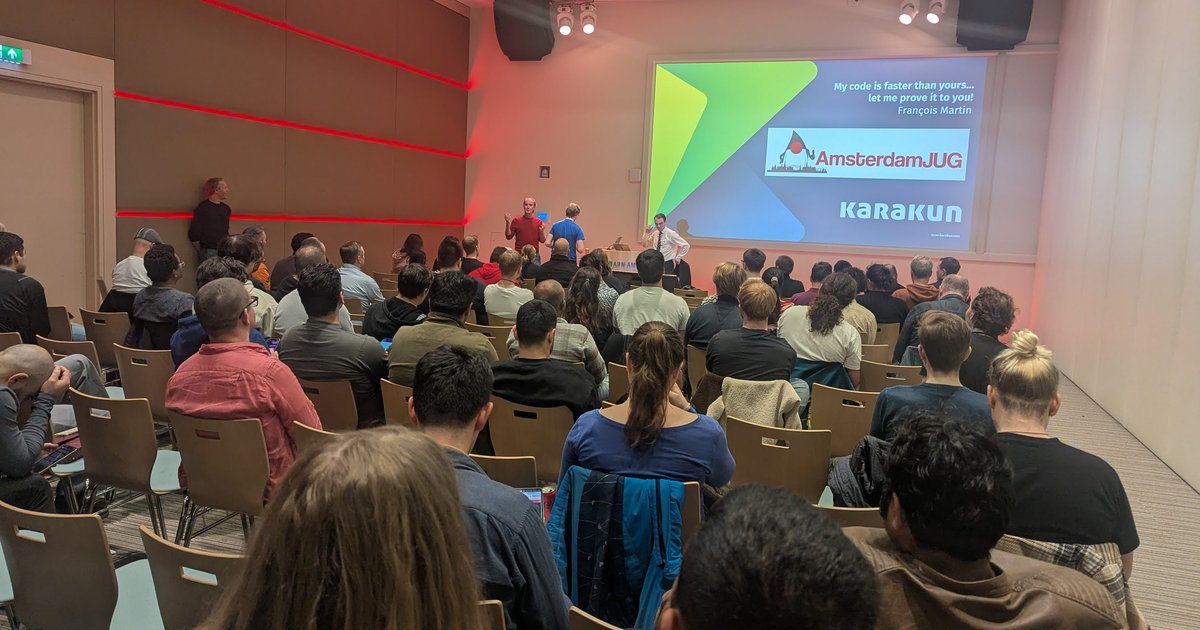
The Amsterdam Java User Group hosted an evening meetup at the Doctolib office in central Amsterdam on May 27, 2026. The headline talk was a production war story that every Spring developer needs to hear.
”I Lost a Day to @Retryable” — Kath Alfaro Ramirez
Kath Alfaro Ramirez, software engineer at Doctolib, delivered a masterclass in debugging Spring’s AOP proxy behavior. The talk title says it all — a single annotation silently failed in production, and it took a full day to figure out why.
The Setup: Mixed AOP Modes
Doctolib’s codebase uses AspectJ Compile-Time Weaving (CTW) for most annotations. This means @Transactional, @Async, and @Cacheable all work perfectly with self-calls — the aspect is woven directly into the bytecode at compile time.
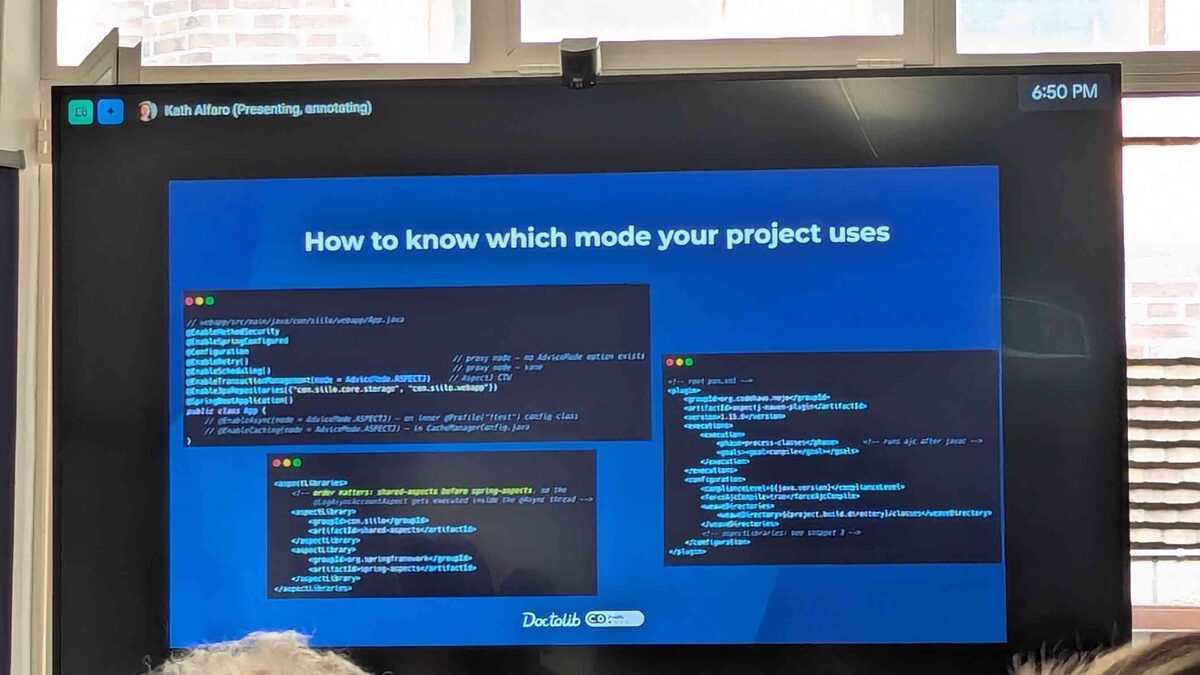
The configuration lives in three places: the Java config class (@EnableTransactionManagement(mode = AdviceMode.ASPECTJ)), the aspectj-maven-plugin in pom.xml, and the aspect library ordering.
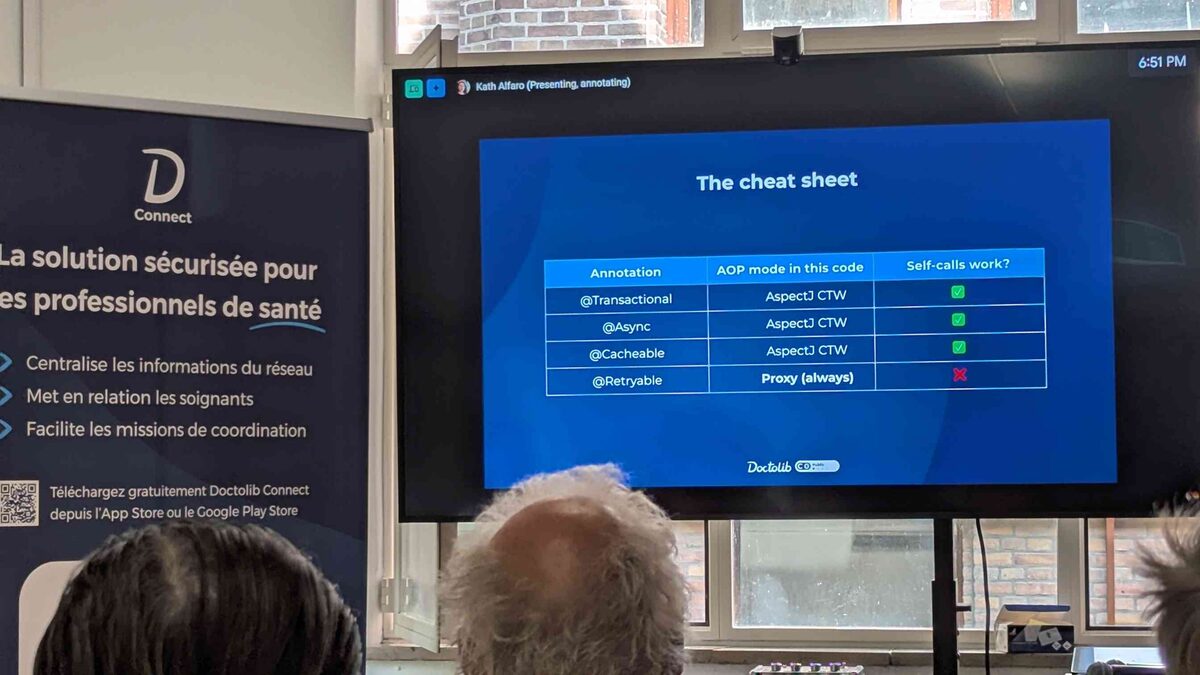
The Cheat Sheet
Here is the critical table every Spring developer should bookmark:
| Annotation | AOP Mode | Self-calls work? |
|---|---|---|
@Transactional | AspectJ CTW | ✅ |
@Async | AspectJ CTW | ✅ |
@Cacheable | AspectJ CTW | ✅ |
@Retryable | Proxy (always) | ❌ |
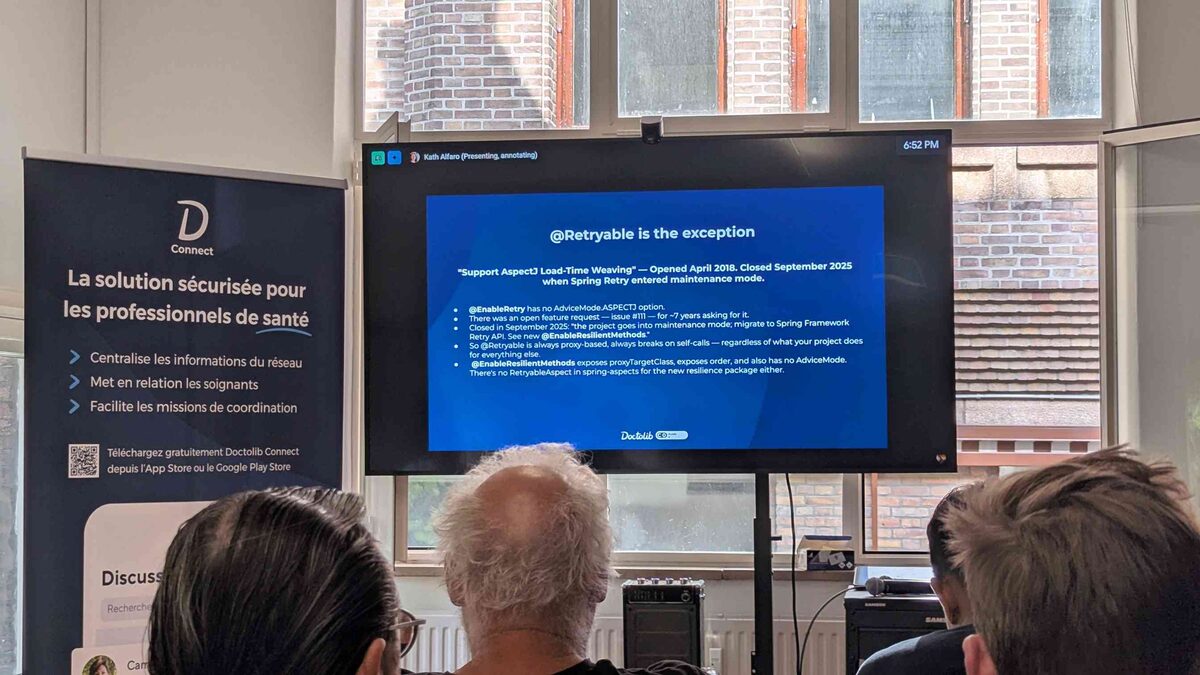
@Retryable is the outlier. It only supports proxy mode. There is no RetryableAspect in spring-aspects.
Why @Retryable Is the Exception
The feature request for AspectJ Load-Time Weaving support (issue #111) was open from April 2018 until September 2025 — over 7 years. It was closed when Spring Retry entered maintenance mode with the guidance: “migrate to Spring Framework Retry API. See new @EnableResilientMethods.”
Key points:
@EnableRetryhas noAdviceMode.ASPECTJoption@Retryableis always proxy-based, always breaks on self-calls@EnableResilientMethodsexposesproxyTargetClass, exposes order, and also has noAdviceMode
The Actual Buggy Code
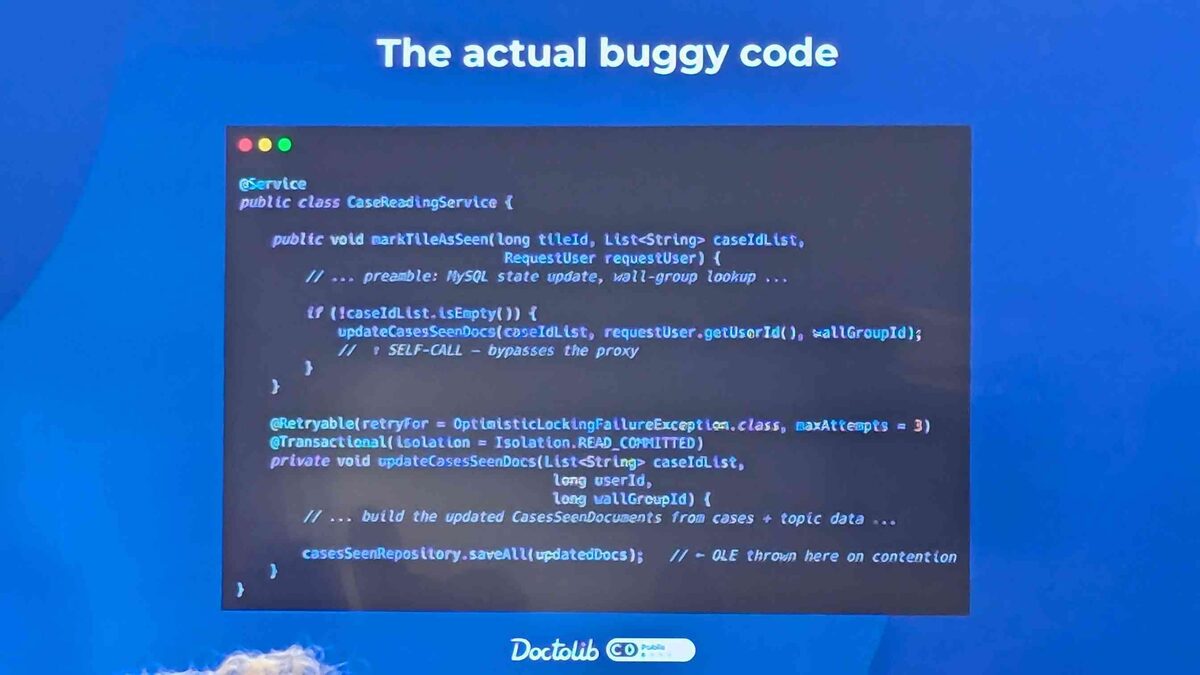
Kath showed the real production code that bit them:
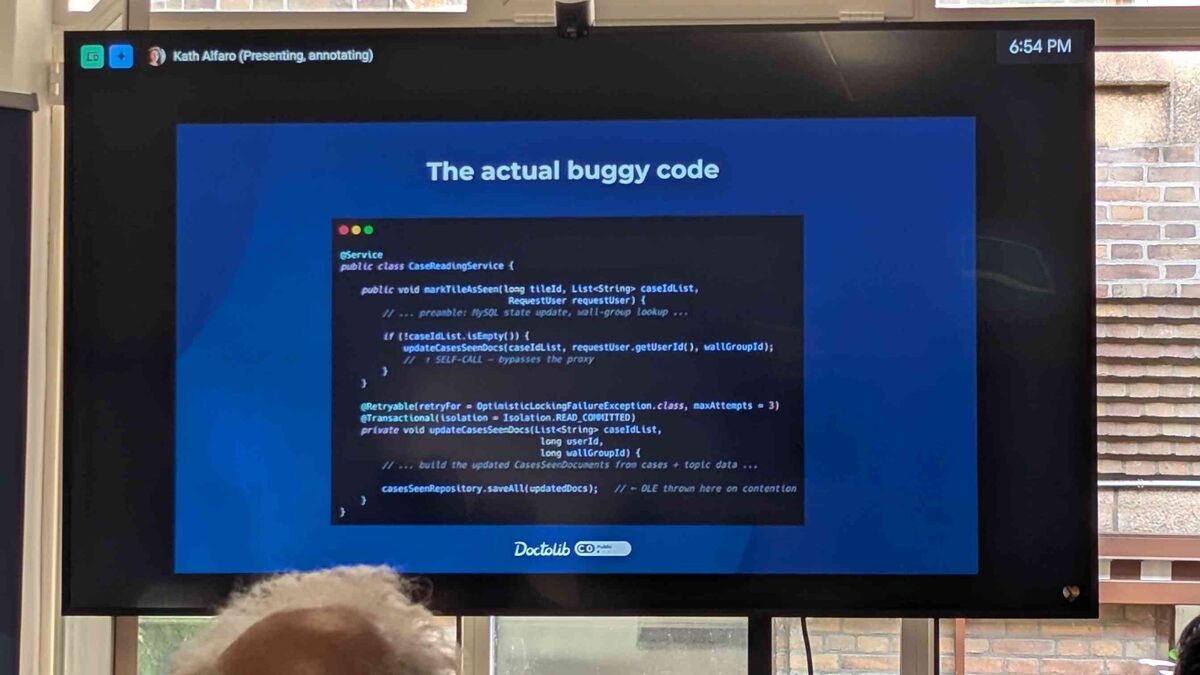
@Service
public class CaseReadingService {

    public void markTileAsSeen(long tileId, List<String> caseIdList,
                               RequestUser requestUser) {
        // ... preamble: MySQL state update, wall-group lookup ...

        if (!caseIdList.isEmpty()) {
            updateCasesSeenDocs(caseIdList, requestUser.getUserId(), wallGroupId);
            // ↑ SELF-CALL — bypasses the proxy
        }
    }

    @Retryable(retryFor = OptimisticLockingFailureException.class, maxAttempts = 3)
    @Transactional(isolation = Isolation.READ_COMMITTED)
    private void updateCasesSeenDocs(List<String> caseIdList,
                                     long userId,
                                     long wallGroupId) {
        // ... build the updated CasesSeenDocuments from cases + topic data ...
        casesSeenRepository.saveAll(updatedDocs); // ← OLE thrown here on contention
    }
}
The @Transactional works because it is woven via AspectJ CTW. But @Retryable? Proxy-only. The self-call bypasses it completely.
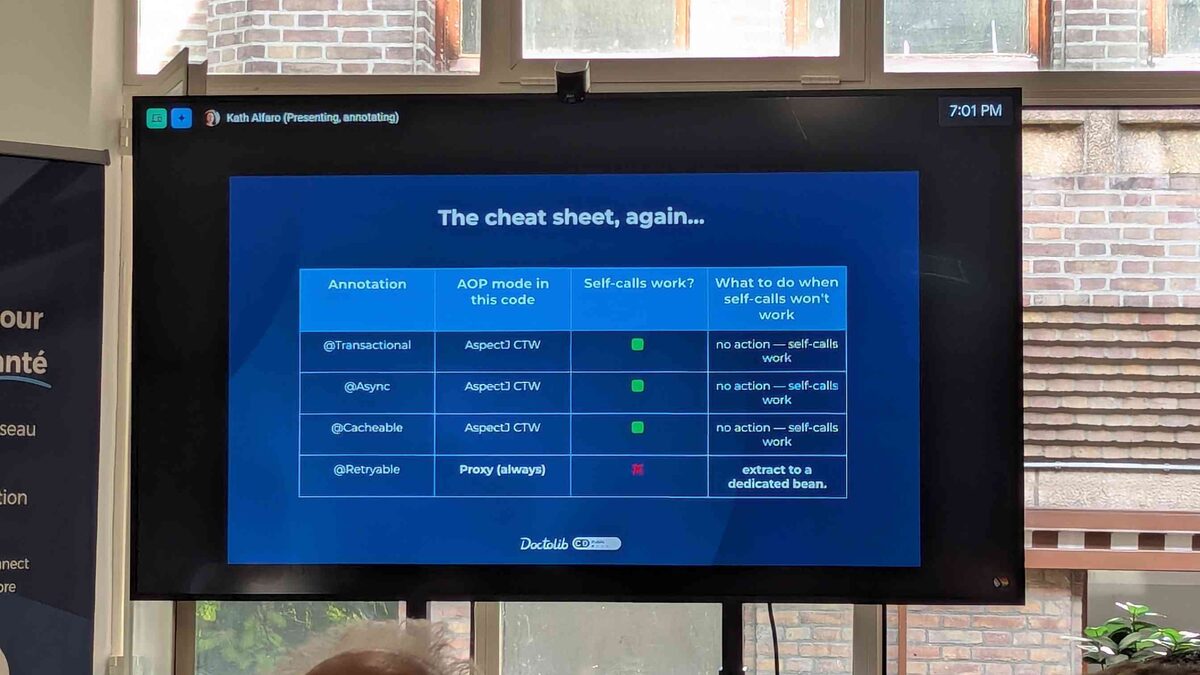
The Silence Is the Worst Part
“No log. No warning. No exception.”
When @Transactional fails on a self-call in proxy mode, you get an obvious “no transaction available” symptom. When @Retryable self-call “fails,” your original method runs normally with zero retry attempts. It looks like the retry decided not to fire. It did not decide. It was never installed.
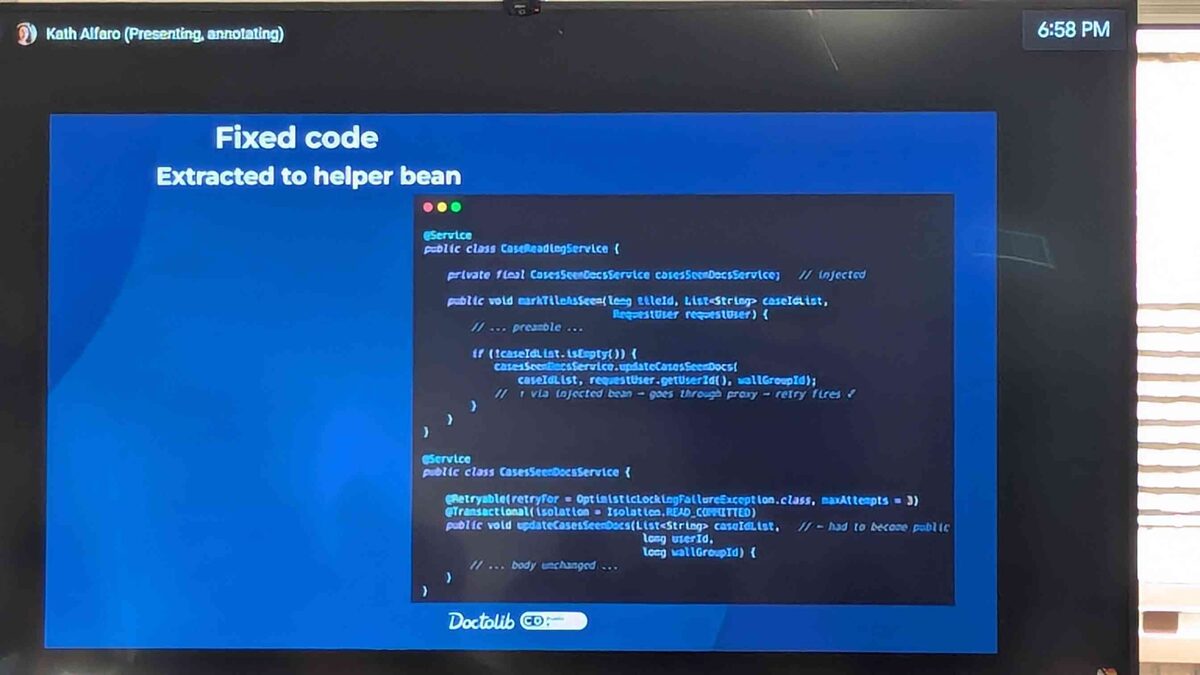
The Fix: Extract to a Dedicated Bean
The recommended fix is straightforward — extract the retryable method into a separate @Service:
@Service
public class CaseReadingService {

    private final CasesSeenDocsService casesSeenDocsService; // Injected

    public void markTileAsSeen(long tileId, List<String> caseIdList,
                               RequestUser requestUser) {
        // ... preamble ...
        if (!caseIdList.isEmpty()) {
            casesSeenDocsService.updateCasesSeenDocs(
                caseIdList, requestUser.getUserId(), wallGroupId);
            // ↑ via injected bean — goes through proxy — retry fires ✓
        }
    }
}

@Service
public class CasesSeenDocsService {

    @Retryable(retryFor = OptimisticLockingFailureException.class, maxAttempts = 3)
    @Transactional(isolation = Isolation.READ_COMMITTED)
    public void updateCasesSeenDocs(List<String> caseIdList, // had to become public
                                    long userId,
                                    long wallGroupId) {
        // ... body unchanged ...
    }
}
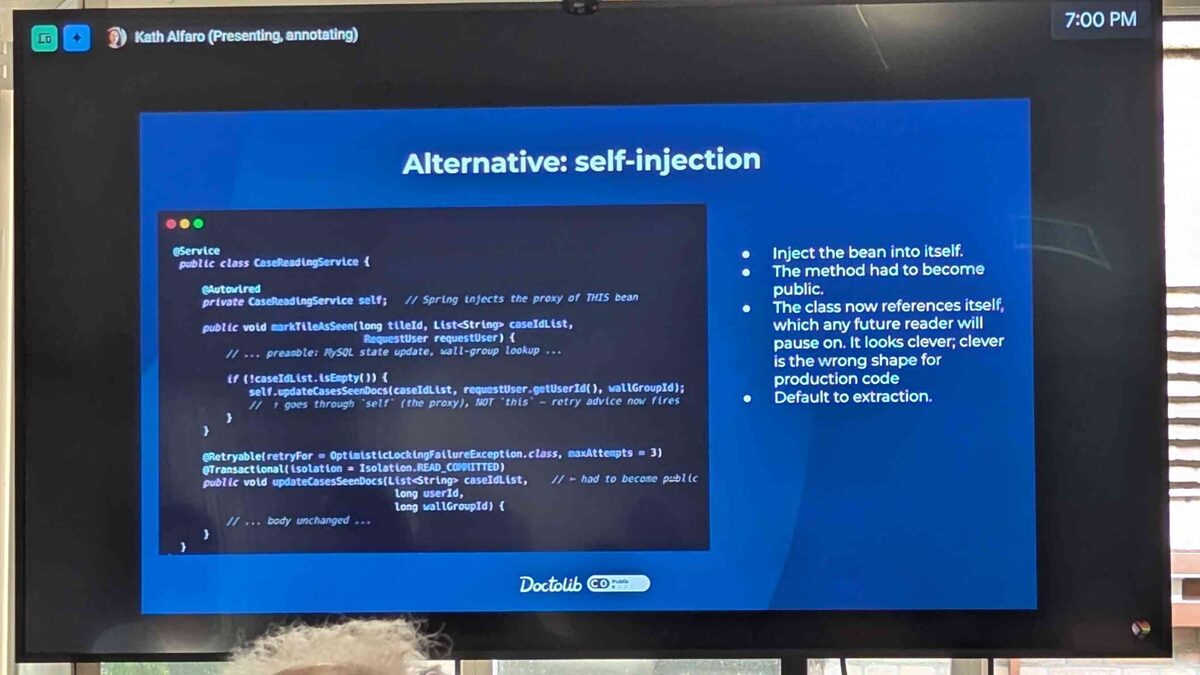
Alternative: Self-Injection (Not Recommended)
You can also @Autowired the bean into itself (private CaseReadingService self;) and call self.updateCasesSeenDocs(). This works — Spring injects the proxy of THIS bean — but Kath advises against it:
“It looks clever; clever is the wrong shape for production code. Default to extraction.”
Verifying the Fix: TestNG, Mockito, and Datadog
Beyond the code fix, the team verified retry behavior using TestNG + Mockito for unit testing (mocking the OptimisticLockingFailureException and asserting retry count) and Datadog for production observability — confirming retries actually fire under real contention.
The Final Cheat Sheet
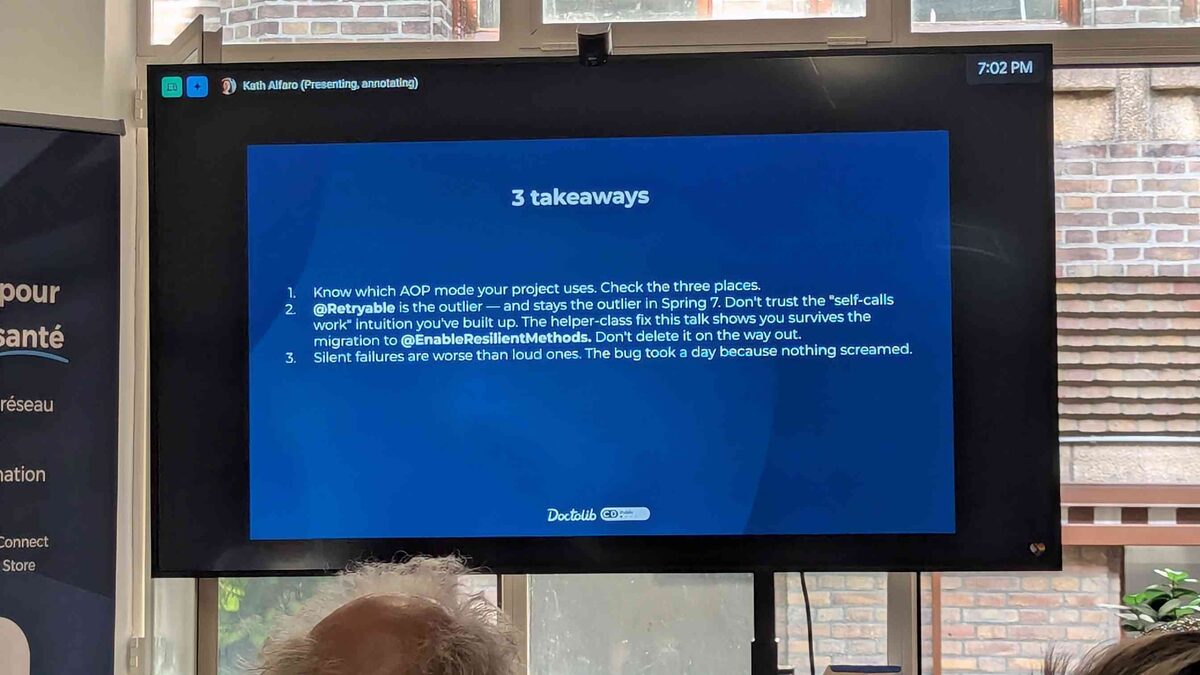
| Annotation | AOP Mode | Self-calls work? | Action |
|---|---|---|---|
@Transactional | AspectJ CTW | ✅ | No action — self-calls work |
@Async | AspectJ CTW | ✅ | No action — self-calls work |
@Cacheable | AspectJ CTW | ✅ | No action — self-calls work |
@Retryable | Proxy (always) | ❌ | Extract to a dedicated bean |
3 Takeaways
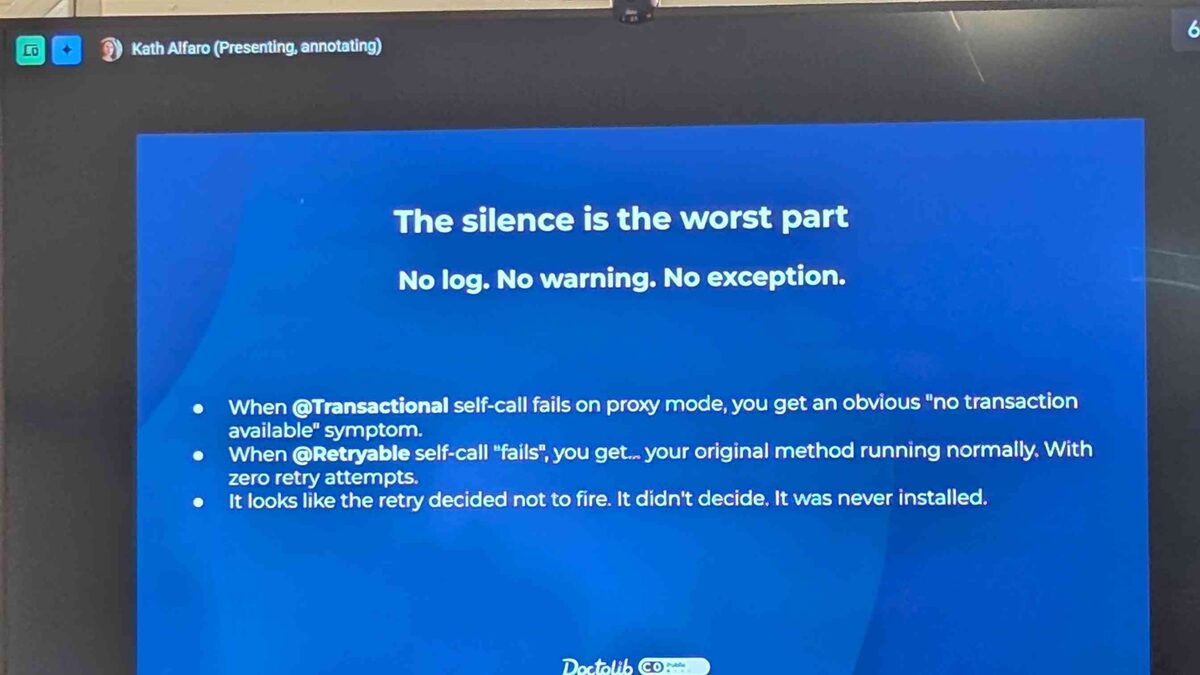
- Know which AOP mode your project uses. Check the three places.
@Retryableis the outlier — and stays the outlier in Spring 7. Do not trust the “self-calls work” intuition you have built. The helper-class fix survives the migration to@EnableResilientMethods.- Silent failures are worse than loud ones. The bug took a day because nothing screamed.
About the Venue
The meetup was hosted at Doctolib’s Amsterdam office — the French-German healthtech company building “La solution sécurisée pour les professionnels de santé” (the secure solution for healthcare professionals). Their platform centralizes network information, connects caregivers, and facilitates coordination missions across Europe.
About the Amsterdam JUG
The Amsterdam Java User Group brings together Java developers from across the Netherlands for regular evening meetups featuring talks on JVM ecosystem topics — from Spring internals to observability, from reactive programming to AI integration.
Have you been bitten by silent proxy failures? I write about Java, Spring, Kubernetes, and production debugging at lucaberton.com. Book a free consultation on Calendly to discuss your platform challenges.