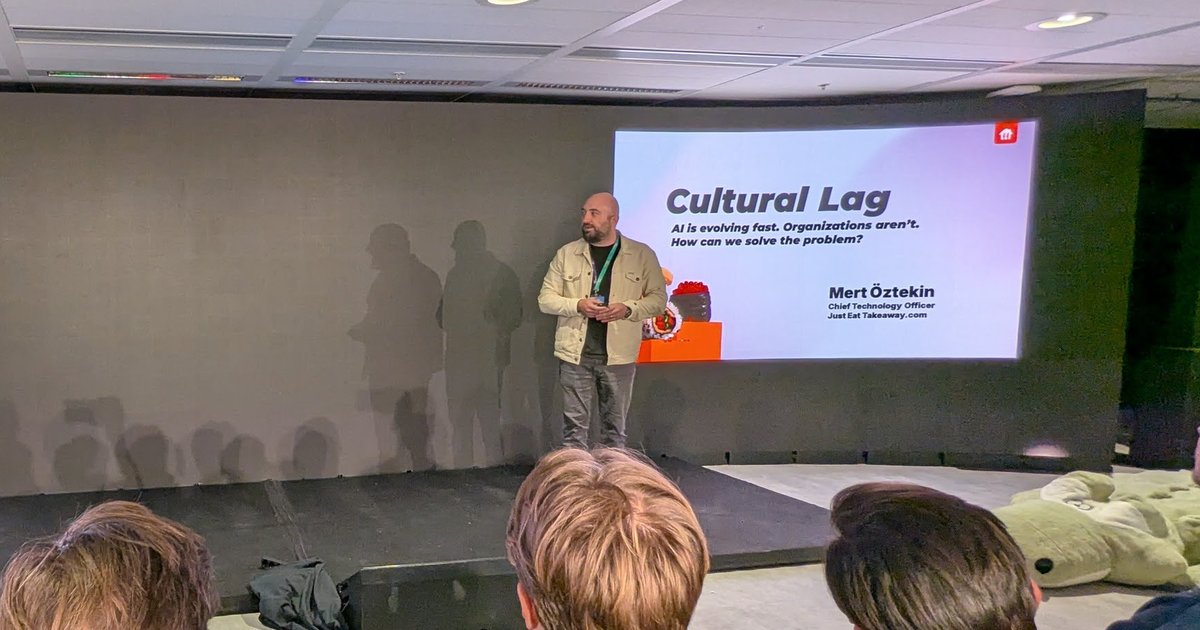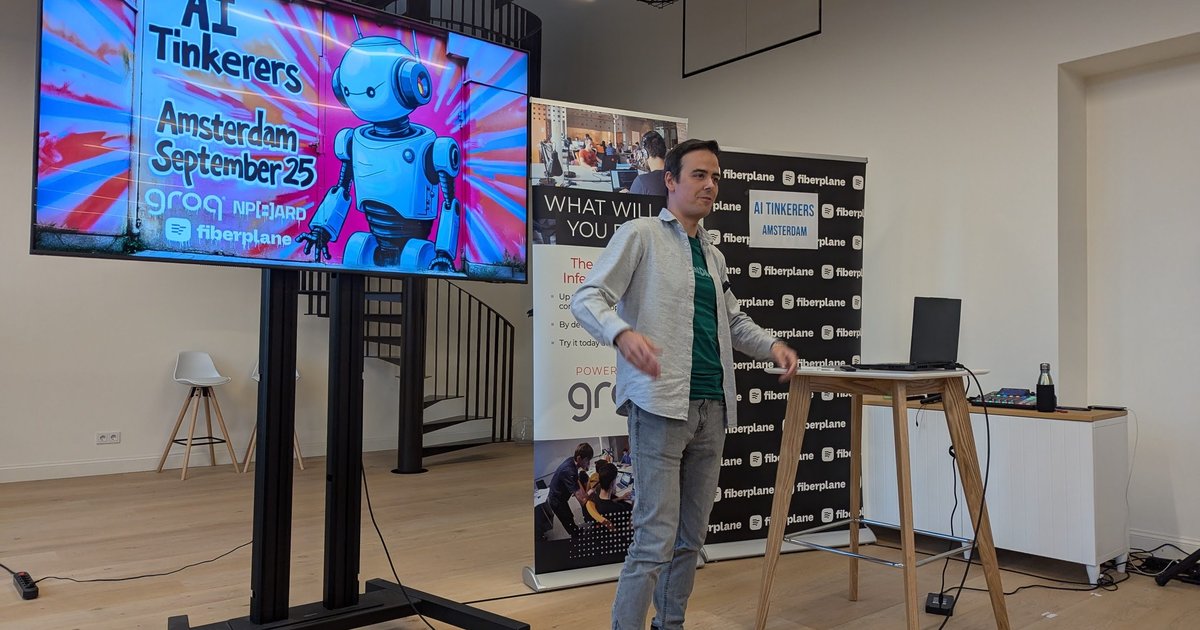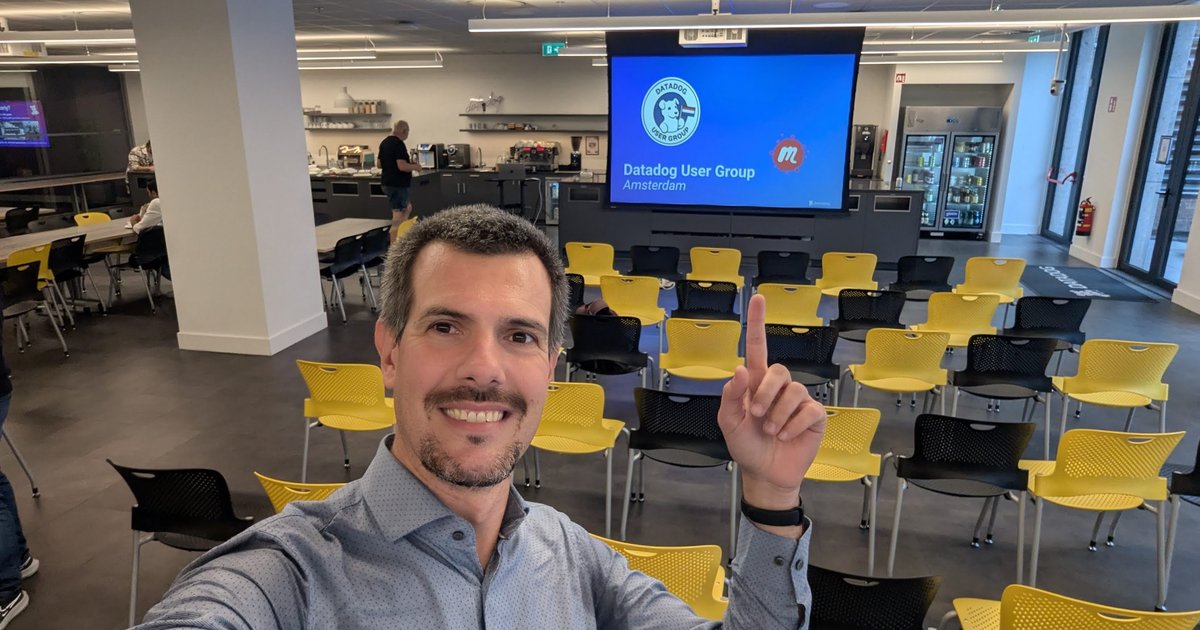
Between September and December 2025 I went to more Amsterdam tech evenings than I could write up one by one. Some have their own posts, like World Summit AI and MongoDB Day and the AI House opening. This post collects the smaller ones: one short section each, in date order, with at most one photo per event.
The content comes from my photos of slides and signs, the event invitations in my calendar, and a few short clips I recorded. I only name speakers whose names were on a slide or on the official event page.
LangChain AI Agents Meetup with Harrison Chase (10 September)
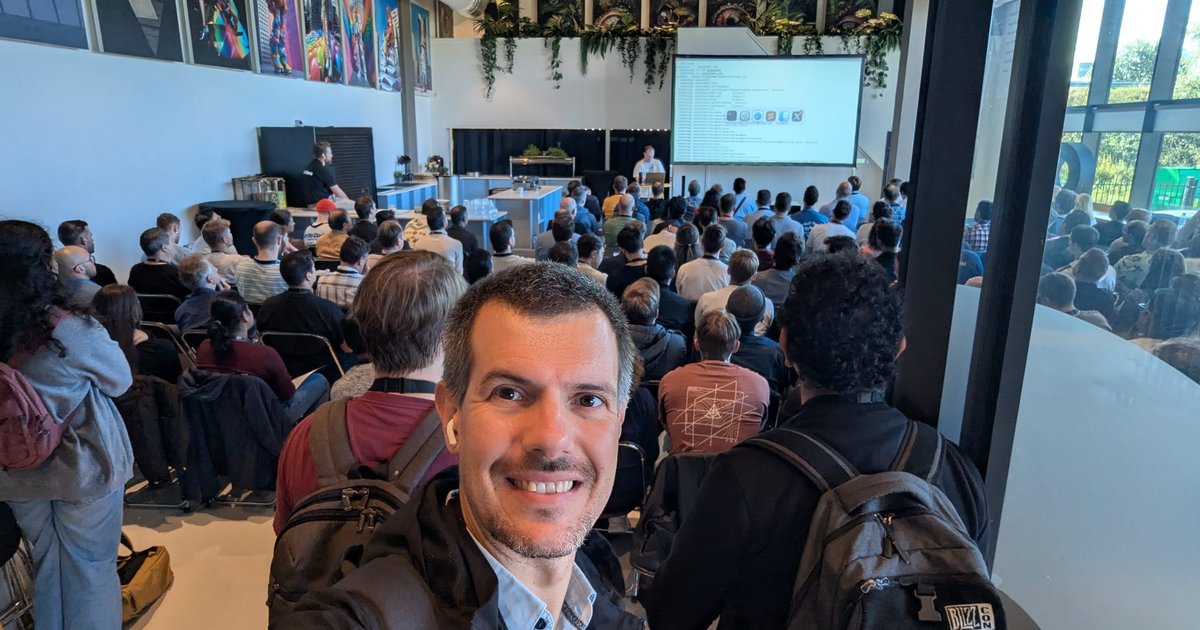
The invitation was “LangChain Presents: AI Agents Meetup with Harrison Chase” at Spaces Amstel. The agenda on the screen in the room gave 18:00–18:30 to Harrison Chase: “Building Reliable Agents” + Q&A (the Luma page had announced “AI Vision and strategy”), followed by an hour of LangChain customer talks from Coolblue, Friday and Bertelsmann, and networking until 20:00.
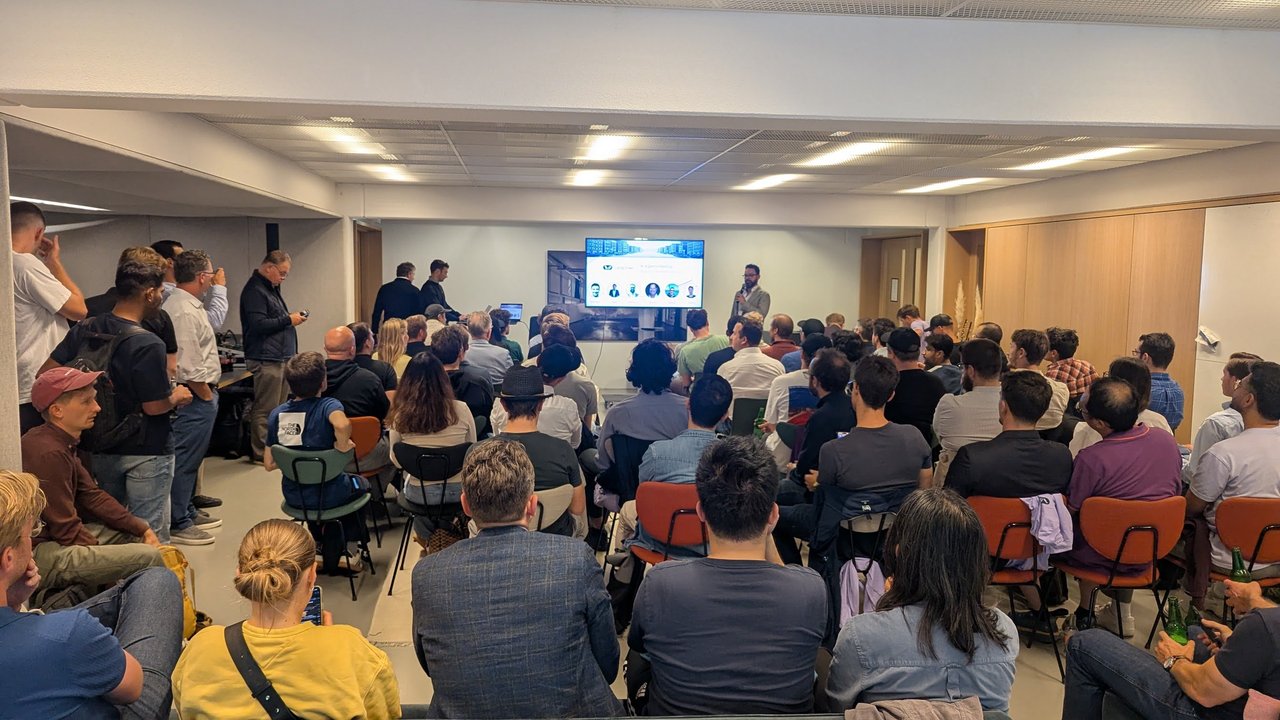
Standing room only at 18:00, when the founder’s talk was scheduled to start.
Apart from that agenda, my photos from the evening are of the room, not the slides, so I won’t summarise the talks. The turnout was the data point: a weekday evening on agent frameworks filled the room completely.
TechEx Europe 2025 at the RAI (25 September)
TechEx Europe brought several expos together under one roof at the RAI. The stands I stopped at were mostly about data and AI infrastructure: Dell AI Factory with NVIDIA, Ververica (“Original Creators of Apache Flink”, “Unified Streaming Data Platform”), Snowflake (“AI Data Cloud”), Couchbase (“Developer Database Platform for AI Applications”), AAEON (edge AI, “an ASUS assoc. co.”), the OPC Foundation, and GoodAccess, which pitched itself on NIS2 compliance.
I recorded a few short clips on the floor. At the Ververica stand, an engineer described Flink as the streaming counterpart to Spark’s batch processing. At AIminify, the team said their tool compresses computer-vision models with one line of code and claimed results up to 10 times faster and 4 times smaller. That’s their claim, not a benchmark I ran. A Cloudflare field CISO told me about a panel he had just done on how the CISO role has changed. I wrote up all eight conversations in TechEx Europe 2025: Eight Booth Interviews.
My take: streaming, edge inference and model compression came up at stand after stand. That’s what happens when AI moves from the cloud to factories and devices.
Top Bot Hackathon demo night (27 September)
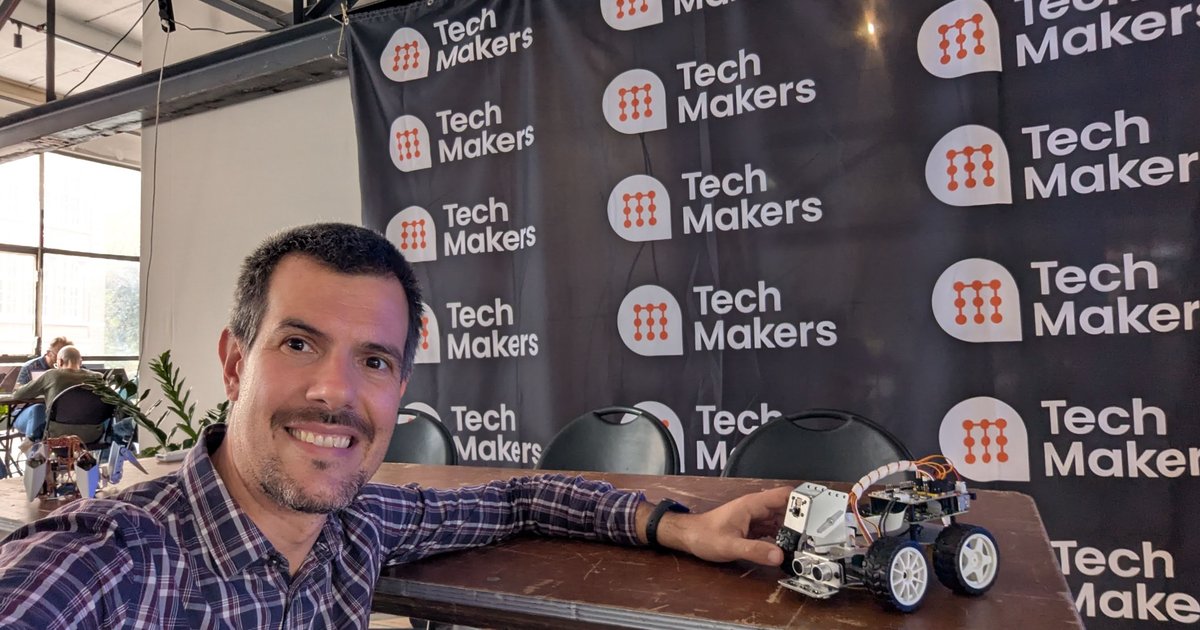
Tech Makers held its first robotics hackathon, the “Top Bot Hackathon”, with a demo night and jury at Vincent Hall in Amsterdam. The kits on the tables were SunFounder PiCar-X, an “AI Self-Driving Robot Car Kit for Raspberry Pi”. Five teams demoed. One, Growpal, pitched a robot “personal gardening assistant” with a soil-moisture sensor that checks whether plants need water. The jury slide included someone from KickStart AI. The organisers said a second edition was planned for November.
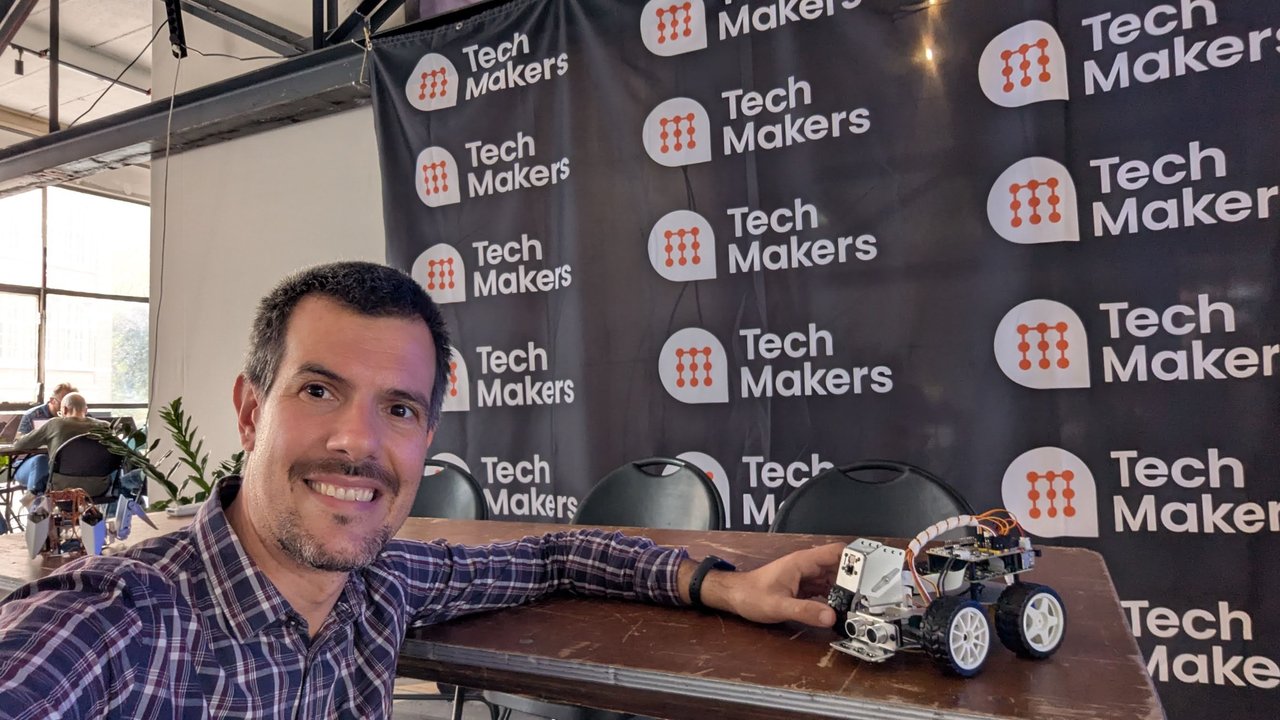
A PiCar-X robot car at the Tech Makers demo night.
ClimateHack Amsterdam: the SCI formula (6 October)
“ClimateHack Amsterdam: AI & Next-Gen Data Applications for Climate” took place at the World Trade Center Amsterdam, hosted by Hack Chapters with World AI Week and Amsterdam Trade & Invest. After a welcome from Amsterdam Trade & Invest, the talks included a promo for CHEMAI 2025 on 21 November (“Entering the fifth paradigm for chemistry and materials”), a startup selling “supply chain risk you can see from space” (GHG emissions, carbon stock, legality assessment) whose slide claimed “€0 → 550K ARR”, and ClimateGPT from Erasmus.AI, billed as the “first foundational model on climate change”.
The talk closest to my work was from Alessandro Stefouli-Vozza, whose intro slide read “GSF Champion @GSF, Sr. Tech Specialist @Microsoft”. He covered why to join the Green Software Foundation, “Code still matters”, and the Software Carbon Intensity formula:
SCI = ((E × I) + M) per R
The slide defined E as the energy consumed by the software in kWh, I as the carbon emitted per kWh of energy (gCO2/kWh), M as the carbon emitted through the hardware the software runs on, and R as the functional unit, such as per user or per device. Its tagline was “The ‘per R’ is what makes the SCI into a tool that works for every software domain, every use case, and every person.” The SCI guide uses the same equation. It describes E as energy consumption for the components inside the software boundary, I as emission factors and M as embodied emissions. His next slide was “Cloud Native to the rescue!”.
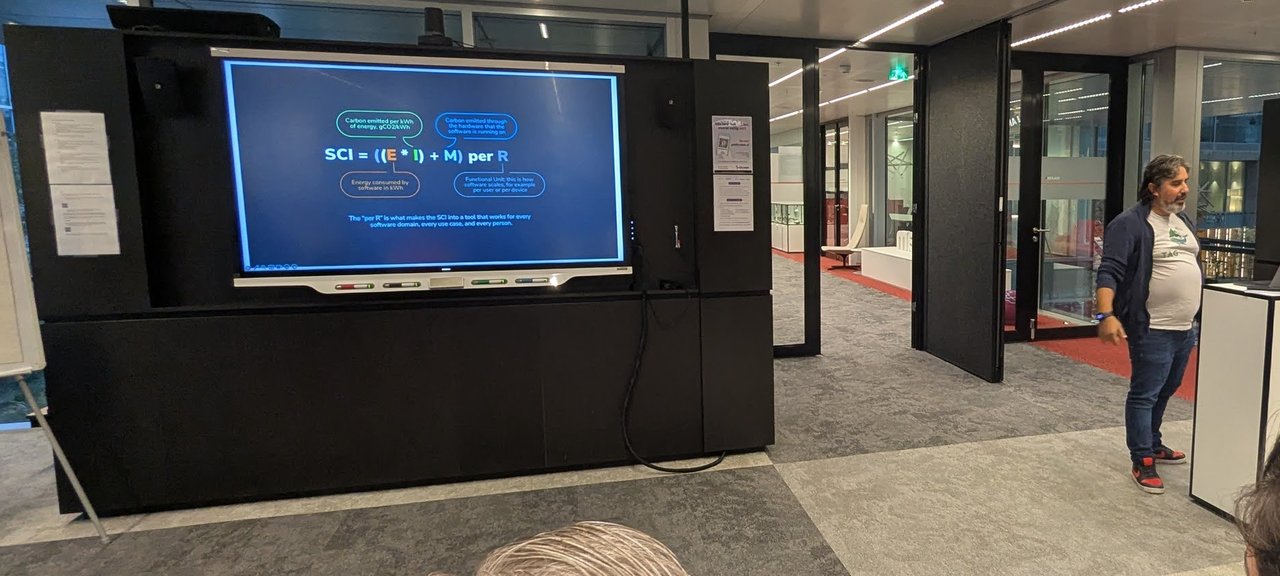
The Software Carbon Intensity formula on screen at the World Trade Center.
My take: the “per R” is what makes SCI usable for platform teams. Total emissions only go up as you grow. Grams of CO2 per request or per user can go down, and you can put that number on a dashboard next to latency. I showed one way to act on the I term in carbon-aware Kubernetes scheduling.
Women Building AI: Beyond Boundaries (7 October)
The next evening was “Women Building AI: Beyond Boundaries”, a roundtable hosted by Women in AI Benelux as a World Summit AI side event during World AI Week. The sign carried the Kickstart AI and The Foundry logos, and the event page promised lightning talks and roundtables on human–AI interaction, what it really costs to scale AI, knowledge-augmented intelligence, and the infrastructure behind it. Slide titles I captured included “The real cost of AI”, “Solution: hardware AND algorithms” and “Challenges for ASR: conversational speech in doctor–patient interactions”.
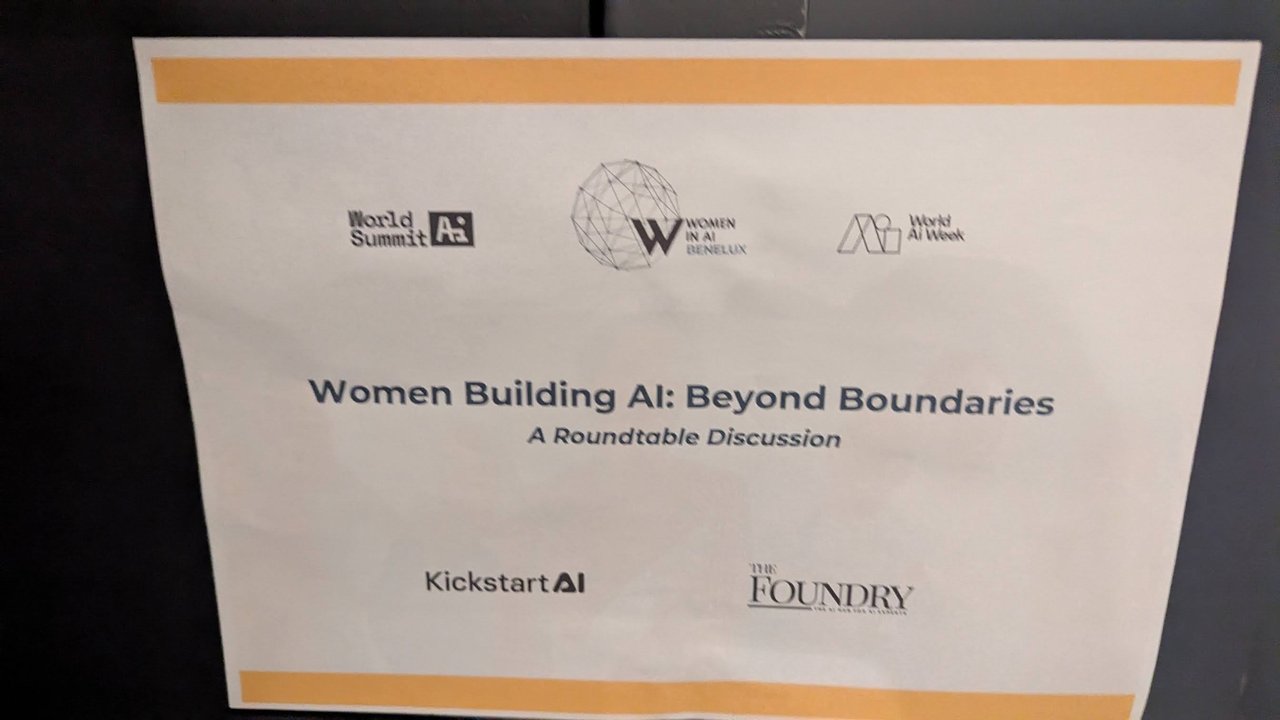
The sign at the door of the World Summit AI side event.
AI House: coding assistants with OpenAI and Google (13 October and 2 December)
AI House Amsterdam, “powered by Prosus”, ran a series called “Learn how to get the most out of AI coding assistants”. The first session, on 13 October, was with OpenAI. The event page named Anouk Muis from OpenAI, presenting ChatGPT’s Codex, followed by a panel. In the part I recorded, she said that Codex completes new tasks up to 90% faster when it still has a cached container image. She noted that agent internet access is off by default and recommended switching it on. She described an AGENTS.md file as a README for your agents and pointed to the agents.md website published with others. She also shared a tip of her own: point every AGENTS.md at Context7 so the agent pulls current docs for the libraries you use, instead of relying on the model’s training cutoff. An “upcoming events” slide listed an MLOps meetup (Y Combinator special), an “AI on the Amstel” agentic-AI meetup and a hackathon for top university students.
The second session, on 2 December, was with Google. The event page named Manasa Kandula, Practice Lead for Application Modernization at Google. The agenda slide promised a coding-assistant demo across the software development life cycle, a short case study on migrating and modernising legacy code, and general tips. The tip I photographed was “Use Checkpoints”: lock in progress with checkpoints, and restore the saved state if the AI hallucinates or your plans change.
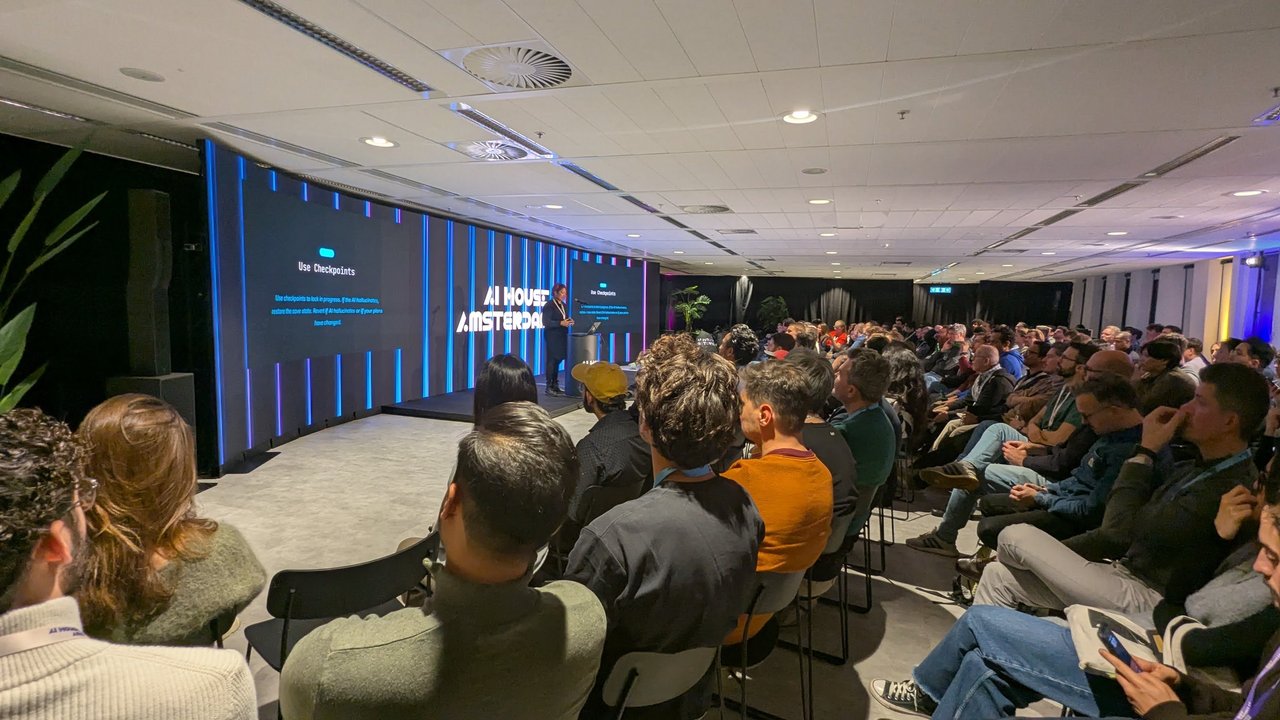
“Use Checkpoints”, the second AI House coding-assistant session.
My take: both talks ended up at the same principle: give the agent the right context and make it cheap to undo. AGENTS.md plus fresh docs handles the first, and checkpoints plus small commits handle the second. I compared doc-retrieval approaches in Context7 vs RAG for documentation retrieval.
Apidays Amsterdam 2025 (6 November)
Apidays Amsterdam sold out at Tolhuistuin on 6 November, under the theme “Enterprise GenAI-readiness with the API mindset”, with CAMARA and anchr as gold sponsors. The session I photographed best was “Full MCP Lifecycle: Workshop using the Axway AI Gateway”. Others were “API Security: Turning Complexity into Confidence” and Twilio’s “Improve user verification experiences & conversion with Number Verify (SNA)”.
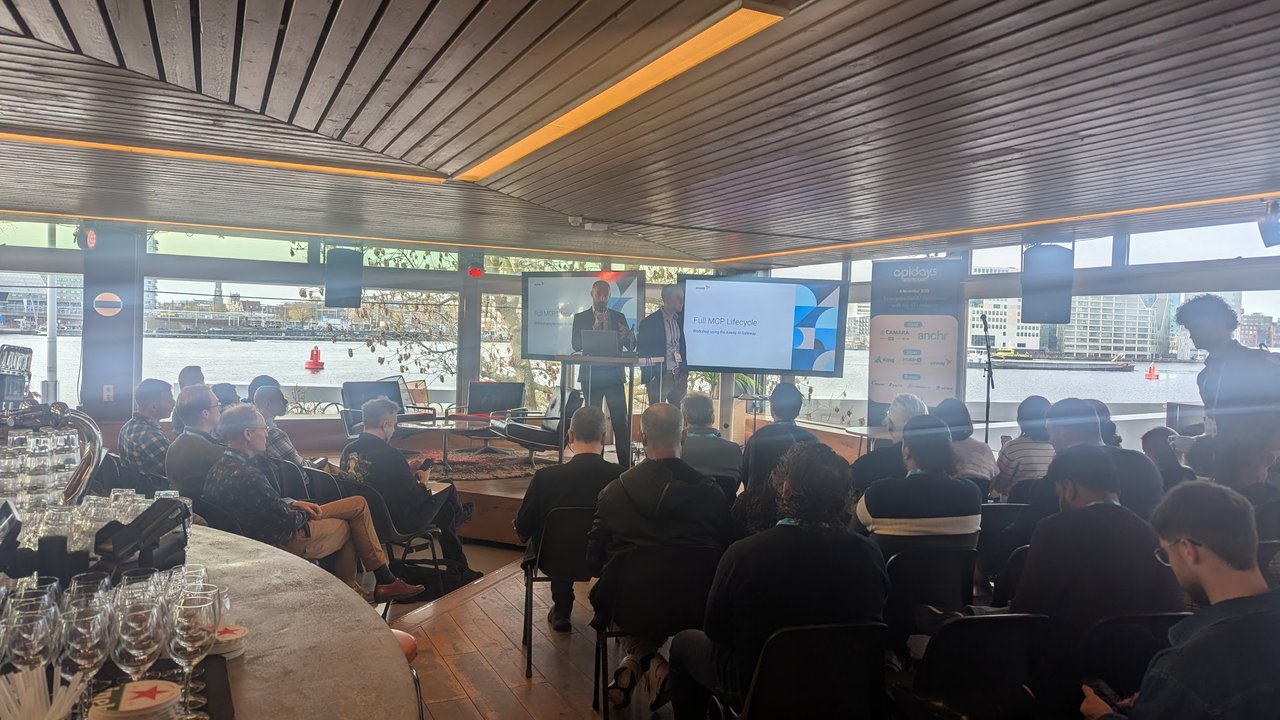
The Full MCP Lifecycle workshop, with the IJ through the windows.
My take: putting MCP servers behind an API gateway is the obvious next step. The same rate limits, auth and audit you already use for APIs now apply to agent tool calls. It’s good to see the API community treat MCP as another API lifecycle, not as magic.
SREday Amsterdam 2025 Q4 (7 November)
At SREday Amsterdam on 7 November, one of the first slides was a case for Kafka in SRE work: “a persistent, replayable log”, “a buffer and transport layer” and “a shared interface across producers”. Harness pitched “The AI-Native Software Delivery Platform”, and the Reliability Guild had banners up. In the afternoon the main stage showed Coté’s title slide: “Private Cloud AI Platform Engineering: What little we right know now, maybe”.
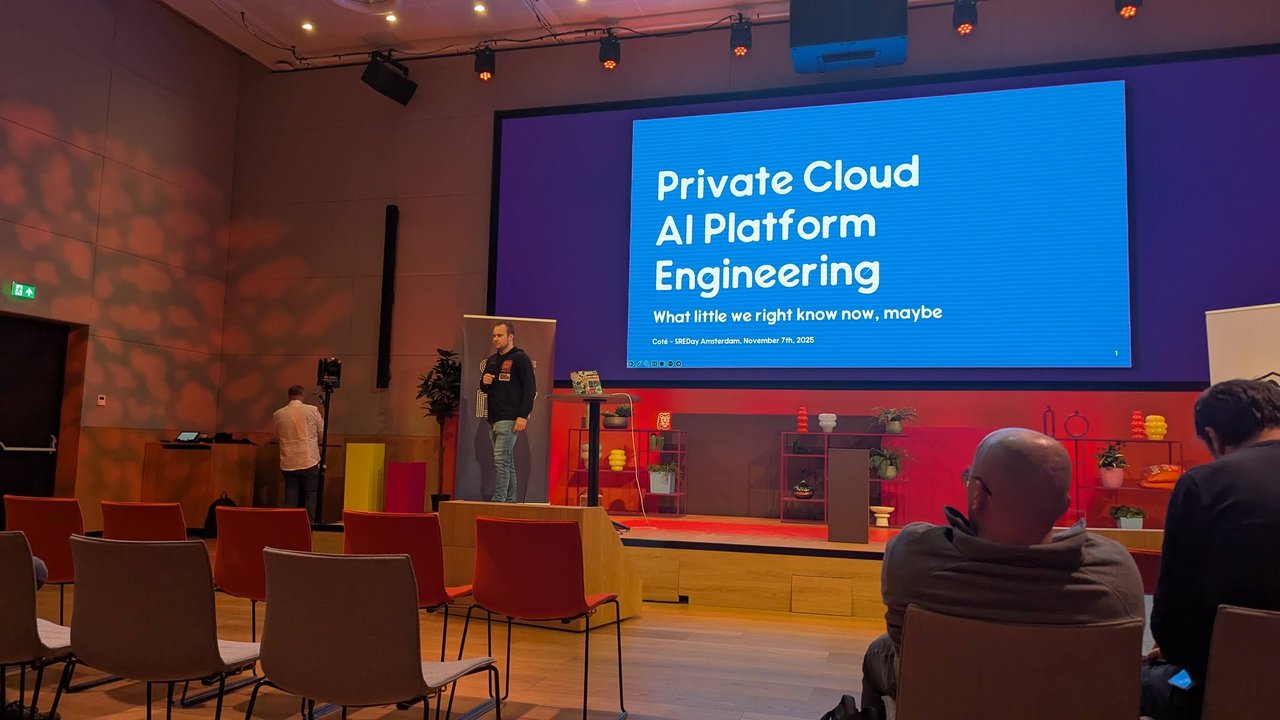
Coté’s title slide on the SREday main stage.
Friends of OpenJDK at Uber (11 November)
The Amsterdam JUG’s “Friends of OpenJDK” evening was hosted at Uber (“Welcome to OpenJDK @ Uber!”). Pavel Belousov presented “Large-Scale Upgrades: Lessons Learned”. Later, a talk with Azul branding, “Scotty, I need warp speed”, covered ways to improve JVM startup and warmup. Another slide that evening quoted Harvey Dent: “You either die a hero or you live long enough to see yourself become the villain.”
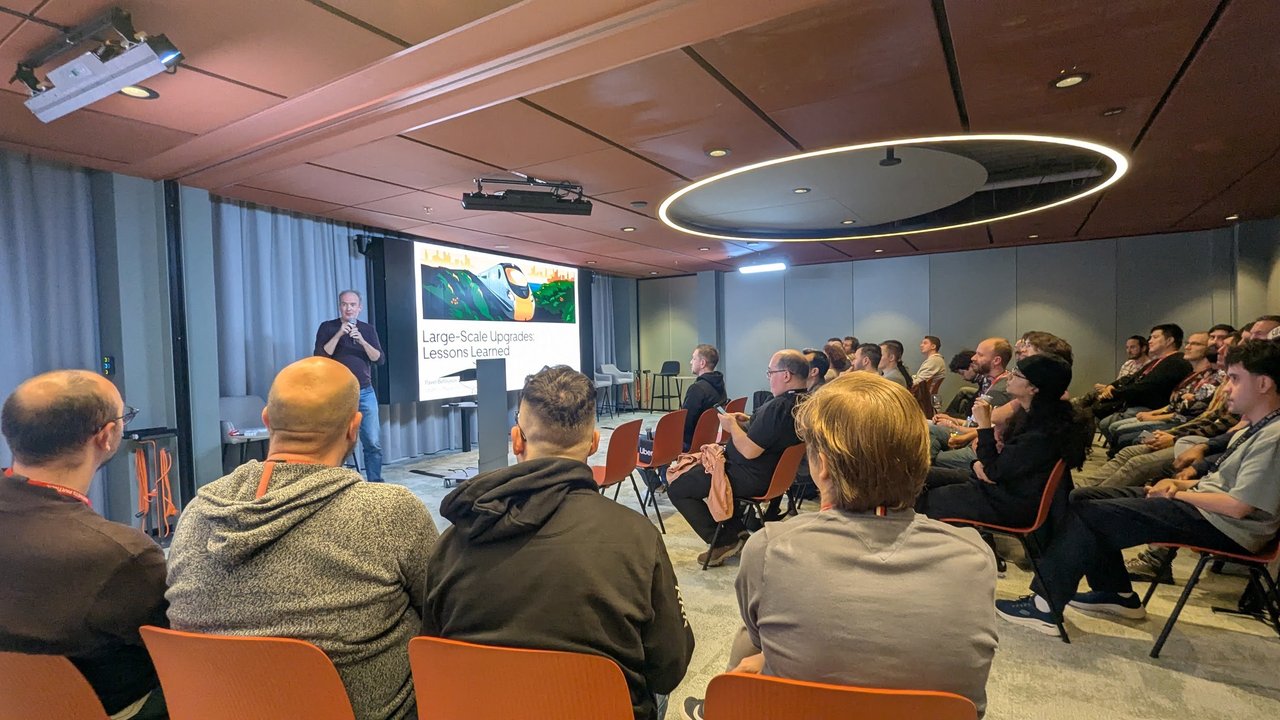
“Large-Scale Upgrades: Lessons Learned” at Uber’s Amsterdam office.
GSF and SITNL: rethinking UX for a sustainable future (20 November)
The Green Software Foundation and Sustainable IT Netherlands met at the Ingka Group Digital Hub for “Scaling Sustainability | Rethinking UX for a Sustainable Future”. One slide in the UX talk was “Not only CO2”: understand the broader environmental and social impacts. A few minutes later came “11 Principles of SUX” (sustainable UX):
- Design for ecosystems instead of users
- Understand the negative impacts
- Design for all aspects of sustainability
- A principle on energy use, partly hidden behind a lamp in my photo
- Design for equality
- Design for wellbeing and fairness
- Design for sustainable users
- Solve the right problems
- Design for less
- Make sustainability default
- Design new narratives
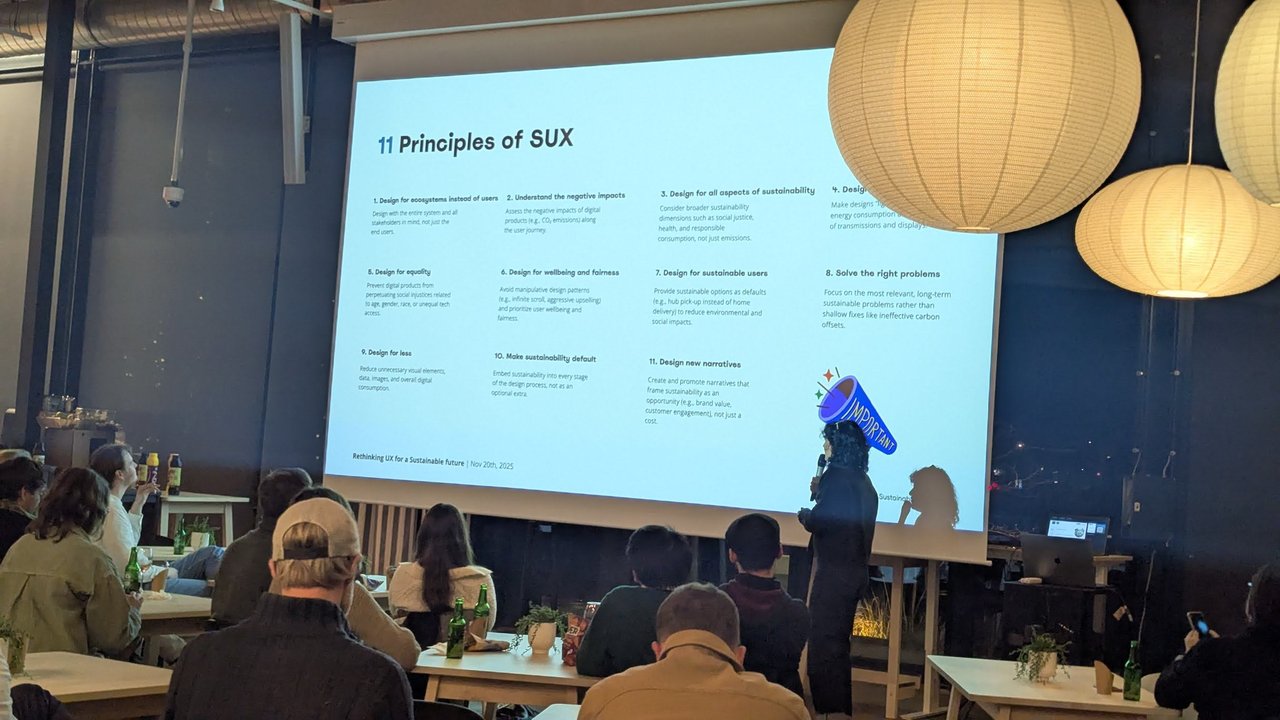
Eleven principles, dated “Rethinking UX for a Sustainable future, Nov 20th, 2025”.
Other slides covered the Web Sustainability Guidelines (“Good user experience reduces time and (data) resources wasted on the journey”), a facilitation toolkit with non-human and non-user personas, a Responsible AI Canvas, the Double Diamond seen through sustainability, and “What blocks change?”, a list that started with fear and included fatigue and a dysfunctional or weak culture. My take: “Design for less” is the principle engineers can act on tomorrow, because fewer images, less data and fewer calls show up directly in the E of the SCI formula above.
Amsterdam n8n Meetup (3 December)
The Amsterdam n8n Meetup at StartDock Coworking Singel promised an introduction to n8n, live demos and Q&A. My photos show a packed room and nothing more specific, so that’s all I’ll say about the content. I covered running n8n yourself in n8n: self-hosted workflow automation.
Microsoft Power Platform: vibe coding and fusion development (12 December)
The last one of the year was a Microsoft Power Platform community afternoon. The first session opened with “Who wants to change?” and “Next-Level Development: Smart, Scalable, AI-Powered”. It moved through an “AI Tech evolution” diagram (credited “Evolution from LLM to Agents – Patrick Debois”), fast working prototypes (“3. Modify with Lovable”), multi-agent observability, and pointers to AI Native Dev and Tessl.
The second talk was Albert-Jan Schot’s “Power Platform Vibe coding: Fusion Development in the AI era”. His slides argued that “Low-code (as we know it) is dead” and that “The balance of expertise is shifting”. One chart sorted low code by technical expertise, from “Pro Dev” to “Citizen Dev”. Another, “AI bends the curve”, set tech expertise against process expertise.
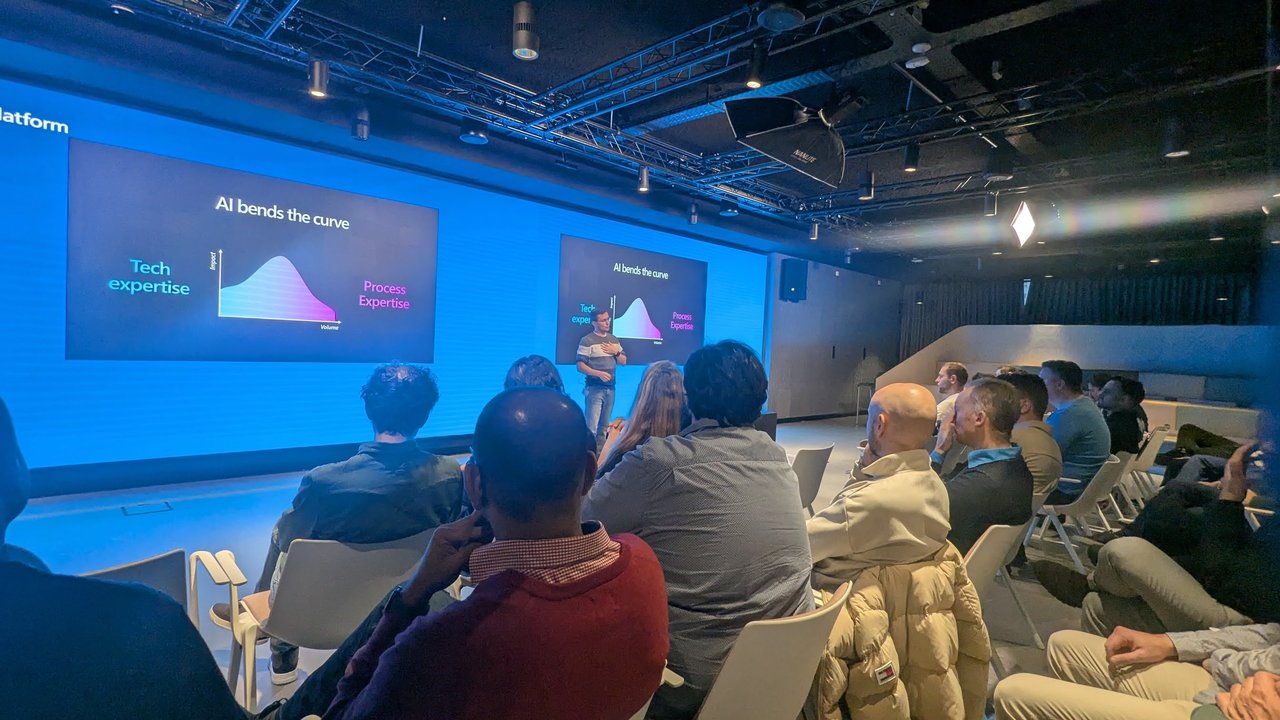
“AI bends the curve”: process experts can now build what used to need tech experts.
My take: I agree with the direction and worry about the operations. When process experts can generate apps and agents, platform teams own the guardrails: environments, data-loss policies, identity and observability for everything that gets built. Fusion development needs a fusion platform team.
What the season added up to
Twelve events, one pattern. The AI sessions were about practice: agent files, checkpoints, gateways and observability. The non-AI ones, like JVM upgrades, Kafka for SRE and sustainable UX, kept coming back to the same foundations. The best part of Amsterdam’s meetup scene is that you can see both in the same week.