AI Tinkerers Amsterdam — May 2026 at NIO House
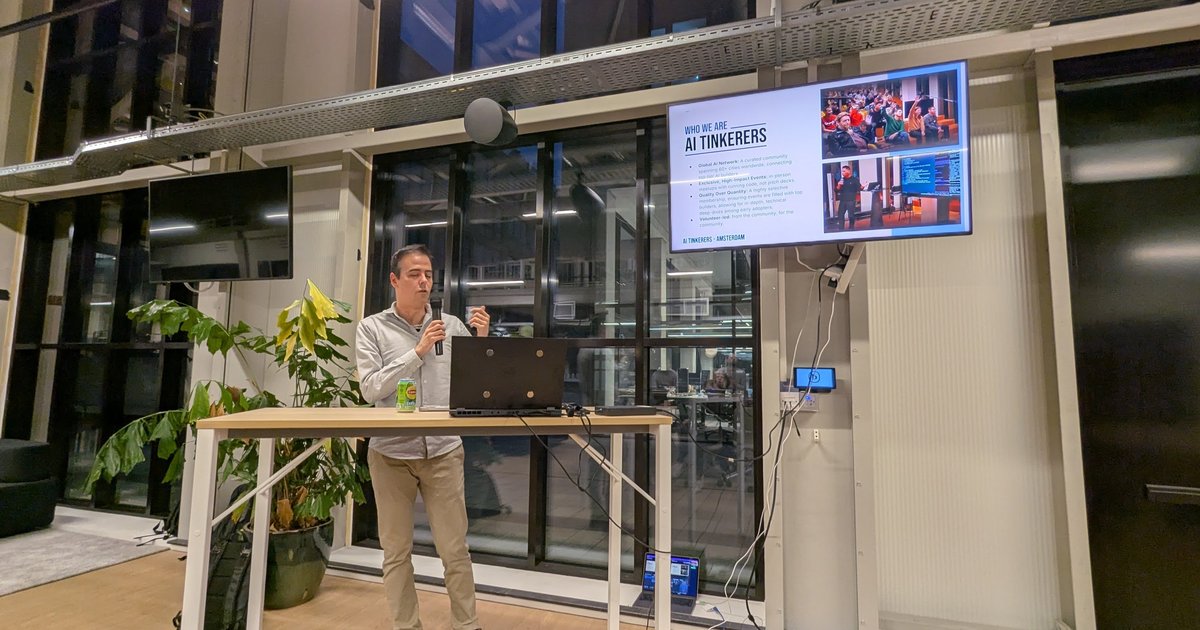
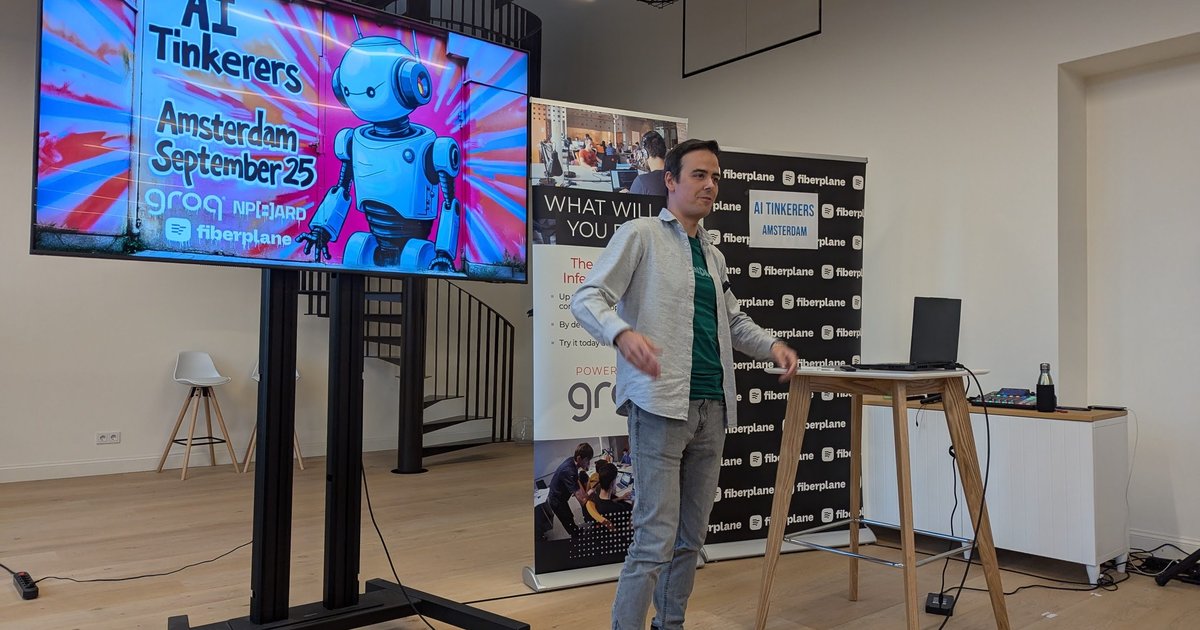
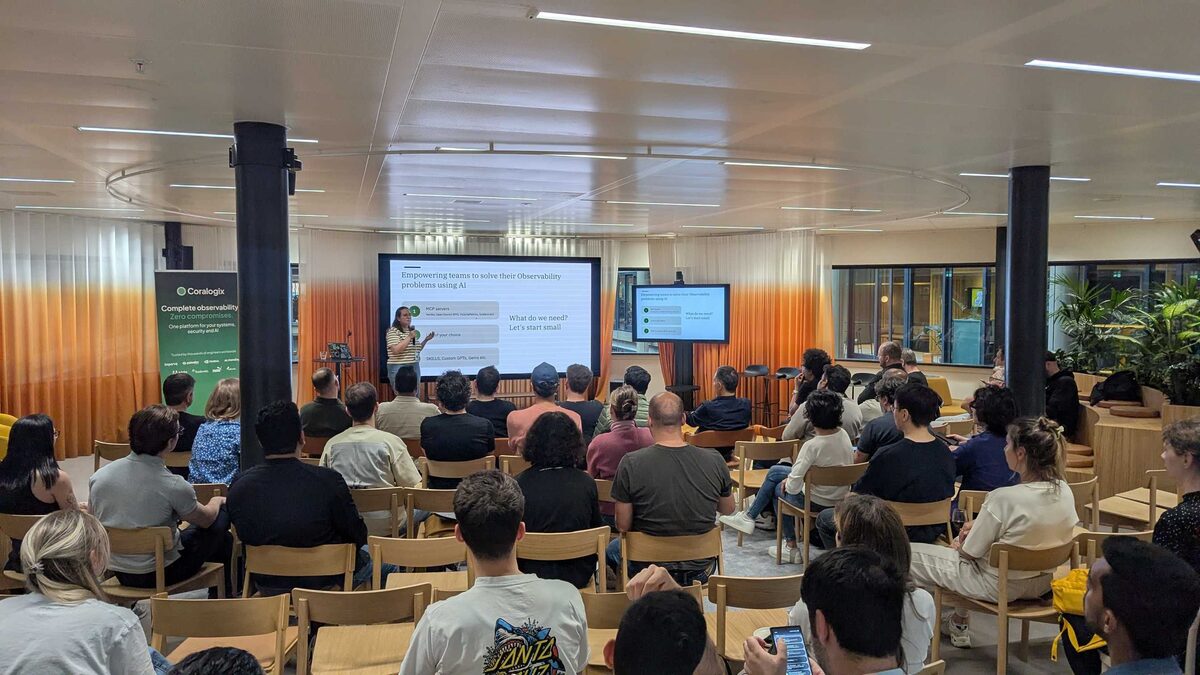
The AI Tinkerers Amsterdam community gathered at NIO House for the May 2026 demo night, co-sponsored by MotherDuck. With 223 cities and 300+ gatherings since 2023, AI Tinkerers has become the go-to community for AI practitioners who want to see real demos — not slide decks.
The venue itself was part of the story: NIO House Amsterdam is an 8-floor lifestyle hub by the Chinese EV maker, featuring a gallery, cafe, co-working space, art exhibitions, and a rooftop VIP experience — all in the tallest building in the area.
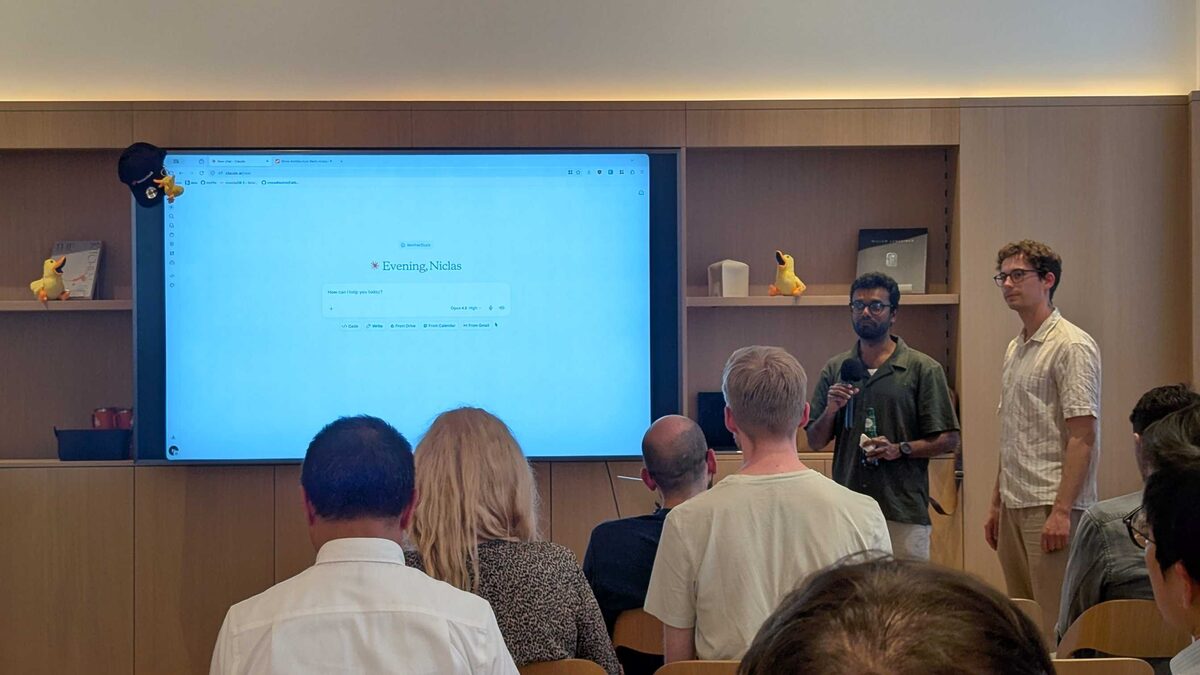
MotherDuck: Conversational BI on DuckDB
The headline demo came from the MotherDuck team — Niclas (presenter) and Adithya Krishnan (co-presenter) — showing how conversational AI transforms analytics.
DuckDB: SQLite for Analytics
The pitch is simple: DuckDB is an in-process analytical database with zero dependencies that runs anywhere. Install with pip install duckdb, create tables from Parquet files, and query immediately.
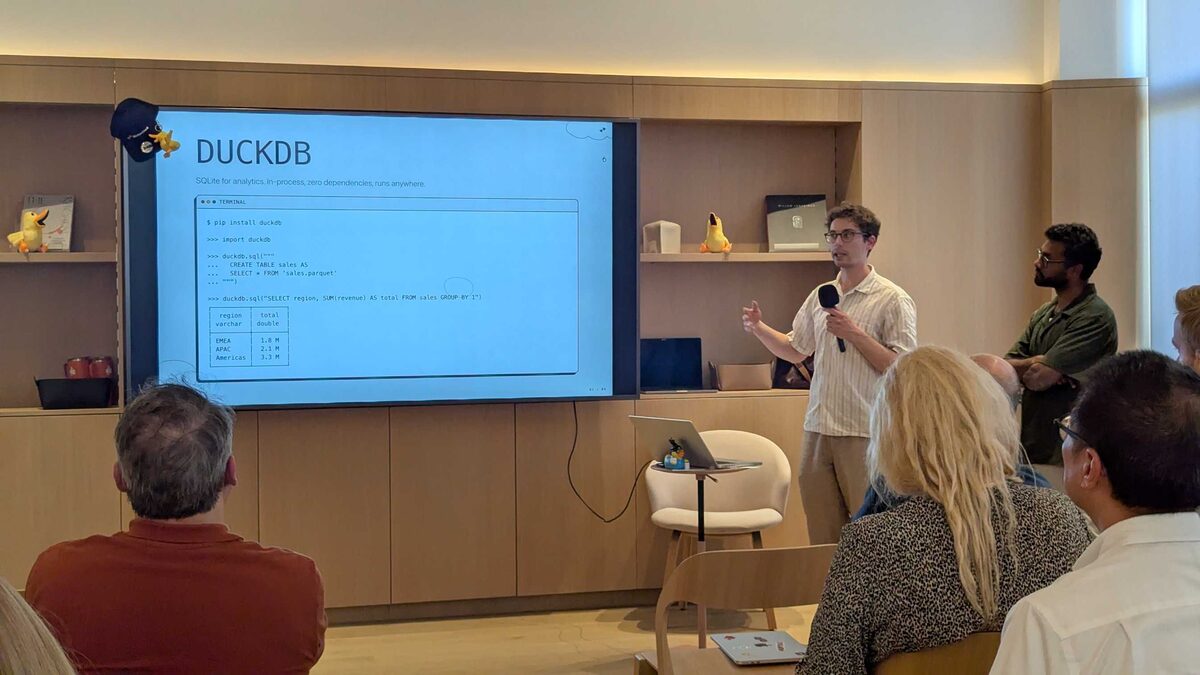
What If Your Laptop Is Not Enough?
When data outgrows your laptop or you need to share databases across a team, MotherDuck extends DuckDB to the cloud. One line of code bridges local and cloud:
import duckdb
duckdb.sql("ATTACH 'md:my_warehouse'")
duckdb.sql("SELECT region, SUM(revenue) AS total FROM my_warehouse.sales GROUP BY 1")
Results: Americas 48.3M, EMEA 31.2M, APAC 22.8M — cloud-scale data with local-speed queries.
AI-Powered Dashboard Generation
The demo used Claude Opus 4.8 High as the AI backend. Starting with a simple “List databases in motherduck.org” prompt, the AI:
- Discovered the
galactic_coffeeshared dataset - Generated a complete interactive dashboard: “Galactic Coffee: Two Years in Orbit”
- Produced KPIs: $4.74M total revenue, 945K cups sold, +16.8% YoY growth, 3.95 avg rating
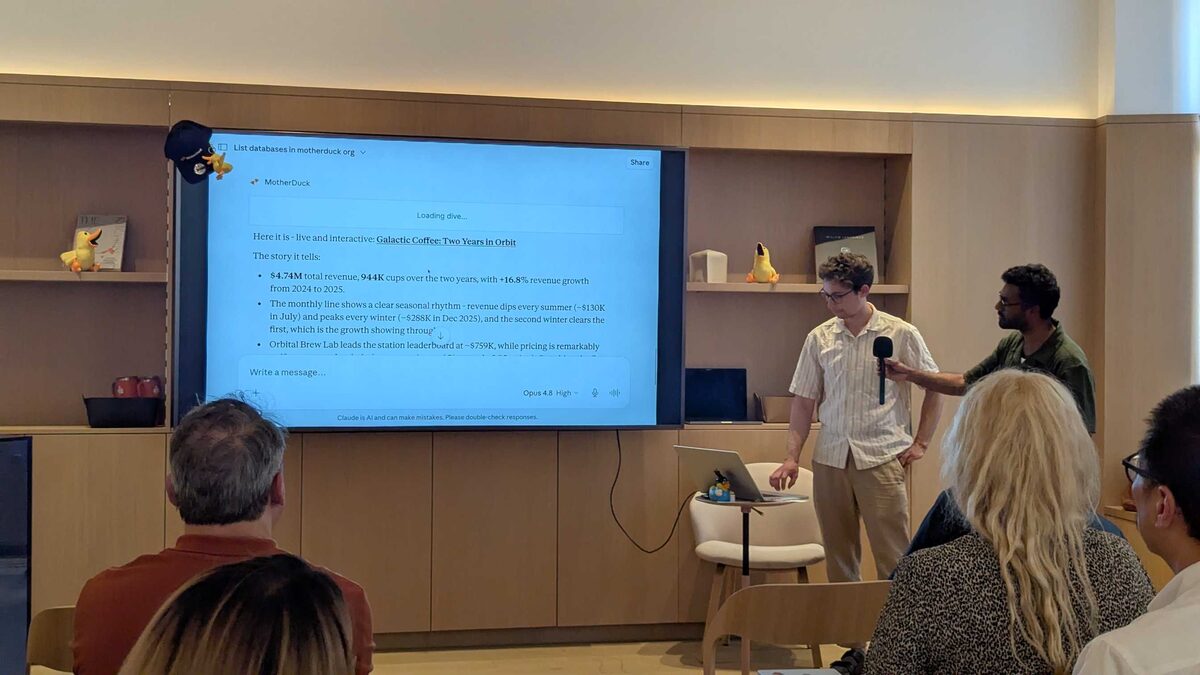
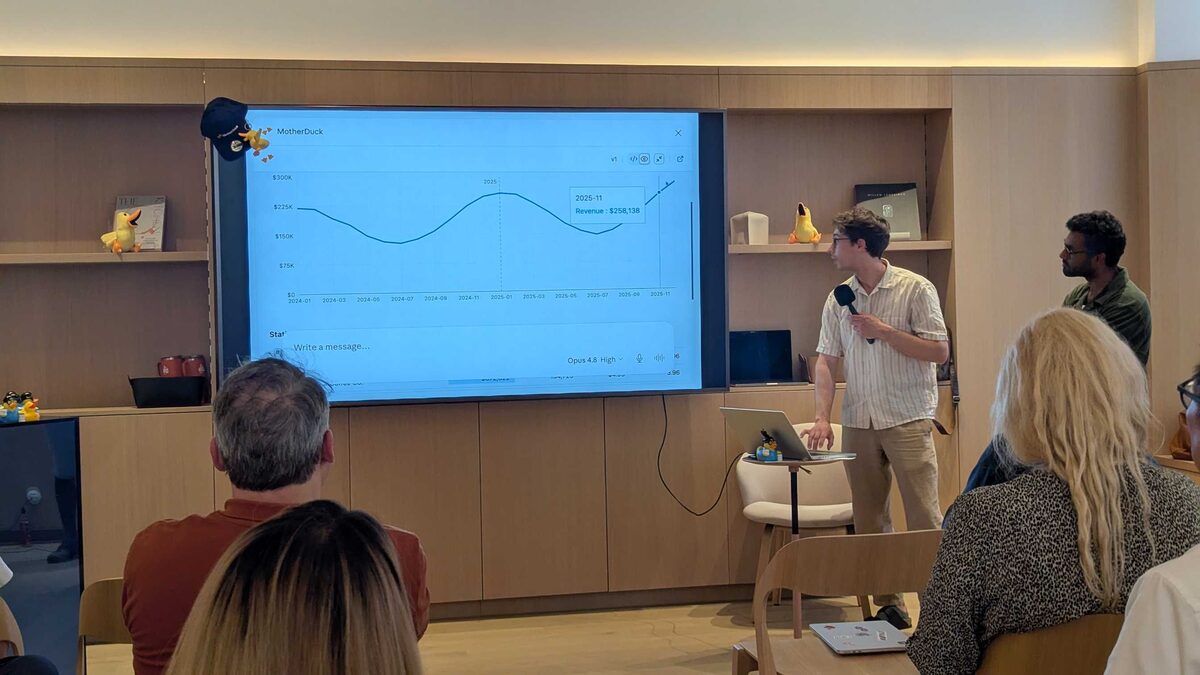
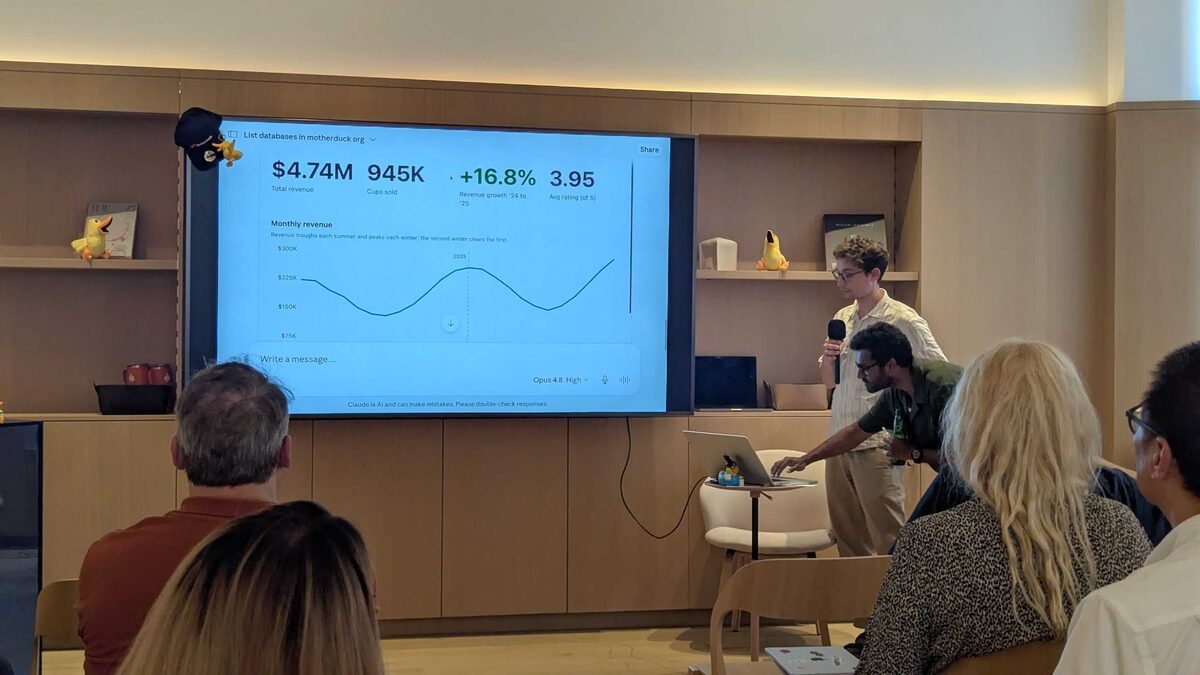
The AI even narrated insights: revenue troughs every summer ($130K in July), peaks every winter ($288K in Dec), and Orbital Brew Lab leads the station leaderboard at ~$759K.
Agents Are the Driver
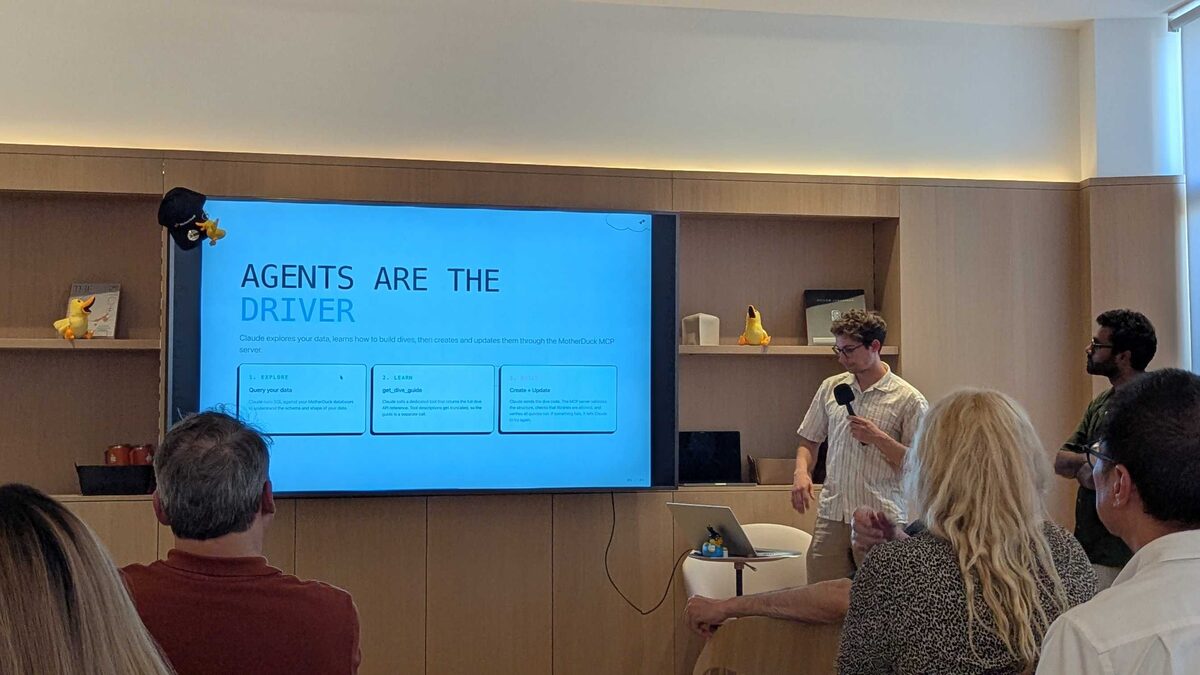
The architecture behind the magic is a 3-step MCP (Model Context Protocol) flow:
- Explore — Claude runs SQL against MotherDuck databases to understand schema and shape
- Learn — calls
get_dive_guide, a dedicated tool returning the full dive API reference - Create + Update — MCP server validates the dive code, checks libraries, verifies all queries run; if something fails, it tells Claude to fix again
Built for the Cloud
MotherDuck’s cloud architecture provides four guarantees:
- Hyper Tenancy — one DuckDB per user, fully isolated, no shared state
- Zero-Copy Clones — branch a database instantly without copying (clone shares storage)
- Snapshots + Time Travel — always recoverable, rewind to any point with a single command
- Perfect for Agents — safe autonomous writes; give an agent its own clone, let it write freely
Running Untrusted Code Safely
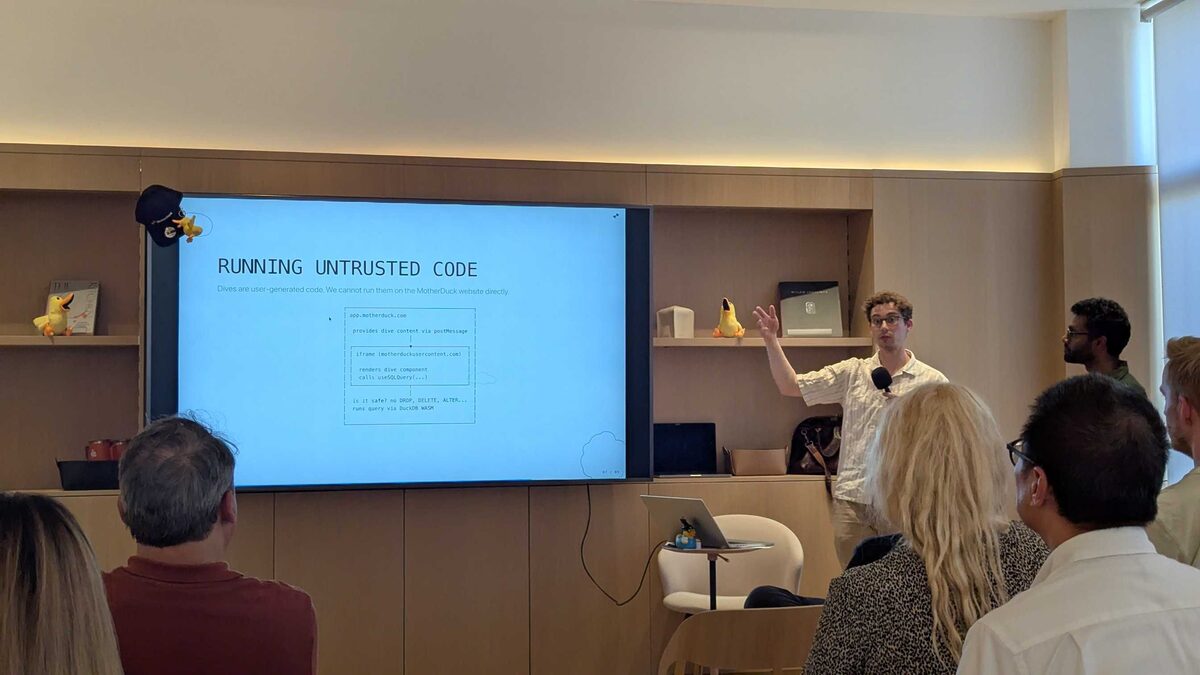
Since dives are user-generated code (created by AI agents), they cannot run directly on the MotherDuck website. The security model:
app.motherduck.comprovides dive content viapostMessage- Code runs in a sandboxed
iframeonmotherduck.usercontent.com - The iframe renders dive components and calls
useSQLQuery(...) - Safety: no DROP, DELETE, ALTER — queries run via DuckDB WASM only
Validation Before Deploy
Every dive goes through three gates before it ships:
- 🔵 Parse and validate JavaScript — must follow supported structure, only allowed features permitted
- 🟢 Validate queries are runnable — test all SQL against the actual data
- 🟠 Upload to MotherDuck — MCP server uploads the dive where it can be viewed and shared
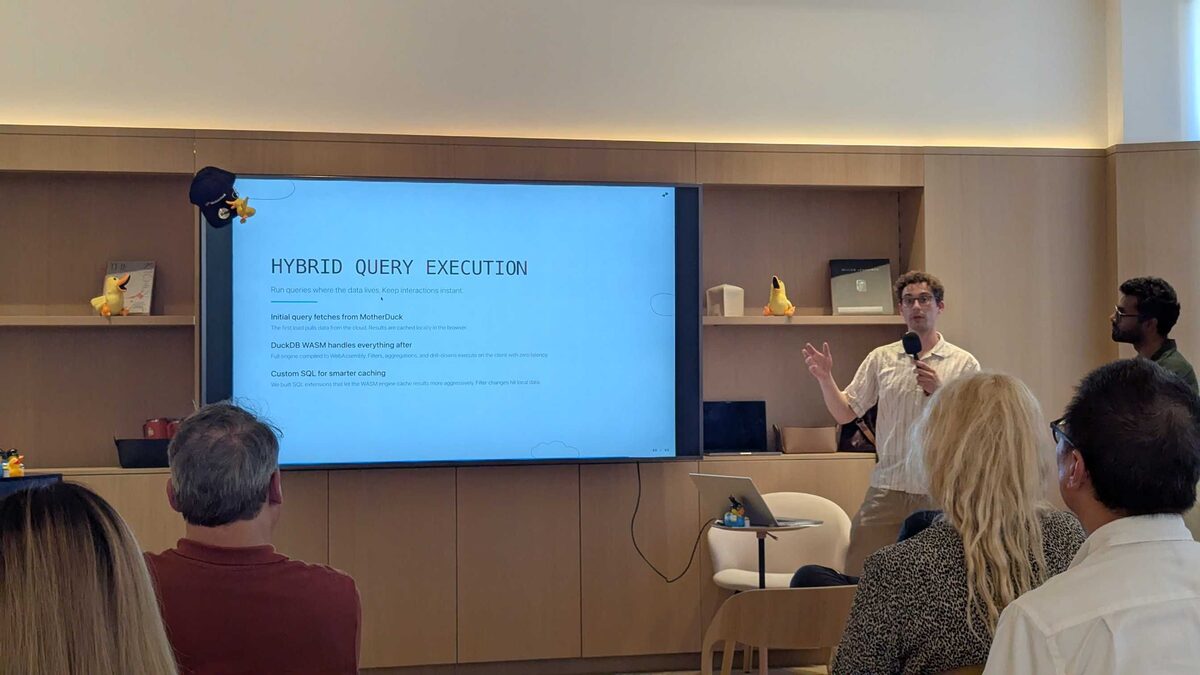
Hybrid Query Execution
The key to instant interactivity: run queries where the data lives.
- Initial query fetches from MotherDuck — first load pulls data from cloud, results cached locally in the browser
- DuckDB WASM handles everything after — full engine compiled to WebAssembly; filters, aggregations, and drill-downs execute client-side with zero latency
- Custom SQL for smarter caching — built SQL extensions that let the WASM engine cache results more aggressively; filter changes hit local data
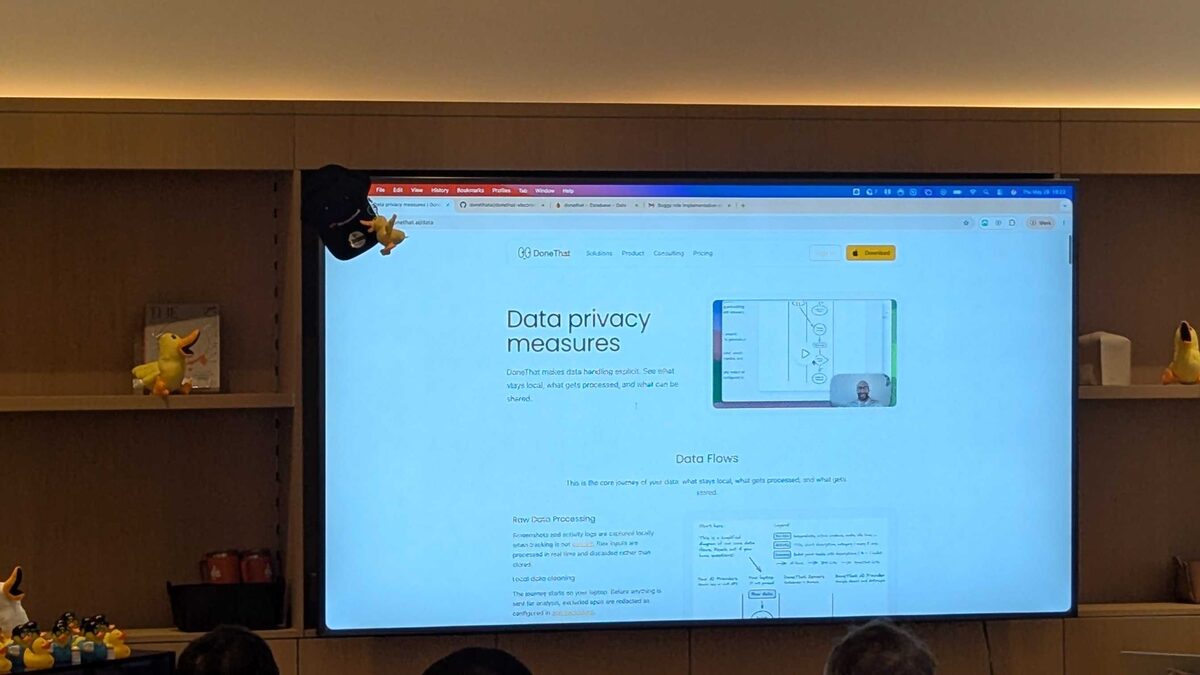
DoneThat: Adaptive Proactive Agents
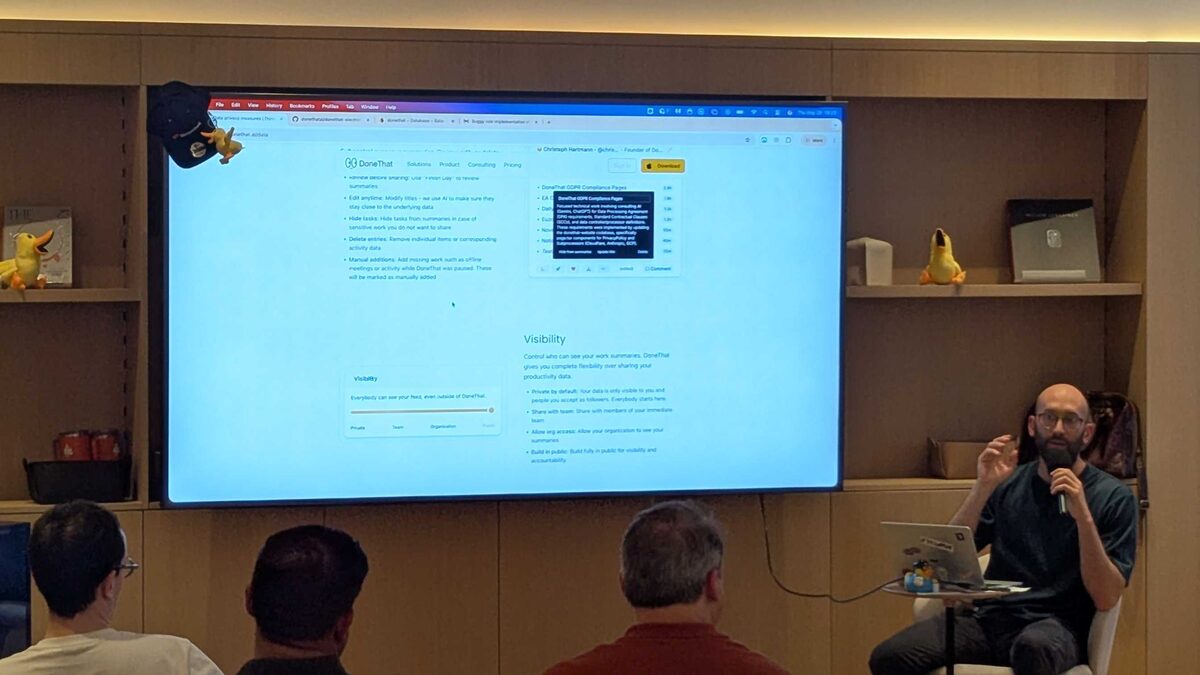
Christoph Hartmann demoed DoneThat — an AI productivity coach that decides when to reach out, not just responds when asked.
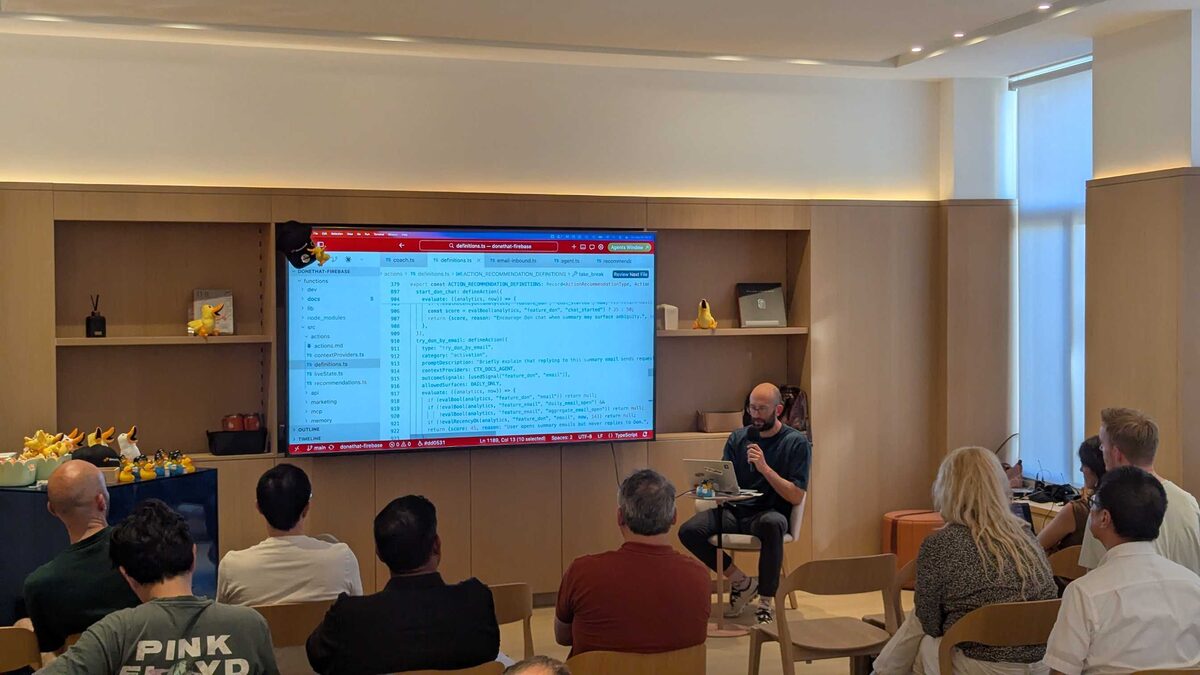
The Architecture
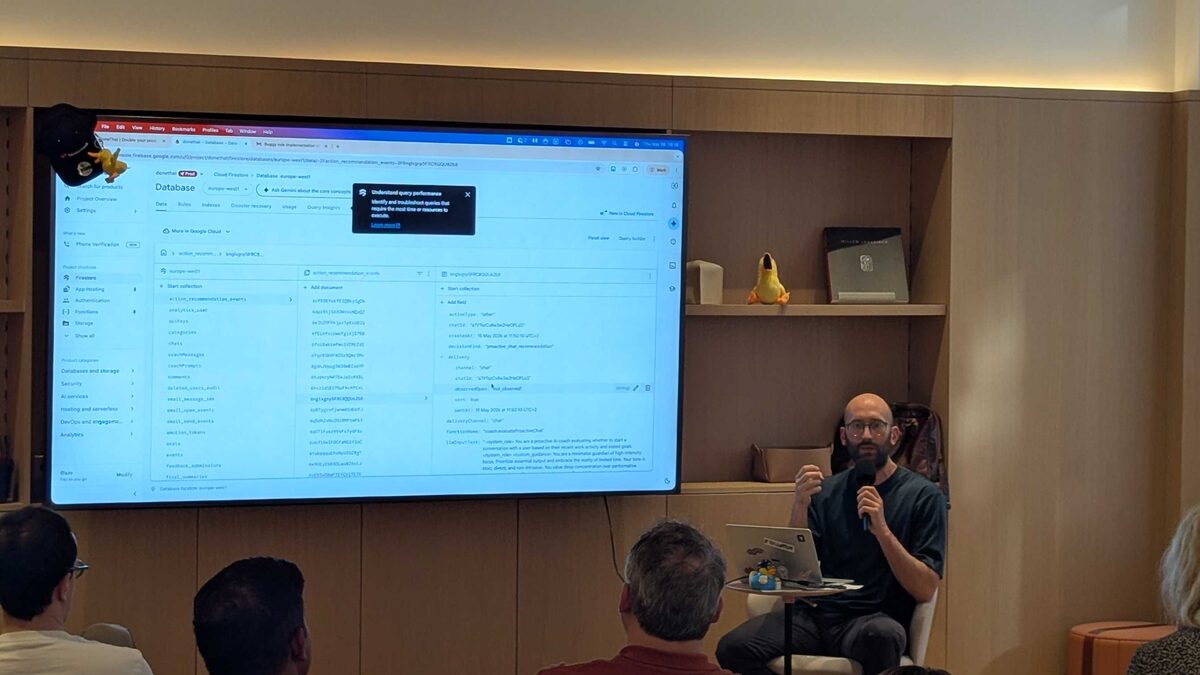
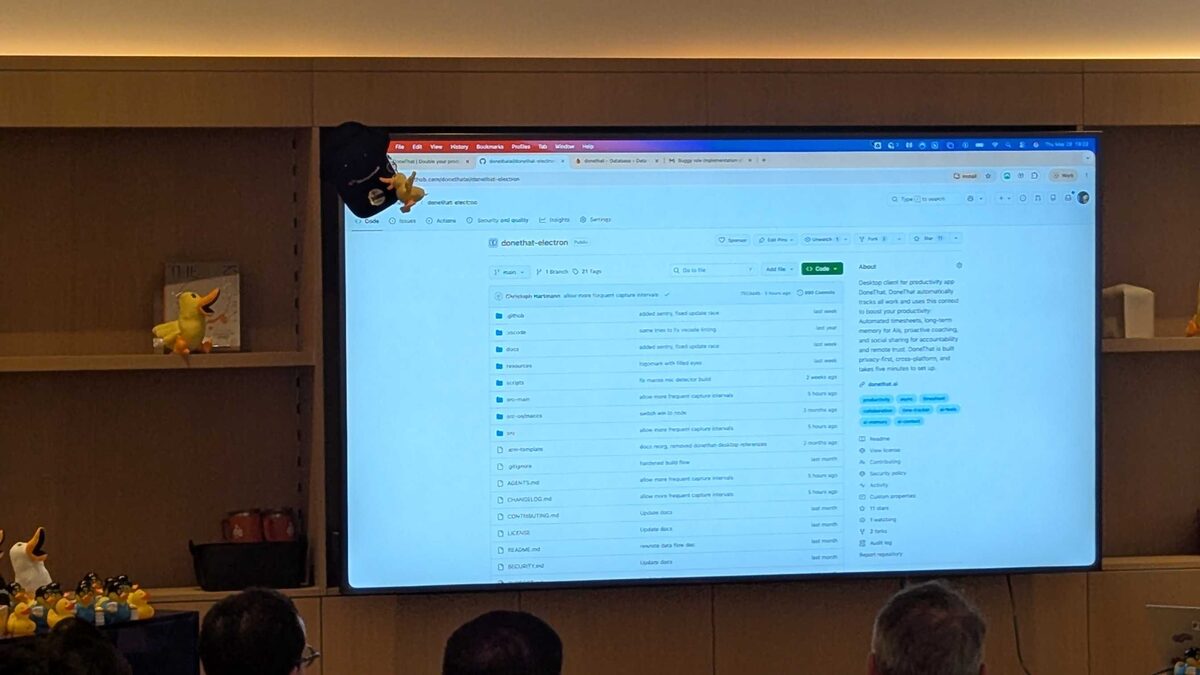
Built on Firebase with an Electron desktop client (open source on GitHub, 11 stars). The codebase shows ACTION_RECOMMENDATION_DEFINITIONS in TypeScript — each action has:
- A category and prompt description
- Context providers (e.g.,
CTX_DOCS_AGENT) - Allowed surfaces (
DAILY_ONLY) - Evaluation functions checking analytics and live state
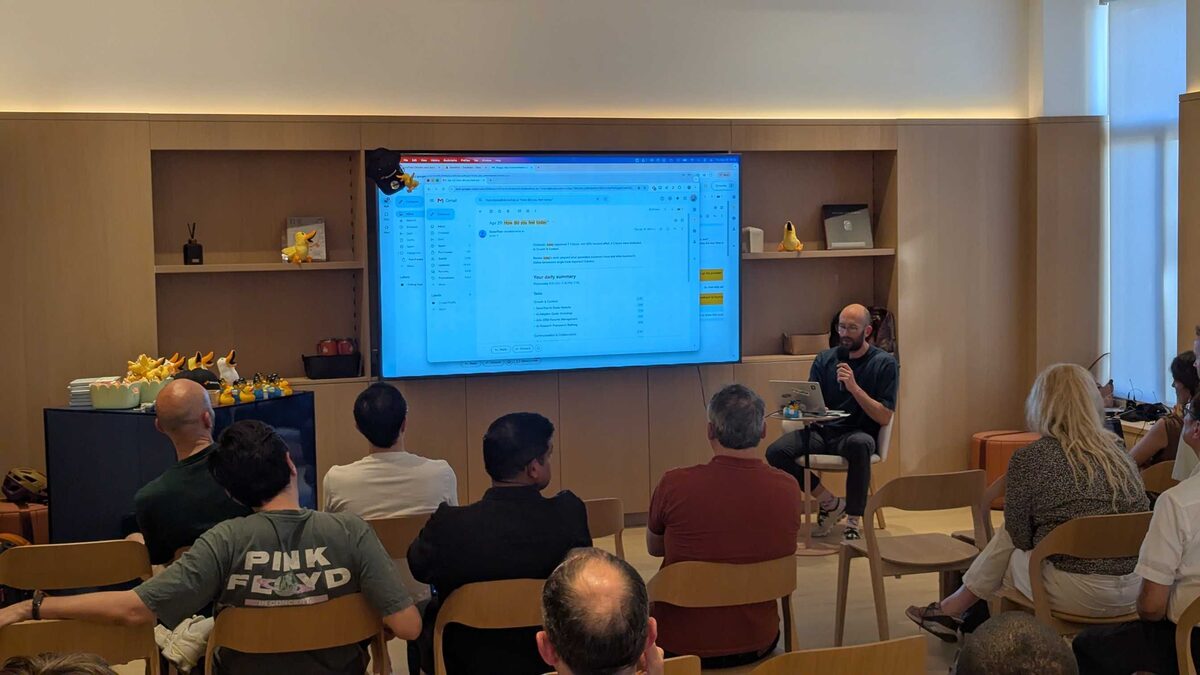
Daily Email Summaries
The agent sends proactive daily summaries via Gmail: “How did you feel today?” with goals breakdown, task completion, and coaching nudges.
Firebase Event Store
The backend uses Cloud Firestore with collections for action_recommendation_events, storing each proactive decision: action type, channel, delivery settings, and the full system prompt defining the AI coach persona.
Privacy-First Design
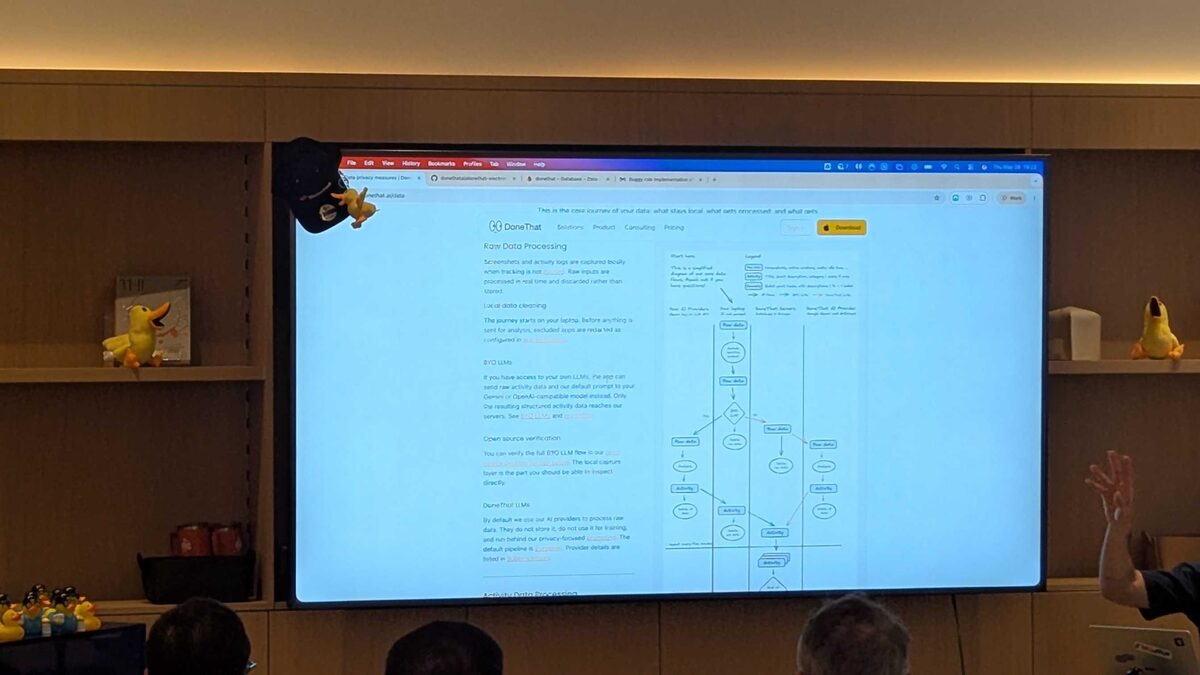
DoneThat takes data privacy seriously:
- Raw data stays local — screenshots and activity logs captured locally, processed in real time, discarded rather than stored
- BYO LLMs — send raw activity data to your own Gemini or OpenAI-compatible model; only structured output reaches their servers
- Open source verification — desktop capture layer fully inspectable on GitHub
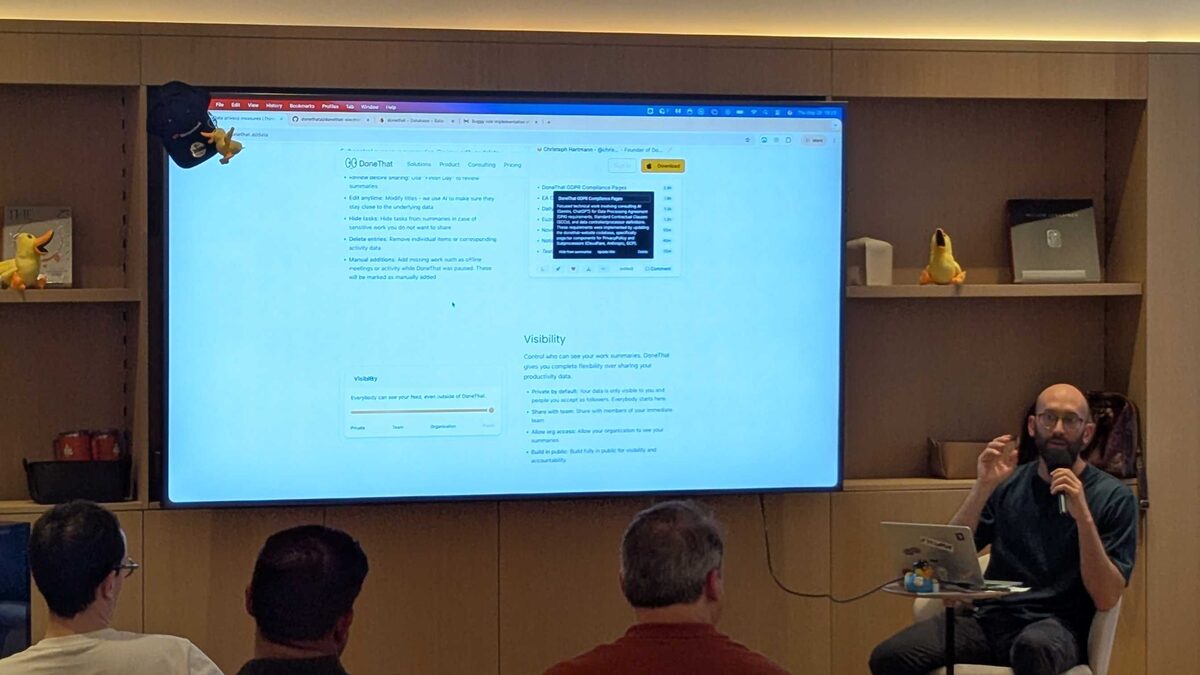
- Visibility controls — slider from Private → Team → Organization → Public
Demo 3: Solace Agent Mesh — Event-Driven Agent Orchestration
Hari Rangarajan took the stage with Solace Agent Mesh — an enterprise-grade multi-agent orchestration platform built on Solace’s PubSub+ event broker with native A2A (Agent-to-Agent) protocol support.
The Platform
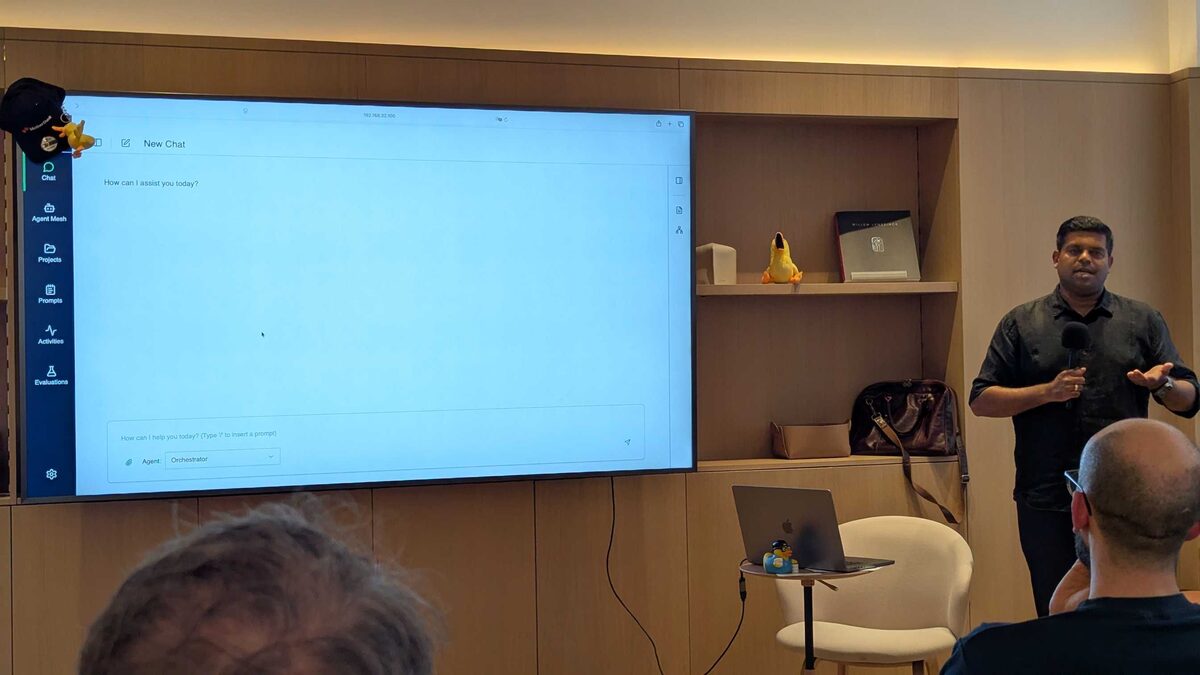
The Agent Mesh UI features six core modules: Chat, Agent Mesh, Projects, Prompts, Activities, and Evaluations. The Agent Mesh tab reveals sub-sections for Agents, Workflows (experimental), Connectors, Gateways, and Models — a complete control plane for multi-agent systems.
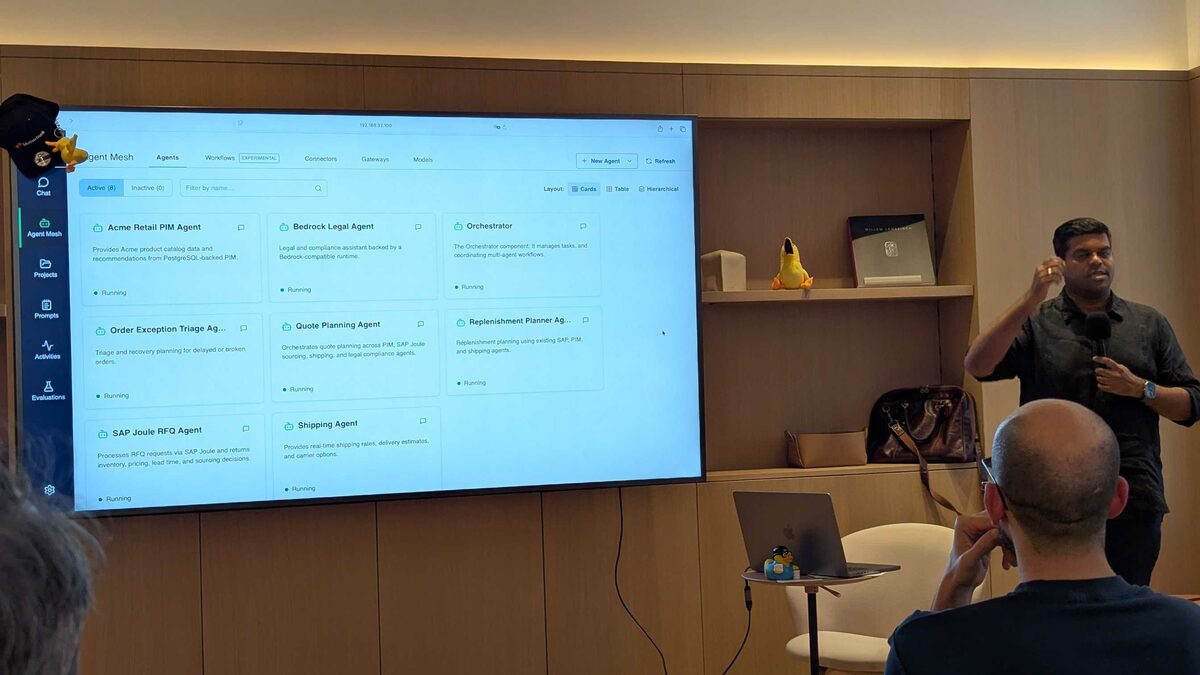
Hari demonstrated 8 active agents running simultaneously:
- Acme Retail PIM Agent — product catalog data from PostgreSQL-backed PIM
- Bedrock Legal Agent — compliance assistant backed by AWS Bedrock
- Orchestrator — manages tasks and coordinates multi-agent workflows
- Order Exception Triage Agent — recovery planning for delayed/broken orders
- Quote Planning Agent — orchestrates across PIM, SAP Joule, shipping, and legal
- Replenishment Planner Agent — planning using SAP, PIM, and shipping agents
- SAP Joule RFQ Agent — processes RFQ requests with inventory, pricing, and sourcing
- Shipping Agent — real-time rates, delivery estimates, and carrier options
The Demo: End-to-End RFQ Processing
The killer demo: an inbound email from operations@alpine-energy.eu requesting a quote for 200 flow meters (SKU MAT-500200) and 200 gasket sets (SKU MAT-700200), delivered FCA to Lacchiarella (MI), Italy by 2026-10-30.
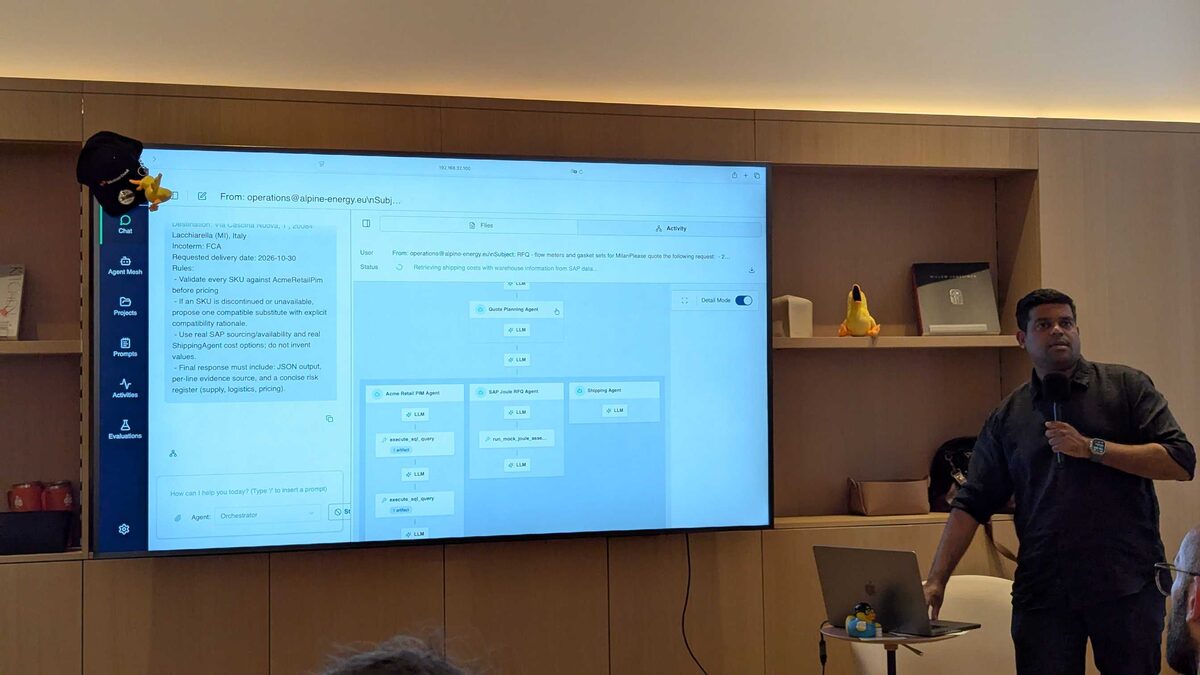
The orchestrator enforced strict rules:
- Validate every SKU against AcmeRetailPim before pricing
- If discontinued, propose one compatible substitute with rationale
- Use real SAP sourcing/availability and real ShippingAgent costs — no invented values
- Final response must include JSON output, per-line evidence sources, and a risk register
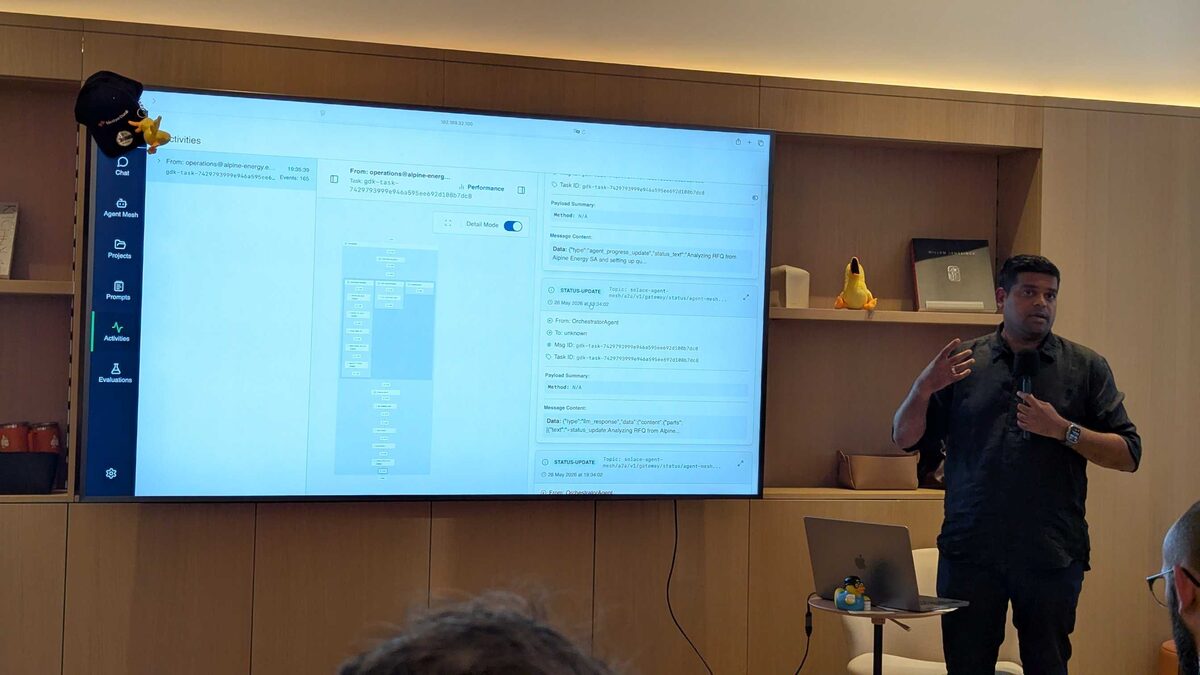
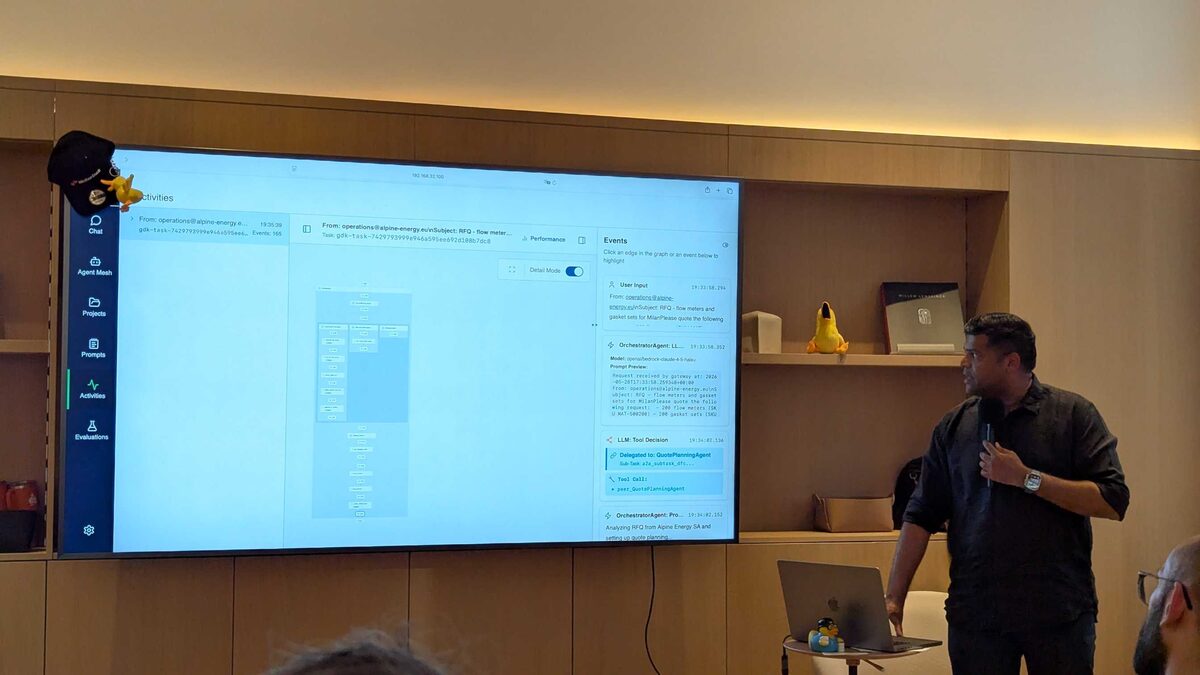
The Activities view exposed the full event trace — Solace topic paths (solace-agent-mesh/v2/v1/gateway/status/...), STATUS-UPDATE messages from OrchestratorAgent, and LLM invocations using openai/bedrock-claude-4-5-haiku.
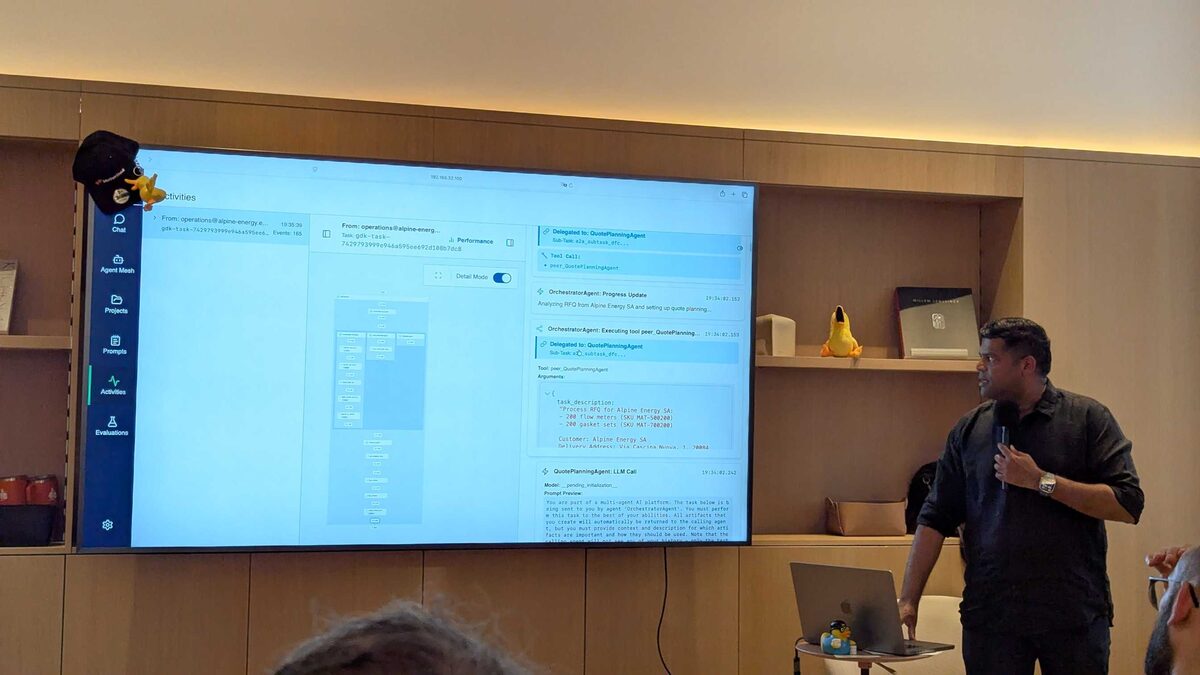
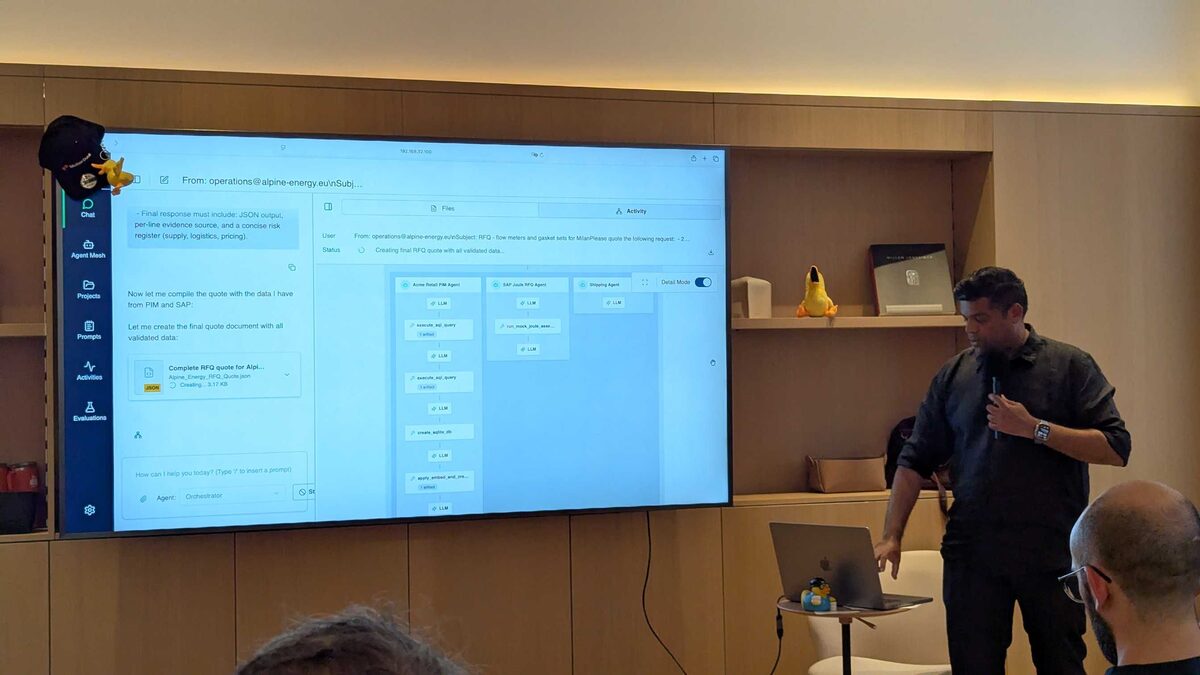
The delegation chain was fully observable: Orchestrator analyzing the RFQ → delegating to QuotePlanningAgent with explicit task arguments → parallel fan-out to PIM Agent (execute_sql_query), SAP Joule Agent (run_mock_joule_asse...), and Shipping Agent.
The Result
Within seconds, the mesh produced a complete validated quote:
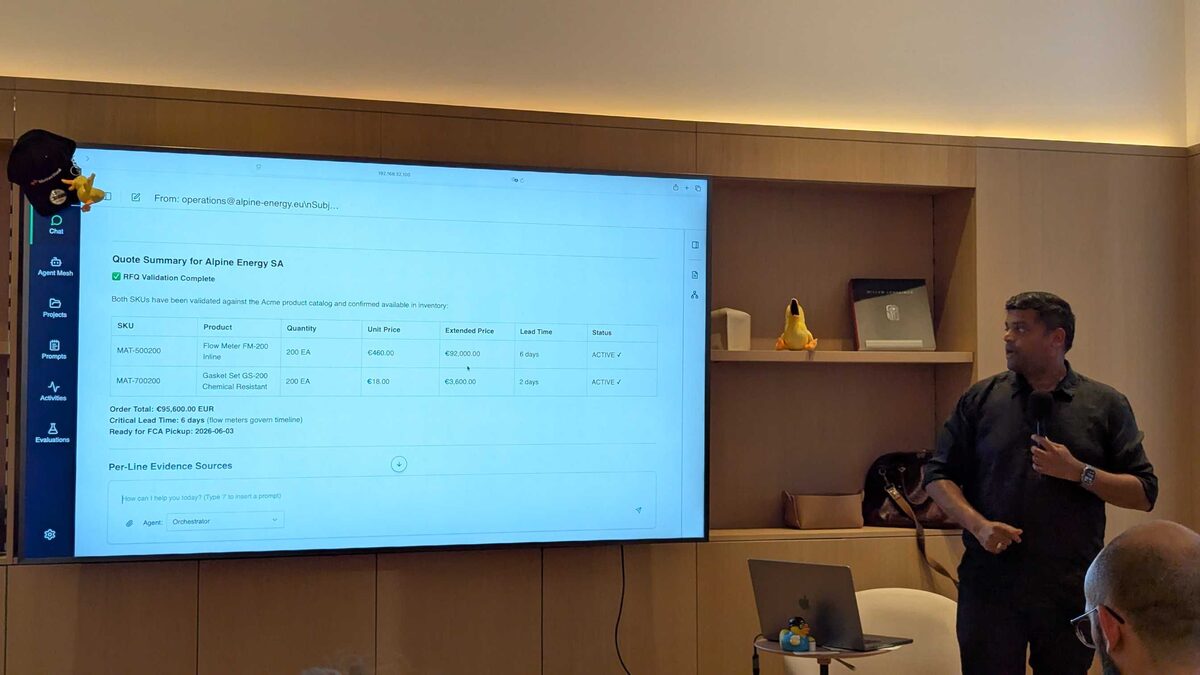
Quote Summary for Alpine Energy SA — ✅ RFQ Validation Complete:
| SKU | Product | Qty | Unit Price | Extended | Lead Time | Status |
|---|---|---|---|---|---|---|
| MAT-500200 | Flow Meter FM-200 Inline | 200 EA | €460.00 | €92,000.00 | 6 days | ACTIVE ✓ |
| MAT-700200 | Gasket Set GS-200 Chemical Resistant | 200 EA | €18.00 | €3,600.00 | 2 days | ACTIVE ✓ |
Order Total: €95,600.00 EUR — Critical lead time: 6 days — Ready for FCA pickup: 2026-06-03.
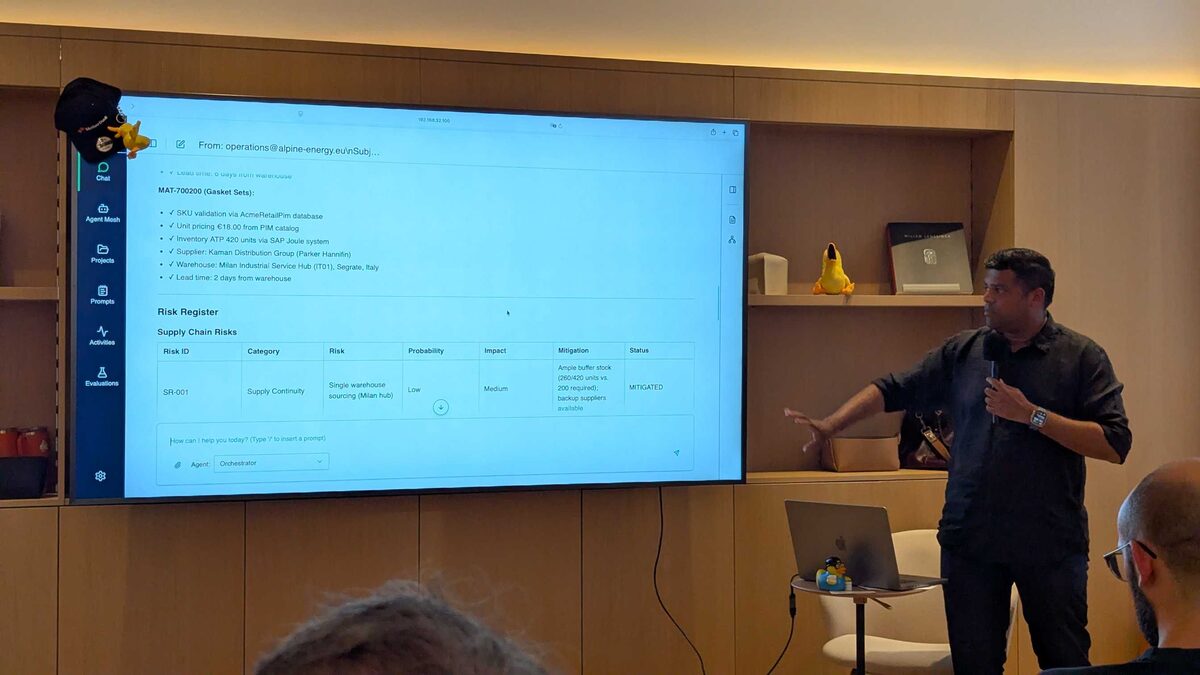
Each line item included full evidence sourcing: SKU validation via AcmeRetailPim, unit pricing from PIM catalog, inventory ATP via SAP Joule, supplier identification (Kaman Distribution Group / Parker Hannifin), warehouse location (Milan Industrial Service Hub IT01, Segrate, Italy).
The Risk Register identified SR-001: single warehouse sourcing (Milan hub) — Low probability, Medium impact, MITIGATED by ample buffer stock (260/420 units vs. 200 required) and backup suppliers.
Why It Matters
Solace’s approach to agent orchestration is fundamentally different from chain-of-thought frameworks:
- Event-driven, not polling — agents communicate via PubSub+ topics, enabling true async parallelism
- A2A protocol support — Google’s open standard for agent discovery and task delegation
- Full observability — every LLM call, tool invocation, and status update is traced with timestamps and topic paths
- Enterprise integration — native connectors to SAP, PostgreSQL, AWS Bedrock, and custom gateways
- Artifact generation — the final JSON output (3.17 KB) is a downloadable, auditable quote document
Key Takeaways
- Conversational BI is production-ready — MotherDuck’s MCP + DuckDB WASM + Claude pipeline generates shareable, interactive dashboards from natural language
- Agent safety requires architecture — sandboxed iframes, validation gates, and read-only WASM execution keep AI-generated code safe
- Proactive beats reactive — DoneThat’s approach of deciding when to engage (vs. waiting for prompts) is the next frontier for personal AI
- Privacy and AI can coexist — BYO LLM, local processing, and open source capture layers prove you do not need to sacrifice data control for intelligence
- Event-driven agent orchestration scales — Solace proves that PubSub+ messaging patterns beat sequential chains for multi-agent enterprise workflows
The Venue: NIO House Amsterdam
NIO House deserves its own mention — an 8-floor experience center:
- Floor -1: Basement
- Floor 0: Gallery (high-end EV showcase)
- Floor 1: Cafe
- Floor 2: Living Lounge
- Floor 3: Co-working
- Floor 4: Art Space
- Floor 5: Back of House
- Floor 6: Event Space (where the meetup happened)
- Floor 7: VIP Experience
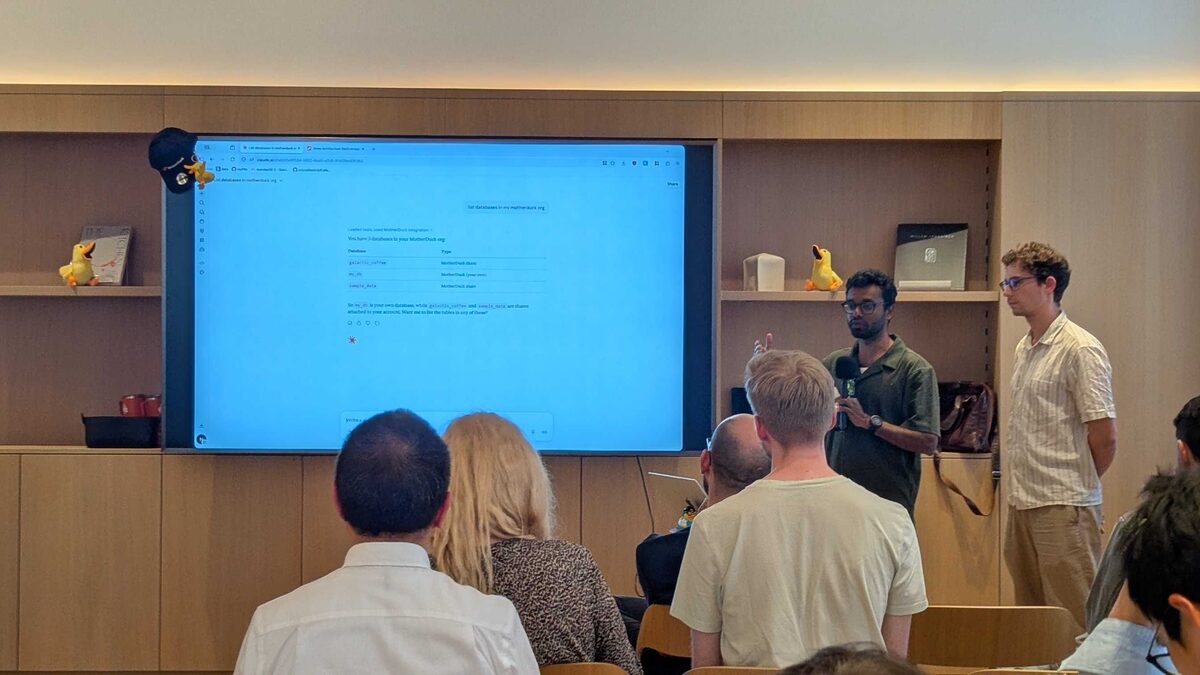
The space featured NIO’s signature yellow duck mascots, warm wood interiors, and a full presentation setup. A perfect venue for the Amsterdam AI community.
Resources
- AI Tinkerers — 223 cities, 100K+ practitioners
- MotherDuck — Cloud DuckDB with conversational AI
- DoneThat — Adaptive proactive AI coach
- DoneThat Electron (GitHub) — Open source desktop client
- Solace Agent Mesh — Event-driven multi-agent orchestration
- A2A Protocol — Google’s Agent-to-Agent communication standard
- NIO House Amsterdam — EV lifestyle experience center