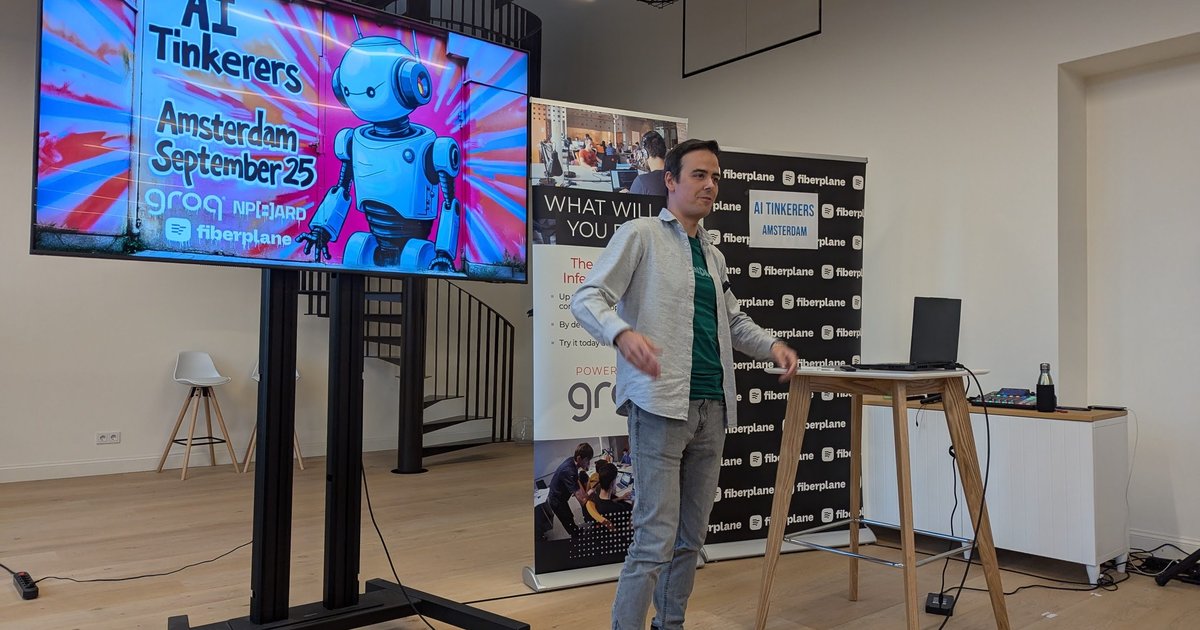
I’ve written up AI Tinkerers Amsterdam in February 2025 and the May 2026 demo night at NIO House. This is the prequel: the two editions I went to in autumn 2024, on Wednesday 25 September and Tuesday 12 November. The format was the same as later: short live demos, running code on the big screen, very few slides. Speaker names below are spelled as they appeared on the organisers’ lineup slides.
Arriving on 25 September: the Fiberplane wall and the AI Tinkerers Amsterdam sign.
25 September 2024: Groq and Fiberplane
The title slide said AI Tinkerers Amsterdam, September 25, with the logos of Groq, NP-HARD and Fiberplane. The room had a Fiberplane wall and a Groq roll-up banner: “The Groq LPU Inference Engine”, “Up to 15x faster inference compared to top cloud providers”, “By developers, for developers” and “Try it today at console.groq.com”.
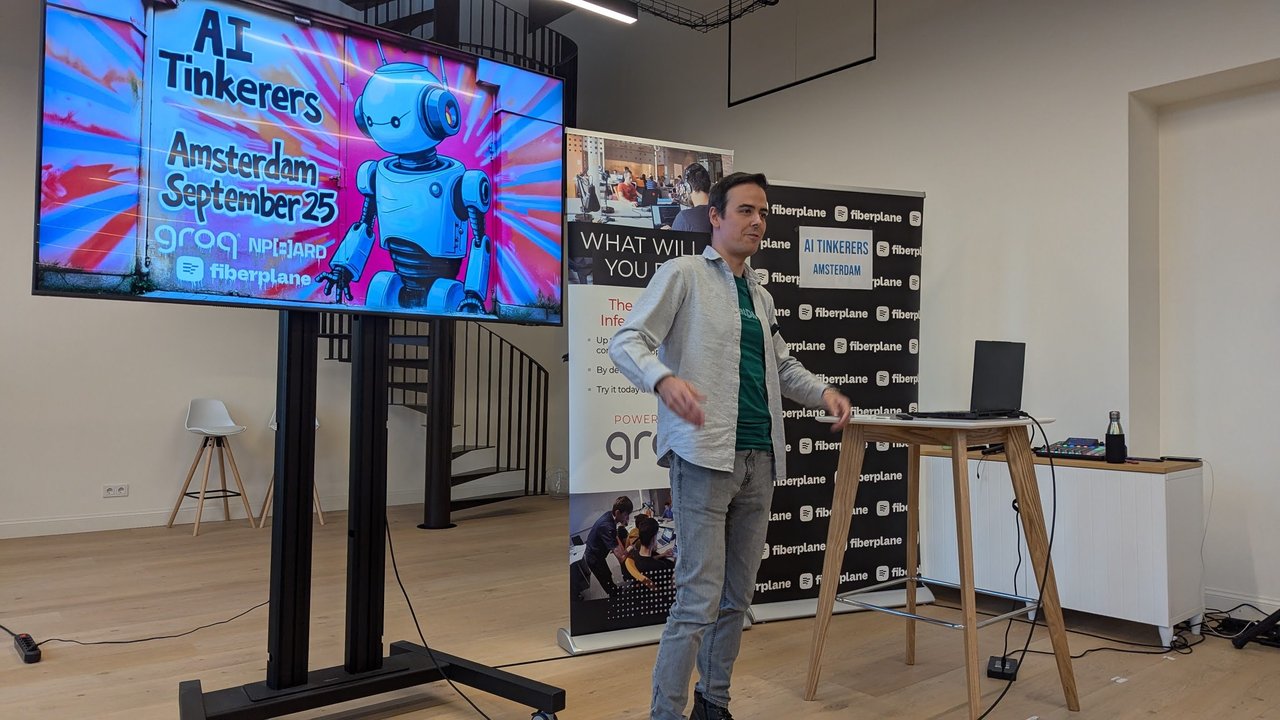
The September 2024 title slide.
The host’s intro slides described AI Tinkerers Amsterdam as “the best technical AI community in the Netherlands”. A map of chapter cities followed, with Bogotá, Kuala Lumpur, Dublin, Palo Alto, Seattle, Atlanta, Los Angeles, London, Paris, Berlin, Prague, Dubai, Bengaluru, Singapore, San Francisco, Medellín and Ottawa around Amsterdam in the middle. There was also a slide on Open Interpreter from the Ottawa chapter.
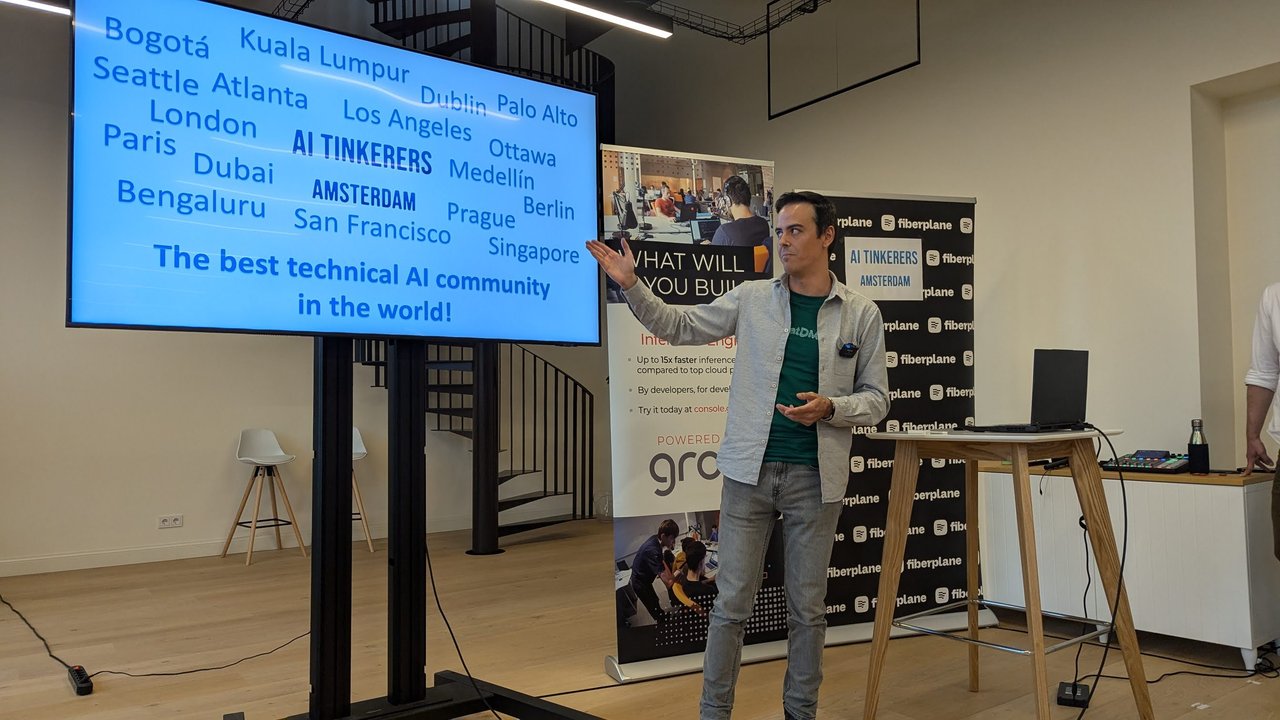
Chapters around the world, with Amsterdam in the middle.
One intro slide stood out. It was Groq’s own post about its open-source tool-use models, Llama-3-Groq-70B-Tool-Use and Llama-3-Groq-8B-Tool-Use, with the highlighted lines: they “were developed in collaboration with Glaive”, and “this collaboration stemmed from a previous AI Tinkerers meetup in Amsterdam”. It’s a good argument for the format: people meet at a demo night, and a few months later there’s a model release.
The lineup slides listed seven demos:
- Laurynas Keturakis (Fiberplane): Post-Postman: Creative End-to-End API Testing with Generative AI
- Ronny Roeller (NEXT): Classifying Data with LLMs
- Stefan Nae (Movebite): Mobi: a health coach for work
- An intermission titled Lucas Meijer is not a firefighter
- Gaurav Chandrashekar (ProductScale): Summarise.live
- Max Engelen (Groq): ScribeWizard and StockBot powered by Groq
- Muhammad Ibne Rafiq (McDermott): Auto Landing AI
Fiberplane: AI-generated API tests
The Fiberplane demo started in the editor. The service was a Hono app on Cloudflare Workers, using @neondatabase/serverless and drizzle-orm for the database, the OpenAI SDK, and instrument from @fiberplane/hono-otel for OpenTelemetry tracing. The sample API was about geese, with a geese table that had fields such as name, description, isFlockLeader, programming language, motivations and location.
The app then appeared in Fiberplane’s local studio, which listed the detected routes: GET /api/geese, POST /api/geese/:id/generate, GET /api/geese/flock-leaders, POST /api/geese/:id/bio, POST /api/geese/:id/honk, GET /api/geese/language/:language and PATCH /api/geese/:id/motivations. The request panel had an “Inputs generated by AI” section, and the trace for a request went down to the Neon database call.
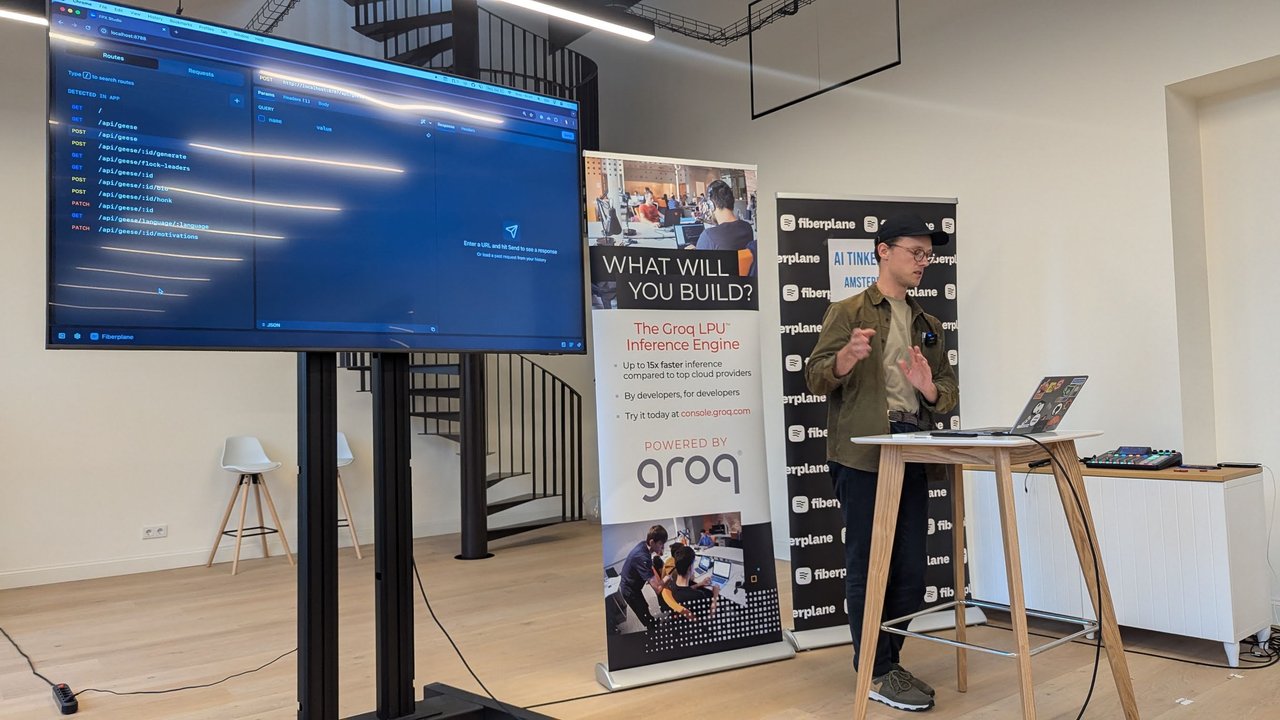
Routes detected from a Hono app, with AI-generated inputs for testing them.
NEXT: classifying feedback with an LLM
Ronny Roeller’s demo started in the OpenAI Playground with gpt-4o. The prompt asked the model to “return a JSON array with the feedback ID and the category” for a list of user feedback, and the answer mapped each UUID to Positive Feedback, Product Issues or Feature Requests. Then came the optimisation I liked best. Since there are only a handful of categories, there’s no point spelling them out every time, so he had the model return just a letter per category, and the output got much more compact.
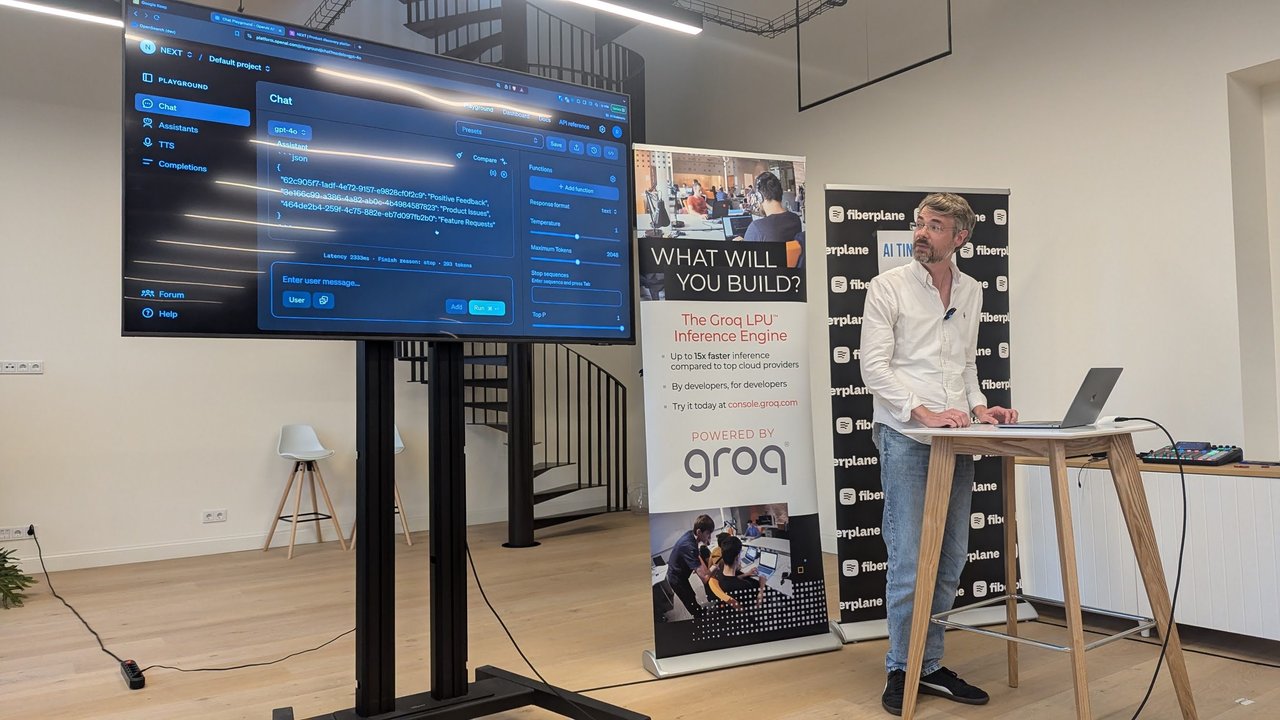
Feedback classification as JSON, before the categories were shortened to single letters.
The same idea then showed up in the NEXT product, on a “Spotify sample data” workspace: highlights clustered into pain points and feature requests, and a generated report titled “How Pain Points Feed into Feature Requests Raised by Spotify Users”.
Movebite, Summarise.live and Groq apps
The Movebite demo started from a problem rather than a model. The screen showed a TNO page headlined “Nederland Europees kampioen zitten”: 26% of the Dutch population aged 15 and over sits for more than 8.5 hours on an average day, against 11% in the rest of the EU, and employees sat 8.9 hours per working day on average in 2022. A video slide followed: “Your desk can be a danger to your mental health”. Later the screen showed Composio, an integration platform for AI agents and LLMs.
Gaurav Chandrashekar showed Summarise.live, with the tagline “Quality summaries of long presentations”. The examples on screen were a long podcast episode and the Unity GDC Keynote 2018, broken into chapters such as “How Do Scriptable Render Pipelines Work?”.
Max Engelen, whose own slide introduced him as a computer engineer, showed two Groq-powered apps. ScribeWizard was hosted on Streamlit, with its code linked from the slide. The other was StockBot. Another slide explained how to get access to GroqCloud: visit console.groq.com.
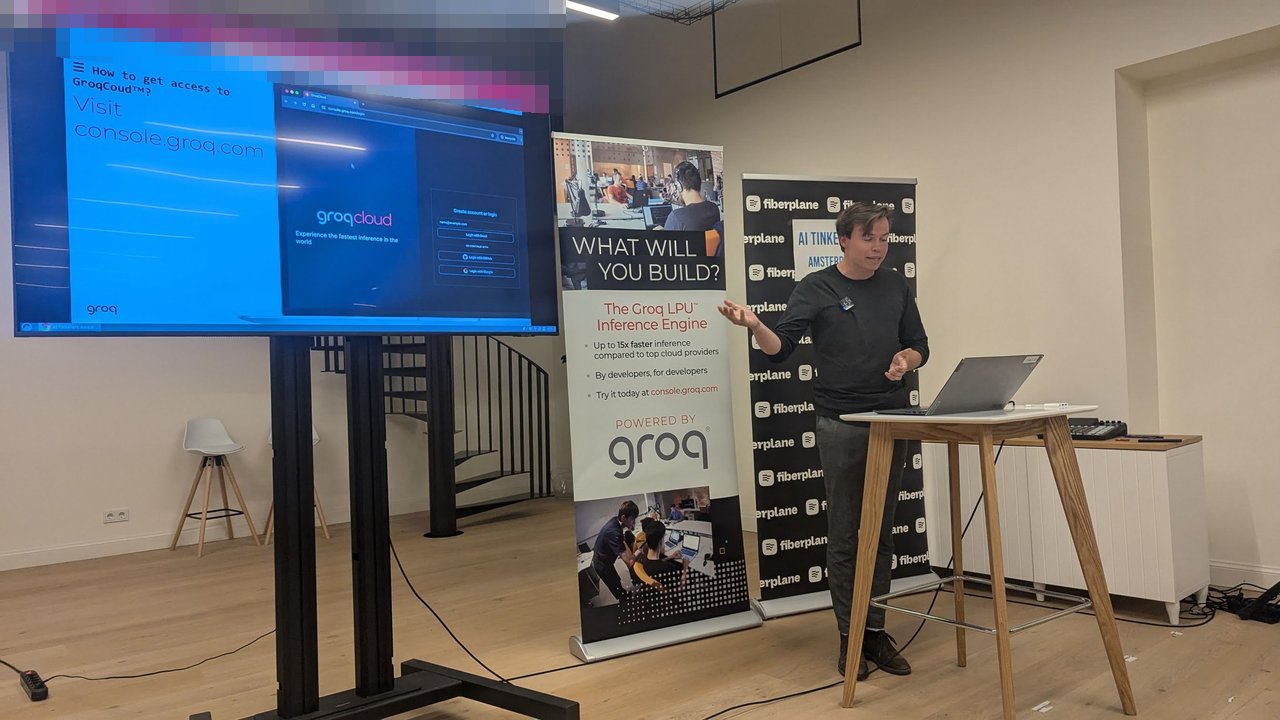
Max Engelen’s GroqCloud slide. I’ve blurred the browser bar above it.
Other screens I caught that evening: a Hugging Face model page for a DistilBERT punctuation model, a prompt asking an LLM to work out a candidate’s name and gender from a transcript (and to fall back to “mevrouw de Vries” when it’s unclear), and a long text on the Eight Queens problem and Gauss. I can’t match those to a lineup entry, so I’ll leave them there.
12 November 2024: the Homebrew Computer Club night
The November edition opened with a nod to history. The host’s first slide showed the Homebrew Computer Club, with archive photos and an early Apple Computer board. The comparison works for me: a room of people showing each other what they built.
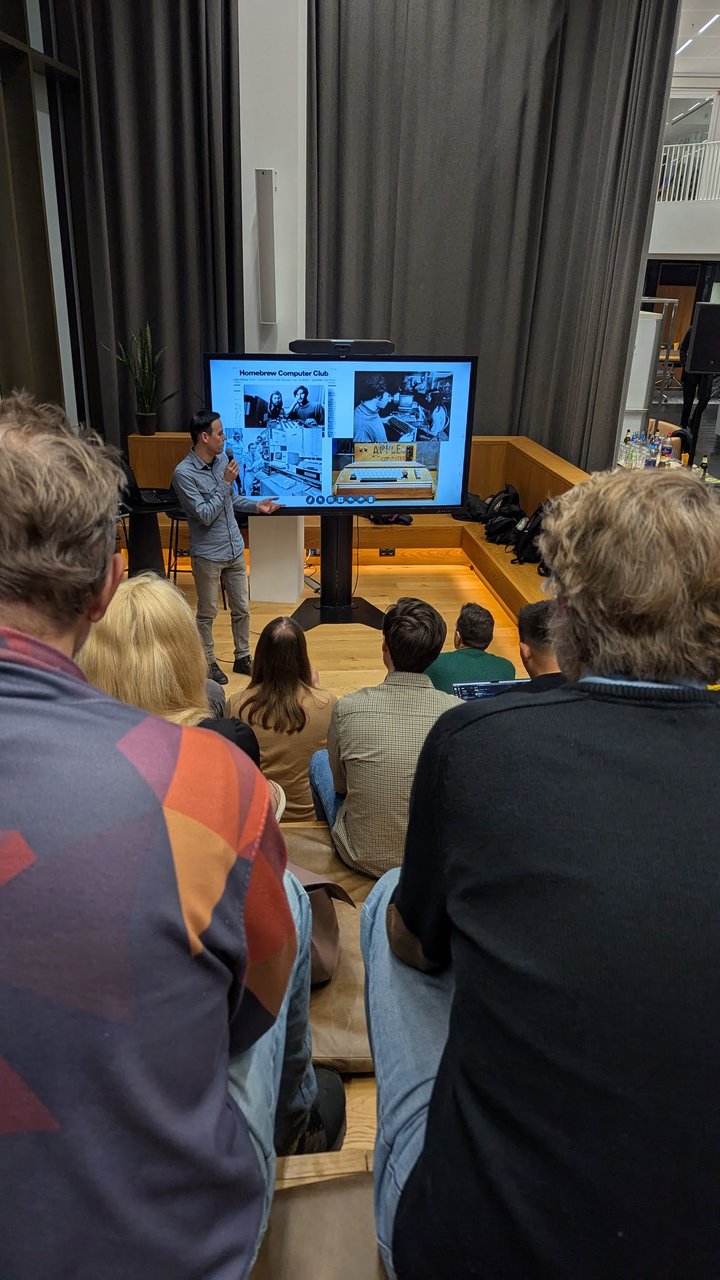
The November opener: the Homebrew Computer Club.
The lineup slides:
- Rogerio Chaves (LangWatch): Automating my own video editing with Whisper, FFmpeg and LLMs
- Thijs Verreck (Wavyr & Protochase): AI Native React compiler
- Gaurav Chandrashekar (ProductScale): AI powered visualisations from YouTube videos
- Alessandro (Calmo): Building an AI SRE
- Nikita Vdovushkin (Nebius): How to substitute ChatGPT with 3rd party inference provider
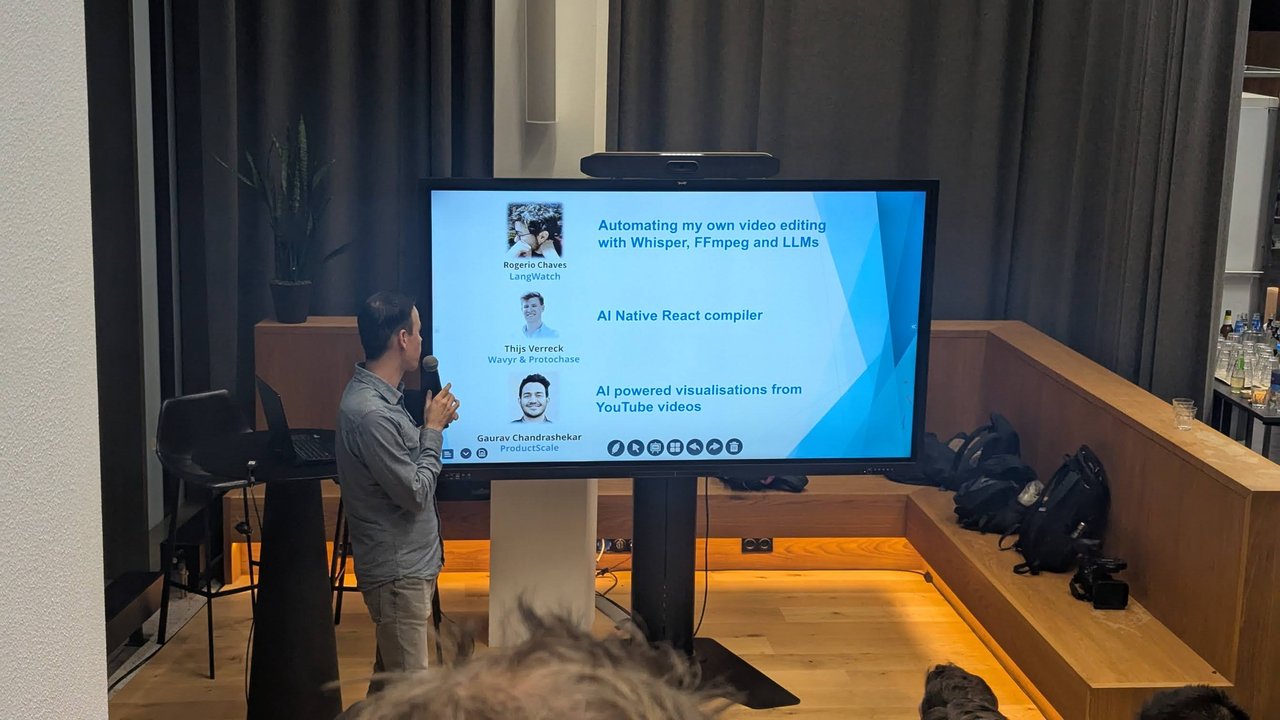
Video editing, an AI-native React compiler and visual summaries.
Video editing, a React compiler and visual summaries
Rogerio Chaves’s demo was Python code. A transcribe_audio function took the audio, the verbose JSON transcript was converted to SRT subtitles, and an LLM prompt asked the model to “group all the sentences that compose similar or repeating blocks”. My guess is that this is how you find the retakes in your own recordings.
Thijs Verreck’s AI-native React compiler had a clean architecture diagram: ui, runtime, bundler and canvas on top of an api layer, on top of the LLM. The code behind it handled files and HMR (hot module replacement): when a file the LLM asks for doesn’t exist in the sandbox, it’s created.
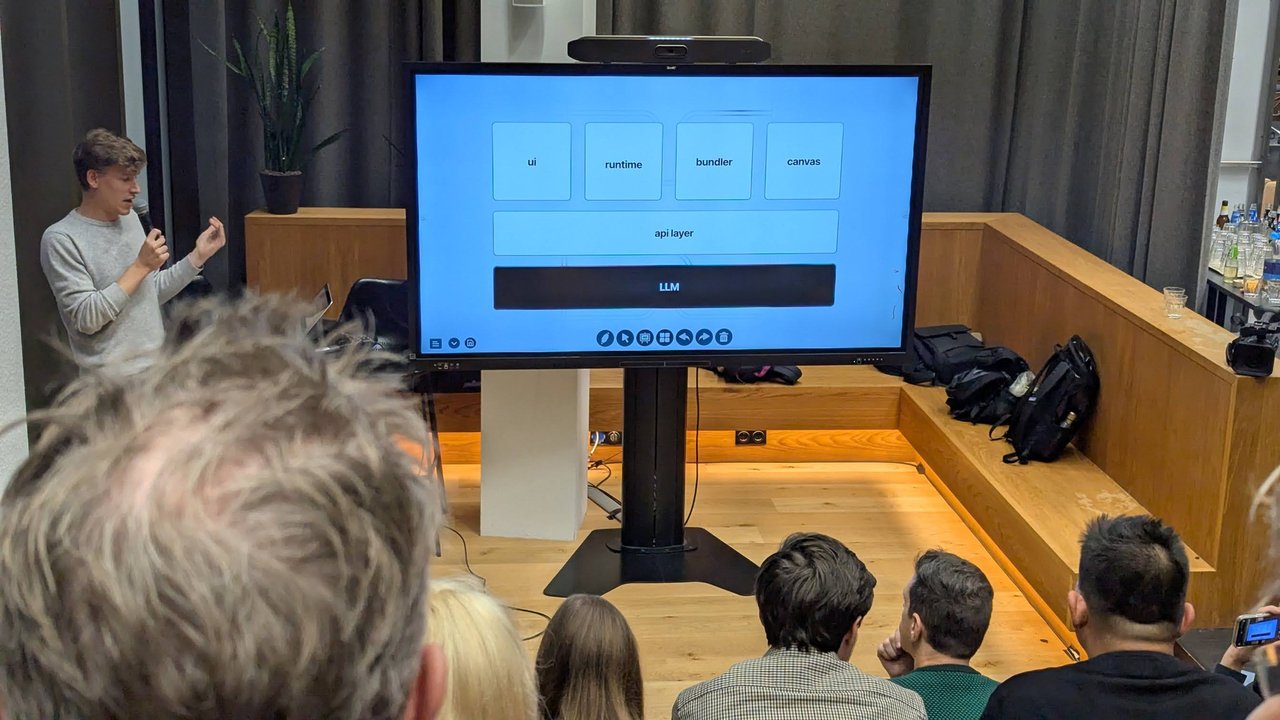
The LLM sits at the bottom of the stack, under the bundler and runtime.
Gaurav Chandrashekar was back with the next step after Summarise.live: “Quality visual summaries of videos”. The raw output on screen was JSON for a YouTube video, with a mindmap field holding a Markdown outline. The example was a conversation with the founding members of the Cursor team about AI-assisted coding.
An AI SRE and graph-based retrieval
The AI SRE slot showed an assistant in a team chat thread, working on a failure report. The questions on screen were “Can you give an example of the logs that show this type of failure?” and the suggestions included monitoring server load during times of high request activity. Around the same time, the screen showed notes on graph-based retrieval: the key challenges (large datasets, retrieval efficiency, low response time, rapid adaptation to new data) and a solution that incorporates graph structures into text indexing and retrieval, with low-level and high-level knowledge, dual-level retrieval and an incremental update algorithm.
Nebius: swapping ChatGPT for an open-model provider
The last demo came from Nebius. Nikita Vdovushkin started on nebius.com, “The ultimate cloud for AI explorers”, with Build, Tune and Run, and an “Explorer Tier with H100” offer.
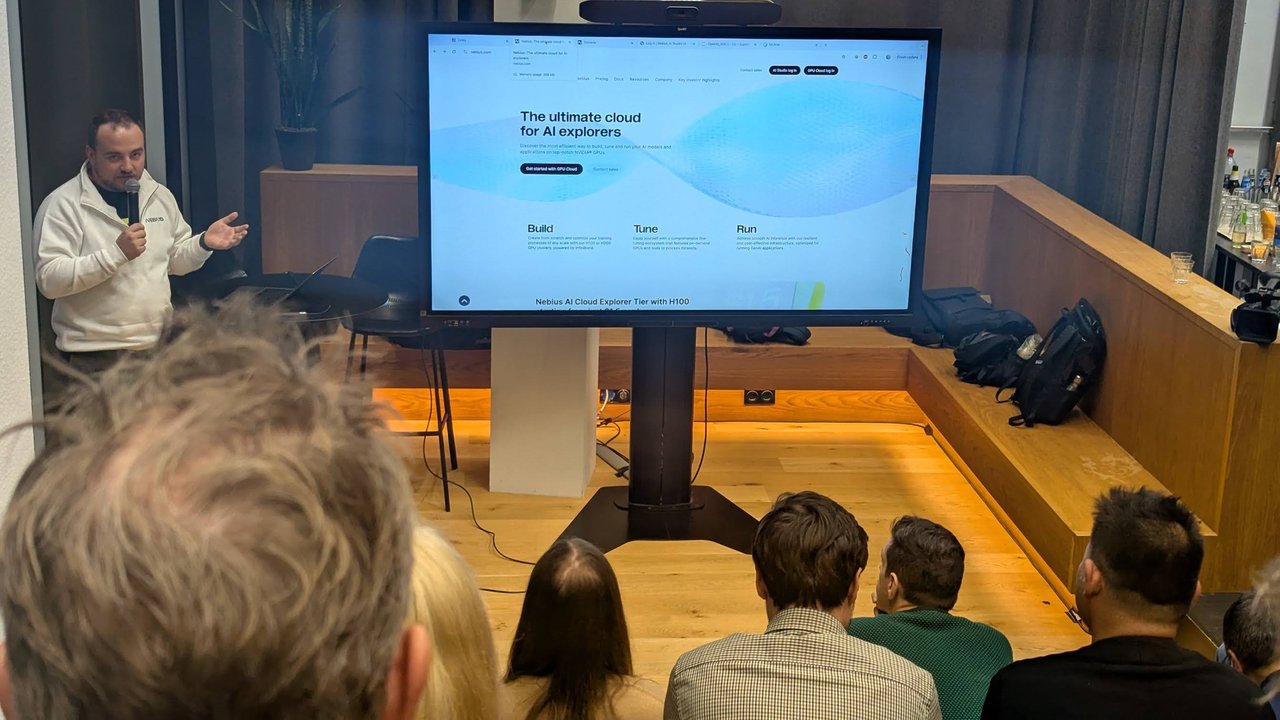
Nebius AI Cloud, before the switch to the inference service.
Then he moved to Nebius AI Studio, the inference service. The Models page had tabs for Text to text, Embeddings and Safety Guardrails. It listed Meta-Llama-3.1-8B, 70B and 405B-Instruct, Mistral-Nemo-Instruct-2407, Mixtral-8x7B and 8x22B-Instruct-v0.1 and Qwen2.5-Coder-7B, with per-million-token prices in a “base” and a “fast” flavour. For Llama 3.1 70B, the 2024 prices on screen were $0.13 in and $0.40 out (base), and $0.25 and $0.75 (fast).
The point of the talk was in the code. To move from OpenAI to another inference provider, you change a couple of lines: the base URL, the API key and the model name, and the rest of the OpenAI SDK code keeps working. He added MLflow tracing with a few more lines, and the whole trace appeared in MLflow. The last example was a small agent: it asked the LLM how to phrase a Google search query, ran the search, and then answered the question, which was “what is Nebius AI Studio”.
I’ve left out the photos of that part. The terminal showed the MLflow tracking settings in full, including the credentials.
Looking back
Watching these two nights again two years later, three things stand out.
First, the OpenAI API had already become the interface. Groq, Nebius and the rest win developers by being a drop-in base URL. That’s still how I’d advise teams to build: code against the OpenAI-compatible API, keep the provider in configuration, and you can switch on price, speed or data residency without a rewrite. Nebius AI Studio itself has since evolved into Nebius Token Factory, which is what the Builders & Brews hackathon in 2026 ran on.
Second, observability came early. Fiberplane wired OpenTelemetry into a Hono app and Nebius showed MLflow tracing, both as part of the demo rather than an afterthought. I go deeper on this in LLM observability in production.
Third, the “boring” optimisations were the most useful. Shortening category labels to one letter doesn’t look impressive on stage, but it cuts output tokens on every call. That’s the kind of thing you only learn by running the code.