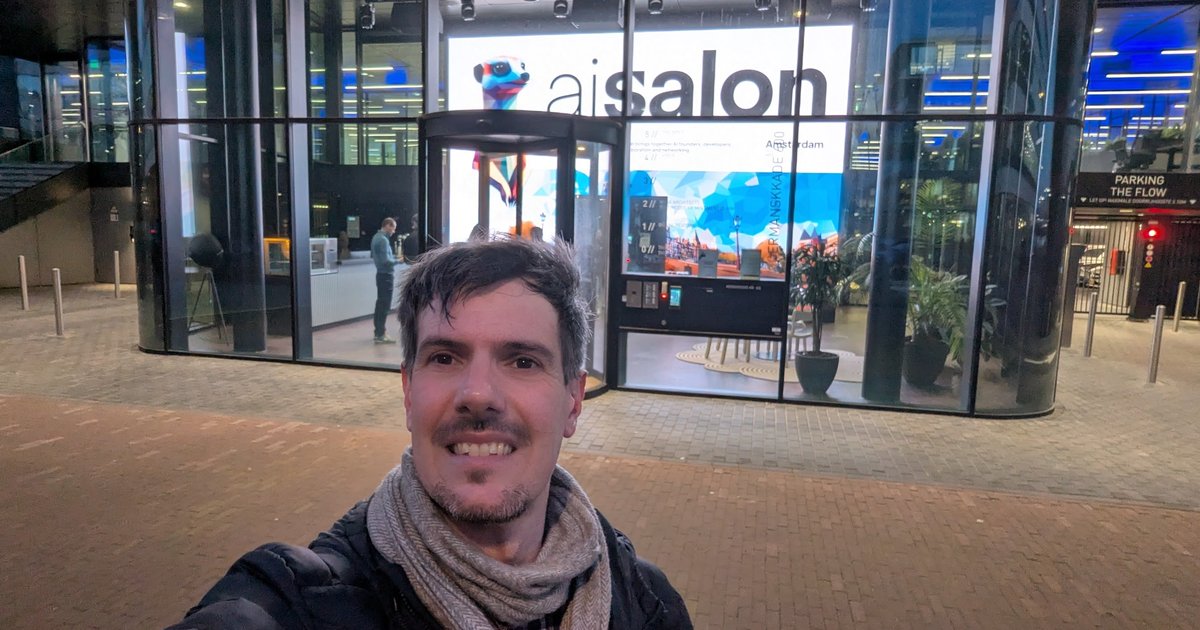
On Thursday 5 June 2025 I went to the eighth AI Salon Amsterdam, hosted by BrainCreators and Techleap, at The Wolf Club at The Flow in Houthavens. I covered the January edition at the same venue in AI Salon Amsterdam 2025: Schiphol Ramp AI and an AI VC. According to the Luma listing, the evening had two speakers: Willem Jonker, Chairman of the Board of AIC4NL, listed at 18:00 on plans for a Dutch AI Factory in Groningen, and Rashid Ivaev, founding member of Nebius, listed at 18:20. After the talks came one-minute demo pitches, then food, drinks and demo tables.
This is a throwback post. I recorded the second talk and the pitches, but not the first talk, so I can only report what was said about it afterwards. I match the Nebius speaker to Rashid Ivaev because the listing gives him the slot after Willem Jonker, and the speaker I recorded said they were from Nebius and thanked the previous speaker. The pitchers’ names were not on slides, so I leave them out.

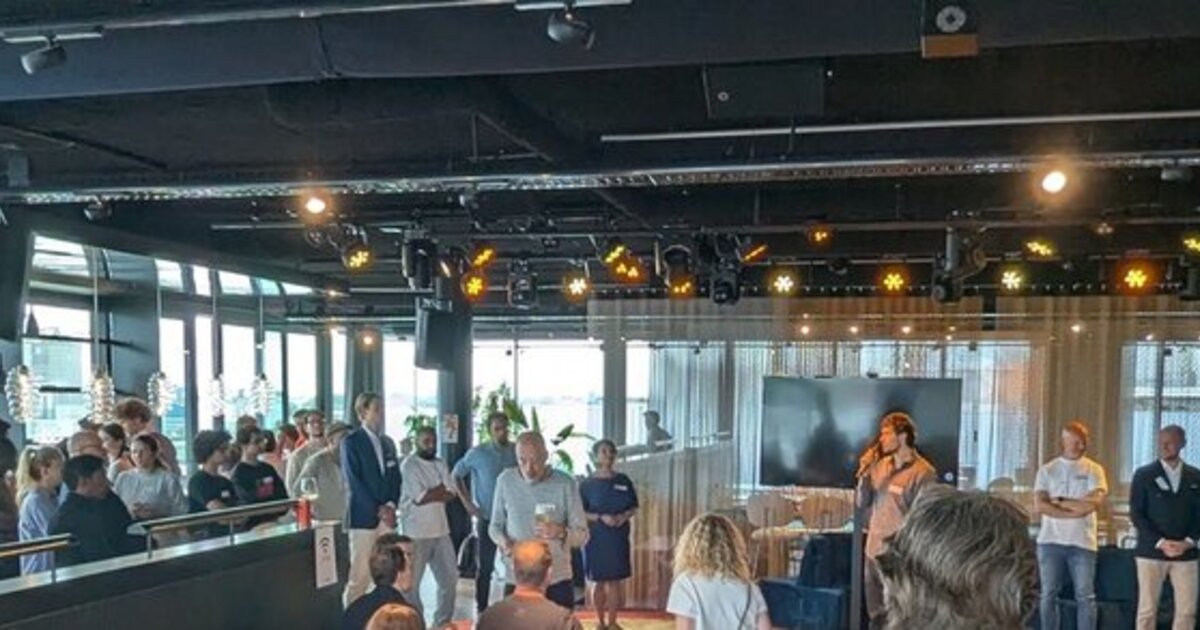
The room during the talks, with the speaker at the front.
Nebius: the US-EU gap and AI factories
The speaker, who opened by thanking Willem for a talk they had learned from, said they would extend the AI factory part of it. They also said they had been asked not to do a sales pitch, and gave a one-slide introduction of the company as paraphrased here: a Dutch-based company with around 500 people in the Netherlands and colleagues across Europe, with a legacy in general cloud that pivoted to a specialised AI cloud as an NVIDIA cloud provider, owning the stack from data centre and hardware up to the software platform, with data centres in Europe and the US and a startup programme.
The core of the talk compared the two markets after about two years of serving both. These figures are the speaker’s, as spoken, and I did not check them:
- Funding. In Q1 2025 the US allocated roughly 80 billion dollars of venture capital, about 70% of global AI funding, with about 70% of all US VC going to AI companies. Europe invested about 13 billion, around 12% of the global total, and only a quarter of European VC went into AI.
- Startup pace. The speaker said their inbox was full of newsletters reporting AI startups funded in the US every few days (the audio is unclear on the exact number), and that they could not find an equivalent European statistic.
- Regulation. The EU has GDPR and AI regulation, while the US has state-by-state rules that are on average lighter, which the speaker named as one reason startups grow faster there.
- Compute. The US has many GPU regions from hyperscalers plus a wave of what the speaker called “new clouds”, specialised AI infrastructure companies. In Europe hyperscaler GPU capacity is scarce and hard to get, and only a handful of regional new clouds exist.
The speaker then turned these challenges into opportunities:
- Public money. Government and EU-led funding: the French investment announcements, the UK AI opportunities plan with local data centres, and the EU’s InvestAI initiative. According to the European Commission, InvestAI aims to mobilise 200 billion euros, including a 20 billion euro fund for AI gigafactories.
- Regulated AI as a feature. Enterprises and the public sector are sceptical of models that are not auditable, transparent or trained on clean data. The speaker argued that domain-specific models built on ethical, transparent AI are an entry point to large enterprises, most of whom will consume generative AI through SaaS rather than directly.
- Talent. Europe has strong talent pools, and the speaker said immigration policy in the US was pushing international talent back, so Europe should “not shut the windows”.
Supercomputers versus AI factories
The last third was the speaker’s own view on supercomputers and AI factories. Their argument was that supercomputers, of which Europe already has several in the Netherlands, Luxembourg and the Nordics, have four limits:
- They are static: you pay for a fixed machine and cannot double capacity when an application goes viral.
- They often have no proper operations team around them, so when something breaks, repair is slow.
- They are single tenant, so they may sit idle and the heavy capital spend pays back slowly.
- Chips from NVIDIA and AMD arrive every six months, so a box bought now is obsolete soon.
An AI factory, in their description, is a public-private partnership where one side has data centres and the other has capital, with a multi-tenant design that keeps users isolated, continuous hardware refresh, and a platform on top so that any ML engineer or researcher can use it. They closed by saying Nebius was applying to take part in several AI factory programmes in Europe, with the aim of Europe building its own AI infrastructure so that it does not depend on a US vendor deciding to switch something off.
My take: the speaker is a vendor and the argument is also a market positioning, but the multi-tenant and refresh-cycle points are fair engineering ones. A fixed-size machine that is idle half the time is expensive however fast it is. The GPU capacity question matters to every platform team I work with.
One-minute demo pitches
Each pitcher had about a minute, then invited people to their demo table. I recorded around a dozen, and the mix shows where early AI products are heading:
- A search and matching engine sold to teams building retail, mentoring or document retrieval products, with feedback so it can suggest coffee to someone searching for tea.
- A qualitative market research tool that simulates focus-group participants with detailed personas.
- Two student entrepreneurs offering tailored AI automation for businesses who do not know where to start.
- A food-testing startup using computer vision to read how consumers react to samples, with the New Coke failure as its opening story.
- A courier marketplace where travellers carry small items between countries.
- A creative technologist building AI workflows, and a personal assistant that helps with screen time.
- A swipe-based fashion app that learns your style and rates your outfit.
- A habit-building app made by students, and an email tool that classifies leads and drafts replies into a CRM.
One pitcher based in San Francisco asked investors and founders to avoid “demo theatre” and expensive distractions, and invited people to a hype bingo at their table.
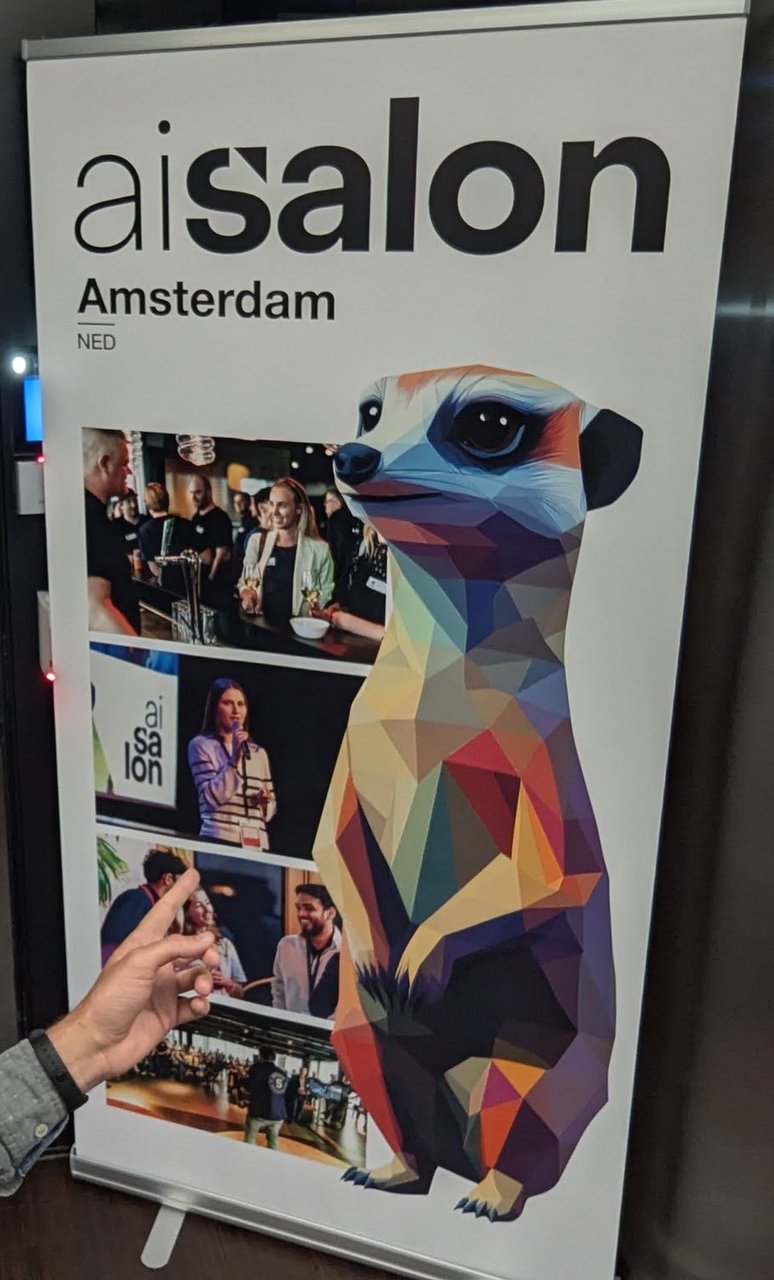
The AI Salon Amsterdam roll-up banner.