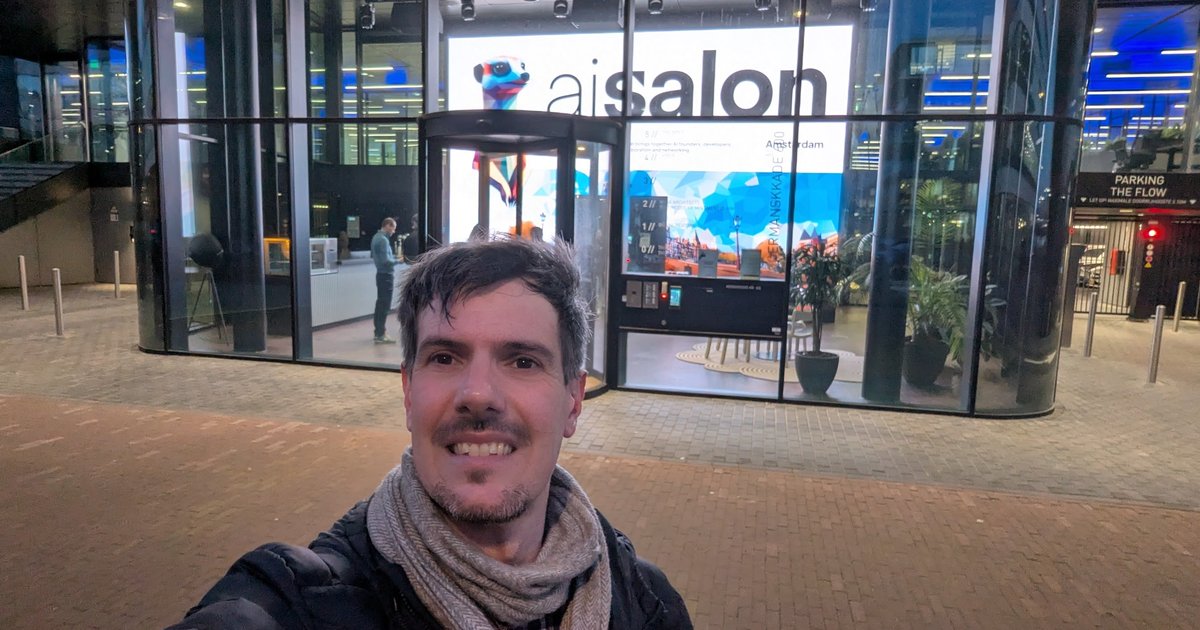
On Thursday 30 January 2025 I went to AI Salon Amsterdam at The Flow in Houthavens. According to the event listing it was the sixth edition, hosted by BrainCreators with Blitzscaling Ventures and Techleap, in collaboration with Amsterdam AI and Women in AI. The format was speakers, startup demos and networking, aimed at founders, data scientists, ML engineers, investors and researchers.
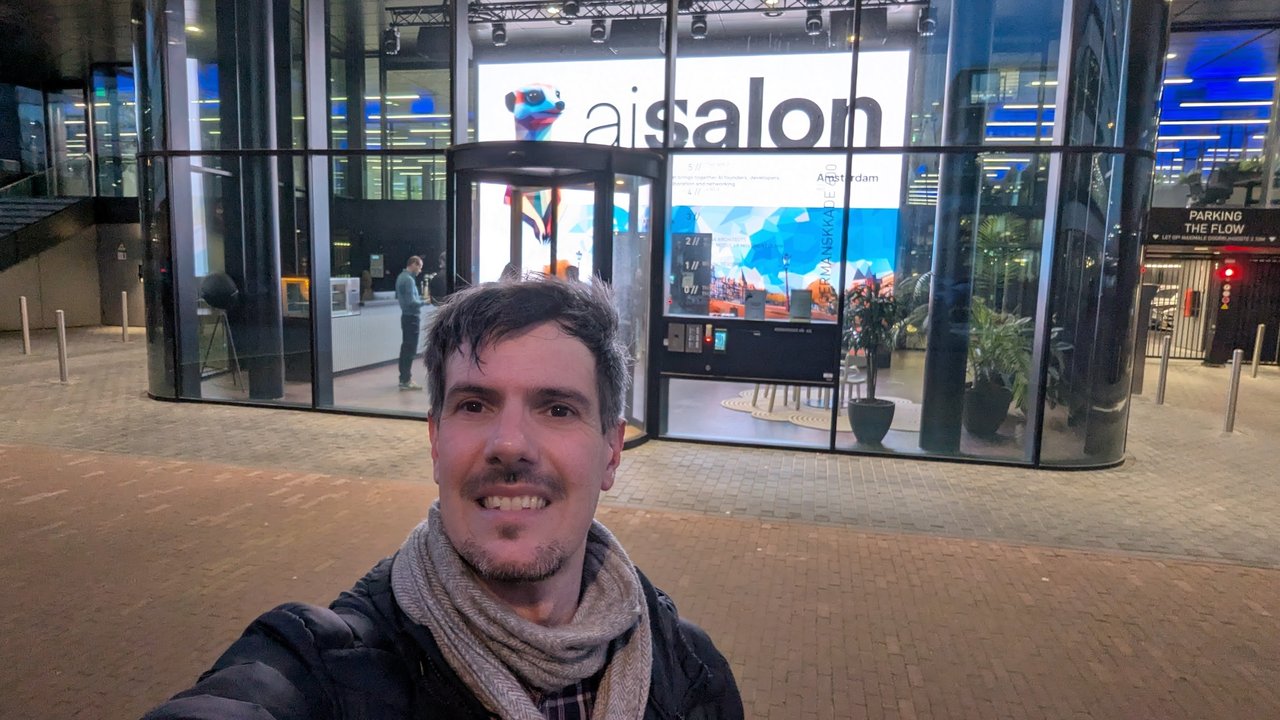
Arriving at The Flow, with the AI Salon screen in the window.
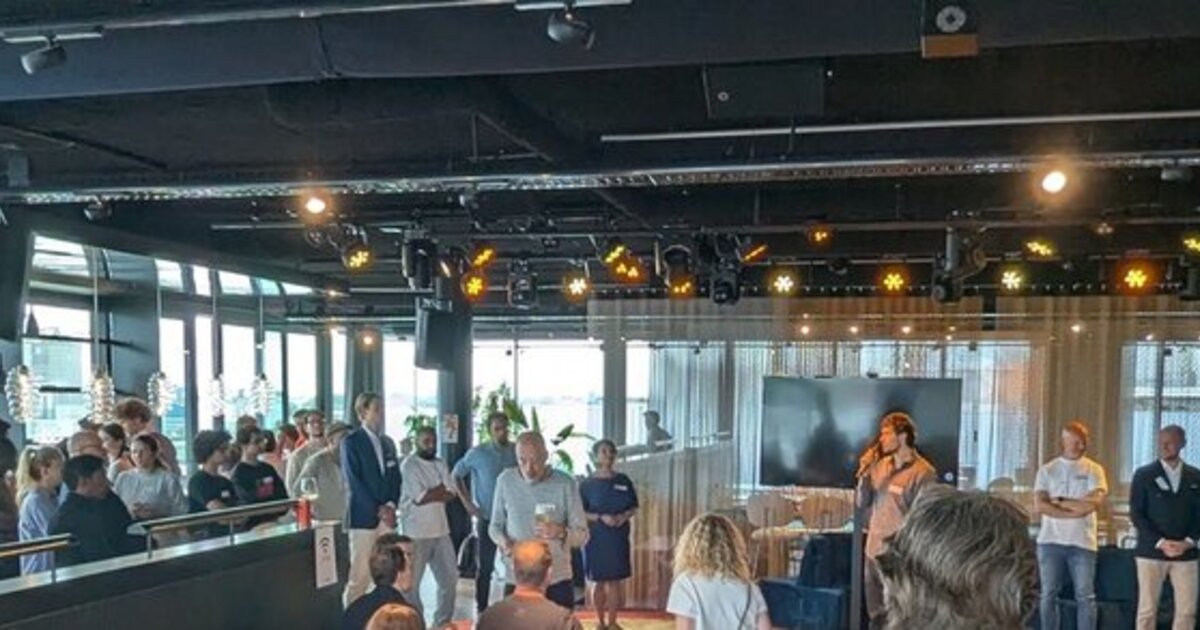
The venue looked more like a club than a conference room: a DJ booth, coloured stage lights and a big screen on a stand. People stood around the stage or leaned on the railings. I photographed two talks.
Computer vision on the ramp at Schiphol
The first talk had Schiphol-branded slides and was about the aircraft turnaround, everything that happens between an aircraft arriving at the gate and pushing back. The “Our goals” slide listed four key challenges at Schiphol:
- Delayed flights: airlines, airports and ground handlers face operational and financial consequences from delays.
- Runway capacity: airports are constrained by runway capacity and want to optimise runway usage.
- Ramp capacity: airports have limited insight into inefficiencies in the turnaround process and want to make better use of gate capacity.
- Collaboration: between airlines, ground service providers and airports, with a desire for actionable insights that integrate into existing systems.
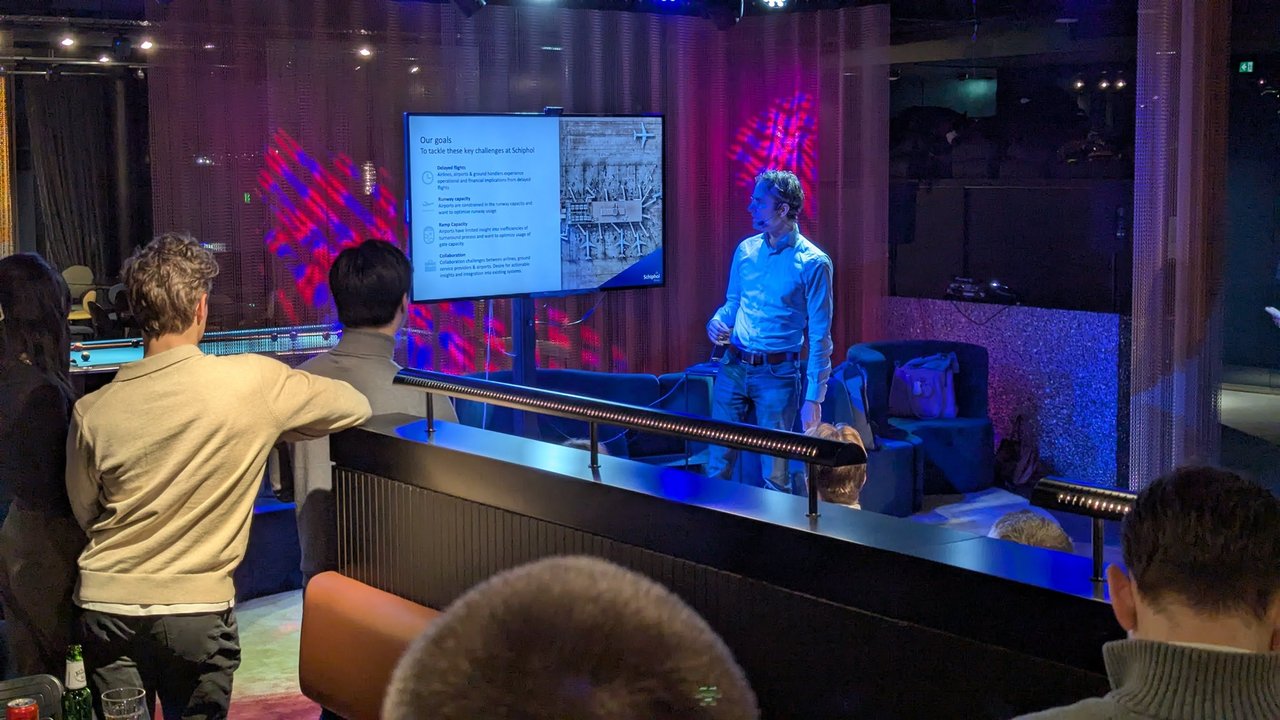
Four challenges at Schiphol, next to an aerial photo of aircraft at the gates.
The “What do we detect?” slide showed examples of events processed by the AI model: cargo doors, catering truck, aircraft, luggage loading, fuelling, cargo, lavatory truck, airplane doors, fuel pump truck, pushback and container loading. The next slide made the claim that “the end-to-end AI model gives an accurate depiction of what is going on at the ramp in real-time”, with camera views of the stand above a turnaround timeline.
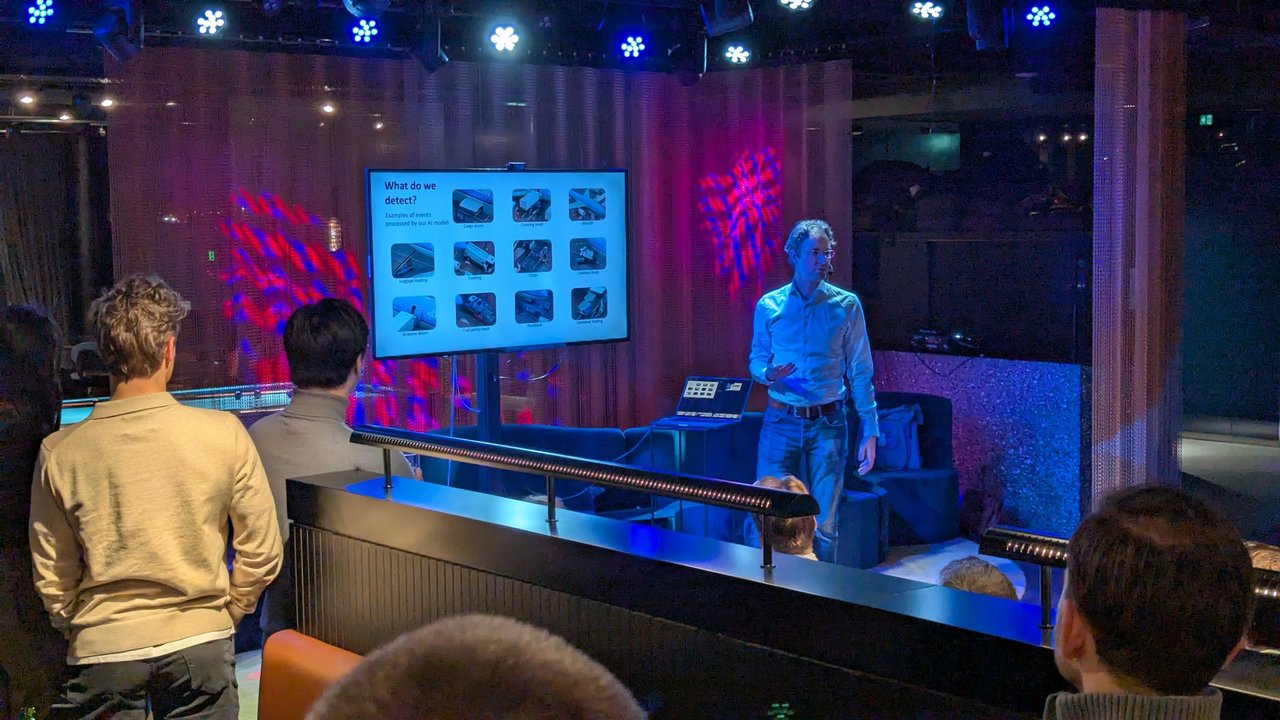
Eleven event types the model picks up from the ramp.
A slide titled “When is data an insight? How can it change behaviour on the ground?” split the business applications into three: historic analysis of turnaround data and potential causes of delay, to improve turnaround processes; real-time dashboards with turnaround insights for the airport and sector partners, to help with decision-making; and predictive notifications about disruptions and delays, using AI and business rules.
The top use case was optimising runway slot usage. According to the slide, departures on the runway are spaced by a minimum of 1.5 minutes. The results slide said that, 15 minutes before planned push-back:
- 73% of the delays are correctly predicted
- 48% of the delays are reported by the handler
- on average there are 15 minutes of delay when a flight misses its slot to push back
- the outcome is fewer missed runway slots
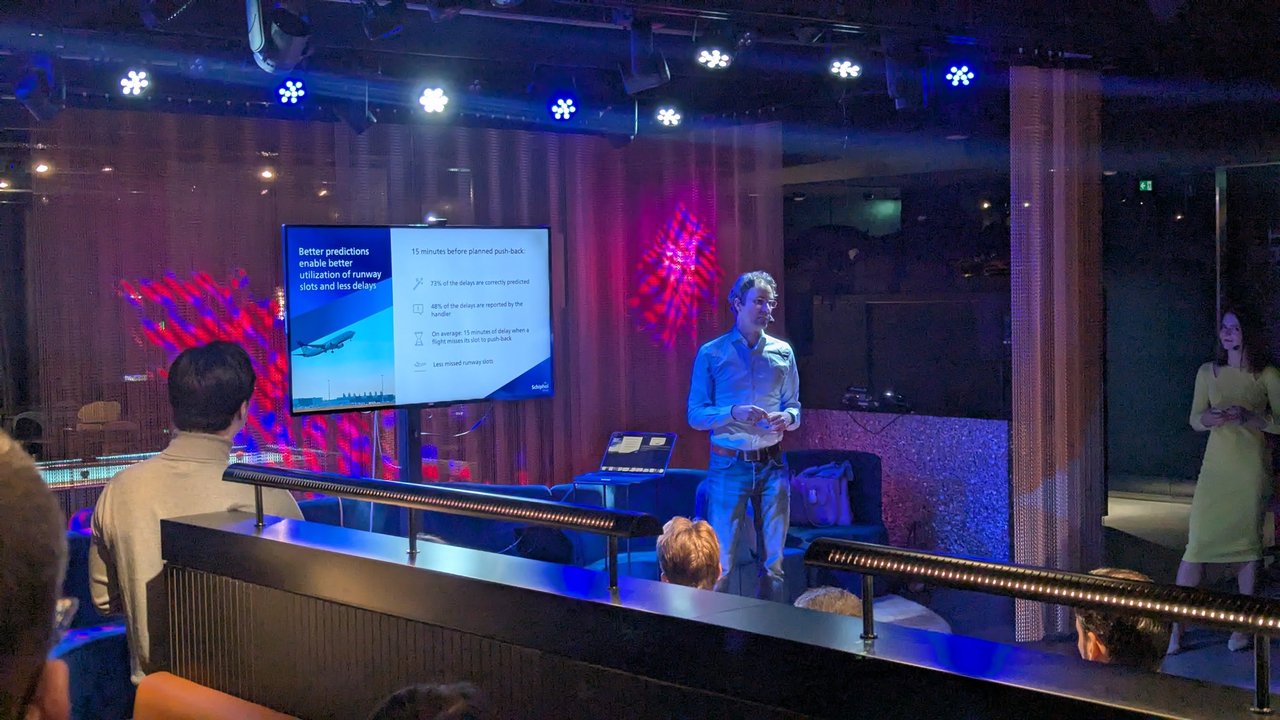
The numbers: 73% of delays predicted 15 minutes before push-back.
Near the end, the talk turned to the people side. The “Ingredients for predictability & collaboration” were a common source of truth, trust, more detailed insights and “no blame-game”. The last slide said the aim was to strengthen collaboration in the industry, with the solution available to airports worldwide. It showed Schiphol, BNE, Eindhoven Airport and Edinburgh Airport around a “Deep Turnaround” logo.
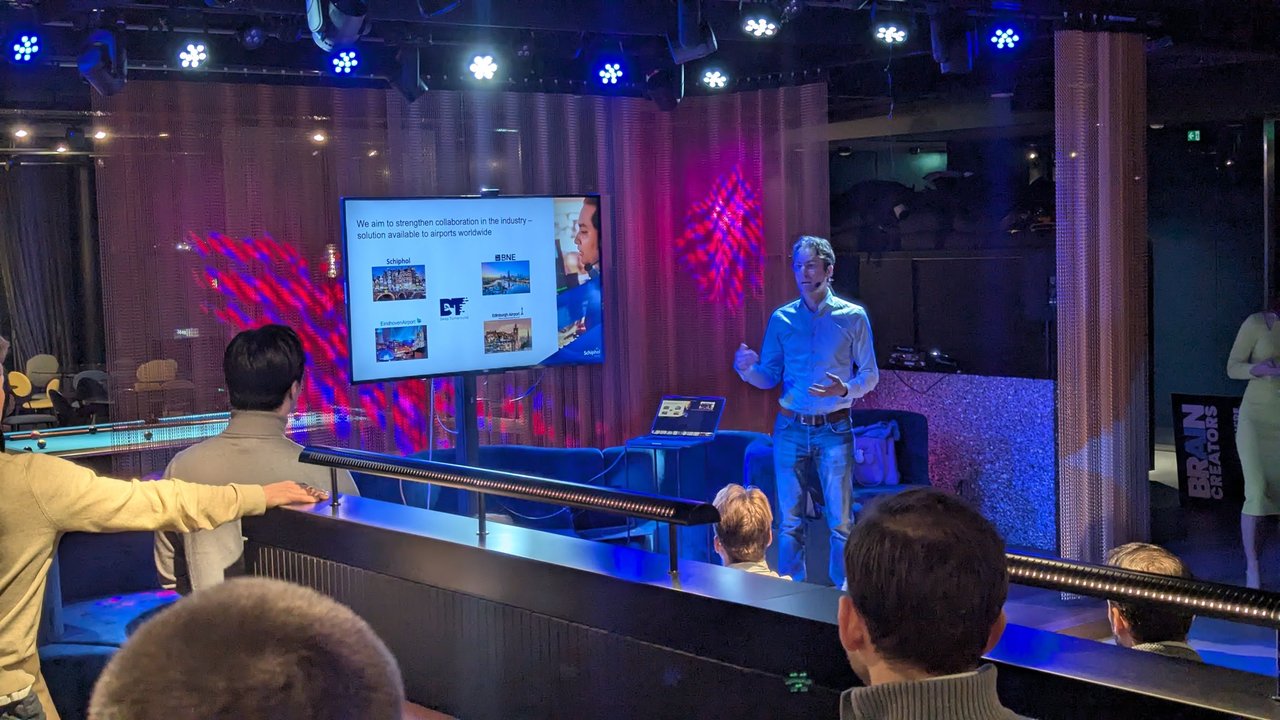
From one airport to several: the Deep Turnaround slide.
My take: the “no blame-game” point is the interesting one. A shared, camera-based timeline of the turnaround is useful because nobody has to argue about whose log is right. If I read the 73% and 48% figures correctly, the model flags more delays in advance than handlers report, which makes the same case.
curiosity, a community-driven AI VC
The second talk introduced curiosity, “a community-driven AI VC from Amsterdam”, with a wall of community member photos on the first slide. The “About curiosity” slide gave the details:
- Mission: support founders in Europe who are building next-generation impactful AI software companies, “to serve the world, not eat it”
- Investment stage: seed and early Series A, post-launch with early customer traction
- Fund: €32M, final closing in December 2023
- Number of investments: 20–24, based on the in-scope opportunities assessed each year
- Geographical focus: Benelux, Nordics and Baltics
- Initial ticket sizes: €500K–€1.5M, plus a reserve for follow-on investments
- Portfolio companies: 16, growing by 5–6 companies per year
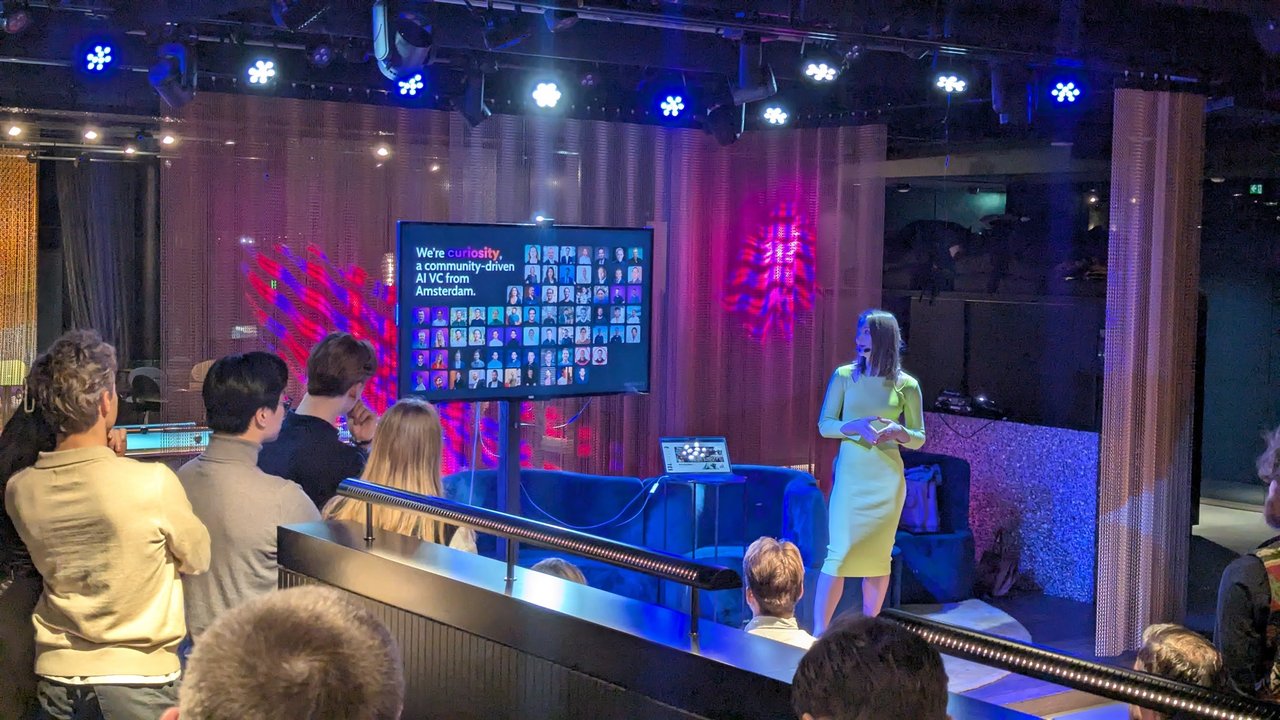
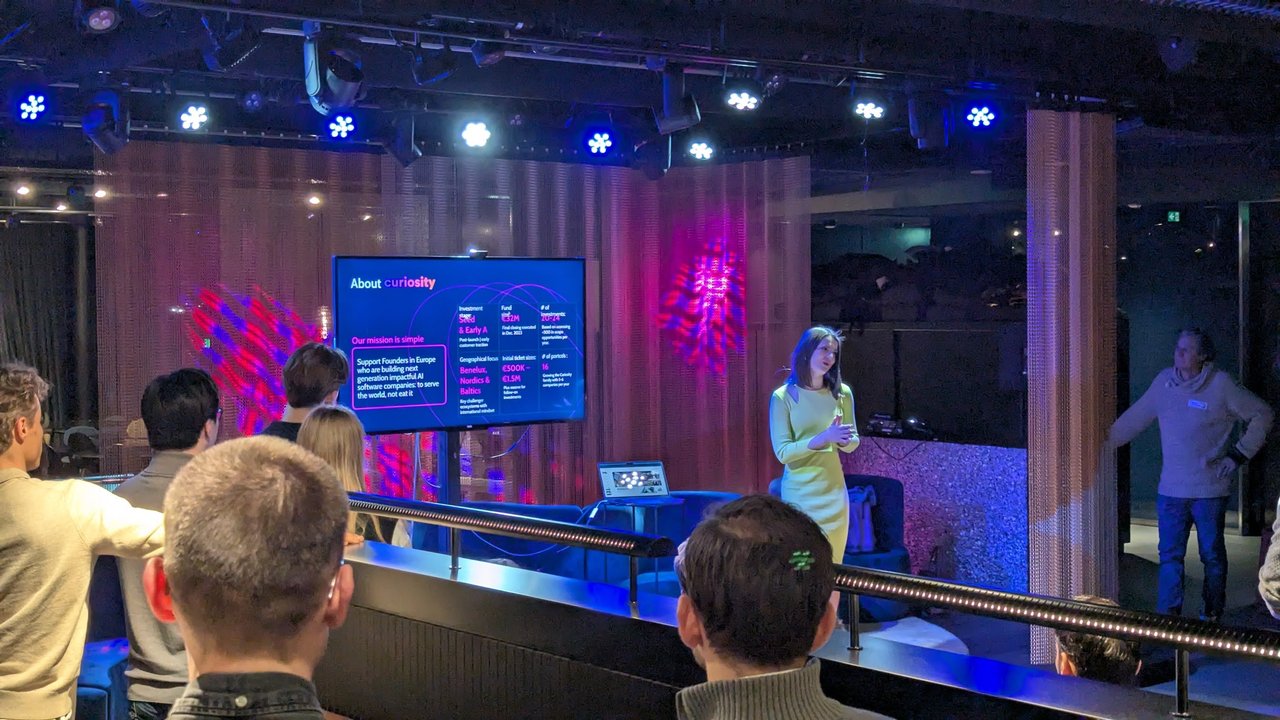
The curiosity introduction and the fund in one slide.
The portfolio slide, “We’ve already bet on 16 AI-centric software companies that are shaping the future”, showed a first page of eight: luna (AI sales prospecting), version lens (a co-pilot for product managers), BeCause (a sustainability data management platform), Altura (RFx bid management), QA.tech (autonomous software testing), Epum (CRE analytics and insights), moonlit (a legal research engine) and onesurance (an insurance analytics platform). A later slide listed the characteristics they look for in “unique AI startups”.
My take: most of that portfolio is vertical AI, a model wrapped in a workflow for one specific job such as bid management, legal research or software testing. I think that’s where the value is: in owning the workflow and the data, not the model.
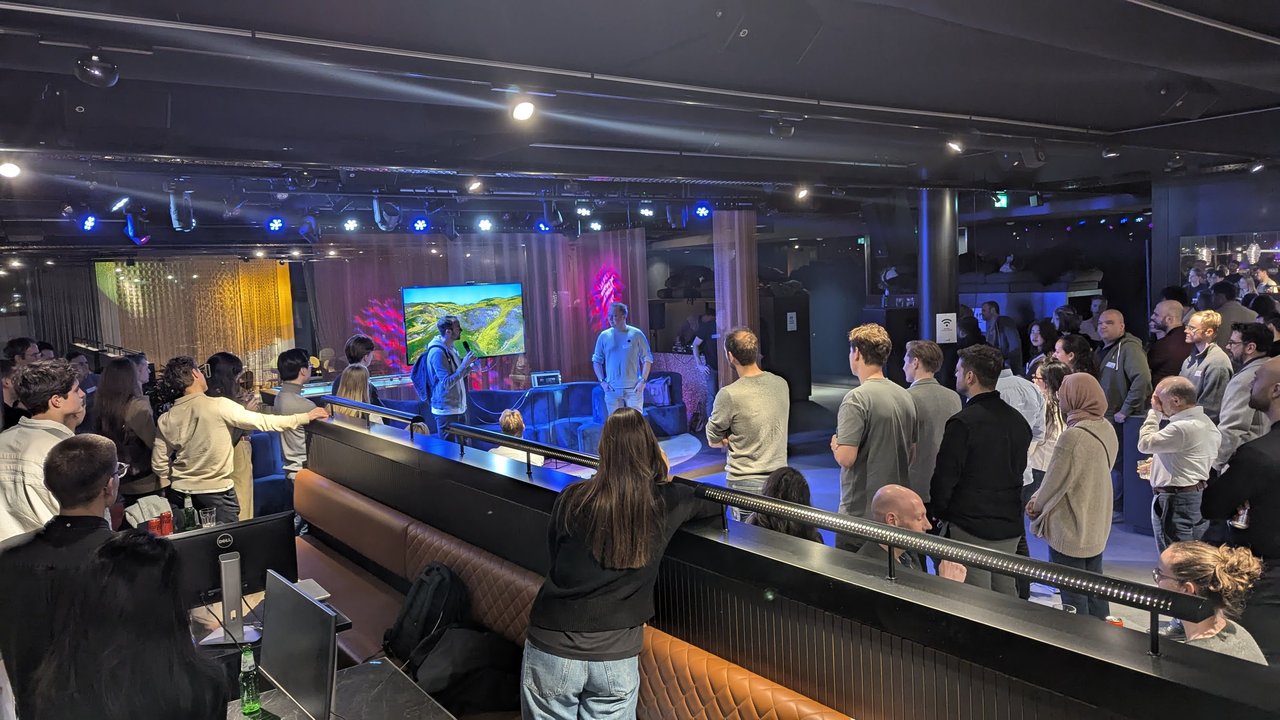
The crowd around the stage after the curiosity talk.
Three startup pitches
After the curiosity talk came a round of short startup pitches. I recorded three of them.
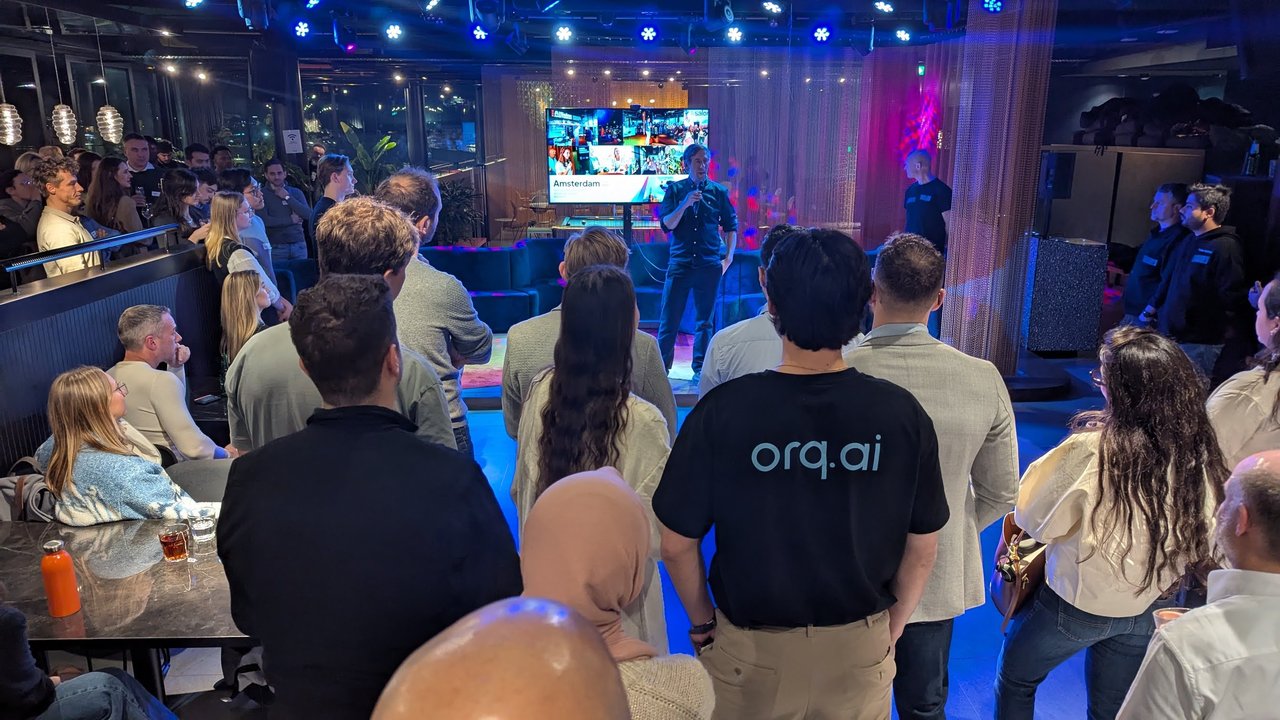
Waiting for the pitches, with an orq.ai T-shirt in the crowd.
An AI companion for elderly people. Four founders set out to tackle loneliness among older people. The speaker’s argument: people live longer, the younger generation isn’t big enough to make up for it, and there won’t be enough caregivers. Their product is an AI companion built for this domain. It uses agentic flows to have meaningful conversations, and in the background it builds a mental model of the person’s world. Those insights can then go to care facilities, or to relatives who look after the person. The beta was ready, and they were fine-tuning it before an app-store launch. The company wasn’t named in my recording.
Orq.ai: GenAI from experiment to production. The second pitch came from Orq.ai’s go-to-market lead, who mentioned that Orq.ai is also a curiosity portfolio company. His point was that AI, unlike traditional software, is unpredictable, so you need tools to monitor, test and deploy it, with performance, cost and security under control. According to Orq.ai, teams save 40% of the time it takes to put AI applications into production and 30% on AI costs. The use cases he listed were legal assistants, chatbots, workflow automation, copilots and agents. A few weeks later I saw the evaluation side of the platform demoed at AI Tinkerers Amsterdam.
AI for network security, with Schiphol data. The third pitch was about AI in cyber security, where the input is network data rather than natural language. The team fuses network traffic, sensors, logs and workflows into one system with a real-time visualisation. According to the speaker, they have worked with Schiphol and collected five years of data. Detection uses two autoencoders: a frequency-based one learns how the network normally behaves and flags irregularities, and a content-based one looks inside packet captures for anomalies such as malware and payloads. They also use LLMs for retrieval over documents, and plan to fine-tune a GPT-2 model to turn network data into human-readable context. This company wasn’t named in my recording either.
My take: the security pitch had a sensible split. Autoencoders are a well-understood way to spot anomalies in high-volume traffic, and the language model sits on top to explain what was found, not to do the detecting. That keeps the expensive, less predictable part out of the hot path.