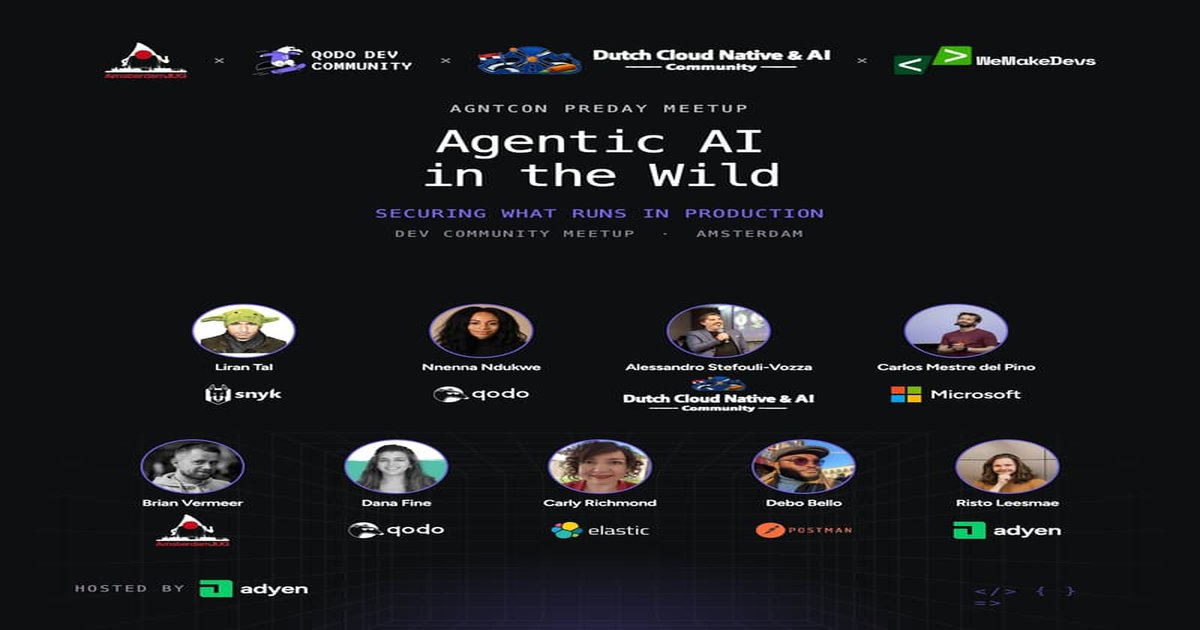
Yesterday evening I attended the AGNTCon PreDay Meetup at Adyen’s Amsterdam office — the unofficial kickoff to AGNTCon, themed “Agentic AI in the Wild: Securing What Runs in Production.” The question on everyone’s mind: AI agents are moving into production. The question is no longer whether to use them, but whether you can trust what they ship.
This was exactly the kind of conversation the Dutch tech scene excels at — no vendor pitches, just practical lessons from systems running in production.
The Hosts
The evening was co-hosted by a powerhouse lineup of community organizers:
- Dana Fine (Global Open Source and Community Manager, Qodo)
- Kunal Kushwaha (WeMakeDevs)
- Ayodeji Ogundare (Adyen)
- Sahar Mor (Bond AI)
Hosted by Amsterdam Java User Group × Dutch Cloud Native & AI Community Group × Codex Community × Qodo Dev Community × AI Security Engineers Community.
Big thank you to Adyen for hosting — their office space and hospitality set exactly the right tone for technical conversation. (And yes, a valid ID is required to enter — worth noting for future attendees.)
The Agenda
The evening was tightly packed with practical content:
- 18:00 — Doors Open, Drinks and Networking
- 18:30 — Welcome and Opening Remarks
- 18:40 — Nnenna Ndukwe (Developer Relations, Qodo)
- 19:00 — Break, Food and Networking
- 19:15 — Panel: Agentic AI in the Wild
- 19:55 — Break, Food and Networking
- 20:10 — Liran Tal (Senior Director, Developer Relations, Snyk)
- 20:30 — Gbadebo (Debo) Bello (Devrel/DX Community, Postman)
- 20:50 — Closing Remarks
The Panel: Agentic AI in the Wild
The centerpiece of the evening was a moderated panel on what it actually takes to move AI agents from proof of concept into systems that operate reliably.
Moderator: Dana Fine (Qodo)
Panelists:
- Brian Vermeer (Developer Advocate, Snyk)
- Carlos Mestre del Pino (Cloud Solution Architect, Microsoft)
- Alessandro Stefouli-Vozza (Technical Evangelist, Microsoft)
- Carly Richmond (Principal Developer Advocate and Manager, Elastic)
- Risto Leesmae (Developer AI Experience Lead, Adyen)
The topic was exactly the right one: what breaks when an agent has write access to your dependencies? The panelists discussed context management, governance, production workflows, failure modes, and what changes when agentic systems run at cloud-native scale.
What struck me most was the shift from “if” to “when” — the conversation had moved beyond whether agents can work, to how to make them safe in production. The Dutch cityscape visible through the windows felt like a fitting metaphor: Amsterdam’s canal system is meticulously engineered to handle water flow from multiple sources, and agentic systems need the same kind of thoughtful infrastructure, not just raw power.
Key Themes: Security, Quality, and Scale
The evening revolved around three themes that are increasingly difficult to separate:
1. Agentic Supply-Chain Risk
The conversation kept returning to a simple question: what does it mean to trust an AI agent’s output when it has write access to your CI/CD pipeline?
When an agent can modify your package.json, push to your main branch, or deploy infrastructure — you’re not just dealing with hallucinations, you’re dealing with supply-chain vulnerabilities. The panel discussed how AI-powered code review tools like Qodo are stepping into this gap, but the fundamental challenge remains: you need machine-readable guardrails that encode your team’s standards.
2. AI-Powered Code Review
Nnenna Ndukwe’s talk on Qodo’s approach to AI code review was particularly grounded. Rather than treating the agent as an autonomous developer, the approach treats it as a collaborative pair program — the agent suggests, the human approves. This matches the “skills first” pattern I heard at the ClickHouse meetup just days earlier: keep the reasoning agentic, but move the guardrails into deterministic code.
3. Cloud-Native Scale
With panelists from Microsoft, Elastic, and Adyen, there was plenty of discussion about how agentic systems behave differently at scale. The failure modes change — what works with 10 agents may not work with 1,000. Rate limiting, context drift, coordination patterns, and observability all become first-order concerns.
Liran Tal from Snyk closed out the individual talks with what was essentially a call to arms: if your security tooling can’t keep up with the velocity of agentic code changes, you’re not securing your software — you’re just hoping for the best.
The Venue: Adyen Amsterdam
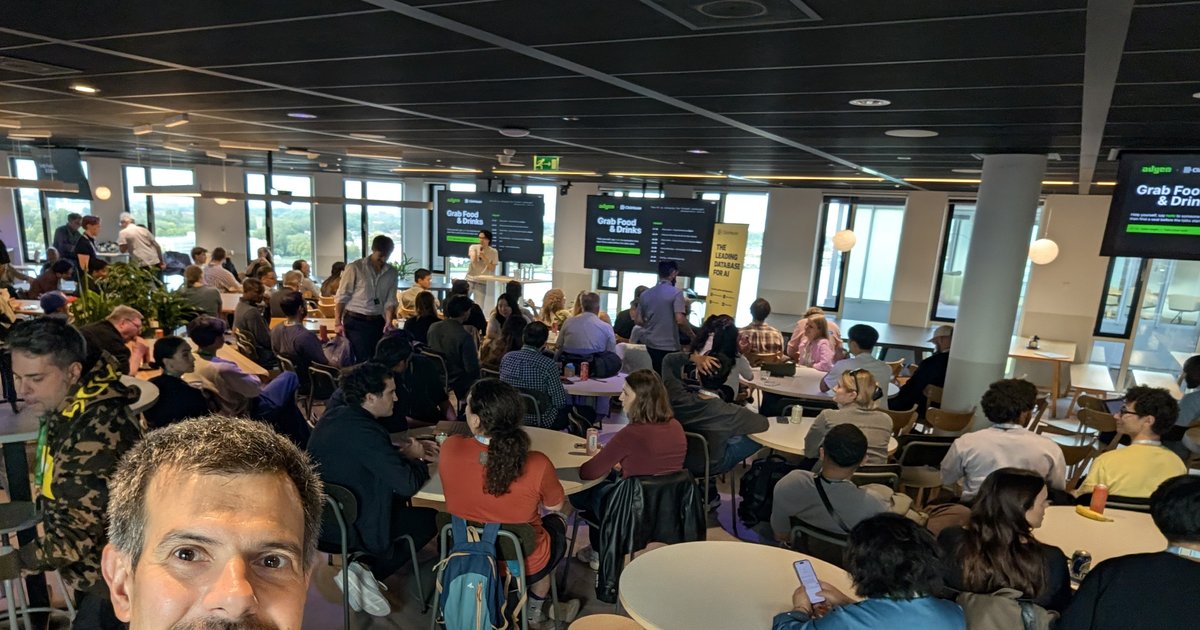
The event was held at Adyen’s Amsterdam office. The space — large windows overlooking the city, plenty of seating, good food and drinks — was exactly what you want for an evening of technical conversation. The green lanyards and “Hello, I’m a visitor” badges (which I noticed some attendees wearing) made it easy to identify fellow newcomers and strike up conversations.
Why This Matters
What I heard at AGNTCon PreDay echoes across every fintech and enterprise stack I work with:
- Trust is the new bottleneck — AI agents can move fast, but they need to move right. In production, correctness isn’t a feature, it’s the baseline.
- Security can’t be an afterthought — the attack surface expands the moment an agent can touch your codebase. AI-powered code review isn’t a nice-to-have, it’s a guardrail.
- Community-driven solutions win — no vendor pitch here, just practitioners sharing what actually works. The cross-community collaboration (AJUG × Dutch CNC × Codex × Qodo × AISecEng) is exactly the kind of multi-perspective approach these problems need.