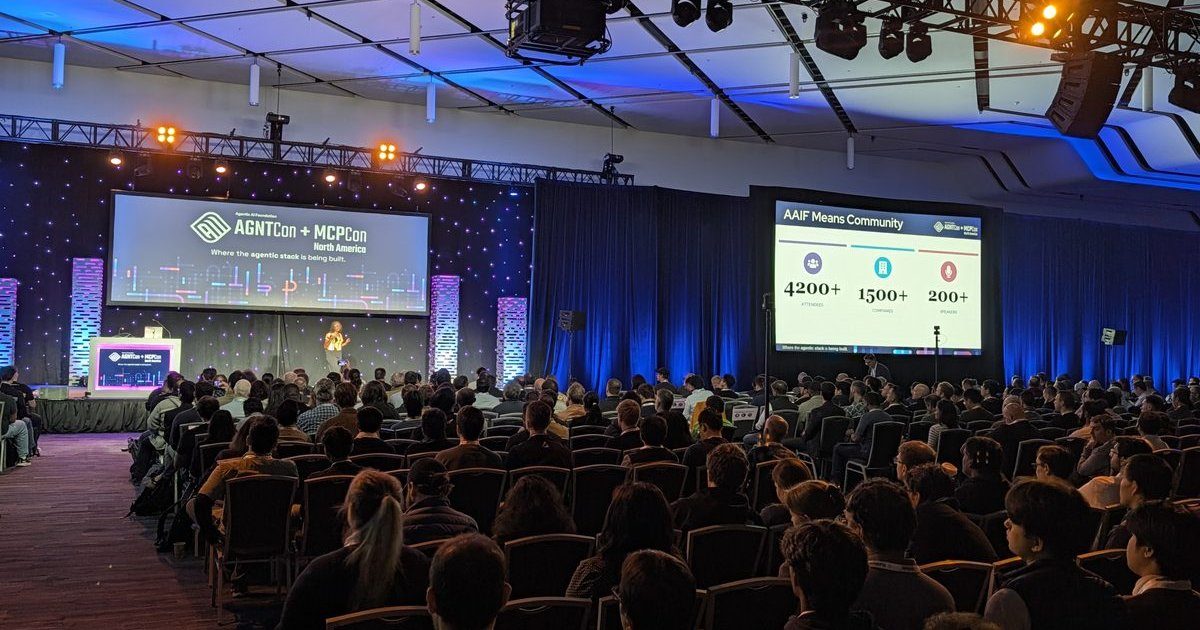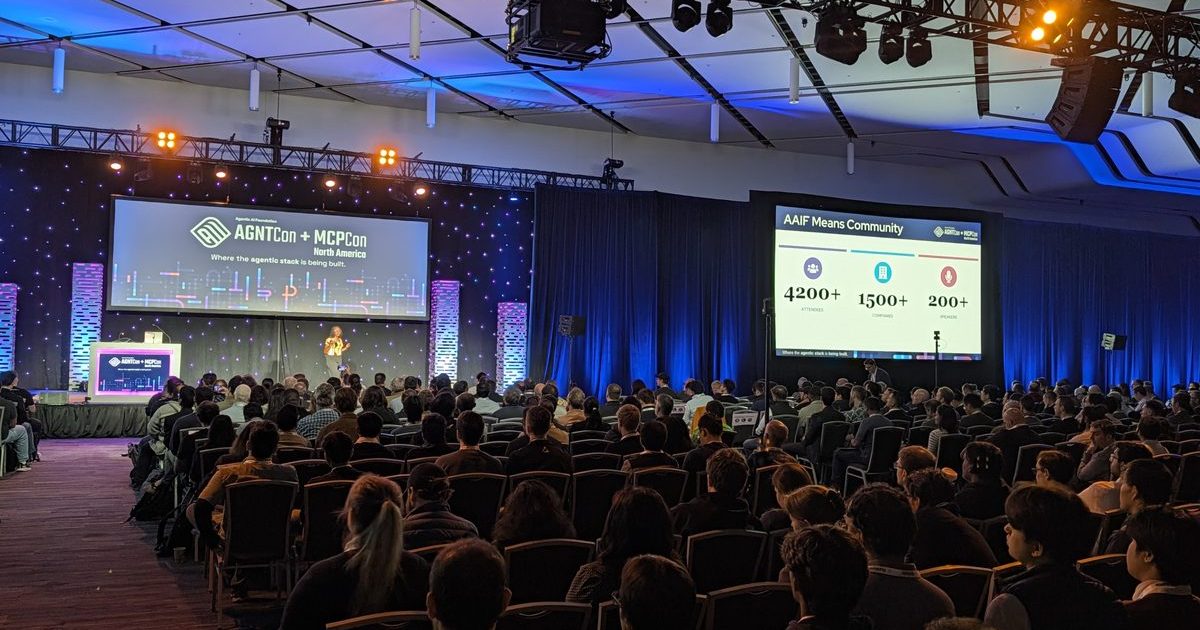
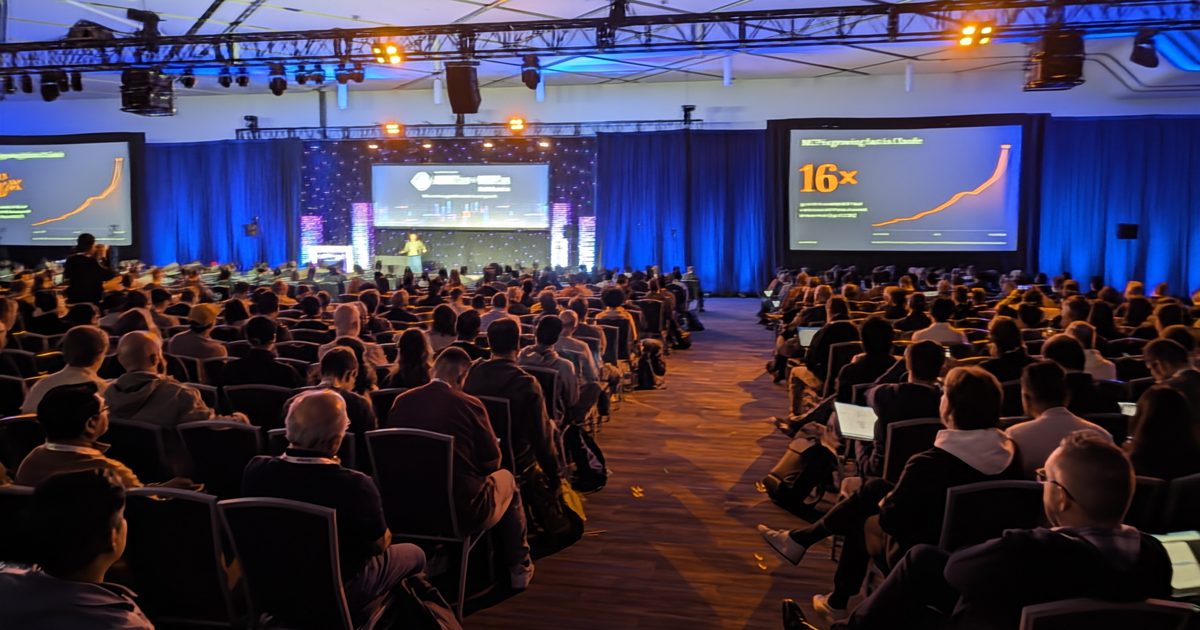
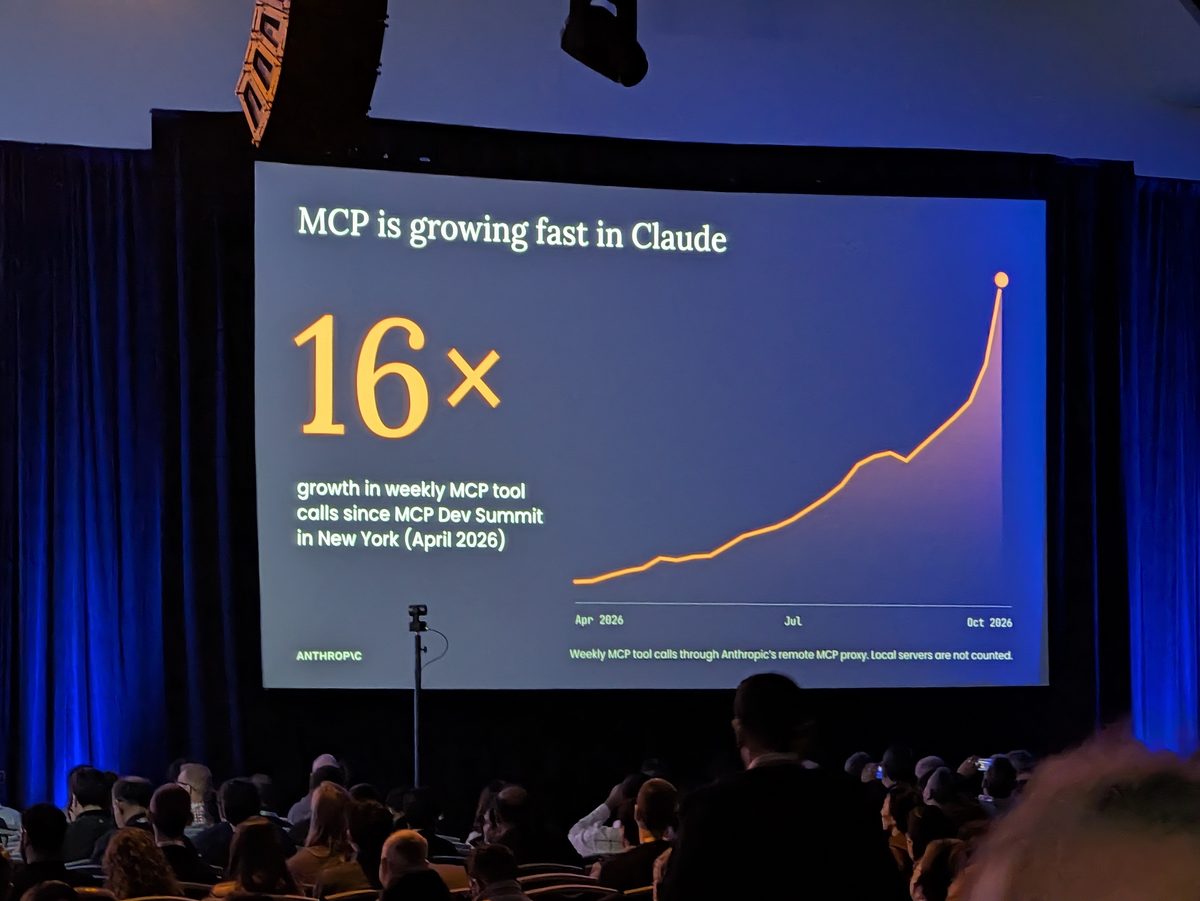
Friday morning in the keynote hall: MCP tool calls in Claude, 16x since April.
Day two of AGNTCon + MCPCon North America, on Friday 23 October 2026, was a morning of keynotes and an afternoon of interviews: thirteen of them, from 09:37 to 16:36, recorded for Udienza. The day hour by hour is on udienza.com: AGNTCon + MCPCon North America 2026: day two. My day one post covered MCP Tasks, Skills over MCP and elicitation.
Here is what I would pass on to a team that builds or runs agents.
Smaller models, and a loop that never stops
The PyTorch Foundation’s keynote came from Jonathan Bryce of the Linux Foundation, and its title, “From Bigger Models to Better Systems”, was the argument: on the open LLM leaderboard, models under 13B parameters keep getting more capable at the same size, and small models frequently outperform larger ones.
The example that stayed with me came from Shopify. A small specialist model for one task (buyer profiles) runs in a loop in production: a calibrated judge detects the weak outputs, critics diagnose them and the model replays with their hints, and the accepted repairs become new training data. On the judge’s score it went from 75.3 to 78.1 to 84.6 in a week, past the frontier model’s 83.0.
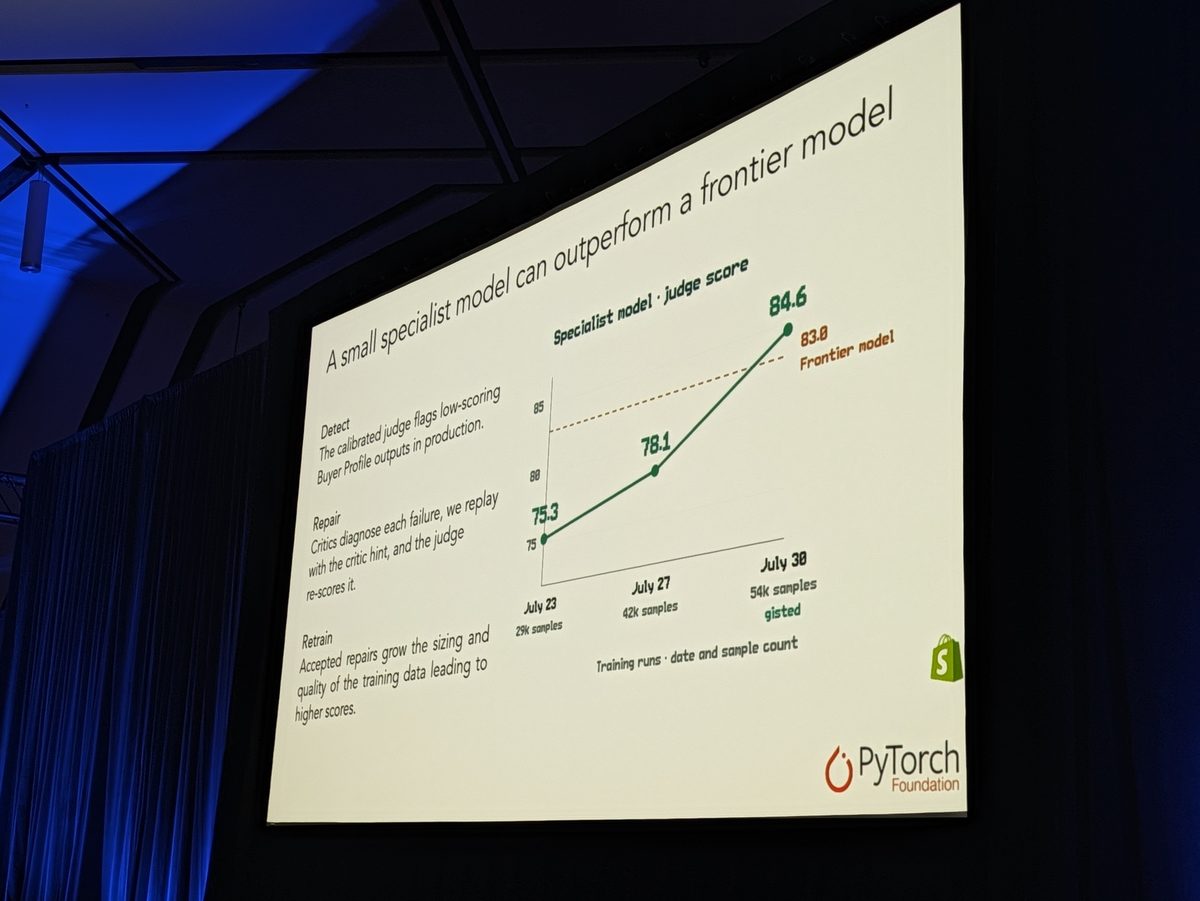
The lesson for platform teams is not “use small models”. It is that the evaluation loop (judge, repair, retrain) is the product, and the model is what it produces. If your agents have no judge in production, that is the piece to build first.
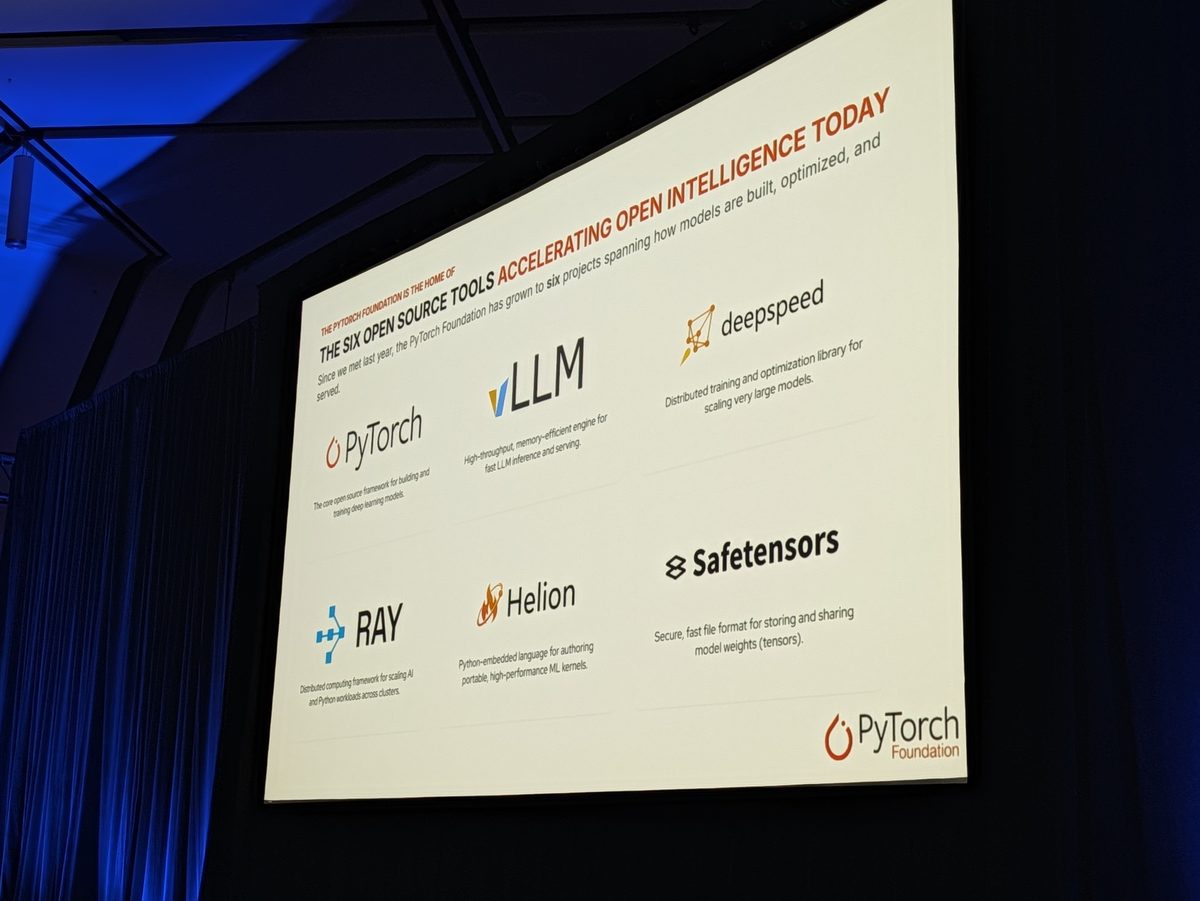
The tools are open, in a PyTorch Foundation that now has six projects: PyTorch, vLLM, DeepSpeed, Ray, Helion and Safetensors.
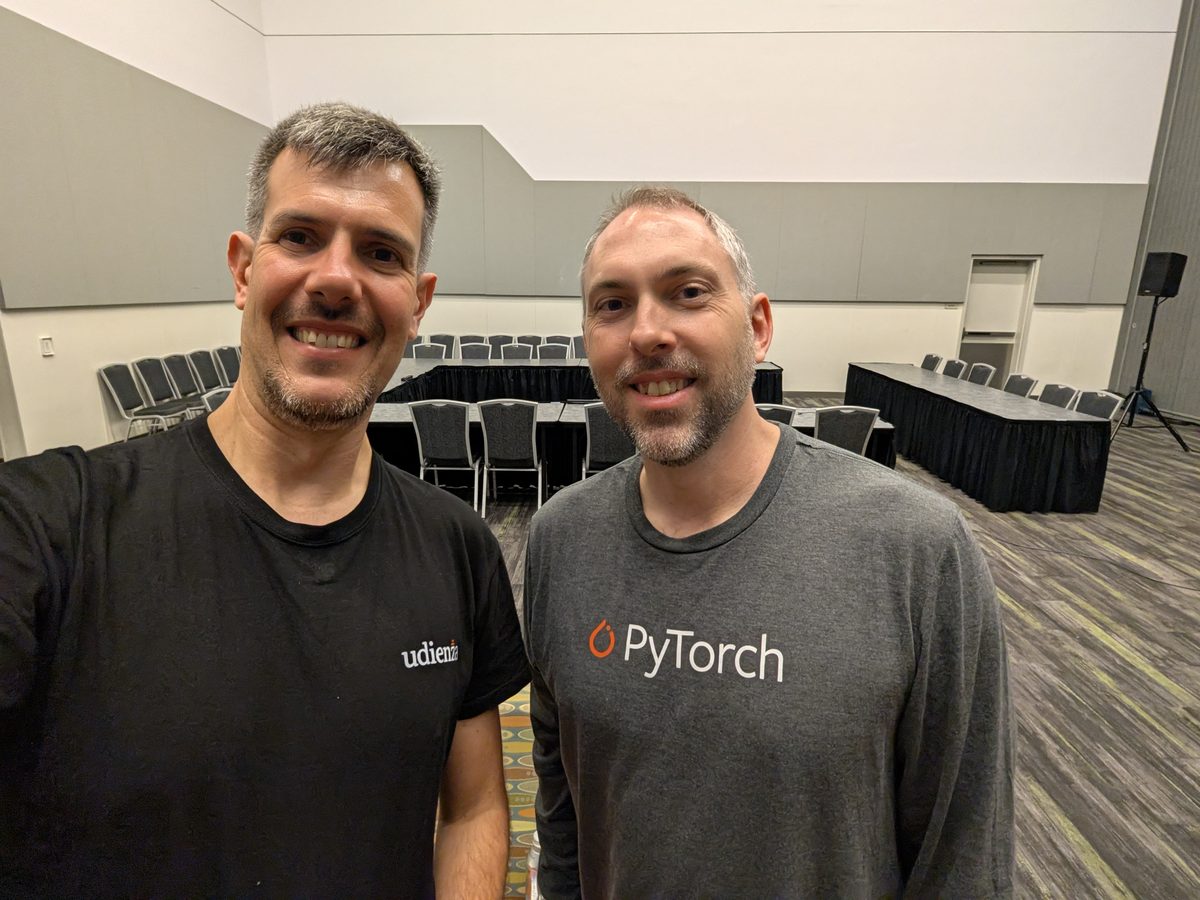
I sat down with Jonathan after his keynote for a 14-minute conversation on PyTorch, vLLM and the foundation, now in production for Udienza.
Universal properties: guarantees for unpredictable agents
Shadaj Laddad of AWS had the most engineering-minded talk of the conference. His answer to agents writing code you cannot fully predict is the universal property: a specification that applies to any application, whatever its logic. Two everyday examples: Rust’s borrow checker guarantees no concurrent access to mutable state, and React guarantees that an incremental render is the same as rendering from scratch.
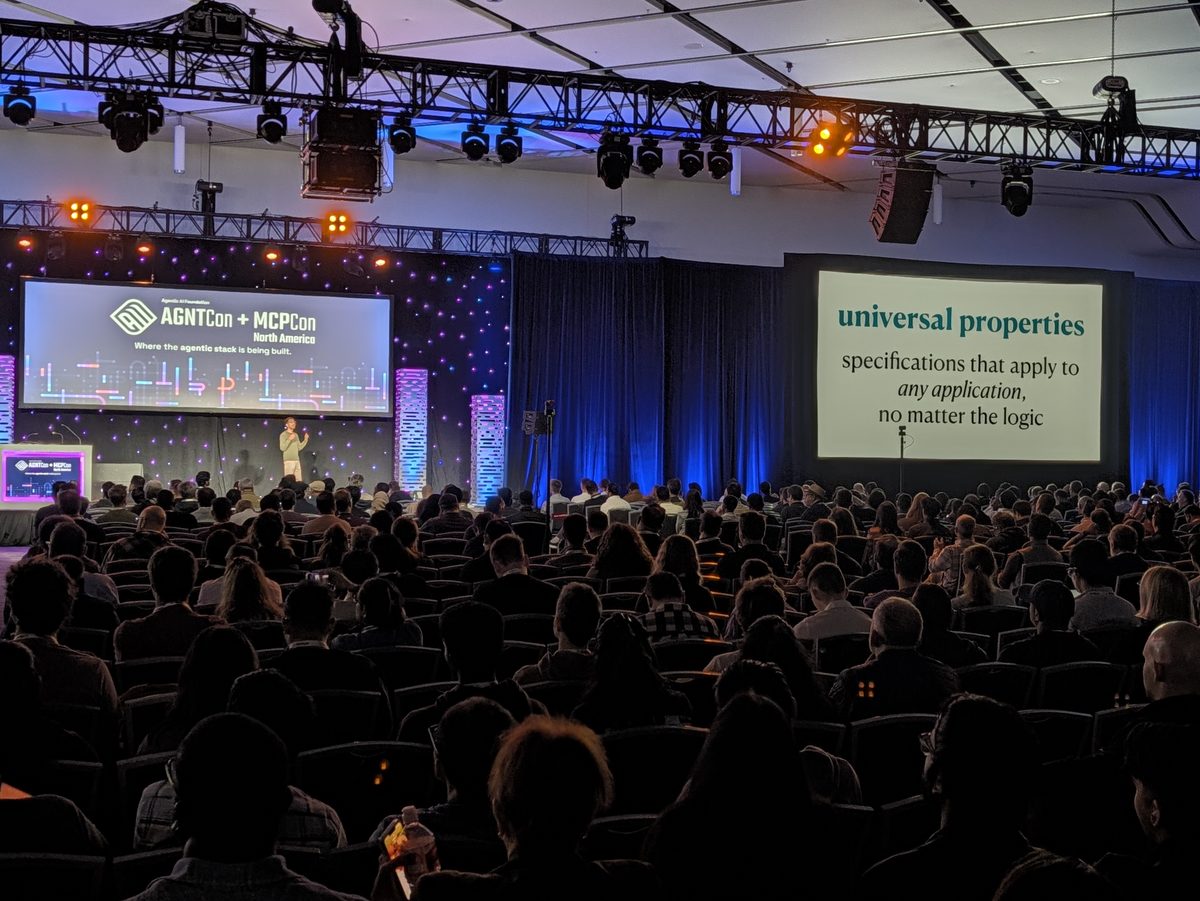
His two projects apply the idea: Hydro, a framework for correct, agent-written distributed systems, and Infinity, an agent runtime where concurrent agents behave the same as sequential execution. What I took home is his three steps: ask which properties hold for all your applications, formalize them apart from any single app, then enforce them with frameworks, strong types and crafted APIs. An agent can then write the logic, and the property still holds.
The swap drill
The question I would put to every team that runs agents came from Rao Surapaneni of Google Cloud (VP, Gemini Enterprise & Agent Platform Governance): can you run a swap drill in under two days? Swap the model, across frontier, open-weight and proprietary. Swap the harness without rebuilding governance. Swap an agent, through A2A and a registry. And through every swap, identity, policy, observability and your business IP stay intact.
His six best practices read like a checklist for a platform team:
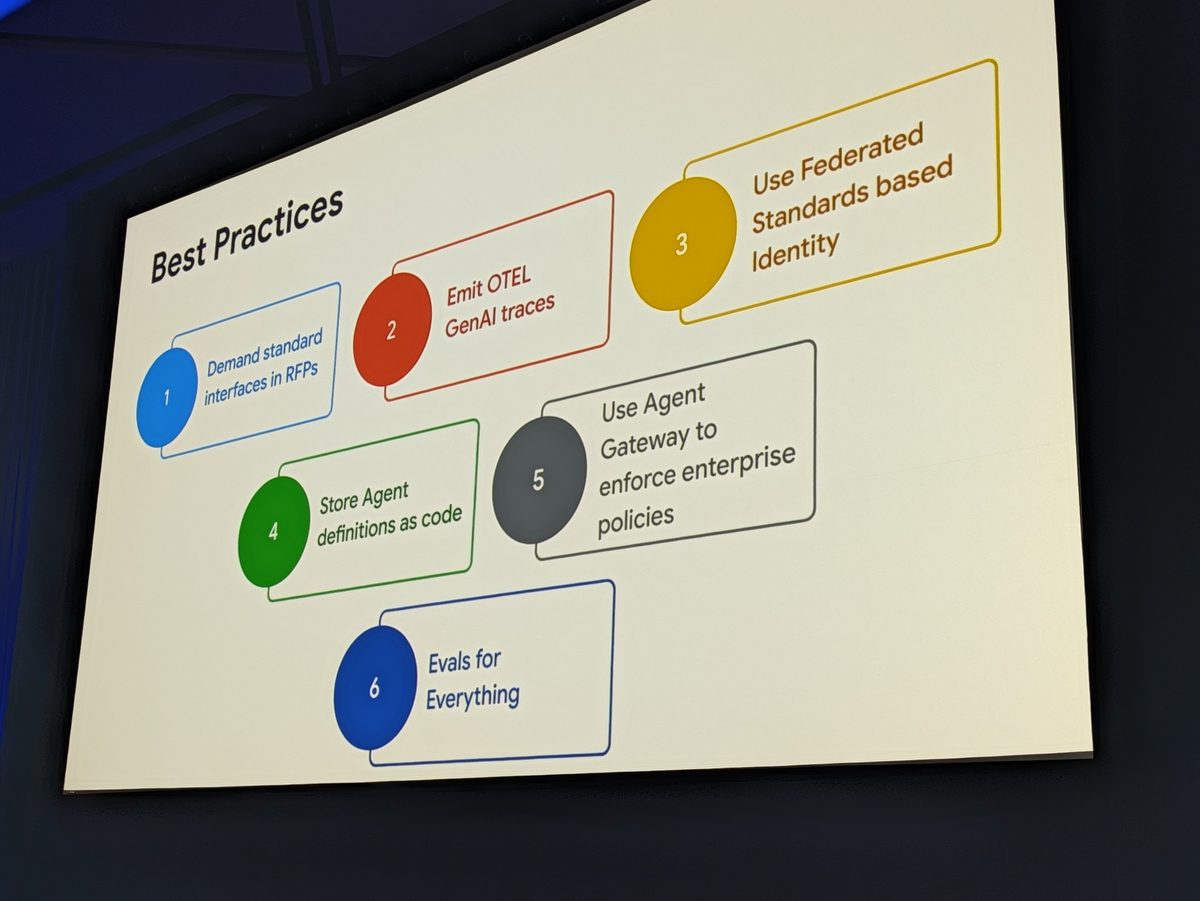
- Demand standard interfaces in RFPs.
- Emit OpenTelemetry GenAI traces.
- Use federated, standards-based identity.
- Store agent definitions as code.
- Use an agent gateway to enforce enterprise policies.
- Evals for everything.
If you run Kubernetes, most of this will sound familiar: declarative definitions in Git, a gateway for policy, standard telemetry. Agents are getting the same platform treatment, and the teams that already have it are ahead.
MCP in Claude: 16x since April
The biggest number of the day was Kelly Fang’s, from Anthropic: 16x more weekly MCP tool calls through its remote proxy than at the New York MCP Dev Summit in April 2026, and more than 6,000 servers in the Claude directory. One server reaches Claude on the web, desktop and mobile, Claude Code, Claude Managed Agents and Claude in Slack.
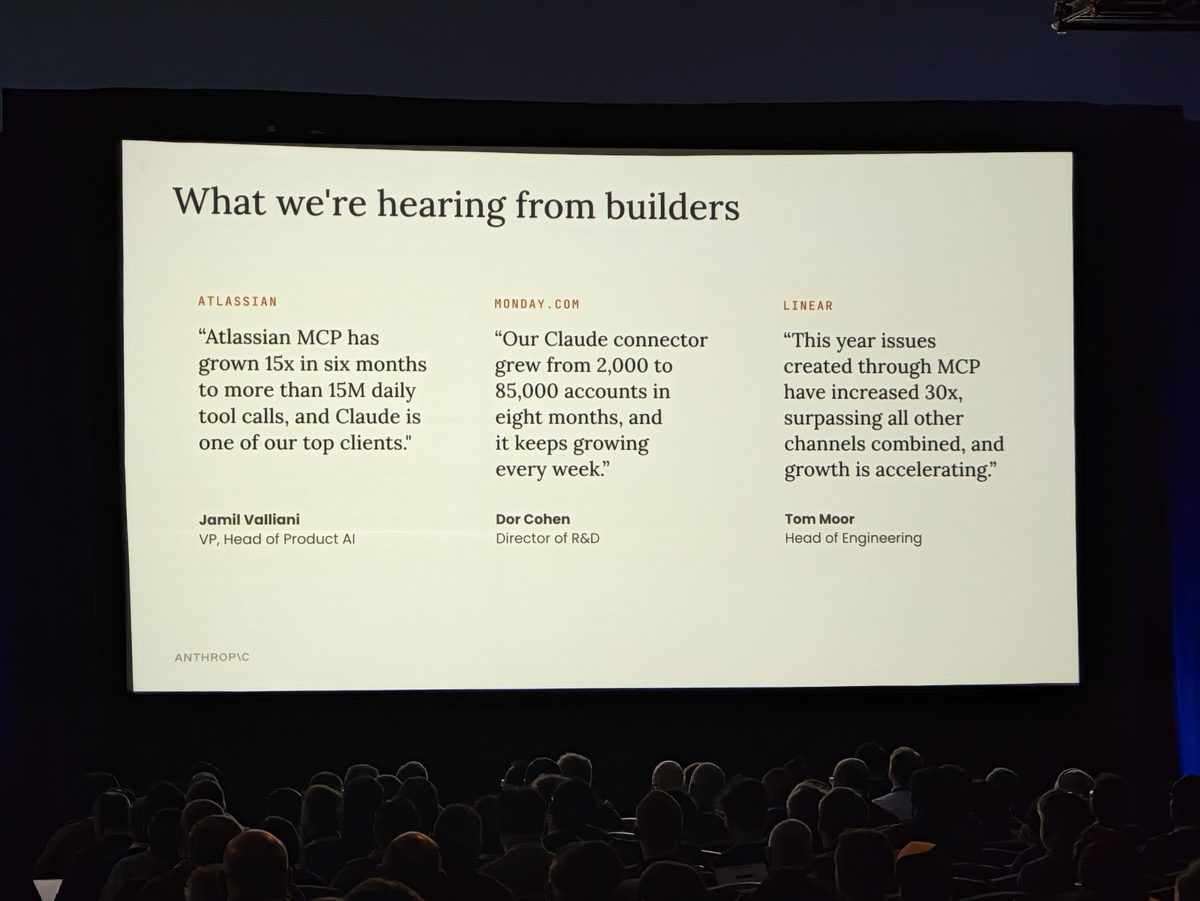
Three builders put numbers on it from their side: Atlassian’s MCP at more than 15 million daily tool calls, monday.com’s Claude connector at 85,000 accounts, and Linear’s issues created through MCP up 30x, more than all its other channels combined. For anyone still deciding whether to ship an MCP server for their product, that slide is the answer.
The first AAIF Technical Excellence Awards
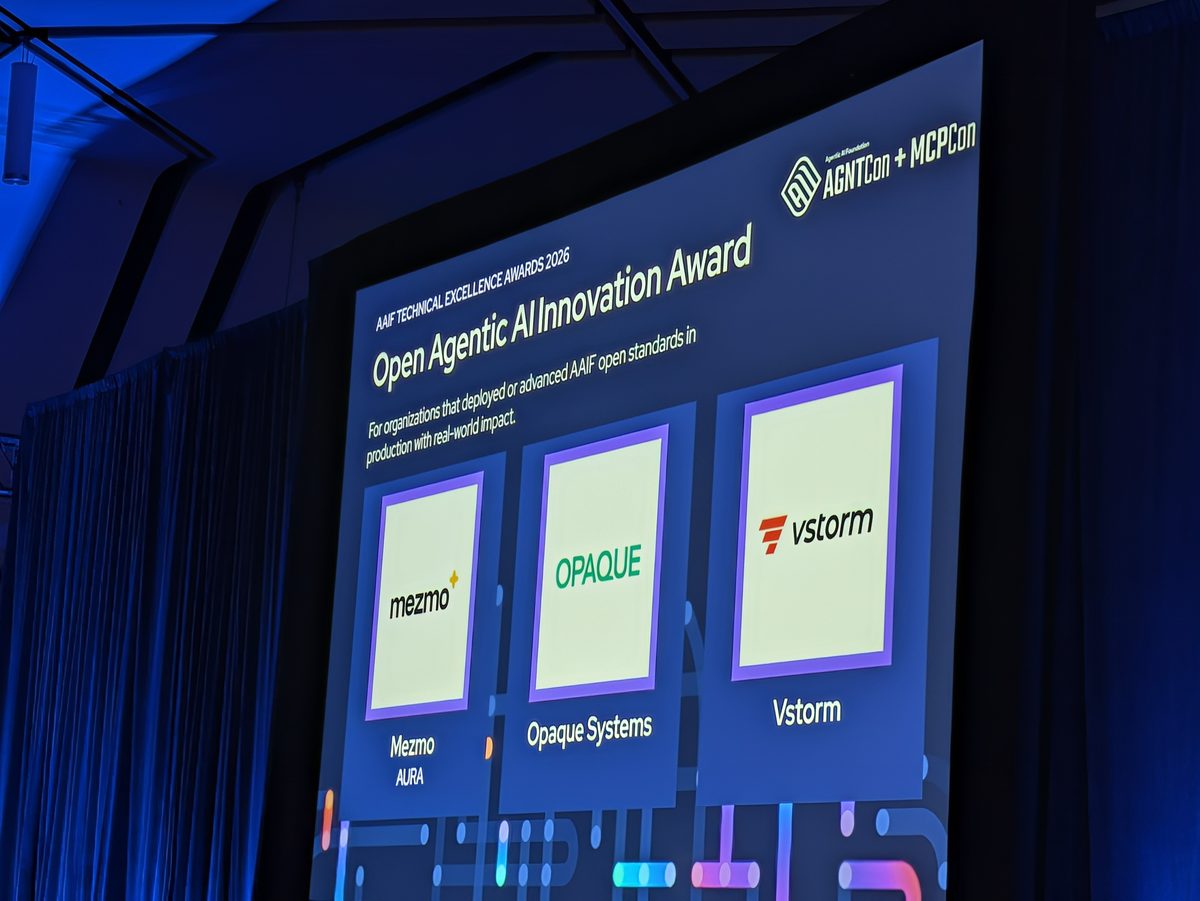
Mazin Gilbert opened the morning with the foundation’s first awards, chosen by a committee of ten: the Keystone Award, Outstanding Technical Contribution, Community Builder and Open Agentic AI Innovation. The innovation slide named Mezmo for AURA, Opaque Systems and Vstorm. One recipient I know of: Lin Sun, VP of Open Source at Solo.io, honoured for years of work from Istio and service mesh to agentic AI infrastructure.
The foundation also announced its next two flagship events, for next year: San Francisco on 28 and 29 April and London on 15 and 16 September.
On the floor: governance, six ways
The afternoon was interviews, about one every half hour. Listen to them side by side, as I did, and most of the vendors are selling a piece of the same thing: the controls around an agent in production. Each draws the line somewhere else.
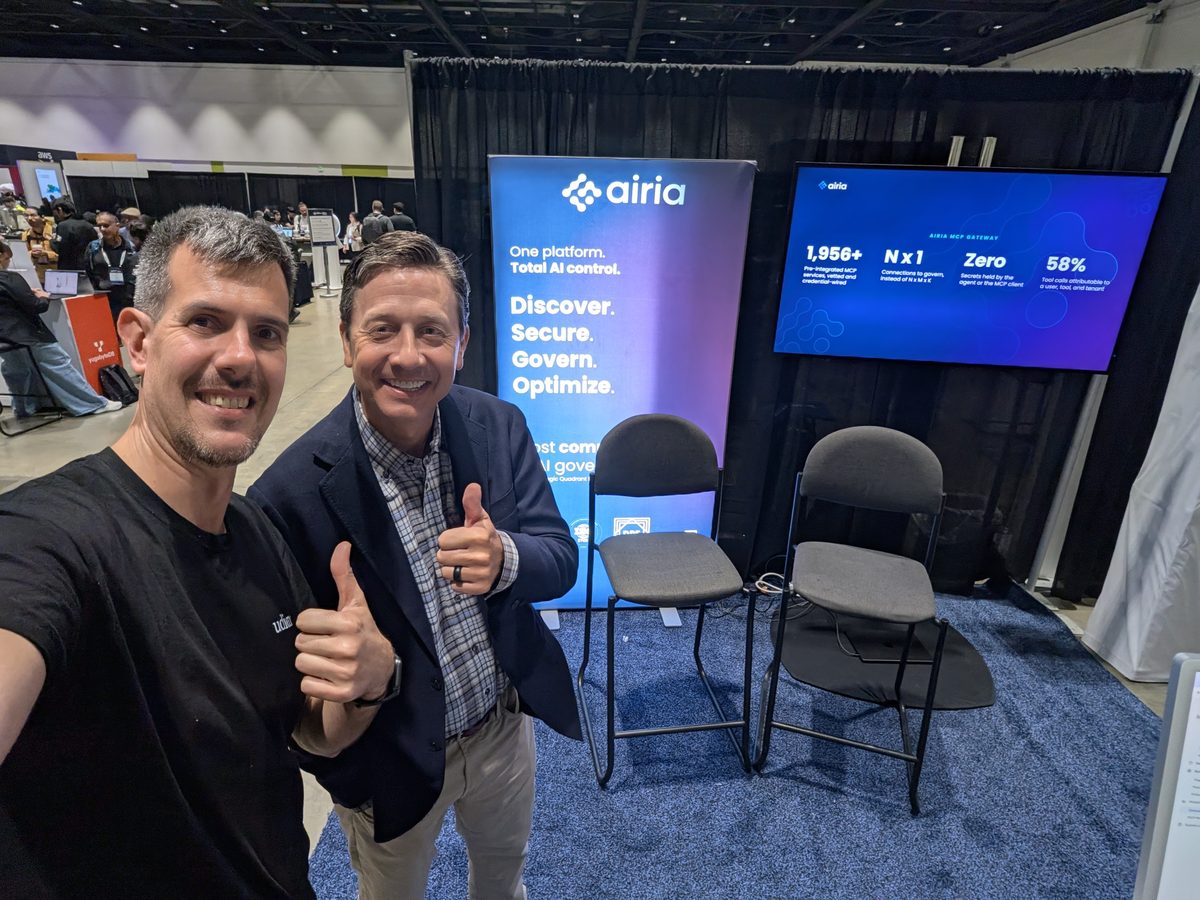
- Airia puts the controls in a gateway: an MCP gateway and “agent constraints” that block what an agent is not meant to do, managed by IT in one place instead of a settings file on every laptop.
- Alterion watches from the network and the endpoint, where many agents have no control plane at all, and classifies their behaviour with its own AI.
- Celigo governs the MCP servers its integration platform publishes, down to single tools, and calls the path to autonomy “earned”.
- Diagrid makes agents durable, so a crash does not send the same email twice, and signs every step an agent takes.
- AgentCat looks for the silent failures, when every call returns 200 and the user still had a bad experience.
- Quesma collects the agents’ session logs, to see what agentic coding is worth and what it costs.
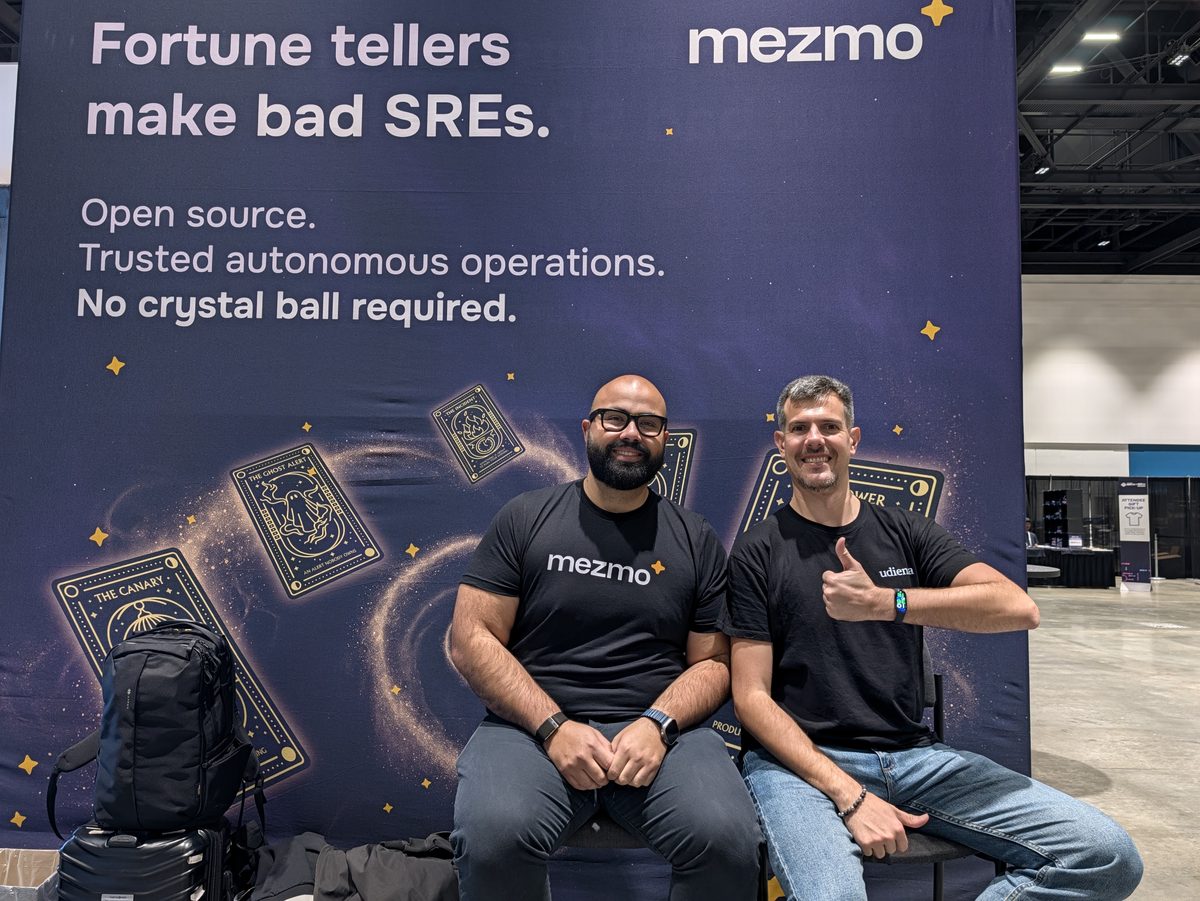
Then there are the layers underneath: Mezmo’s AURA, an open source SRE agent with a strict human in the loop before any remediation; YugabyteDB’s Meko, a context layer of memory and knowledge for every agent; Safe Software’s FME, which publishes no-code MCP servers over hard-to-reach data like 3D building models and sensor feeds.
My take: the questions to ask any of them are the same ones as in Amsterdam. Where does it run (on-premises, air-gapped, on Kubernetes)? Which identity standards does it speak? Does it emit standard telemetry? Can you leave without rewriting every agent? Those are Rao Surapaneni’s swap drill, asked of a vendor.
Thirteen conversations
Each interview gets its own article on udienza.com and its own episode over the coming weeks:
- Jonathan Bryce, Linux Foundation (PyTorch Foundation)
- Andre Elizondo, Mezmo
- Jacek Migdał, Quesma
- Hari Krishna Sunder, YugabyteDB
- Kashish Hora, AgentCat (I wrote about AgentCat’s AX platform in September)
- Mark Fussell, Diagrid
- Spencer Reagan, Airia
- Tyler Lamparter, Celigo
- Sanford Redlich, Alterion
- Matt Meeboer, Safe Software
- Angie Jones, Agentic AI Foundation
- San Ramani, Mobilityecommerce
- Katherine Druckman, JetBrains
Angie Jones gave the shortest summary of why the foundation exists: it is “where we say the agentic stack is being built”. After two days in San Jose, the layer around the agents is where much of the floor was competing.
Related Content
- AGNTCon + MCPCon North America 2026: day two (udienza.com)
- AGNTCon North America 2026 Day 1: MCP Tasks and Skills
- AGNTCon Day 2: Stateless MCP, Agent Identity, Multi-Agent
- AgentCat Launches First Agent Experience (AX) Platform at AGNTCon
- WSO2 Agent Manager Brings Sovereign AI Governance to Enterprise Agent Sprawl