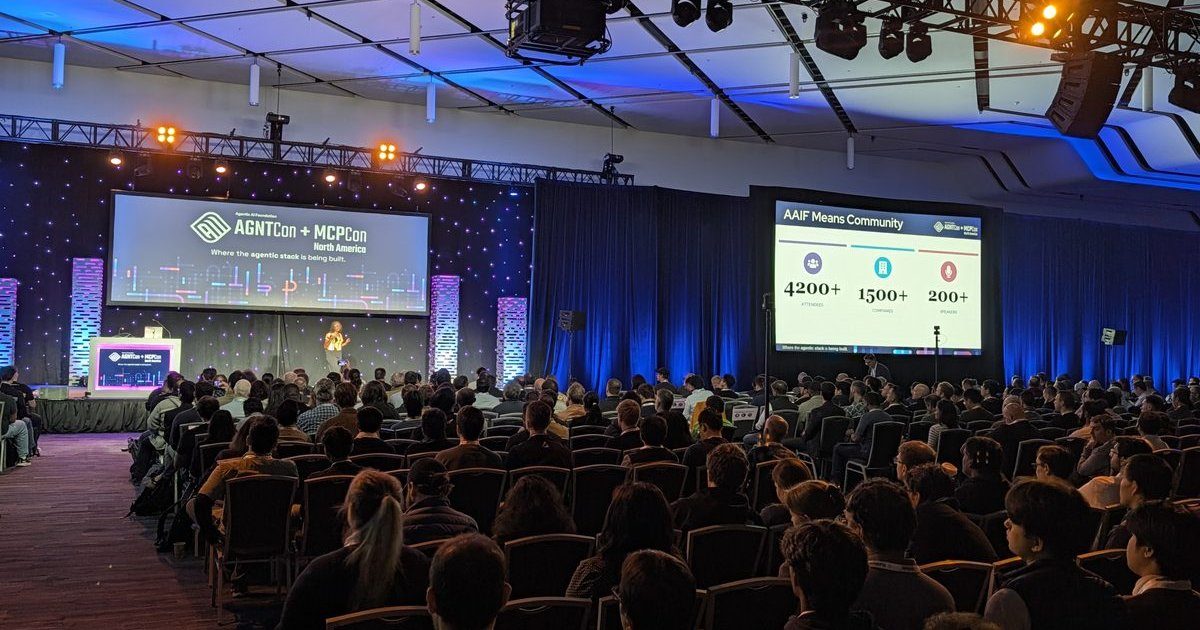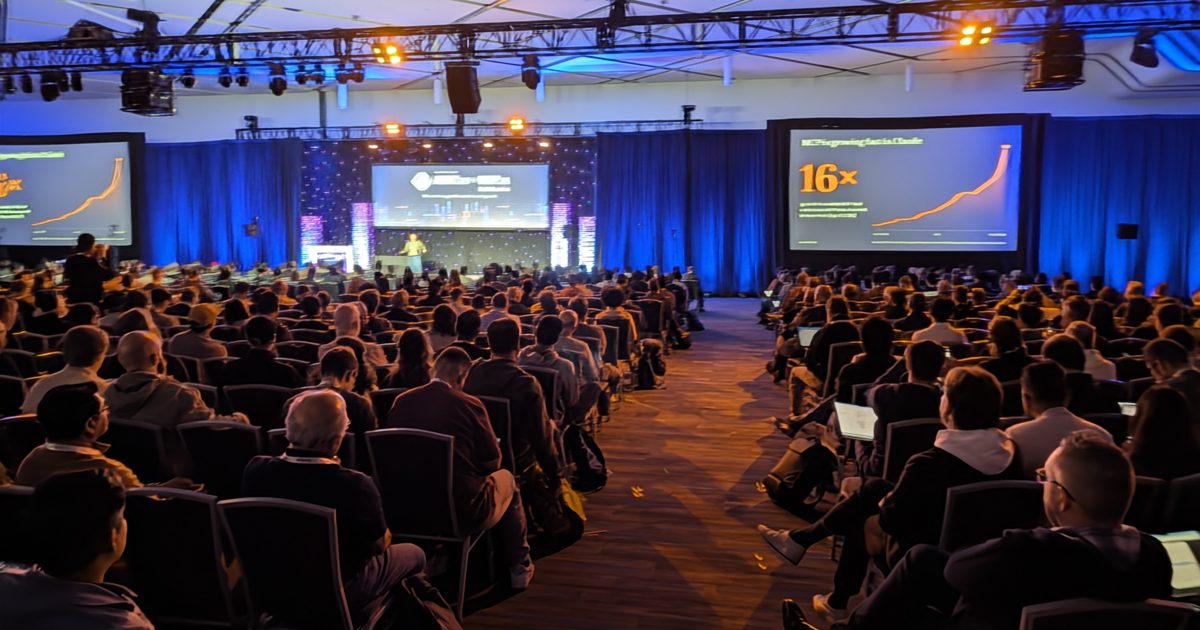
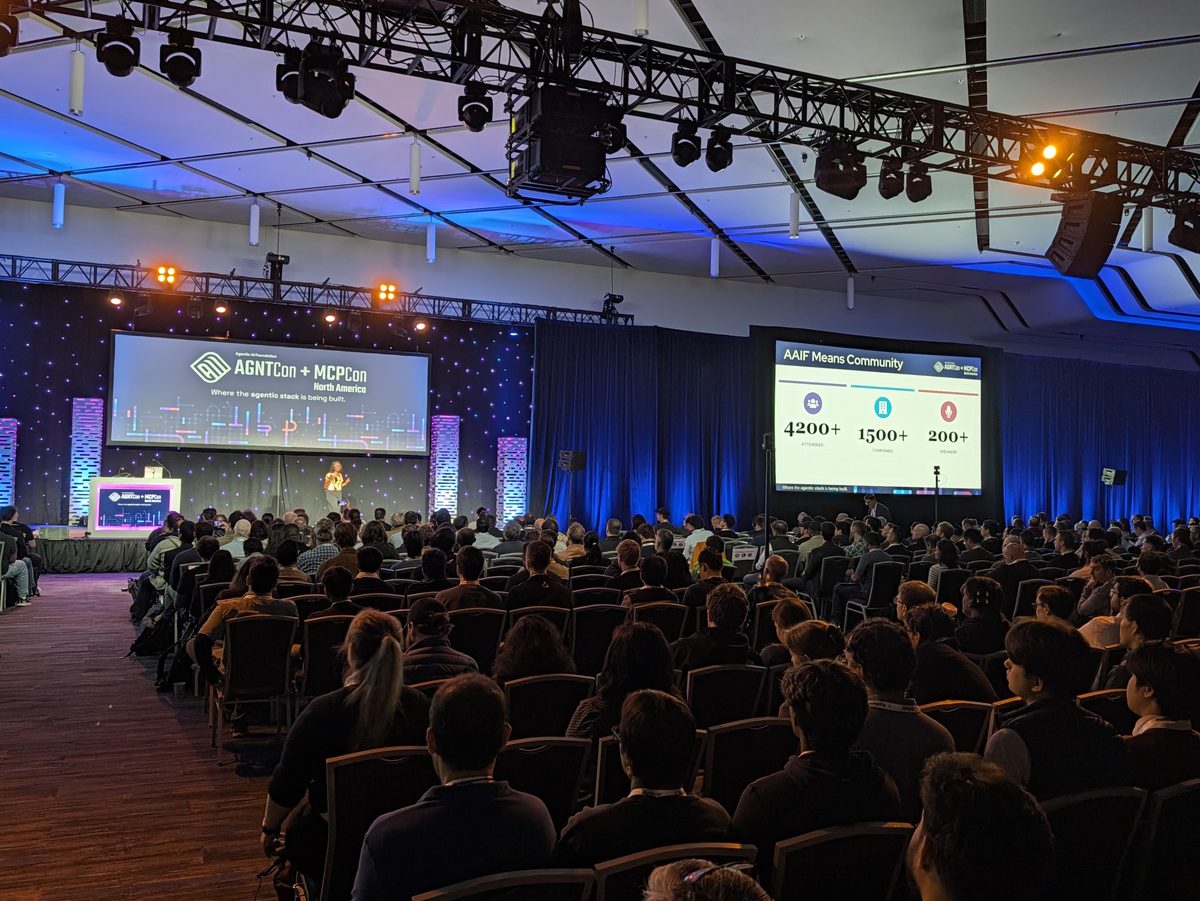
The keynote hall at the San Jose McEnery Convention Center at 09:06, filling up.
A month after AGNTCon + MCPCon Europe in Amsterdam, the Agentic AI Foundation (AAIF) brought its conference to San Jose on 22 and 23 October 2026, and I was there again as an official media partner with Udienza, my video podcast. The full day, hour by hour, with every interview and the maintainer roundtable, is on udienza.com: AGNTCon + MCPCon North America 2026: day one.
This post is the shorter version I would give an engineer who builds agents and could not be in the room: what changed in MCP, what the foundation’s numbers say, and what the maintainers warned about.
The foundation, one month later
In Amsterdam, Manik Surtani’s slide showed six hosted projects, eight working groups and more than 270 member companies. In San Jose the numbers were ten projects, eight working groups and 305 members, sixty of them new this quarter. The new Gold members are Ant Group, the Gates Foundation, MongoDB, Nutanix, the Royal Bank of Canada, Vercel and Vultr, seven in all.
The four new projects arrived on day one:
- Agent Skills, from Anthropic;
- Open Responses, contributed by OpenAI: an open specification that lets LLM interfaces interoperate;
- OpenEnv, from Hugging Face, for the environments that train and evaluate agents with reinforcement learning;
- OpenSandbox, from Alibaba, a secure place for coding agents to run.
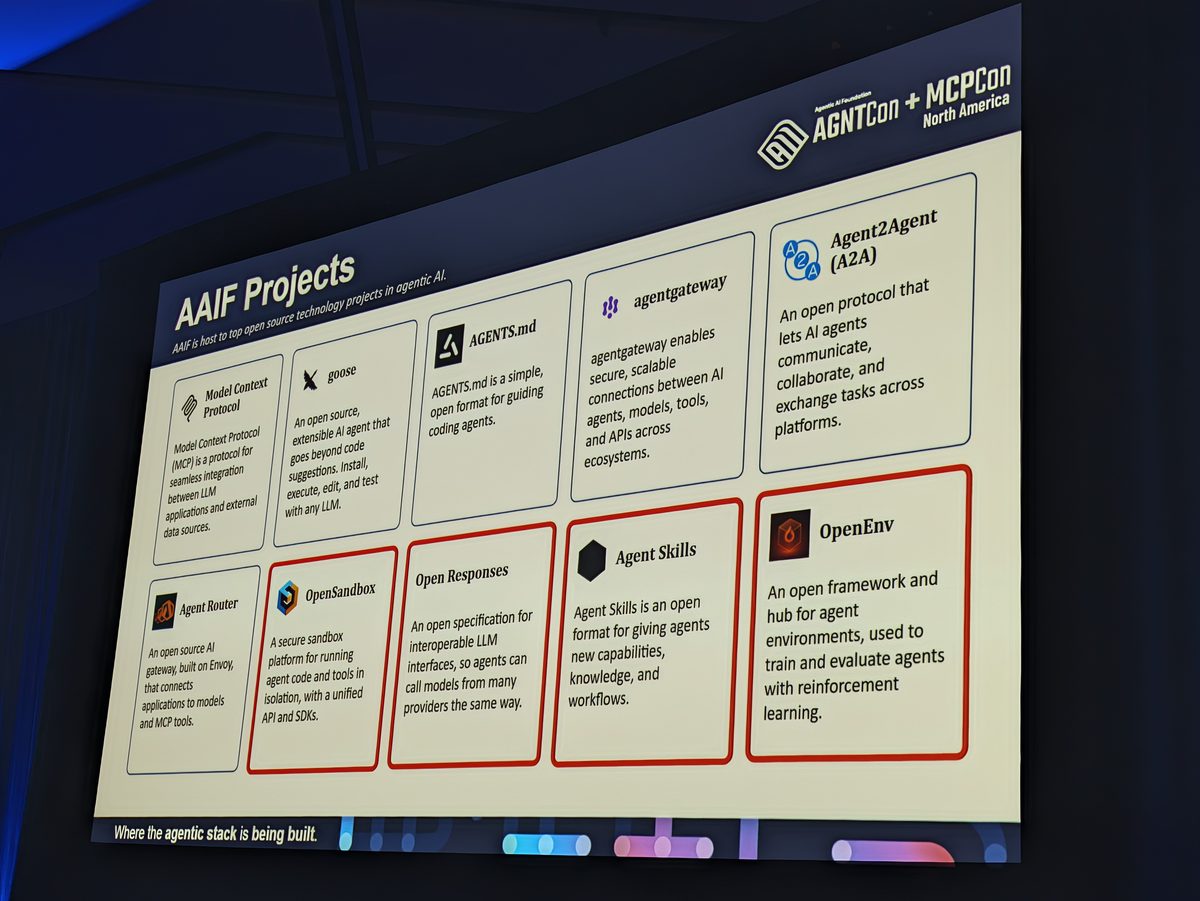
Both announcements are public: four new projects and 305 members. Angie Jones also opened the keynote with the MCP Associate certification, the vendor-neutral credential I wrote about when it launched, open now to anyone.
The slide I photographed for my own notes was the member survey (186 members, the 2026 AAIF Member Pulse Survey):
- 81% have agentic AI in production today, 51% at production scale;
- 89% use or evaluate MCP, ahead of Skills (69%), A2A (57%) and AGENTS.md (51%);
- 60% run multi-agent systems;
- oversight: 66% human-on-the-loop, 63% bounded autonomy, 23% fully autonomous.
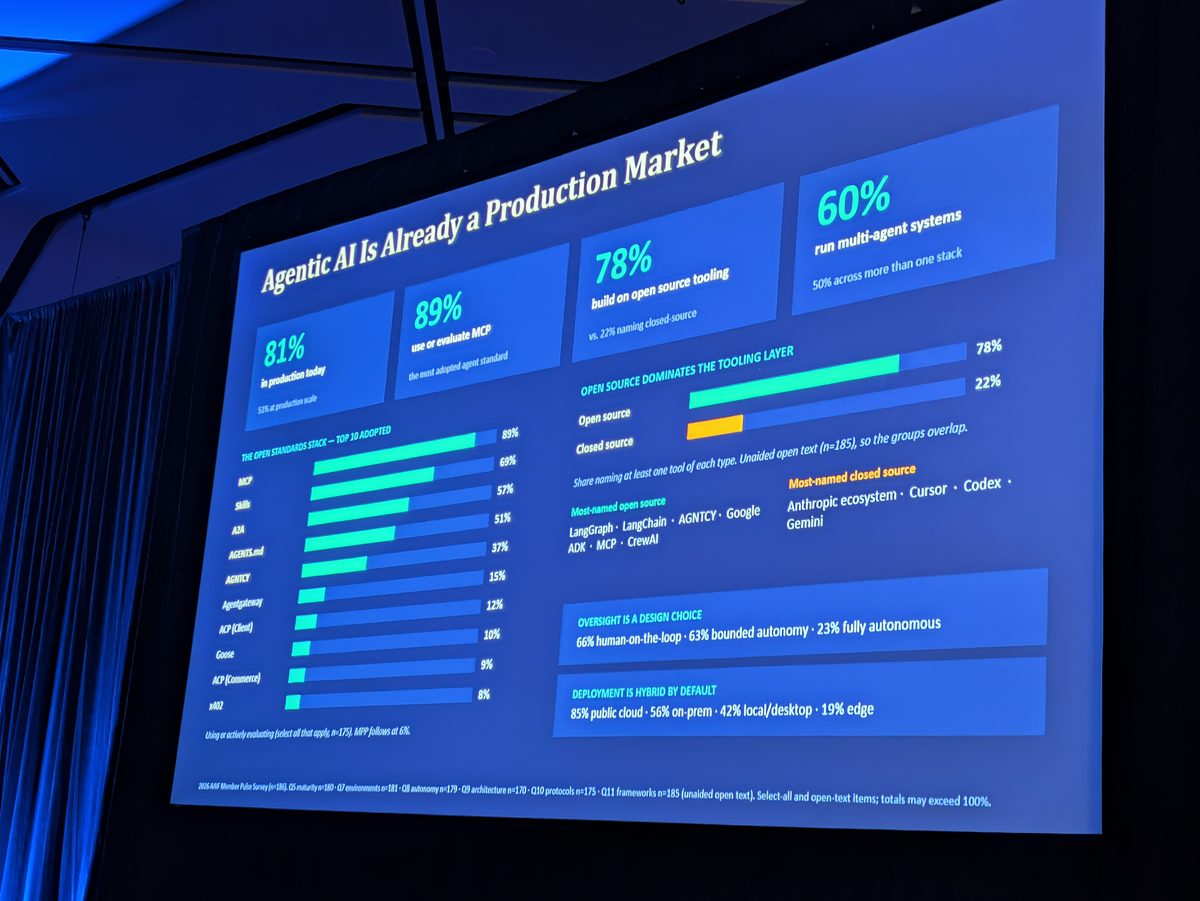
Read that last line twice before you design for full autonomy. The people who run agents in production mostly keep a person on the loop, and the protocol work below is built for that.
MCP Tasks: a handle, not a wait
David Soria Parra, co-creator and lead maintainer of MCP at Anthropic, gave the talk I would send anyone to watch. Its headline was MCP Tasks. Until now a tool call had to finish inside the 10 to 30 seconds most platforms allow. With Tasks it can run for minutes, hours or days: the call returns a handle, and the client checks back. Tasks are polling-based today; with MCP Events, the server can push the update instead.
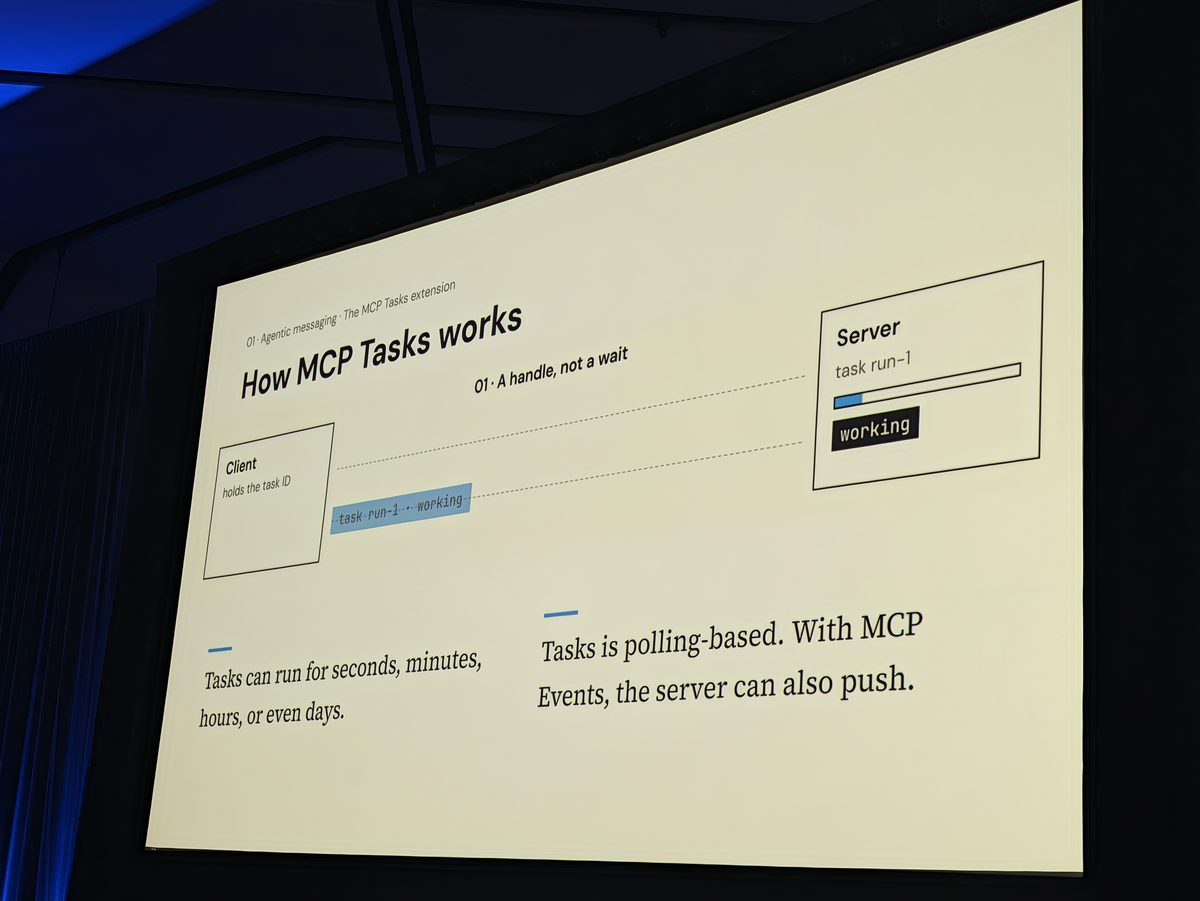
They work in Claude Code from day one. His example was a CI run: no waiting on a tool call, no 30-second limit, no polling tools built by hand. “This is all now native.”
If you maintain an MCP server, this is the change to plan for. Every tool that starts something slow (a build, an export, a report, a migration) and then makes the model poll a second “get status” tool is a candidate for a task.
Skills over MCP, bound to your login
The second announcement goes further than it sounds. Agent Skills are files on disk today. A new extension, developed in the MCP community, will serve them over MCP, so a server brings its domain knowledge with its tools. Because MCP carries authorization, the skills can depend on who logs in: an engineer gets the engineering skills, a designer the design ones. The slide put it in one line: skills travel with the connection, and which ones you get depends on your login.
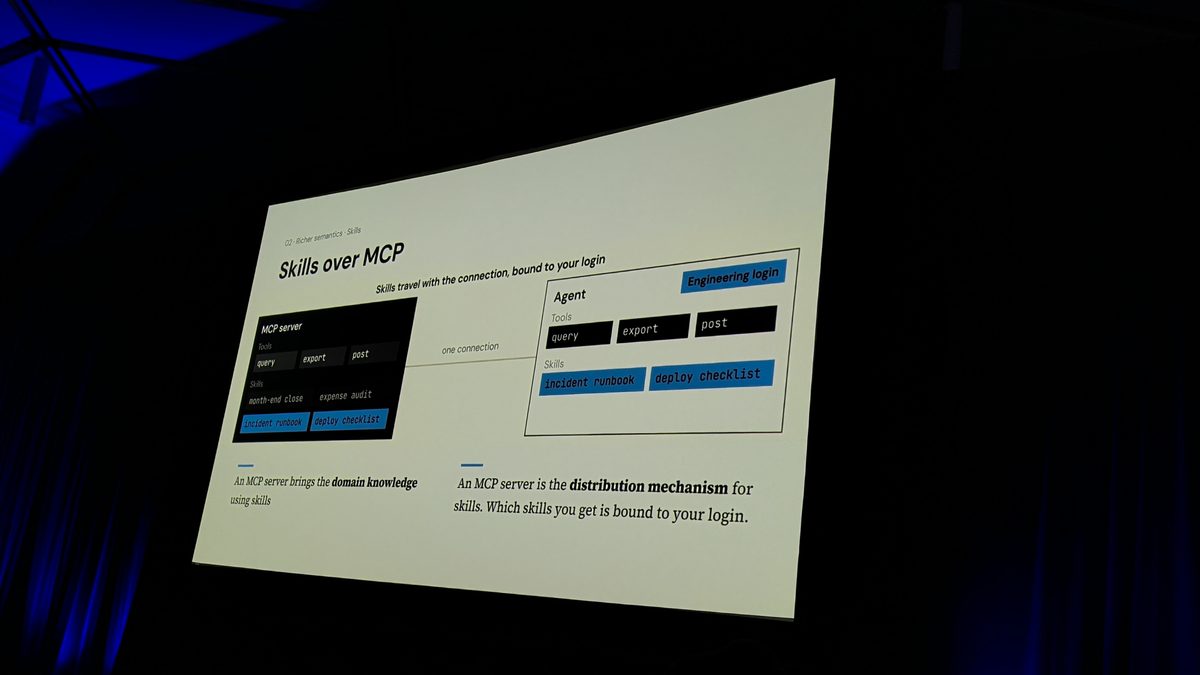
A minute later came the matching news: Agent Skills joins the AAIF, under neutral governance.
Elicitation, the feature nobody uses
His third point was a feature that has been in the protocol for a long time. “Who is using elicitations in MCP? Very few.” Elicitation lets a server stop mid-action and ask the person: to confirm a destructive or expensive step, to supply a setting rather than guess it, or to sign in at a URL. The demo was a deploy that stops to ask whether it should go to preview or production.
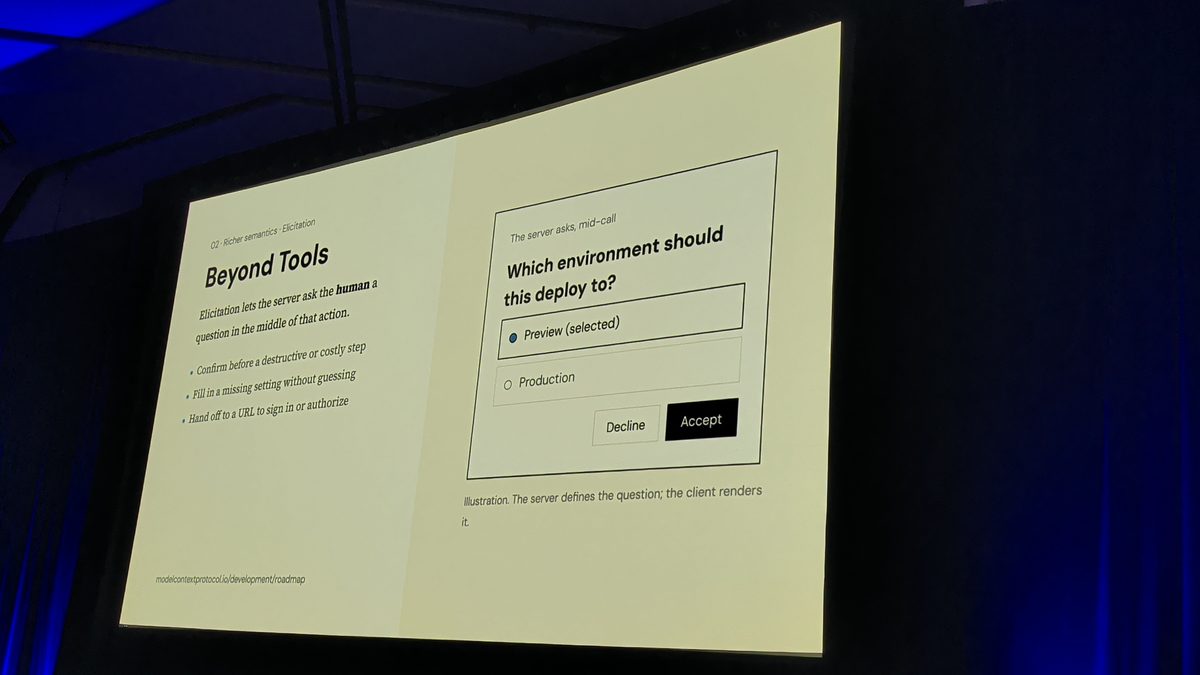
This is where I would start on Monday. Put an elicitation in front of every tool that deletes, deploys or spends money, and the human in the loop stops depending on how each client happens to confirm tool calls.
The roadmap in five areas
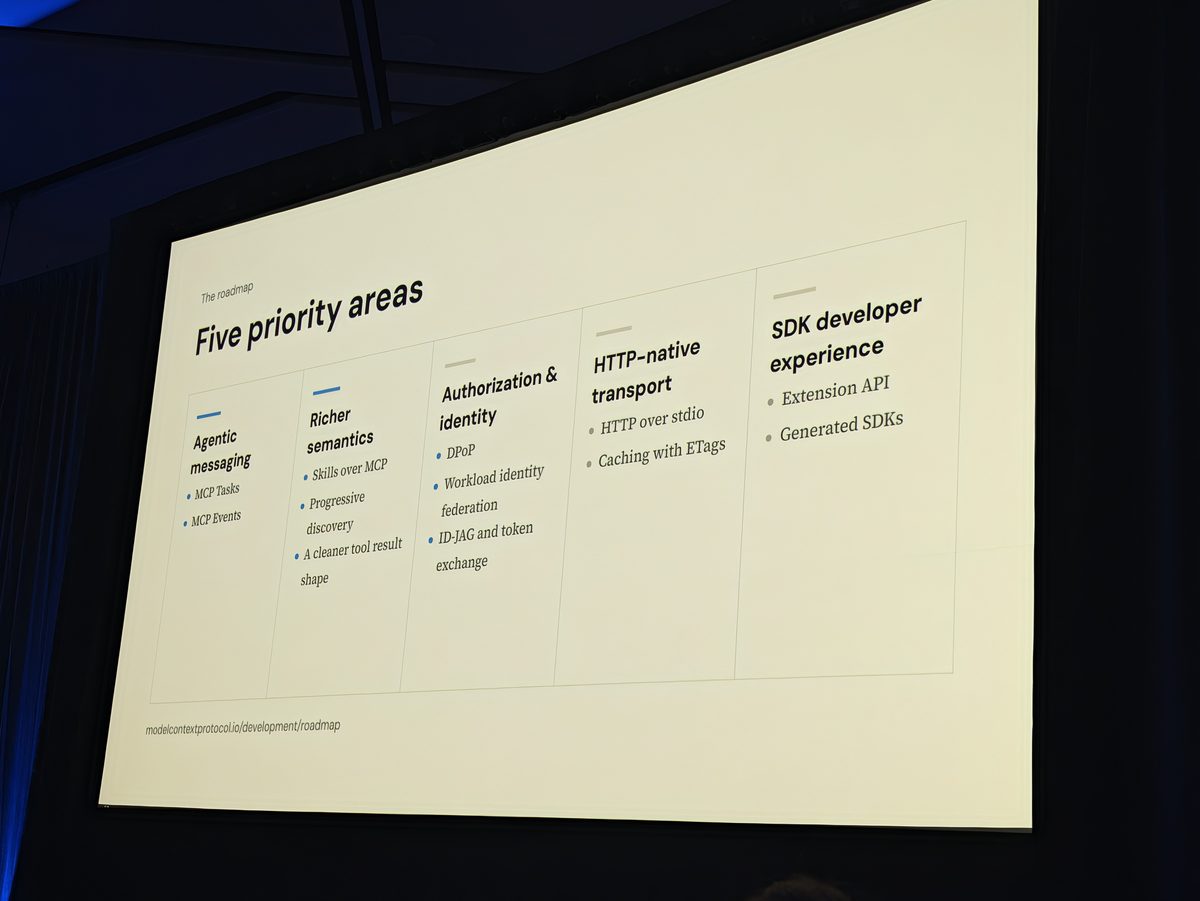
- Agentic messaging: MCP Tasks and MCP Events.
- Richer semantics: Skills over MCP, progressive discovery, a cleaner shape for tool results.
- Authorization and identity: DPoP, workload identity federation, ID-JAG with token exchange.
- HTTP-native transport: HTTP over stdio and caching with ETags.
- SDK developer experience: an extension API and generated SDKs.
The roadmap lives at modelcontextprotocol.io/development/roadmap. The usage behind it: 2 billion MCP tool calls in Claude, and growing.
What the maintainers warned about
At 16:00 the media and analysts sat down with six maintainers: David Soria Parra (Anthropic), Caitie McCaffrey and Darrel Miller (Microsoft), Nick Cooper (OpenAI), Douwe Osinga (Block, goose) and Varun Talwar (Tetrate, Agent Router). There was no video, by the organisers’ rule. Three answers are worth taking home.
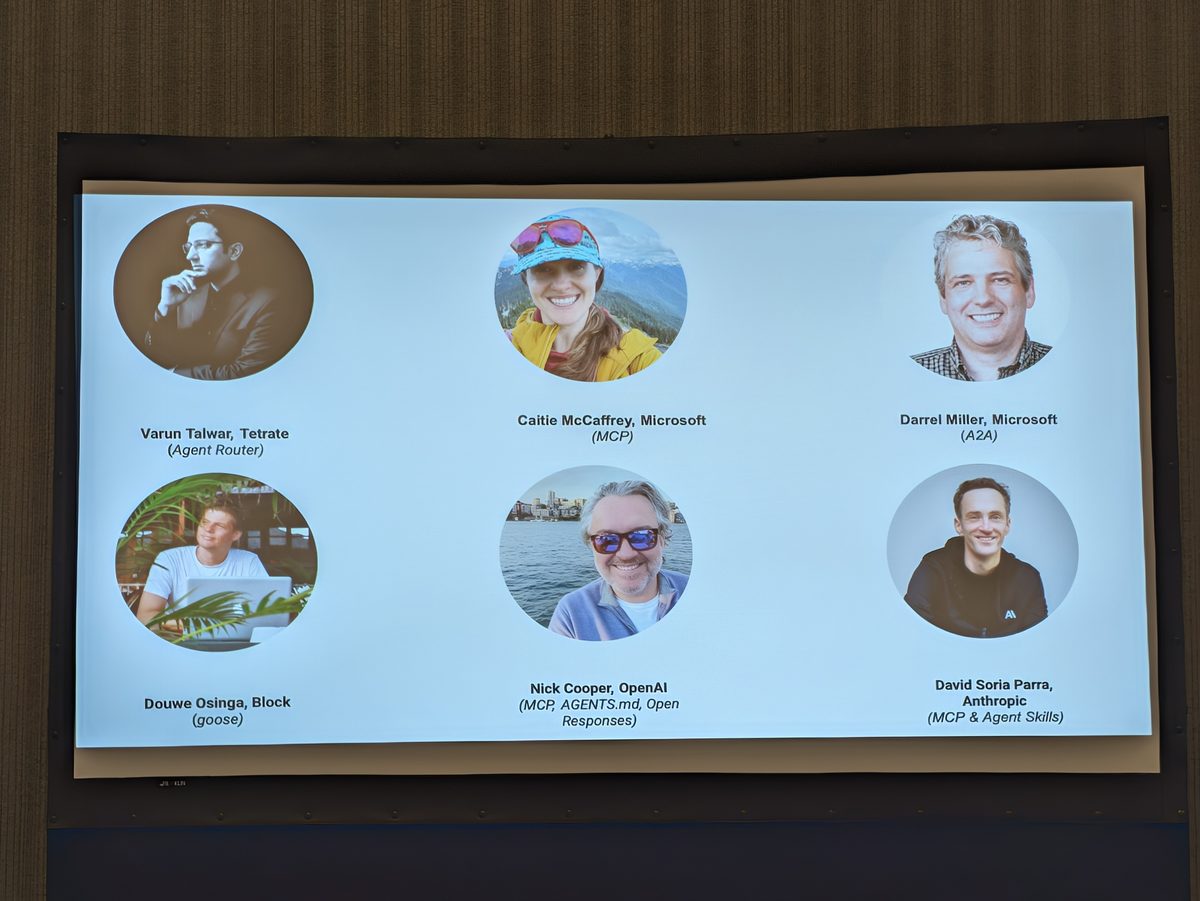
- Your backend will feel it. “Any useful agent will talk to your back-end.” A service that was never critical becomes critical because an agent is calling it constantly. Capacity-plan the APIs your agents reach, not only the agents.
- Deny by default. For organisations that cannot afford a mistake, allowlist what agents may do instead of blocklisting what they may not.
- Don’t pick a side. Skills, MCP servers and CLIs “all still exist”, and teams combine them. The project avoids premature standardization and waits for value shown at scale. AGENTS.md, in one maintainer’s words, is just the old rule that a project should have documentation.
On pace, Caitie McCaffrey said the core maintainers ship the protocol about twice a year, “actually crazy fast” for a protocol this widely adopted, and introduced extensions so the community can experiment without blocking the protocol.
J.R. Storment of the Tokenomics Foundation asked the keynote hall how many people knew what their agents cost. A few hands went up. How many could tie that cost to value? One. That gap is the next problem after production.
On the floor: seven conversations
Between sessions I recorded interviews for Udienza, two cameras and two microphones in fifteen-minute slots. Each one has its own article on udienza.com:
- Lena Hall, Akamai, on running agents in production at the edge, where control means locality: the conversation.
- Daniel Hoang, Akuity, on Argo CD, Kargo and agents that build GitOps pipelines through MCP: the conversation.
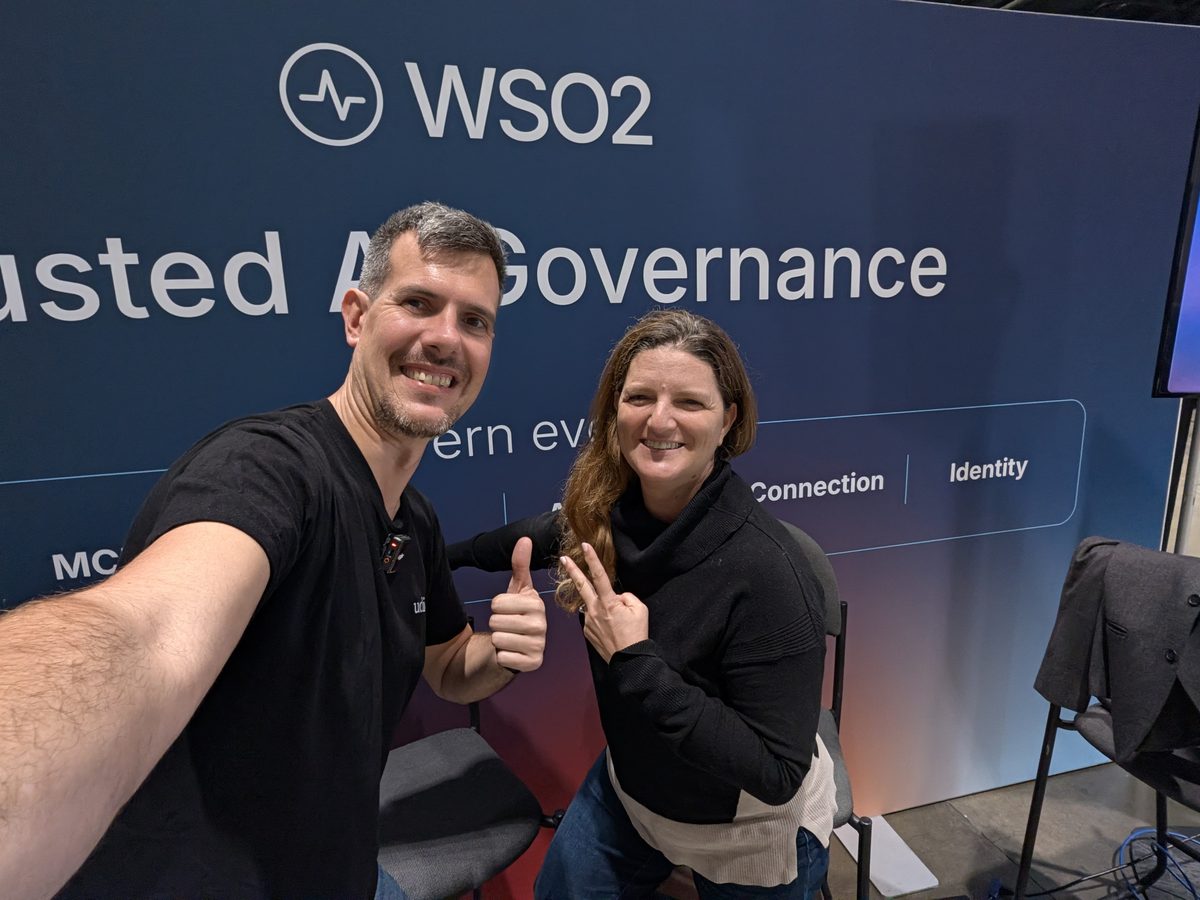
- Rania Khalaf, WSO2, on the agent “halo” of perimeter, identity and evals; I covered WSO2 Agent Manager in September: the conversation.
- Nathan Slavik, Arcade.dev, on authorization, enforcement and governance for agents acting as you: the conversation.
- Yuval Hazaz, Overcut, on a software factory of agents and why the dark factory comes gradually: the conversation.
- Sean Knight, SaturnDocs, on documentation whose main readers are agents: the conversation.
- Siddarth Shekhar, San Jose State University, a data science student at his first conference: the conversation.
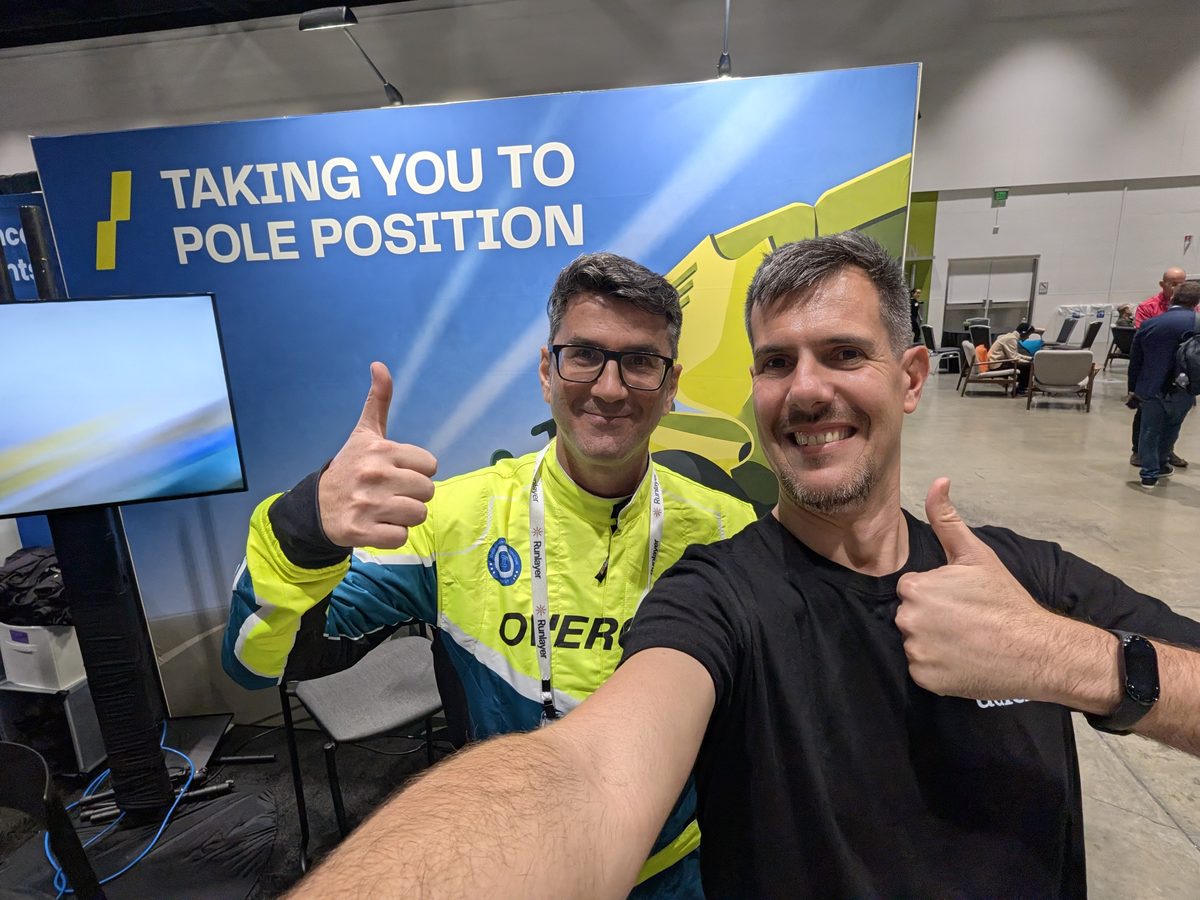
The episodes are being produced and go out on the Udienza YouTube channel over the coming weeks.
Related Content
- AGNTCon + MCPCon North America 2026: day one (udienza.com)
- AGNTCon + MCPCon Europe 2026: Two Days of Real Agentic AI at RAI Amsterdam
- AGNTCon Day 2: Stateless MCP, Agent Identity, Multi-Agent
- MCPA Certification: Validating MCP Expertise at AGNTCon + MCPCon Europe
- WSO2 Agent Manager Brings Sovereign AI Governance to Enterprise Agent Sprawl
- Where Udienza Films: Conferences and Media Partnerships