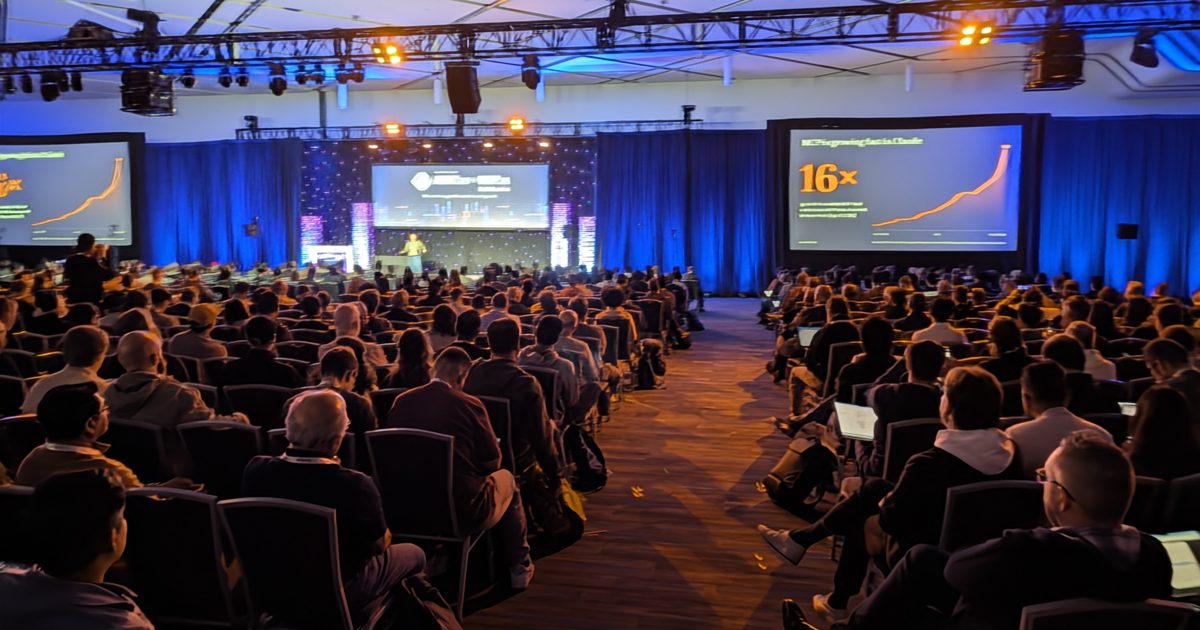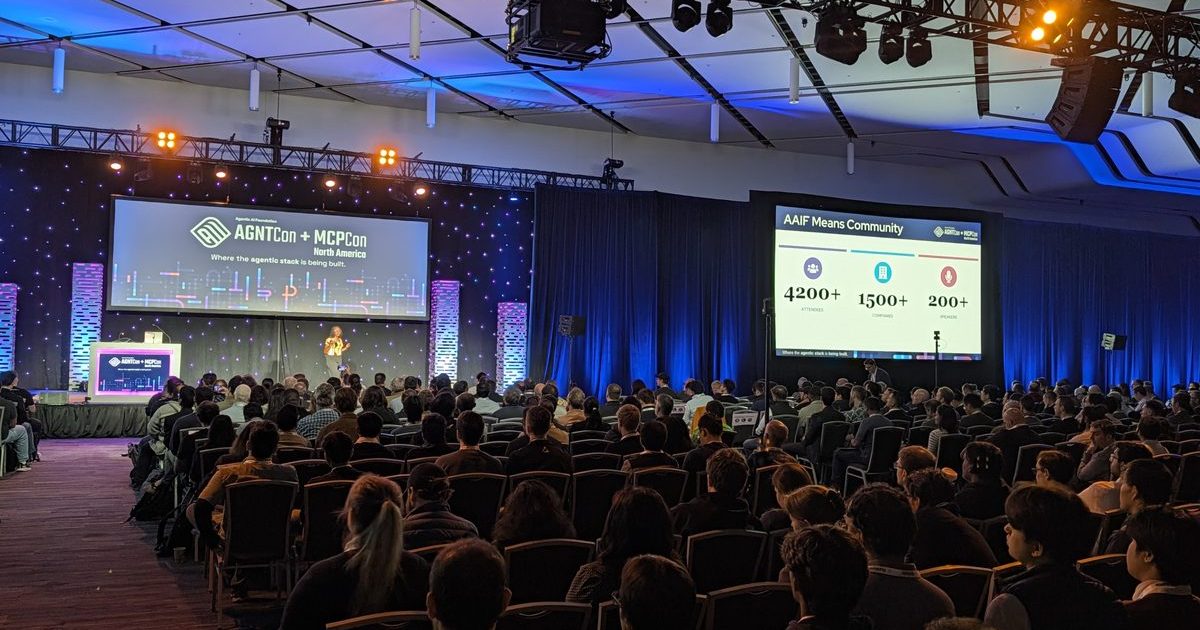
I was at AGNTCon + MCPCon North America in San Jose as an official media partner with Udienza, my video podcast. This post gathers every takeaway in one place: the three I recorded at the end of the week, then those of each of the 19 conversations whose pages are up on udienza.com, as each page has them. The whole event, in one read, is on udienza.com: AGNTCon + MCPCon North America 2026.
Three takeaways from the week
One: the open agent stack is growing fast. The Agentic AI Foundation has 305 members and ten projects, up from three. Four joined on day one: Agent Skills, Open Responses, OpenEnv and OpenSandbox. The message on stage: what makes open permanent isn’t a licence. It’s neutral governance.
Two: MCP is growing up. Two billion tool calls in Claude, and weekly calls up sixteen times since April. With MCP Tasks, a tool call can now run for minutes, hours, even days.
Three: on the floor, one word came back in nearly every conversation: control. Where the agent runs, who it is, what it may do. Katherine Druckman of JetBrains: generating code got cheap, but the cost of reviewing it has not, the cost of understanding it, the cost of trusting it.
Every conversation
22 October 2026
Siddarth Shekhar, Student, San Jose State University
A first con in Silicon Valley, on Udienza.
- AGNTCon + MCPCon North America was Siddarth’s first conference, a place offered through one of his university clubs.
- As a data science student, he saw a conference about agentic AI and MCP as exactly where he wanted to be.
- He grew up in Fremont and chose San Jose State because it is near home and in the middle of Silicon Valley.
- He is still undecided, but leans towards data analysis or data engineering, which people in the industry told him is more sought after than AI or machine learning engineering.
- He had no session circled in the programme: he planned to see what was there and learn.
Lena Hall, Senior Director of Developer Relations, Akamai
Agents in production, at the edge, on Udienza.
- Akamai Cloud’s distributed infrastructure is meant to give developers a fast, effective and secure environment for the more complicated things they now build with agents.
- Autonomous operations are among the biggest use cases she sees, in retail, banking and health care: personalized recommendations, and a shorter path from exploration to purchase.
- A demo on a frontier model forgives downtime and slow answers; production has to account for scale, security, distribution and latency.
- In a voice agent the delay is what people notice: if the speech lags, they cancel the call.
- Control means locality: some data cannot leave a place, and a request should be routed to the model and compute closest to the user.
- Open-weight models can be deployed and fine-tuned on Akamai Cloud’s NVIDIA GPUs, Blackwell among them, so customers keep control of location, data and latency.
- Its serverless functions run on Spin, a CNCF project built on WASM, so there are no cold starts.
- Her advice: start from a quick start or a workshop, build something real with a coding agent, keep production’s constraints in mind, and sandbox agents that can do dangerous things.
Daniel Hoang, DevOps Sales Engineer, Akuity
Argo CD and Akuity, on Udienza.
- When Kubernetes was new, teams scripted their own deployments, and nothing helped them see what was running or what had gone wrong.
- Argo CD, built by the team behind Akuity, brought a GitOps developer experience: what is deployed where, and remediation when something goes wrong.
- Implementing Argo CD still means scripting; Kargo has the steps built in, a UI of what is deployed where, and gates between environments.
- Many people now prefer AI as their front end, so Akuity built an agentic control plane layer on MCP that gates the agent’s permissions.
- From an assistant such as Claude or Copilot, a user can ask for a Kargo pipeline that follows best practice, or for the applications degraded across every environment.
- Argo CD and Kargo are open source; the MCP and agent layers are part of Akuity Enterprise, with a trial.
Rania Khalaf, Chief AI Officer, WSO2
AI governance at WSO2, on Udienza.
- WSO2 covers, in her words, all a digital agentic enterprise needs: agent management, AI traffic security and agent identity, down to APIs and integrations.
- Agent Manager, just released, brings WSO2’s work on agent identity and AI gateways together around an agentic application.
- It guards the agent’s traffic, its calls to LLMs and MCP servers, and gives the agent an identity of its own, separate from its users, with least privilege.
- Observability and evals monitor the agent continuously, so it can be stopped, shut down or have its tokens revoked when it misbehaves.
- AI brings a probabilistic factor into systems run deterministically for years, which changes what testing, versions and fixes mean.
- Agent Manager has a fully SaaS free trial and is open source; the AI gateway and agent identity can also be taken on their own.
- Teams stuck in pilot, or with agents already out of control, get further with what she calls the agent halo: consistent controls and guardrails across any framework or runtime.
Nathan Slavik, Editor, Arcade.dev
Agents that actually work, on Udienza.
- Arcade.dev makes agents actually work, in three steps: authorization, enforcement and governance.
- Authorization asks whether an agent can act on behalf of its user, for example signing into Salesforce as them.
- Enforcement means the agent can do what its user can do, nothing more and nothing less.
- Governance is a complete audit trail of which agent did what, on whose behalf, and when; that layer is why large banks trust Arcade in their systems.
- Use starts with engineering and dev teams and spreads, with traction now in go-to-market teams and in HR, such as booking time off in Workday.
- Arcade sits as an action runtime between the user and a program such as Gmail, so an agent can do nothing without approval.
- It is model agnostic, whether you use Claude, Cursor or Grok, with no limit on the number of agents; at a thousand employees with ten agents each, policies have to be checked automatically.
- You can sign up for free at arcade.dev; enterprises can run it on premises or air-gapped.
Yuval Hazaz, Co-founder & CEO, Overcut
Overcut, on Udienza.
- An overcut is a Formula One pit-stop strategy; the name came through his daughter, a Formula One fan.
- A software factory runs autonomous agents on top of the software development lifecycle.
- As in Formula One, almost every team has the same engine, the model; the winners differ in orchestration, teamwork and strategy.
- Overcut manages the whole stack: agents, MCP servers and skills, deterministic and non-deterministic steps, sandboxed execution, monitoring and audit trails.
- Logs and monitoring feed back into the workflows and into memories: a self-improving loop.
- The biggest use case is spec to code, or ticket to PR; customers also run root cause analysis, code review, documentation updates and testing.
- Overcut is not tied to an industry; it also runs on premises, in private clouds and regulated environments, usually in the customer’s own VPC.
- Yuval expects the dark factory, with no human inside, but gradually, and probably not in the next 12 to 18 months.
Sean Knight, Co-founder, SaturnDocs
Docs for agents, from the other founder, on Udienza.
- SaturnDocs starts from the premise that AI agents will be the primary consumers of developer and product docs.
- Docs have to be current and verified against the product, and findable and readable by agents.
- Before the conference, SaturnDocs audited the docs of every vendor there; many lacked Markdown mirrors, llms.txt and WebMCP.
- Where WebMCP was there, it was because someone on the team got excited about it: docs platforms do not implement it out of the box.
- An agent migrates a team’s docs to SaturnDocs and builds the full version before the customer pays anything.
- Tagged in a Slack thread, SaturnDocs drafts a docs page in the docs’ own voice, checked by review agents and an approval process.
- Nothing is 100% accurate, docs kept by people included; in his view docs kept by agents often beat them, and docs rarely have one owner in a company.
- SaturnDocs onboards customers one by one for now; the name comes from his wish to give every company he starts a space theme.
23 October 2026
Jonathan Bryce, Executive Director of Cloud & Infrastructure, Linux Foundation
PyTorch, vLLM and the brain behind agents, on Udienza.
- Agents and harnesses rest on intelligence, and the PyTorch Foundation’s projects provide it: PyTorch turns data into a model, and vLLM, an inference engine, serves it from a GPU.
- On the cloud native side, where Kubernetes is the original project, PyTorch and vLLM now run in clusters: inference must be distributed, and training runs even more so for their data.
- Adoption has exploded in the last year or so, from chatbot mode, a prompt and a response, to agents that chase a goal by hitting the LLM hundreds or thousands of times and spinning off sub-agents.
- Agent frameworks first pointed at frontier models, expensive by the token, so enterprises facing millions of customer interactions must make agents efficient for speed, cost and quality.
- The cutting edge, long the model layer of PyTorch, vLLM and Ray, now spreads to tools that start agents in sandboxes and contain them, and Kubernetes is changing at its core to match.
- No AI optimization is premature today: adoption has gone vertical, the limits are power and data center space, and software gets more capacity out of the same footprint.
- Jobs once predicted to disappear have more roles than ever, and as agents write most of the code, expertise shifts from knowing syntax to breaking a problem down and guiding it toward the true outcome.
Andre Elizondo, Head of Product, Mezmo
AURA, an open source SRE agent, on Udienza.
- The booth’s slogan, fortune tellers make bad SREs, is about production’s one-way doors at scale: a fortune teller guesses, and production is no place for guessing.
- Mezmo open sourced AURA in February so that getting an agent to help manage production takes a couple of hours rather than weeks or months.
- AURA takes a Kubernetes-style approach: you declare the outcomes you want from the agent, and the system handles orchestration, tracing, human in the loop and governance.
- Mezmo’s SRE team built in what it wished had existed: better root cause analysis, and a strict human in the loop that approves each remediation and keeps an auditable trail.
- It is Apache 2 licensed: a one-line install from the mezmo/aura repository, then an init command that generates an agent made for SRE work.
- What sets it apart, he says, is the declarative approach: one simple config file in source control instead of 28 things to build, and tracing so an agent with a problem does not hallucinate silently.
- Root cause analysis of incidents is the most common use; teams also run it for security incidents and SecOps, performance, capacity and cost planning, from ad hoc to proactive work.
Jacek Migdał, Founder, Quesma
What agentic coding is really worth, on Udienza.
- Writing software is one of the biggest use cases and very hard to measure; Quesma’s aim is to maximize the economic value of agentic coding.
- Quesma collects a log of every action an agent takes with an open source collector, scrubs out credentials and private details, encrypts it and analyses it with other LLMs.
- He sees three kinds of value: coaching people to prompt with a clearer final goal, a setup that makes agents faster on fewer tokens, and attributing spend to departments or cost centers.
- It is usually installed through the company’s MDM on every laptop, where it watches for new session logs from any harness, Claude Code to Codex, and uploads them.
- Anyone who only wants to archive the data uses the open source collector free forever, individuals pay nothing, and companies and enterprises start with a free pilot.
- For sovereignty, the open source design runs on your own cloud with your own key, and on-prem for bigger companies: how a company uses AI shows how it thinks, so it should own that data.
- A better setup can mean spending 50% less, but many customers put the savings into AI in new areas instead, a Jevons paradox: you take pictures cheaper, so you take more of them.
Hari Krishna Sunder, Architect, YugabyteDB
A context layer for every agent, on Udienza.
- Meko, named for memory and knowledge, is an agent context layer with RAG and graph already plugged in, so that teams only have to worry about their data.
- What is new, he says, is sharing context between agents and across a team or organization; where most tools solve one part, such as memory, Meko combines conversations, audit trails, artifacts and knowledge.
- It comes as a fully managed cloud version, as bring-your-own-cloud on your own hardware, air-gapped if needed, and soon as an open source version to run on a laptop.
- Onboarding starts by seeding the initial context: upload PDFs or text files, and Meko takes care of chunking and embedding within a few minutes.
- It is MCP native, so practically every agent connects to it through MCP and just works.
- At YugabyteDB, engineering keeps its whole context in it, from the PRDs to code review and release notes; sales uses it for account management and marketing for content.
- Meko targets AI-native companies and companies willing to use AI, data restrictions included: deployed on their own hardware, air-gapped, with their own models, none of the data leaves their system.
Mark Fussell, Chief Product Officer and Co-founder, Diagrid
Durable execution for agents, on Udienza.
- Durable execution recovers a long-running, stateful process after it or its machine dies, every state variable and everything it was executing, so the work carries on from where it left off.
- Retries handle an external system that is not there; the harder part is a process that has itself failed, which takes snapshots, checkpoints and detecting that the service is down.
- Agents built with LangGraph, Strands, Google ADK or Microsoft Agent Framework are long-running systems in a loop, which makes durability much more important in the agentic era.
- Recovered state means an agent does not send the same email or write to the database a second time, and does not waste token calls on work it has already done.
- Diagrid focuses on business agents rather than coding agents, such as a warehouse agent reading incoming emails, or an agent for Zeiss that turned prescription information into glasses sent out to people.
- Each agent has an identity that limits which agents and MCP servers it may talk to, and every step it takes is cryptographically signed, proof that logs and audits, which can be tampered with, cannot give.
- It runs completely disconnected, in a manufacturing plant or a company’s own cloud, on a local Kubernetes cluster; to start, Diagrid Catalyst has a free account, and Diagrid University has free courses that run in the browser.
Spencer Reagan, Product Director for MCP and Integrations, Airia
Securing agents inside the enterprise, on Udienza.
- Airia’s mission is to help enterprises actually use AI and agentic workloads, which raises problems of security, governance and RBAC and, above all, attack vectors that are new.
- Unlike decades of deterministic software, an agent is unpredictable and already inside the enterprise: a bad prompt can take over the model, the model can call internal tools, and its traffic is trusted.
- Airia first finds every agentic workload and normalises the data, so unified guardrails can target an interaction, a user or a use case, each agent with an identity or some attribution.
- Above simple if-this-then-that policies, agent constraints use AI to infer what an agent is for from its prompt and tools and block the rest, down to the parameters of a tool call.
- Deny rules in a Claude Code settings file live on each machine, so 100 developers mean 100 copies to maintain; Airia moves them into its proxy and gateway, where IT controls them in one place.
- Security turns urgent when use spreads from developers to knowledge workers in HR, legal, sales and marketing, who know even less about the restrictions.
- For regulated industries such as finance, Airia keeps track of the rules that apply wherever the data, the organisation and the users are, so a non-compliant action hits a guardrail.
Tyler Lamparter, Product Manager, Celigo
MCP servers with governance built in, on Udienza.
- Celigo is an integration platform as a service: for over 10 years it has connected back-end systems such as ERPs and CRMs, with connectivity to thousands of enterprise applications.
- MCP extends that connectivity to the agents people now have, so Celigo lets customers create MCP servers on its platform that reach back-end systems securely and with governance.
- What sets it apart, he says, is the governance layer, the traceability, auditability and observability of what agents do, in a single platform not bolted together from acquisitions.
- Instead of connecting straight to a vendor’s MCP server from the Claude or Cursor marketplace, customers can proxy it through Celigo and restrict access down to individual tools.
- The free trial has every capability of the platform; agents built in it use your own keys or models Celigo hosts, while the MCP servers themselves need no AI.
- In finance automation, emails are fetched deterministically, agents sort them and draft replies, and a person reviews each reply and sends it.
- Celigo calls the idea earned autonomy: a deterministic flow earns the right to become more autonomous over time, with an agent only at the points where one is needed.
Sanford Redlich, Head of Engineering, Alterion
Governing agents across the network, on Udienza.
- Alterion’s first differentiator is completeness: it watches agentic behaviour from the endpoints out to SaaS services and classifies what matters, such as compliance, legal and return on investment.
- It runs on premises, air-gapped if needed, and classifies with a proprietary AI system, since in his view a deterministic system cannot govern non-deterministic agents.
- Even one endpoint is hard: the Claude app, Copilot and VS Code have API control planes, but many other agents, and their calls to MCP servers on the network or over standard IO, have to be intercepted.
- Among the companies Alterion talks to, one has 10,000 agents of a single kind, so the interface is visual, made to make sense to a CISO or to a leader responsible for compliance.
- The classification aims to catch violations of GDPR Article 9 and Article 22, and when a team such as finance looks odd, the investigate button shows its traffic, people and agentic workloads.
- A control can then be set for a boundary like the finance department, so that agents of one type there cannot send certain information; social security numbers are the simplest case.
- Alterion is working with healthcare, finance and big tech, and he calls agents a third kind of entity: unpredictable like people, yet very fast, enough to make any CEO nervous.
Matt Meeboer, Customer Solutions Specialist, FME
Hard-to-reach data for every agent, on Udienza.
- Safe Software, a data integration and orchestration platform, started over 30 years ago in GIS, named after a geospatial format of the 90s called SAFE, and now integrates with almost anything.
- Its aim now is connecting any data source to any agent through MCP, above all hard-to-reach data such as a building’s 3D model, validated, transformed and put into a structure an agent understands.
- Since the 26.2 release of FME Flow, users can create one or more MCP servers, with their MCP tools, without writing code.
- The work is not only spatial: Safe Software builds tools for customers with every kind of dataset, so that they can give that data to agents.
- FME’s no-code pipelines are easy to move around: published to its web server, a pipeline can serve as the code behind an MCP tool or a web application automation.
- A traffic-monitoring customer gives agents its real-time vehicle sensor data through FME Flow’s MCP servers, and a transit customer wants to thin out bus positions reported every 10 seconds first.
- An early adopter of MCP, Safe Software plans to grow with the protocol and to make the lineage of each tool call easier to see, graphically.
Angie Jones, VP of Developer Experience, Agentic AI Foundation
The neutral home of the agentic stack, on Udienza.
- The foundation is where, in her words, the agentic stack is being built: a neutral home for open source projects and protocols such as MCP, A2A, AGENTS.md and Agent Skills.
- Its more than 300 member companies may compete with what they build, but all of them need an interoperability layer underneath.
- Buying on the web is solved for people but not for an agent buying on your behalf: the merchant has to know the purchase matches the customer’s intent, and the agent has to pay without being handed your card details.
- The model at the core of an agent is non-deterministic, so testing takes evals, environments such as OpenEnv from Hugging Face, and guardrails that block undesirable behaviour before it happens.
- Without standards developers build on variations that can change; with AGENTS.md, she says, the Claude team listened to the community and decided to support the standard too.
- Developers can get involved as one of 140 ambassadors, through the foundation’s roughly 100 local chapters, or by contributing to its ten open source projects.
- Two flagship AGNTCon + MCPCon events are announced for next year: San Francisco on 28 and 29 April, and London on 15 and 16 September.
San Ramani, CEO, MobilityeCommerce
From startup to enterprise, with agents, on Udienza.
- His team helps startups in the Bay Area scale and grow as they build agents and agentic commerce, starting with go-to-market: getting into the enterprise, where the paying customers are.
- For that it draws on its ERP experience, with more than 6,000 customers on ERPs such as SAP, Oracle and Microsoft Dynamics.
- Investor Connect helps a startup that has found product-market fit raise funding from top investors worldwide.
- On data centres, it brings investors and end users together: enterprises moving to AI need secure access to power, water and low-cost AI, and AI is so expensive without owning those components that local AI has become their focus.
- For brands, a single channel handles product placement, promotion, pricing and market access autonomously, so a brand can find out what to make before it makes it.
- With about 80 people the company now does more than it did with over 100, and it works worldwide, for tech and physical products alike.
- Its focus now is the role AI can play in all of this, bridging AI companies, finance and accounting companies and investors so that startups can raise what they need to scale.
Katherine Druckman, Head of Community and Partnership Engagement, JetBrains
The human part of AI development, on Udienza.
- She has been in open source communities so long that she no longer counts the years, and takes part in the Agentic AI Foundation and the OpenSSF, both of which JetBrains is a member of.
- JetBrains takes AI development very seriously, for open source communities as well as for developers of all kinds.
- Generating code has become cheap in time, but reviewing it, understanding it and trusting it have not.
- Writing code is less and less the job, yet people remain responsible for what AI generates: they have to know what is in their software and be accountable for it.
- The human in the loop is often talked about as a safety gate, but it is an actual person, who is accountable and needs a reason to change a code base, and to understand the reason behind it.
- That person needs effective tools and, in open source, resources, support and budgets, which can also go toward time: people pitching in.
- JetBrains supports developers who work with AI and those who do not, has just launched JetBrains Air, and showed a tool at the conference that helps developers understand cost, such as the tokens spent on a task.