Wednesday 19 November 2025 was a two-venue day for me. In the morning and afternoon I was at HOPE 2025, the HCS Open Platform Experience, which my calendar puts at the Meervaart in Amsterdam. In the evening I crossed the city to AI House Amsterdam for Agents in Production (In Person), MLOps x Prosus.
The two events looked unrelated on paper: one about running internal platforms, one about running AI agents. The talks I photographed made the same argument from two sides. The technology is rarely what holds an organisation back. Adoption, habits and ownership are.
This is a throwback post built from my photos and the slides on screen. I only name speakers whose names appeared on a slide or in the event invite.
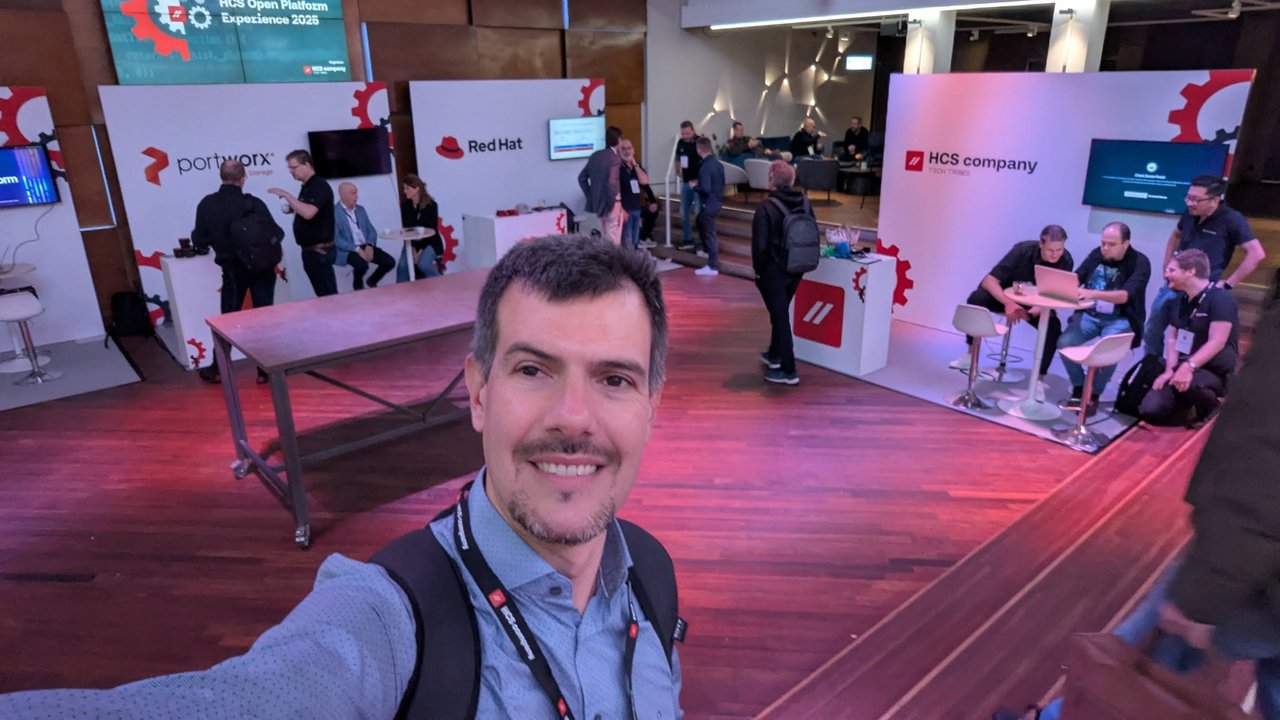
The HOPE 2025 expo floor before the sessions started, with the Portworx, Red Hat and HCS company stands.
HOPE 2025: the HCS Open Platform Experience
HOPE is organised by HCS company (the “Tech Tribes” logo was on every screen). The sponsor screen at registration thanked Red Hat, Portworx by Pure Storage, GitLab, Chainguard, GRN.CLOUD, Grafana, Ingram Micro, EDB Postgres AI and SUSE. The stands had the usual one-line pitches. Portworx had “Any Application. Any Cloud. Any Infrastructure.”, SUSE had multi-Linux support and “no vendor lock-in”, and EDB had “Just solve it with Postgres”. Between sessions the main hall screen read “We HOPE you’re enjoying yourself! Where to go next? Check out our awesome programme!”, and there was a photo booth with the hashtag #HOPE2025.
”We have a platform. It’s running. Now what?”
The session I came for had the best title of the day: “We have a platform. It’s running. Everyone’s enthusiastic. Right? So… now what?” The subtitle was “Maturity Model – IT platforms”, with the case study named as a Dutch government IT service organization. The slide carried the HCS company logo.
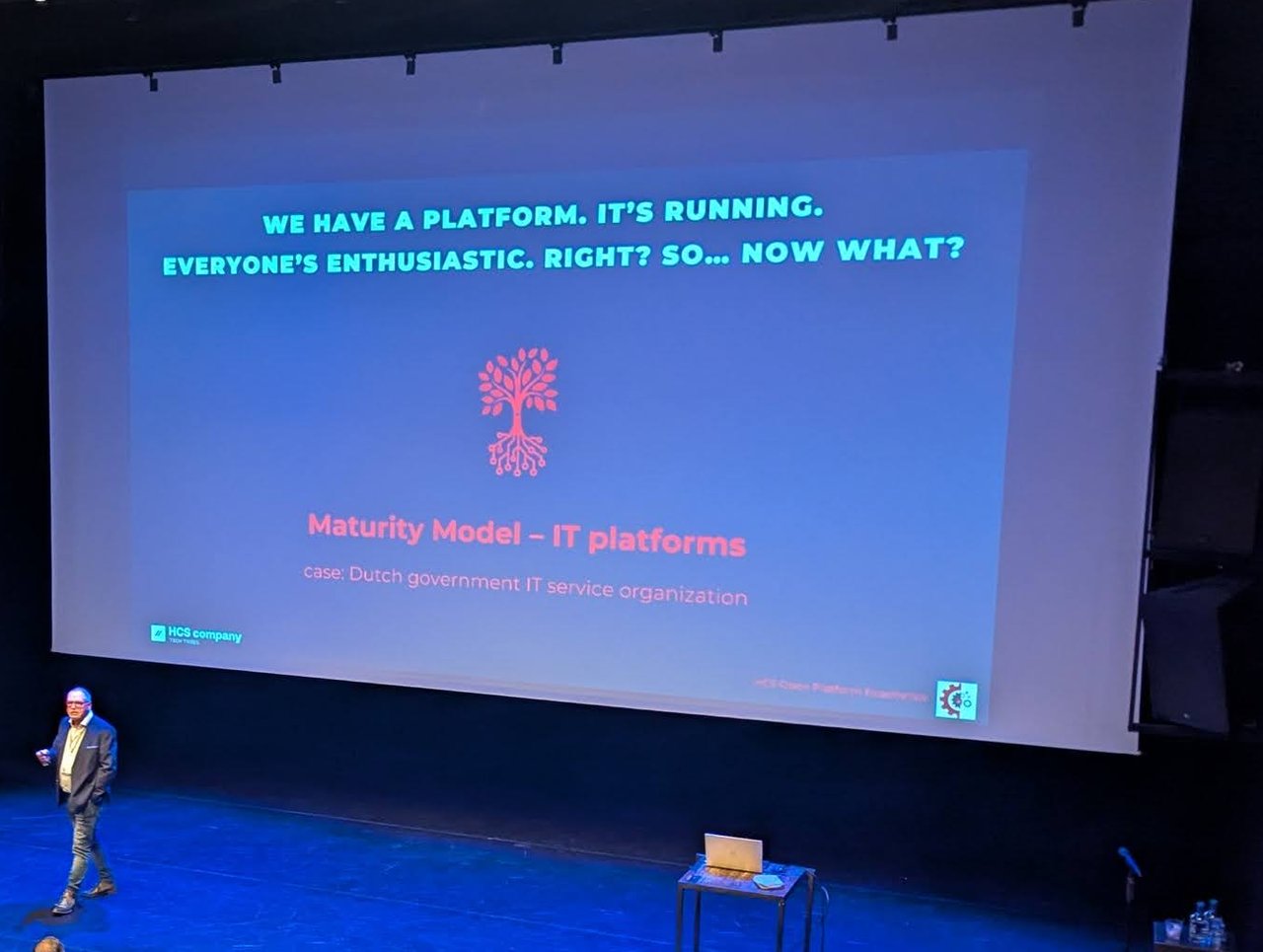
The question most platform teams reach about a year after go-live.
Later in the talk the presenter put the full model on screen as one canvas: a PDF named “HOPE 2025 - We have a platform - now what”, on page 34 of 37. I photographed it because it is one of the more complete platform maturity frameworks I have seen on a single slide:
- Maturity levels: absent, emerging, exploratory, operational, institutionalised and leading.
- Vision & strategy at the centre: purpose and value, direction and alignment, evaluation and recalibration.
- Governance & evolution around it: platform ownership and management, principles and policies, shaping and realisation, reflection and adjustment.
- Organisation & collaboration: platform organisation, platform engineering, platform enablement and organisational embedding.
- Capabilities & architecture: core capabilities, AI capabilities, capabilities for applications and data, architecture and design, technology integration.
- Engagement & adoption: onboarding, effective usage, experience and participation, modernisation and migration.
- Participants: platform teams, platform customers, ecosystem teams and management.
- The process: initiate, kick-off, assessment, interviews, analyse, compose the model, discuss, finalise and present.
- Outputs: artefacts (scorecards, analysis, a dashboard) and a maturity profile (current state, growth potential, ecosystem opportunities, fresh perspectives).
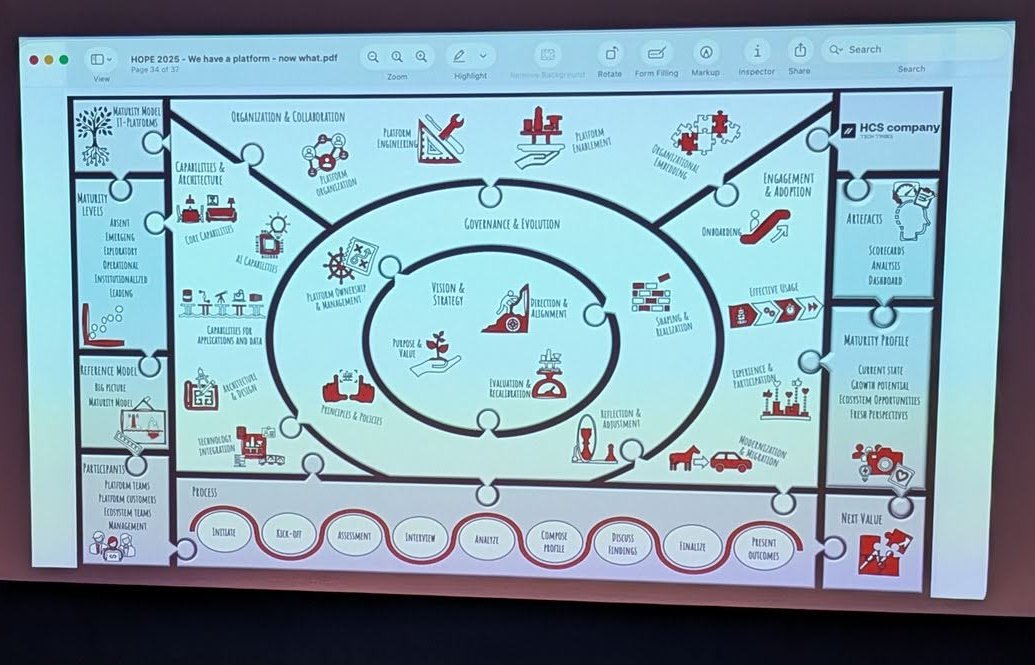
The whole maturity model on one page. Note that “AI capabilities” sits next to core capabilities, and that adoption is a whole area of its own.
My take: the canvas gives adoption and governance as much space as capabilities, and I think that is the right proportion. Most platform assessments I see score the tooling and stop there. A platform that is “running” but has no ownership model, no onboarding path and no feedback loop doesn’t stay healthy for long. I described a similar ladder in my platform engineering maturity model post. The useful addition here is the explicit interview-based process, and the “participants” box, which includes platform customers and management, not only the platform team.
AI brings out the human side
A later session on AI showed a news headline on screen, “Klarna’s AI bot is doing the work of 700 employees. What will happen to their jobs?”, and ended on a one-line conclusion slide: “AI brings a lot aspects of mankind to the surface”.
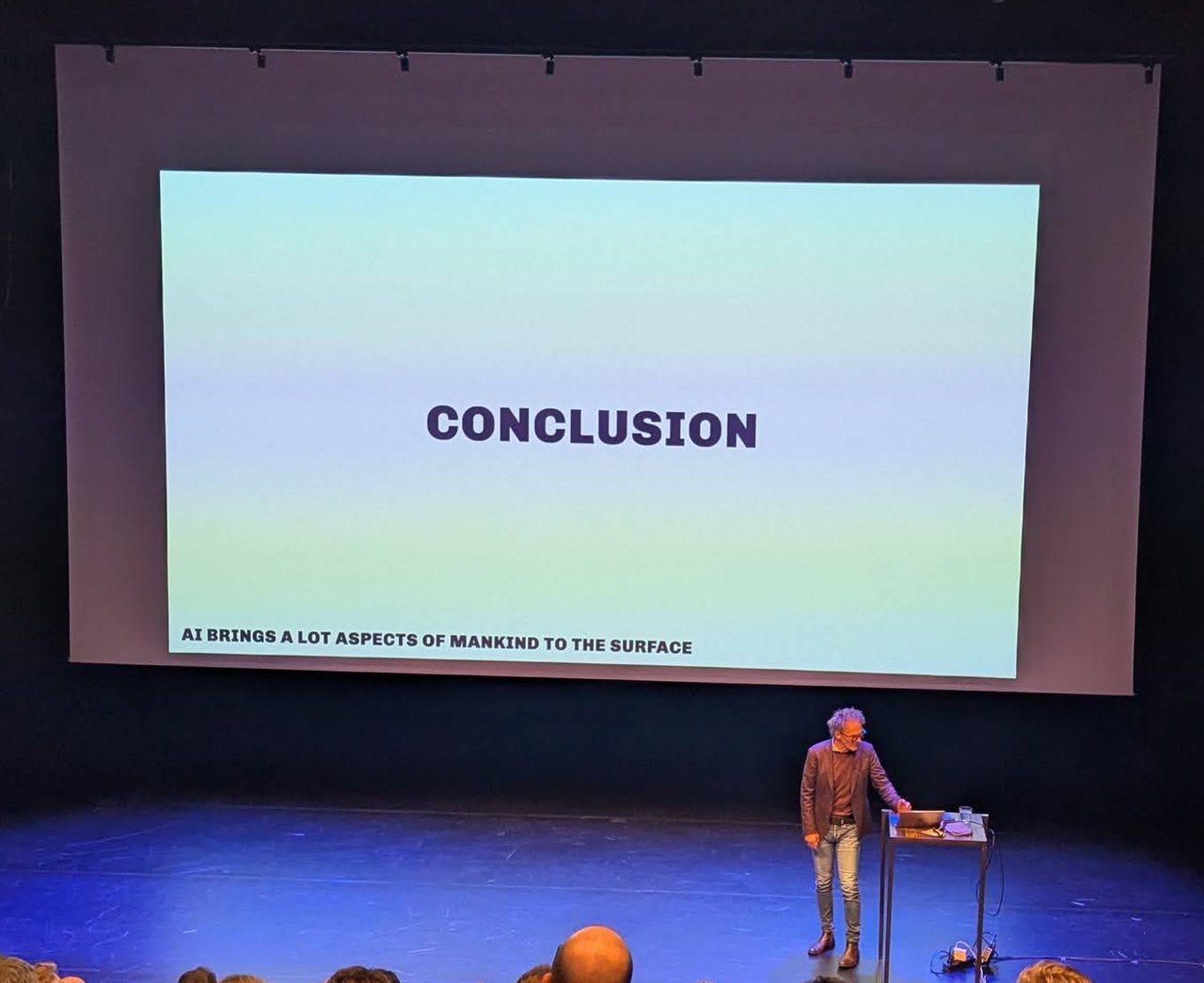
The conclusion slide of the afternoon AI session at the Meervaart.
That line turned out to be a good bridge to the evening.
Agents in Production at AI House Amsterdam
Agents in Production is the MLOps Community’s conference on AI agents. According to the invite in my calendar, the in-person evening at AI House was the companion to the community’s 6th Annual Virtual Conference (30+ talks online), with 200 seats at AI House, Gustav Mahlerplein 5. It was billed as “MLOps x Prosus”, and the invite listed one headline talk: Mert Öztekin, CTO, Just Eat.
The sponsor area had a few stands. A Kilo Code banner said “#1 on OpenRouter”, “500k+ Kilo coders” and “Kilo Code is the fastest growing coding agent because it is open. Open models. Open pricing. Open source.” Those are Kilo’s own claims. The demo screen next to the banner had Kilo Code building “a fully functional todo application using only frontend technologies”, testing it in a browser itself, with auto-approve switched on for read, write, execute, browser and MCP, and Claude Sonnet 4.5 selected as the model. Toqan (“Enterprise Scale, Start-up Speed powered by Agents”) showed a chart titled “Toqan Adoption and seniority of Agents” with a Prosus footer, and Redis had a board reading “Build AI apps with more speed, memory, and accuracy”.
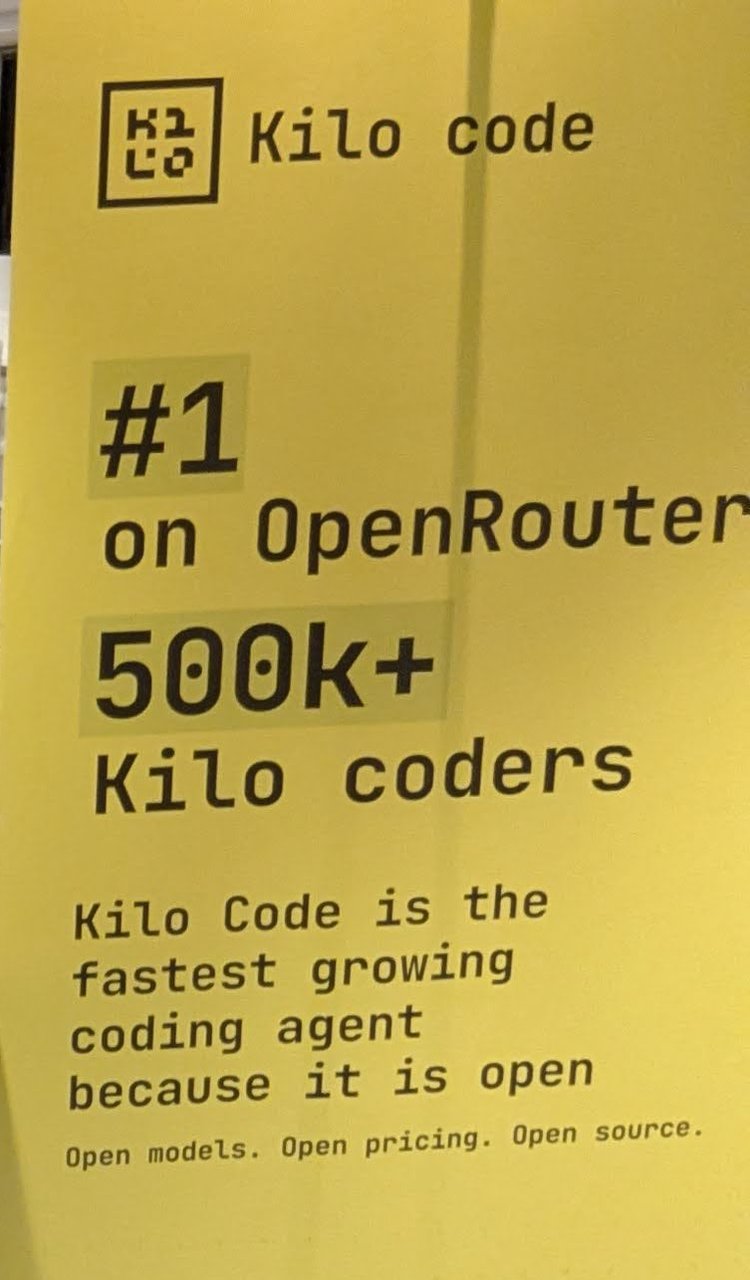
Kilo Code’s banner: openness as the selling point (vendor claims, as printed).
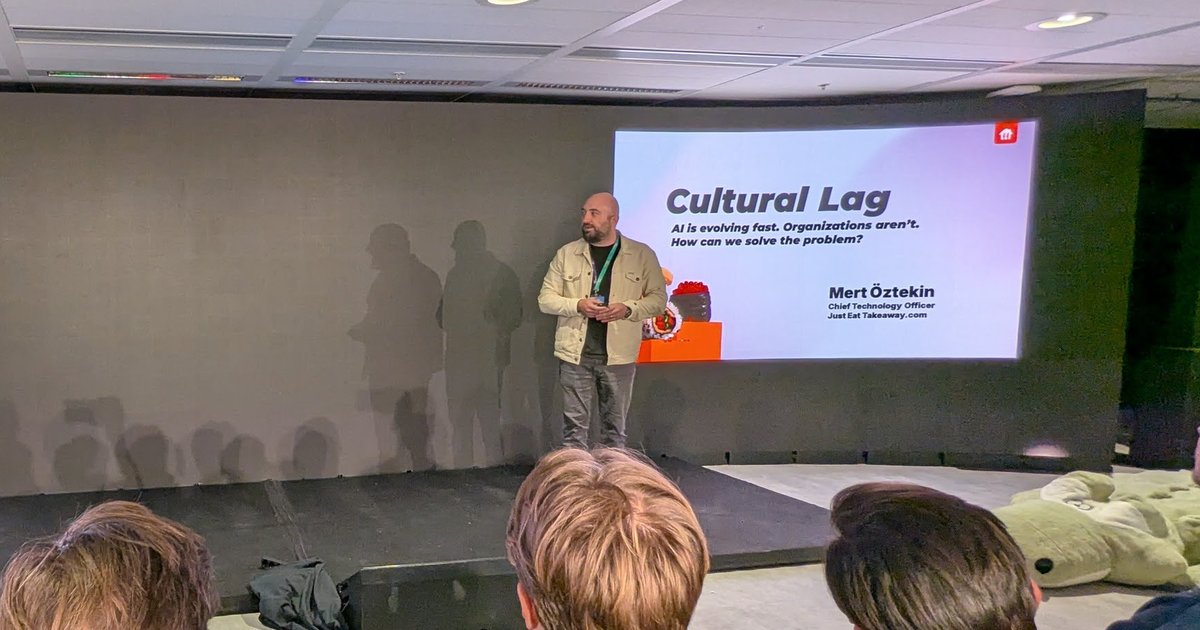
Mert Öztekin: “Cultural Lag”
The headline talk was “Cultural Lag: AI is evolving fast. Organizations aren’t. How can we solve the problem?” by Mert Öztekin, Chief Technology Officer, Just Eat Takeaway.com.
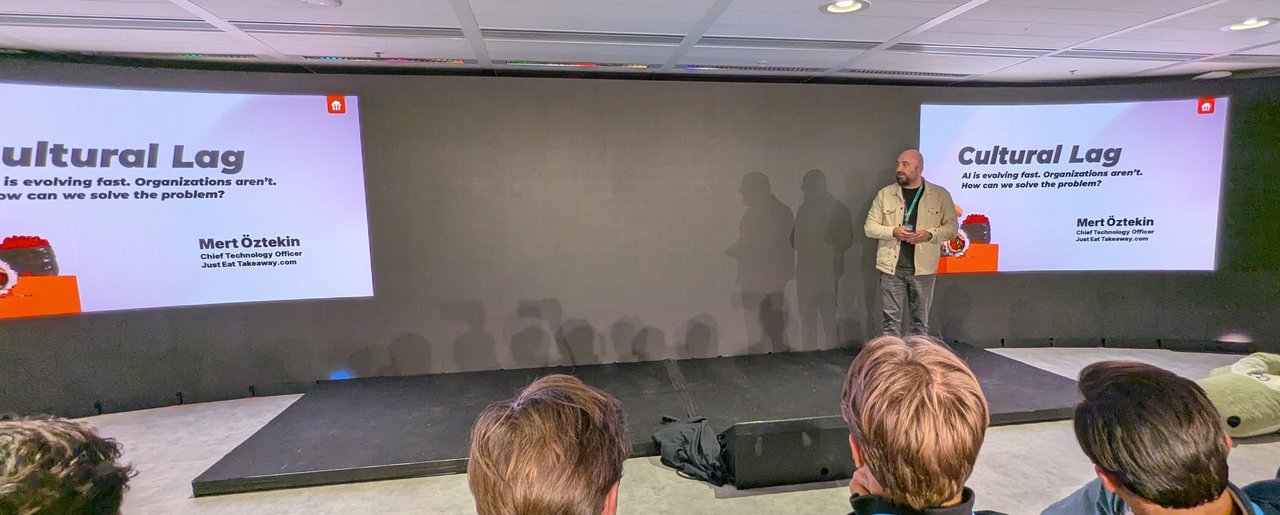
The headline talk of the evening.
He opened with the company in numbers, on a slide titled “Empowering Everyday Convenience”: 356K partners, 61M active customers, 2.5K people in the technology organisation, 17 countries and 653 million orders processed in 2024. The footnote dated the numbers to December 2024. A Prosus logo was marked “part of Prosus since Q4’25”. The brand logo rotated while I was taking photos: one shot shows Menulog, the next Pyszne.pl.
The core of the talk was one diagram, “The difference in the Speed of Evolution”. Three vehicles stand for three speeds: an excavator for regulation development, a saloon car for culture development and a sports car for technology development. The gap between the last two is labelled “Cultural Lag”. The next slide backed this up with a McKinsey chart, “Use of AI by respondents’ organizations”, plotting organisations that use AI and gen AI in at least one business function, with both lines climbing steeply in the last years.
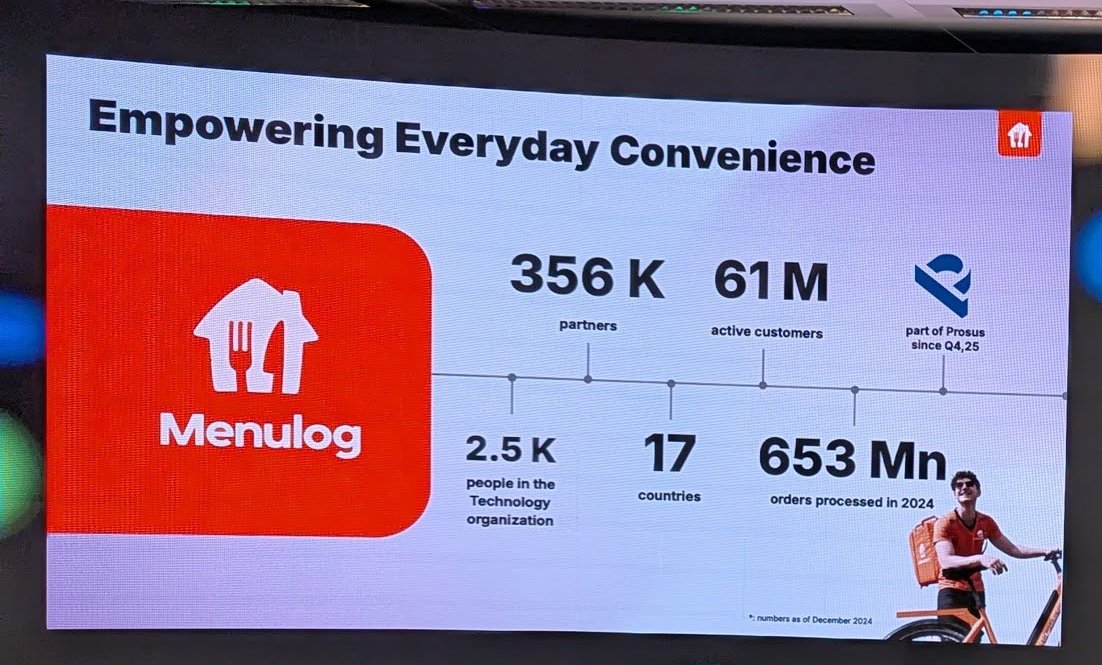
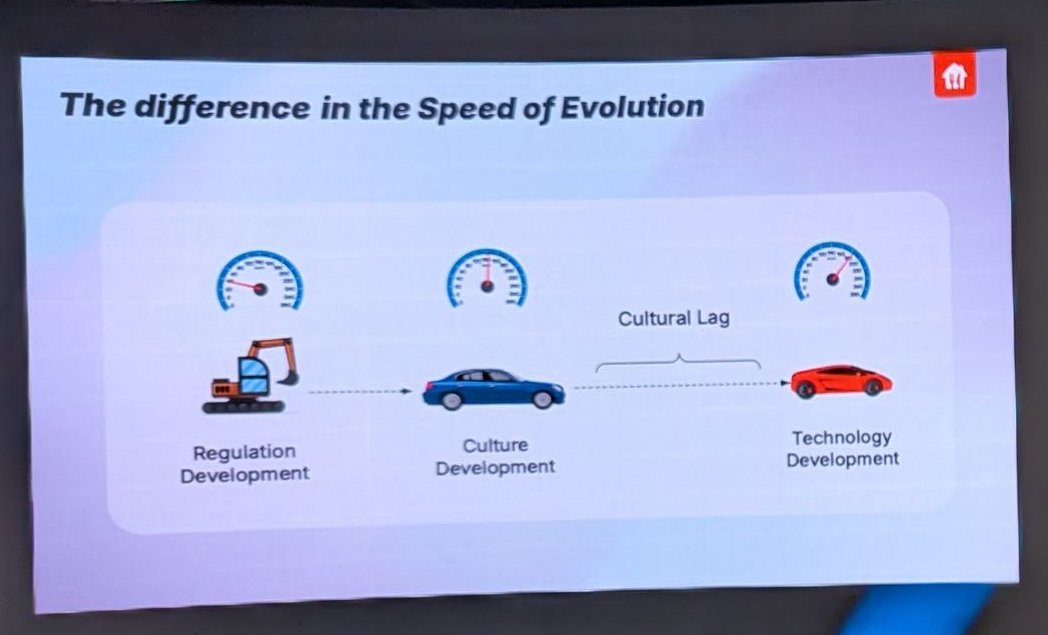
Left: the scale of the organisation the talk was about. Right: the cultural lag diagram, with regulation slowest and technology fastest.
Why does culture move slowly? The answer slide was “Why Organization Culture Evolves Slower: culture moves slowly because behavior moves slowly”, with three causes:
- Habits: “Our daily work is automatic. We do what we already know.”
- Fear / bias: internal psychology, fear of the unknown.
- Psychological safety: external factors, “created by team, manager, leader”.
For the way out, he went back to Everett Rogers’ Diffusion of Innovations: innovators (2.5%), early adopters (13.5%), early majority (34%), late majority (34%) and laggards (16%), with “the chasm” marked between early adopters and the early majority and a “50% inflection” point after that.
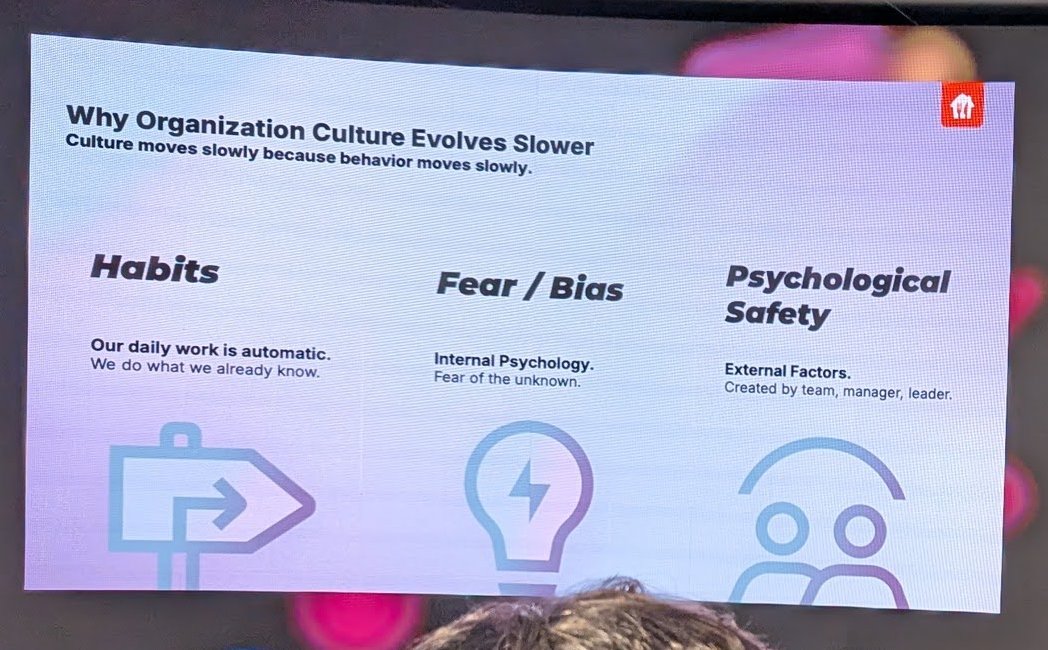
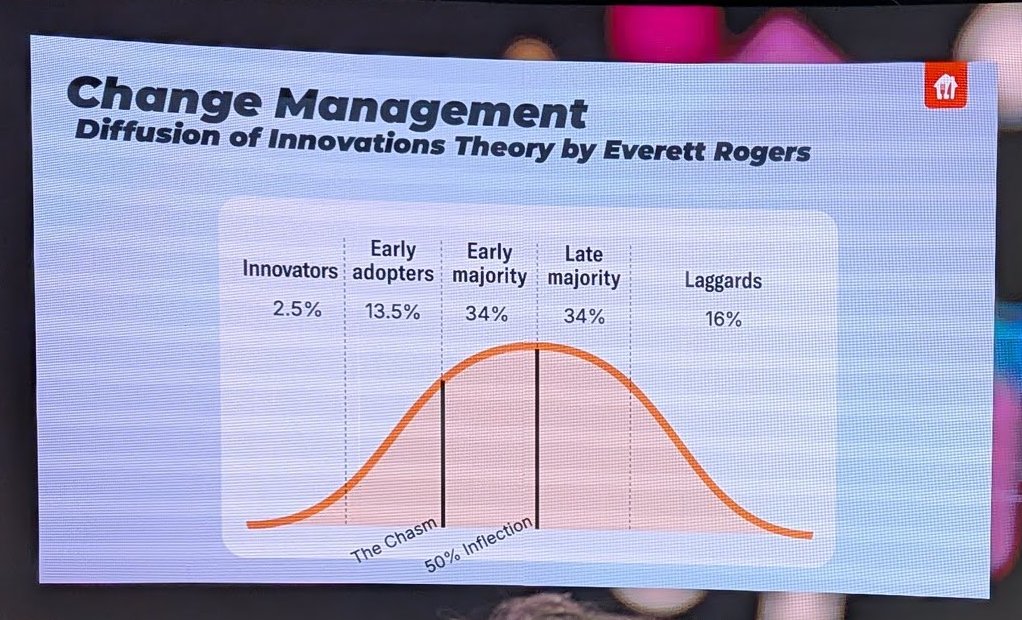
Left: three reasons behaviour changes slowly. Right: the adoption curve used as a change-management map.
The practical part covered what the company did. An “AI ambassador programme” slide described a volunteer-based, cross-functional network “to support, challenge and inspire”, shown as a wall of people’s photos (which I’m not reproducing here). An “Enterprise Chatbot Adoption” dashboard showed an overall adoption rate of 69.44%, up 1.9% from the previous month, with a monthly trend running up to October and a breakdown per department.
The last slide I captured was addressed to managers, “What Team Managers should do?”, tagged with the same three causes (habits, fear/bias, psychological safety):
- Show encouragement: walk the walk.
- Recognize your AI talent: encourage and unblock them.
- Focus on your mission: your mission is not your task or process.
- Review objectives and incentives: people respond to incentives.
- Take the initiative: don’t wait for direction, go get what your team needs.
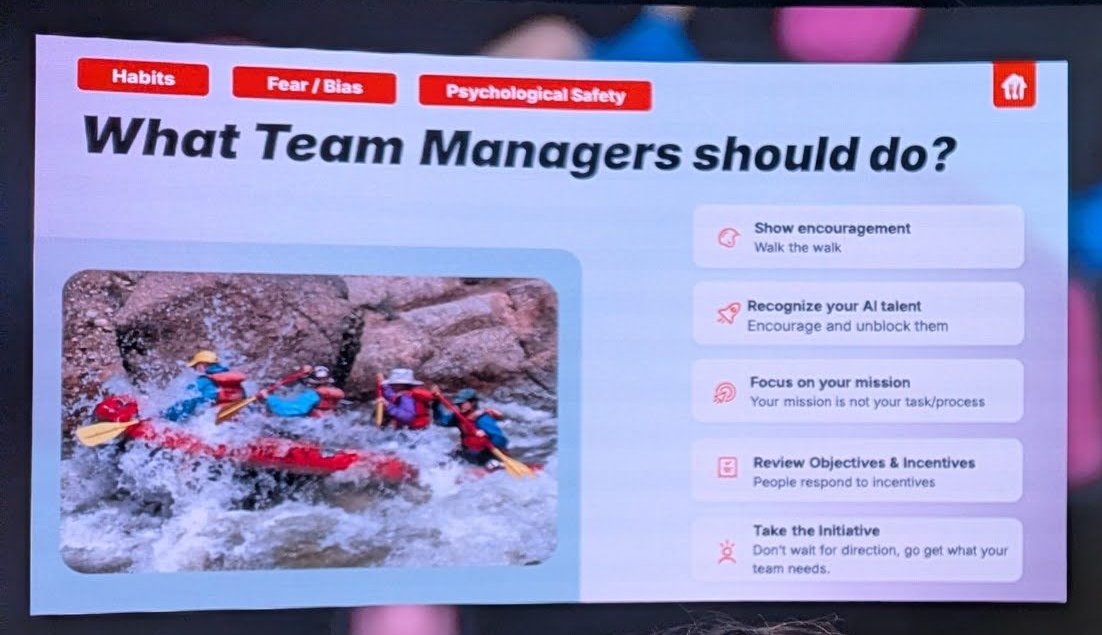
Five manager actions, each tied back to habits, fear and psychological safety.
My take: this was the most useful talk of the day for me because it treated AI adoption as a change-management problem with a measurable output (that 69.44% adoption rate), not as a tooling rollout. The ambassador network is the same pattern that works for internal developer platforms: a volunteer group in each team does more for adoption than a mandate from the top. Point 4 is the one I see skipped most often. If performance reviews still reward the old way of working, the chatbot dashboard will plateau, whatever the training budget. I wrote more about this in People and Culture in Technology Transformation.
A panel, FINI and “Not all context is good context”
After the keynote came a panel. The stage screen showed Luciana Ledesma (CEO and founder, MeaningStack) and Alex Salazar (co-founder and CEO, Arcade.dev), plus a third panellist whose name card I didn’t capture in full.
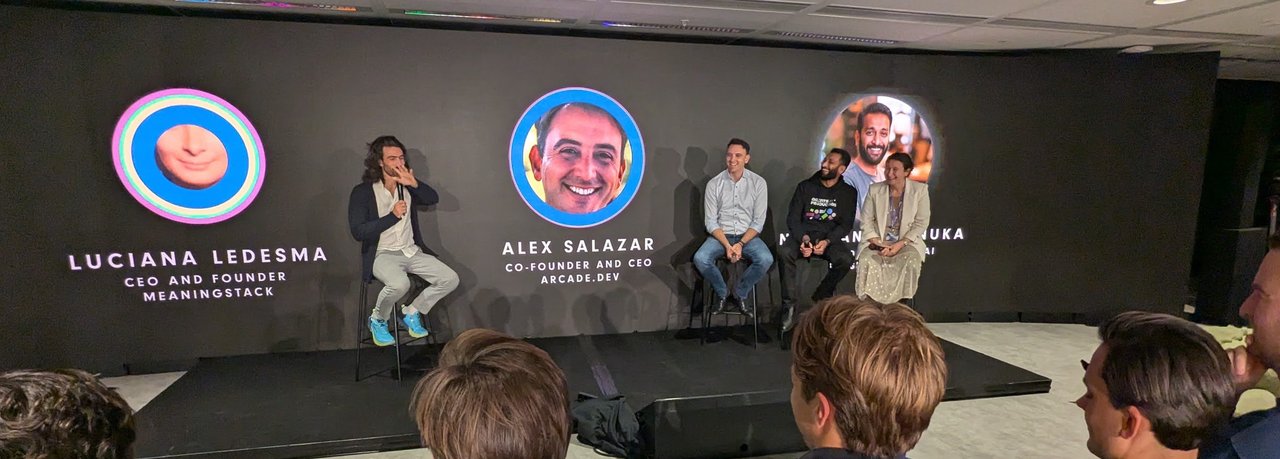
The panel on the AI House stage.
Later in the evening, two shorter talks went into the mechanics. The first was titled “This is how FINI works behind the scene”. Its architecture slide placed an LLM supervisor behind safety guardrails, in front of a stack of numbered layers, with a live evaluation and feedback loop at the bottom. The outputs were framed as “insights like” trust metrics (escalation reasons, user sentiment) and product analytics (feature requests, bugs, user intents).
The second, a talk with Redis branding in the slide footer, was “Not all context is good context: bigger input sizes hurt performance, and your budget.” It showed a social media post (the author’s name blurred on the slide) arguing that GPT-5’s usable context stays effective at a 256K window where o3 degraded at 128K, next to a long-context benchmark chart. The price line underneath was the punchline: “GPT-5 API Price: $1.25 / 1M input tokens – $10 / 1M output tokens”.
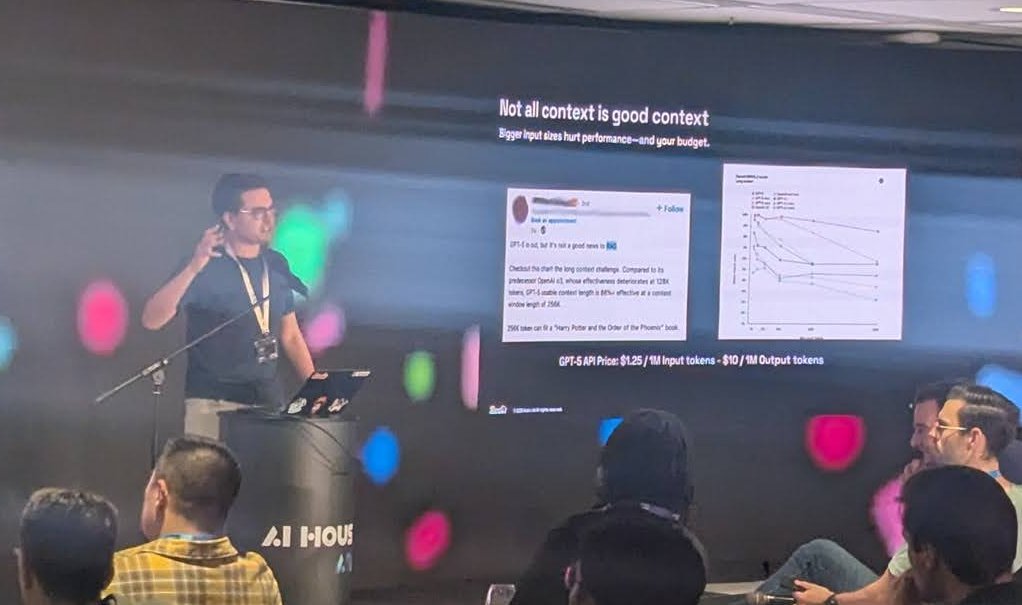
A bigger context window is not free: every token you send is paid for, and long inputs can still hurt answer quality.
My take: “not all context is good context” is the agent-era version of “garbage in, garbage out”. A long context window is a limit, not a goal to aim for. Retrieval, memory and caching layers exist to keep the prompt small and relevant, and they pay for themselves in both cost and accuracy. I cover the practice in Context Engineering vs Prompt Engineering.
What linked the two events
Platforms in the morning, agents in the evening, but the slides I kept were nearly all about people. The HOPE maturity model gives adoption and governance as much space as capabilities. The Just Eat Takeaway.com talk put culture between regulation and technology as the bottleneck. As a consultant who builds both platforms and AI infrastructure, I see the same thing in my projects. The deployment is the easy part. The adoption curve after it is where most of the work is.