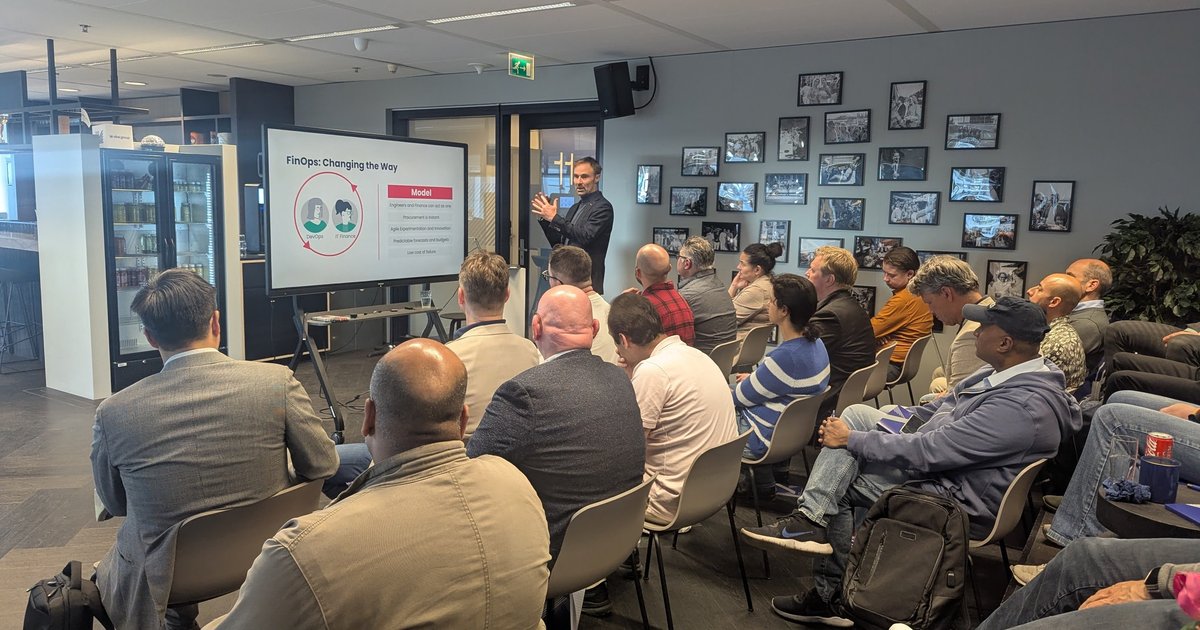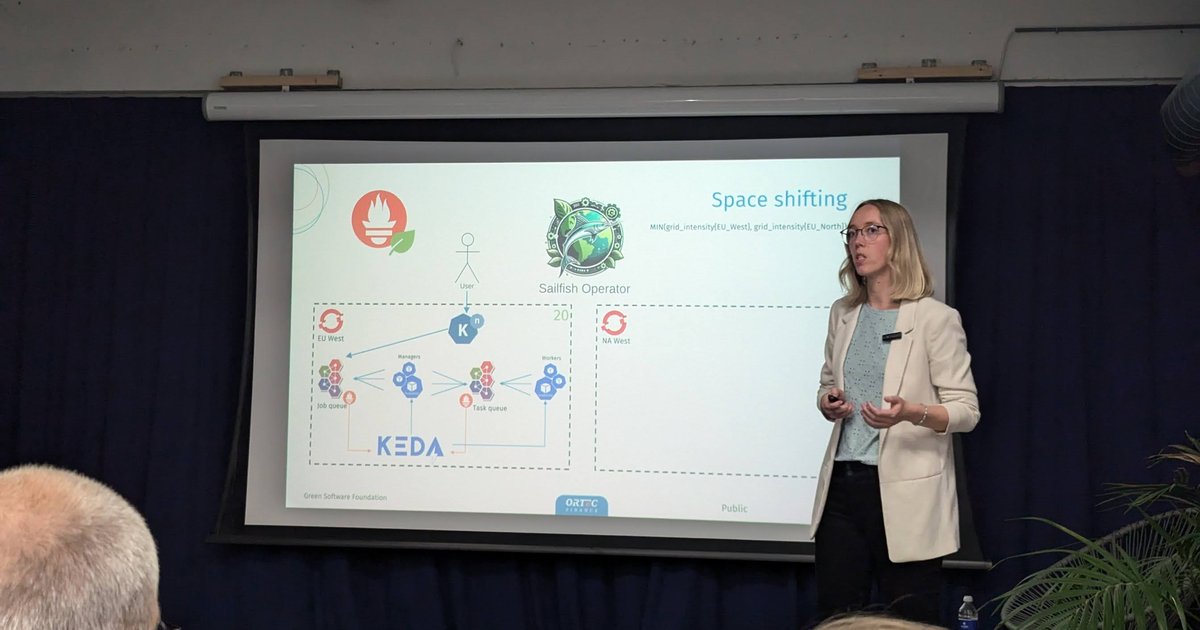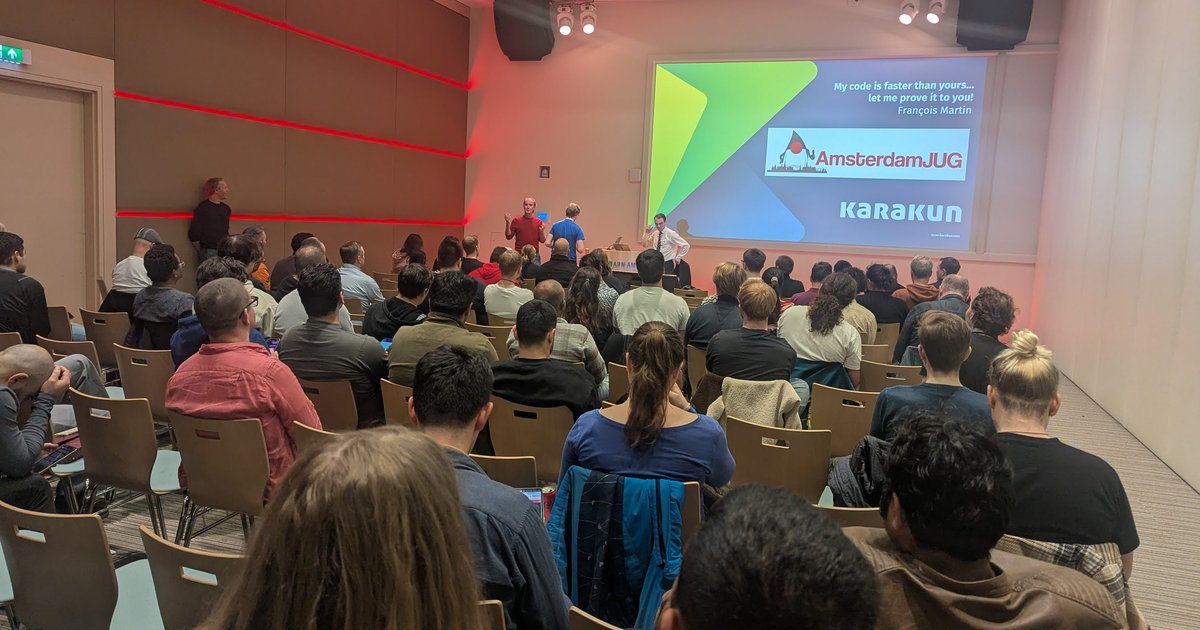
On 20 March 2025 I spent the evening at Cloud Optimization 2025, an event at Xebia’s Amsterdam office on Wibautstraat. Xebia’s event page billed it as “FinOps, GreenOps & AI Efficiency”, with training workshops followed by spotlight talks. The talks I photographed were a CNCF sustainability introduction, ABN AMRO’s FinOps timeline, a FinOps maturity assessment method, a Wehkamp cost-alerting story and a short wiv.ai product slide. This post is my write-up of what the slides showed.
Setting the scene: CNCF TAG Environmental Sustainability
The first talk was a short introduction from the CNCF Environmental Sustainability technical advisory group. Xebia’s page lists Alessandro Vozza (CNCF Ambassador, Environmental Sustainability) among the speakers. From my recording: the group organises a Cloud Native Sustainability Week every October, its meetings run over Zoom in the late afternoon to suit several time zones, and it carries projects such as Kepler, a Prometheus-based tool for measuring the emissions of clusters. The point for a FinOps audience is that cost and carbon are increasingly looked at together, which comes back at the end of the ABN AMRO timeline.
ABN AMRO: Public Cloud Platforms, FinOps, Journey To Shifting Left
The title slide read “Cloud Optimization 2025 / Public Cloud Platforms | FinOps / Journey To Shifting Left”, dated 20 March 2025 in Amsterdam, with the speaker shown as Shantinath Patil, FinOps Expert, ABN AMRO.
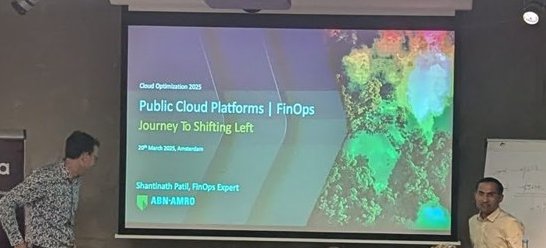
The ABN AMRO talk opens: “Journey To Shifting Left”, 20 March 2025.
The talk then walked through a “FinOps Journey Timeline”, one slide per year. I photographed three of them.
2019, first year: start of the FinOps journey. The slide says the practice was started by Hans de Kruif, who “was single man army till 2023”, and quotes 1150 applications and 484 DevOps teams. The first step was show-back with multiple views such as application and environment, followed by budget (spend target) forecasting at application level, and a first commitment to Azure Reservations.
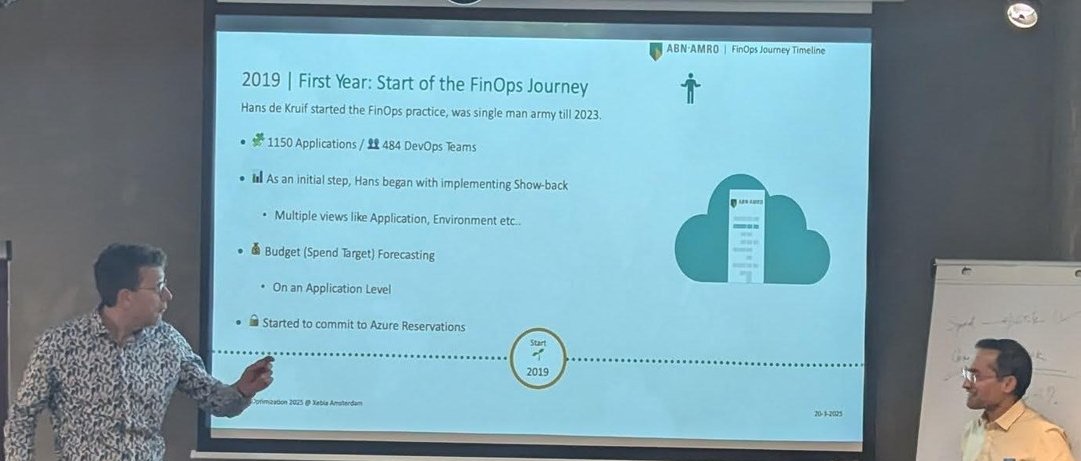
2019: show-back first, then forecasting and reservations.
2023, fifth year: the FinOps team was formed. The slide lists a dedicated cluster for Sentinel and monitoring, a Microsoft-published article, an internal programme that caused “double run and related challenges”, and a proactive approach: reaching out to DevOps teams and providing consultancy to implement FinOps recommendations. The article thumbnail on the slide carries the headline “ABN AMRO increases business agility, optimizes Azure spend by more than €1 million monthly with Azure Reservations, hybrid cloud”.
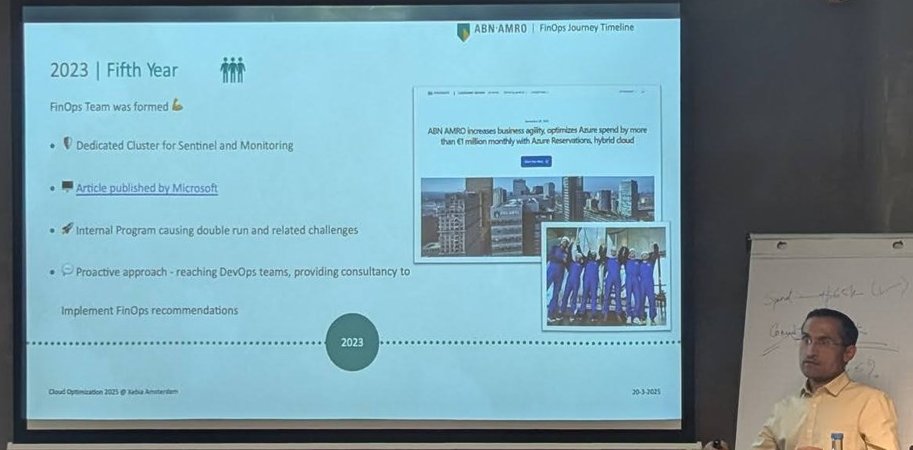
2023: the single-person practice becomes a team.
2024 to present, sixth year: automation and GreenOps. The bullets are a new contract (EA to MCA), rebuilt Power BI reports, automation scripts to implement optimization recommendations, a campaign to stop services during the year-end and furlough period, a CO2 savings dashboard, “integrating GreenOps in FinOps” with an energy rating at application level, and spreading FinOps awareness through newsletters, blogs and hackathons.
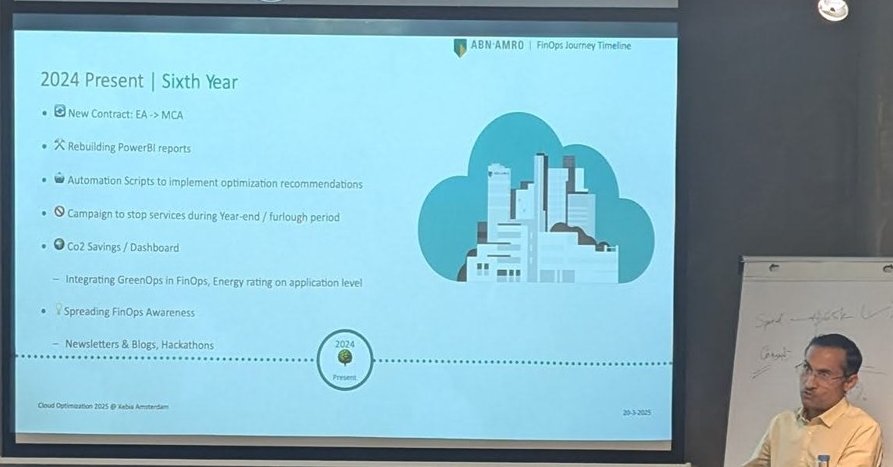
2024 onwards: automation, shutdown campaigns and a carbon view.
What the timeline maps to in the FinOps Framework
The FinOps Framework describes the journey as three phases, Inform, Optimize and Operate, and a maturity model of Crawl, Walk, Run. Its principles include “FinOps should be enabled centrally” and “Everyone takes ownership for their technology usage”. The ABN AMRO story reads like that in practice: visibility first (show-back, forecasting), then commitments, then a central team that goes to the DevOps teams, then automation. My take: “shifting left” in the talk title fits the same direction, getting cost feedback to the people who make the architecture decision instead of to finance a month later.
FinOps maturity assessments, from Xebia
The next talk was FinOps Maturity Assessments by Rajat Mital (the title slide carries his name and the Xebia logo).
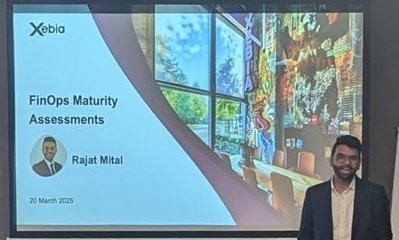
Xebia’s FinOps Maturity Assessments talk.
The “FinOps maturity assessment journey” slide shows five steps:
- Kickoff: finalise scope, identify personas, set context and get buy-in.
- Interviews: assess current capabilities and compare them against rubrics.
- Deep Dive: analyse data, dashboards, tools and cloud environments.
- Recommend: create a scorecard of capabilities, identify gaps and achievements, develop a roadmap and present next steps.
- Implement: implement the recommendations, define processes and train teams.
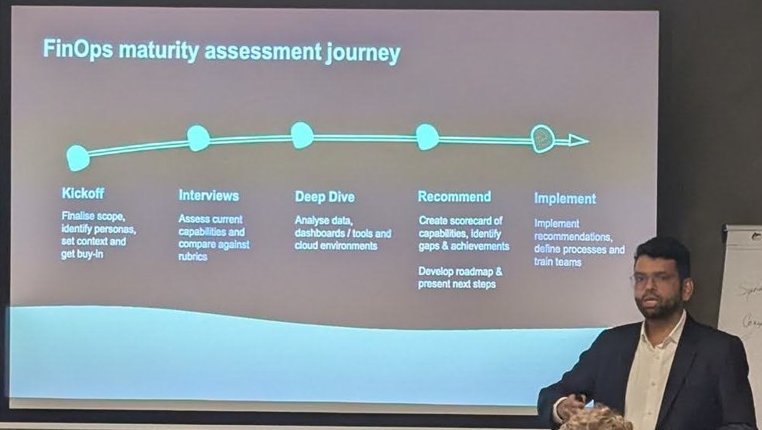
Five steps from kickoff to implementation.
Wehkamp: how a rising AWS bill led to a cost bot
The following talk was by Wehkamp. The intro slide had two first names with roles (“Kees, Engineer & Pathfinder” and “Martin, Lead Platform”) and “18 teams building a WRG tech…” platform. Xebia’s page lists Martin van der Linden and Kees C. Bakker from Wehkamp as speakers, and Xebia has a customer story on Wehkamp’s FinOps work on AWS.
The story slides were candid. “How did we get here?” showed a four-panel meme (Move to AWS, Reduce costs, Unlimited resources, Surprise bill) with the line “A bill in 2022 and the trend upwards…”, and a companion slide put the start at “2015: move fast from on prem to the cloud”.
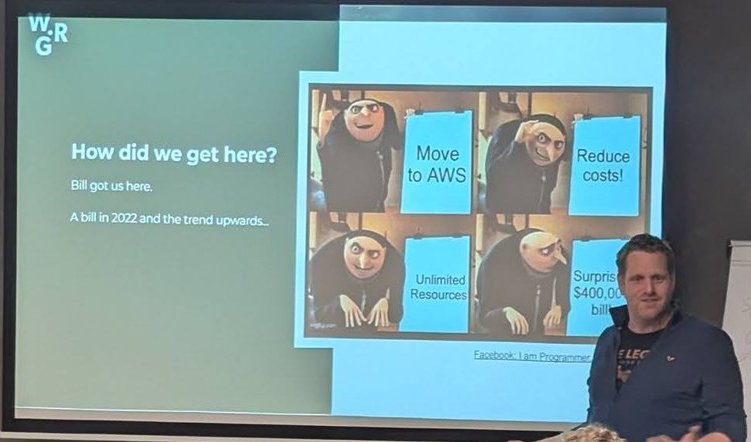
“A bill in 2022 and the trend upwards.”
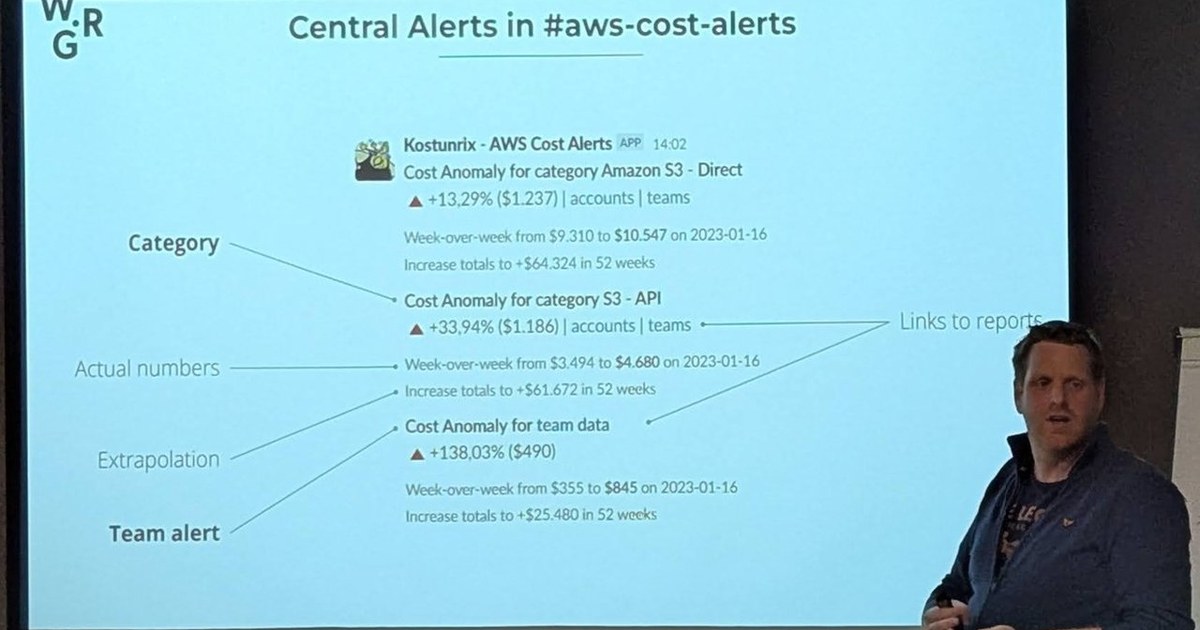
Their answer was “Let’s build a FinOps bot”, a character called Kostunrix whose traits are listed on the slide: noisy weekly alerts in Slack channels, a lack of nuance (there is often a reason for an increase and the bot does not know it), drama (it extrapolates cost to 52 weeks) and smelly links. The “Central Alerts in #aws-cost-alerts” slide breaks one message into category, actual numbers, extrapolation, team alert and links to reports, with week-over-week changes per AWS cost category.
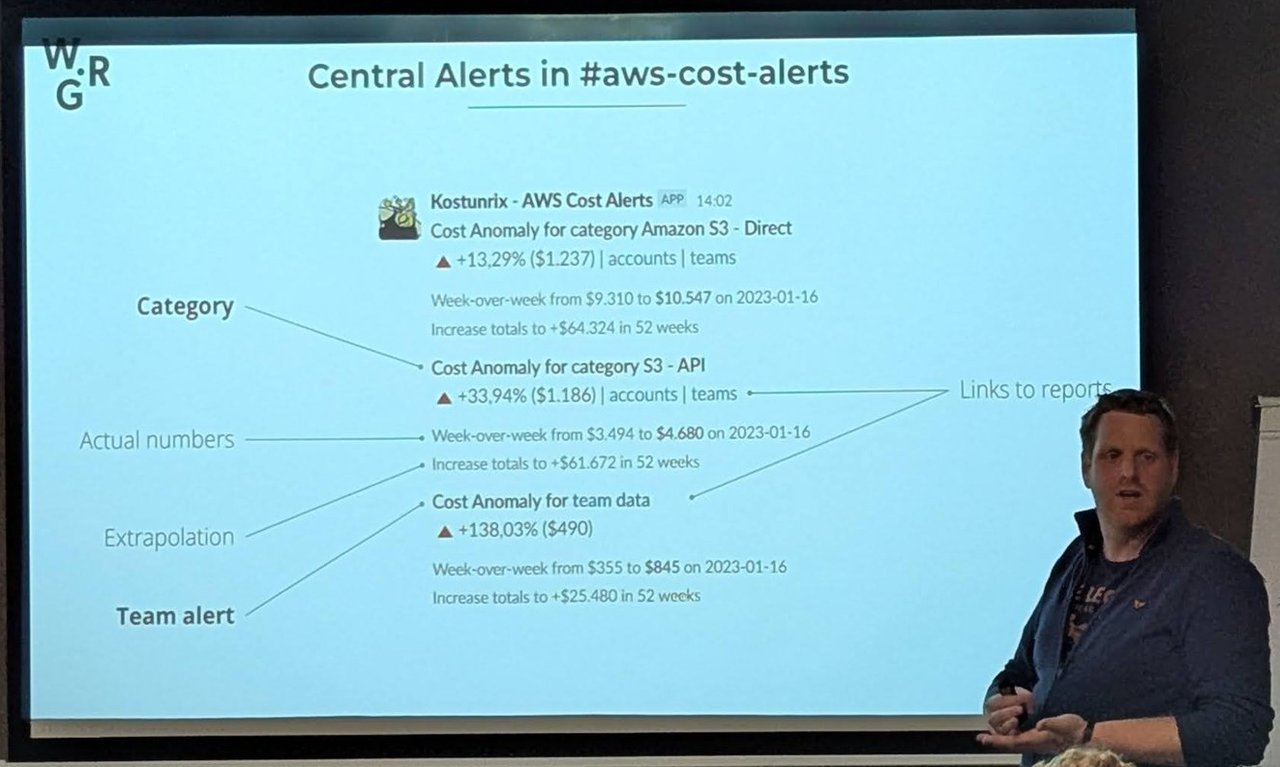
The anatomy of a Kostunrix cost alert.
My take: the self-deprecating framing is the useful part. A cost alert that says what changed, for which team, with a link to the report, gets read; an alert that only says “the bill is up” becomes noise.
wiv.ai: no-code FinOps automation
The last slide I photographed was from wiv.ai, whose speaker is listed on Xebia’s page as Roni Karp. The slide describes Wiv as a cloud-native, no-code, drag-and-drop workflow automation platform for FinOps and operations teams, with the mission “Helping enterprises automate FinOps tasks and reduce cloud costs through intuitive, no-code solutions.” The company’s website describes the same thing: automating FinOps across AWS, Azure and GCP. That is a vendor description, not something I tested.
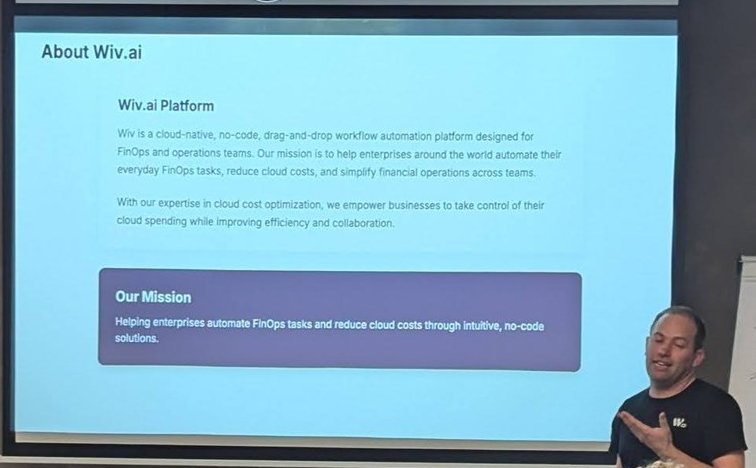
wiv.ai’s own description of its platform and mission.
What I took away
- Start with show-back and forecasting before commitments; ABN AMRO’s order was visibility, then reservations, then a team.
- Plan for the central team early. The slide marks 2023 as the year the one-person practice became a FinOps team.
- Automate the boring remediation, and make the alert human-readable.
- Treat carbon as a sibling metric. Both ABN AMRO and the CNCF introduction pointed there.