Beyond Chatbots
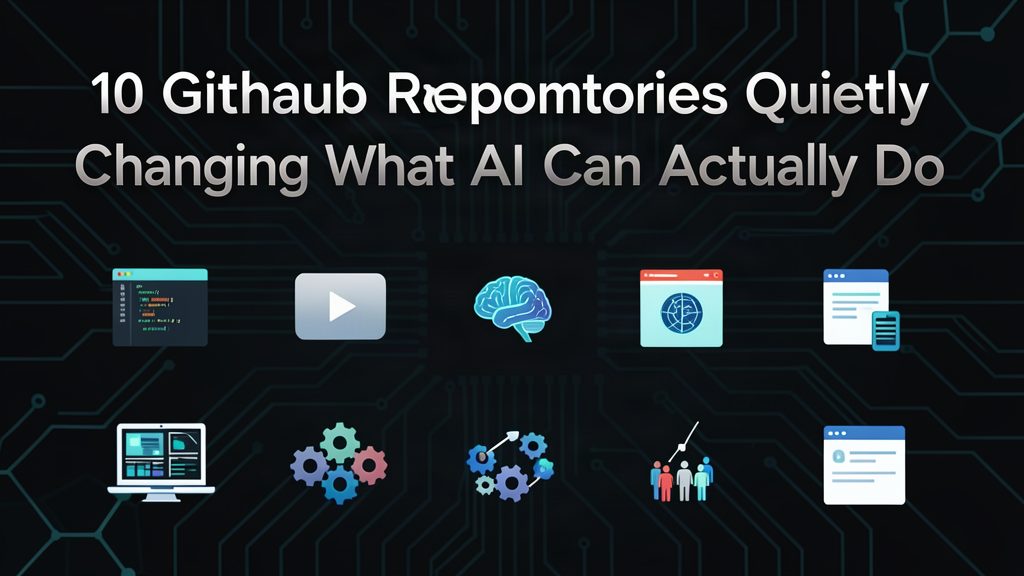
A few weeks ago, Divyansh Tewari shared a thread on X highlighting 10 GitHub repositories that are quietly changing what AI can actually do. Not another list of chatbots — these are the tools underneath the workflows.
I dug into each one. Between September 2026 star counts and fresh READMEs, here is what these projects are really building, and why they matter.
1. HyperFrames — Write HTML, Render Video
Repository: heygen-com/hyperframes · Stars: 49.5k · License: Apache 2.0
HyperFrames takes a route that feels closer to normal web development: the video itself is HTML. You define scenes like a web page, animate them with GSAP, CSS, Lottie, Three.js, or Anime.js, then render to MP4 from the command line.
The interesting part: an AI coding agent can be given a simple prompt and produce an editable video — the same project can be previewed, edited, and rendered into a real video file. The CLI is non-interactive by default, which makes it agent-friendly. Agents already write HTML; this gives them a production loop.
npx skills add heygen-com/hyperframesHyperFrames ships with skills that teach agents the video-production patterns that generic web docs miss: planning the video, writing valid HTML, wiring seekable animations, adding media, linting, previewing, and rendering.
Why watch it: Video generation has been the domain of specialized, opaque APIs. HyperFrames puts it back into the web stack — HTML handles structure, CSS handles presentation, the browser handles rendering, and FFmpeg handles output. It is content automation, batch video generation, and data-to-video workflows for AI agents.
2. Orca — An IDE for Parallel Coding Agents
Repository: stablyai/orca · Stars: 67.8k · License: MIT
Running one coding agent is useful. Running an entire fleet of them in parallel is a completely different workflow.
Orca is the ADE (Agent Development Environment) for managing multiple AI coding agents at the same time. Each agent runs in its own git worktree, so two agents editing the same file can’t overwrite each other. The desktop app gives you a visual workspace where you can watch agents work side by side, compare results, and pick the best changes to merge.
Available on desktop (macOS, Windows, Linux), with a mobile companion app for monitoring and steering from your phone, and a remote runtime option. It is YC-backed and MIT-licensed.
Why watch it: As soon as teams accepted that AI coding assistants produce different answers to the same prompt, the question became: why run one? Orca’s bet is that parallel exploration + visual comparison + git worktree isolation is the workflow that actually scales agent-assisted development. The star count (growing by thousands per week) suggests the market agrees.
3. Nodeterm — A Visual Canvas for Parallel Agents
Repository: eneskirca/nodeterm · Stars: 1.8k · License: BUSL-1.1 (converts to MIT after 4 years)
Ever had 10 terminal windows open because you’re running multiple AI agents?
Nodeterm turns those sessions into a visual canvas where you can see and manage parallel agent sessions as draggable nodes. Right-click the canvas to open a terminal — or an AI agent. Each runs in its own persistent tmux session, next to sticky notes, Monaco editors, diff views, and web/video nodes — arranged spatially, like a map.
What makes it notable: quit the app, or even restart the machine, and every session comes back. The same canvas also doubles as a kanban board — cards are your live sessions, dragged across columns while the agent keeps running.
Why watch it: Orca operates at the project/worktree level. Nodeterm operates at the terminal session level — it is the layer underneath, the pane manager that keeps 10 agent terminals visually organized and persistent. If you are running fleets of agents, you need both.
4. Atlas — Source Control for Agents
Repository: pacifio/atlas · Stars: 3.7k · License: MIT
When multiple coding agents modify the same project, keeping track of everything gets messy fast. Agents write a large share of code now, and they keep none of the reasoning behind it.
Atlas is source control for agents. It tracks and queries changes made by multiple coding agents in one place. It is local-first: your code, notes, and sessions stay on your machine. Secrets are scrubbed before anything is written to disk. Accounts are opt-in — sign in to sync across devices and teammates.
Built as a Tauri app with a Rust backend, Atlas integrates with Claude Code, Codex, and other agent runtimes.
Why watch it: Orca and nodeterm give you parallel execution. Atlas gives you parallel provenance — the ability to ask “which agent made this change, and why?” when five agents have all touched the same file over the weekend.
5. Ruflo — Multi-Agent Orchestration with Memory
Repository: ruvnet/ruflo · Stars: 72.3k · License: MIT
Ruflo is a multi-agent orchestration system with memory and RAG built into the workflow. It can coordinate different agent backends instead of forcing you into a single AI model or provider.
The architecture is a self-learning harness around Claude Code and Codex workflows:
User --> Ruflo (CLI/MCP) --> Router --> Swarm --> Agents --> Memory --> LLM Providers
                          ^                           |
                          +---- Learning Loop <-------+
It features adaptive memory, self-learning intelligence, federation, and vector RAG integration. The first thing to know: it is from the same lineage as claude-flow, which means it has deep roots in the agentic orchestration space.
Why watch it: If Orca is the IDE for parallel agents, Ruflo is the operating system — routing tasks to specialized agents, maintaining cross-session memory, and coordinating swarms. The 72k star count reflects years of accumulated trust in the claude-flow ecosystem.
6. Magnitude — Local Inference, Right-Sized for Your Hardware
Repository: magnitudedev/magnitude · Stars: 4.5k · License: Apache 2.0
What if your AI agent could automatically choose the right local model for the hardware available?
Magnitude is an open-source inference engine that profiles your machine — chip, memory, bandwidth — estimates fit and tok/s for every model in the catalog, then ranks them by speed, accuracy, and memory. Based on that, it downloads, tunes, and runs the right model automatically.
It supports Apple Silicon, NVIDIA GPUs, AMD GPUs, and CPU-only setups. Plug it into Pi, OpenCode, Hermes, OpenClaw, Codex, Claude Code, Oh My Pi, and Cline. Once a model is loaded, no internet connection is needed.
npm install -g @magnitudedev/cli
magnitude docs onboarding
Why watch it: The friction in local LLMs has always been “which model actually runs on my machine?” Magnitude automates that decision. For teams wanting to keep code and prompts off the cloud, this is the missing piece.
7. ByteBot — Give AI Its Own Computer
Repository: bytebot-ai/bytebot · Stars: 11.1k · License: Apache 2.0
ByteBot gives AI its own computer. Instead of browser-only agents or API integrations, ByteBot ships with a full virtual desktop where it can use any application, download files, log into websites, read PDFs, and complete multi-step workflows across different programs.
It is self-hosted, containerized (Linux desktop environment), and can deploy via Docker or Helm on Kubernetes. It supports 100+ LLM providers including Azure OpenAI, AWS Bedrock, local models via Ollama, and Claude Code SDK integration.
Why watch it: ByteBot represents the “AI as virtual employee” vision — an agent with persistent identity, file system, and applications. Even though the repo is archived, the 11.1k stars indicate strong momentum, and the containerized approach (Docker + Helm) has influenced the next wave of desktop-agent deployments.
8. NanoBrowser — AI Web Automation in Your Browser
Repository: nanobrowser/nanobrowser · Stars: 13.8k · License: Apache 2.0
NanoBrowser is a Chrome extension for AI-powered web automation. It runs locally in your browser — extract data, fill forms, scrape content, navigate websites, and interact with pages programmatically. It is an open-source, local-first alternative to OpenAI Operator.
Supports OpenAI, Claude, and other LLM providers via your own API key. Can run multi-agent workflows, and includes visual browser testing capabilities through a companion browser-testing tool.
Why watch it: Browser automation has historically been the province of expensive SaaS tools or low-level Selenium scripts. NanoBrowser puts it in a Chrome extension that any developer can install and run locally with their own API keys. The 13.8k star count shows the market demand for self-hosted browser AI.
9. UI-TARS Desktop — ByteDance’s Multimodal Agent Stack
Repository: bytedance/ui-tars-desktop · Stars: 39k · License: Apache 2.0
UI-TARS Desktop is the open-source multimodal AI agent stack from ByteDance. It ships with two complementary projects:
- Agent TARS — a general multimodal agent that brings GUI Agent and Vision into your terminal, computer, browser, and product
- UI-TARS Desktop — a native desktop application that provides a local computer-use agent driven by the UI-TARS model
It uses vision-language models to “understand” UI elements on screen, comprehend natural language instructions, and simulate real mouse and keyboard actions. Cross-platform (Windows/macOS), with browser operators and MCP integration.
npx @agent-tars/cli@latestWhy watch it: ByteDance open-sourced a full multimodal agent stack — including the paper UI-TARS: Pioneering Automated GUI Interaction with Native Agents (arXiv:2501.12326). This is the most production-backed open-source entry into the “agent that sees and clicks” space.
10. TeamAI CLI — Make Every Team AI-Native
Repository: Tencent/teamai-cli · Stars: 4.4k · License: MIT
TeamAI CLI is a command-line framework for making development teams AI-native. It focuses on coordinating AI agents around actual team workflows rather than treating AI as just another chatbot.
The core idea: every team has shared context — coding rules, skills, documentation, agents, hooks, MCP configurations, and knowledge. TeamAI syncs these across the team automatically.
npm install -g teamai-cli
teamai init    # OAuth login, link repo, register member, inject hooks
teamai push    # Push local resources to a branch, open Merge Request
teamai recall  # Search the team knowledge base (BM25 + graph-boost)
teamai codebase --extract [path]   # Extract code facts, build knowledge graph
Features include parallel worktrees, real terminals, embedded browser workflows, mobile steering, and a CLI that lets agents drive TeamAI itself.
Why watch it: The last three tools on this list (Ruflo, UI-TARS, TeamAI) all converge on a common insight: the hard part of agentic workflows is not the model — it is coordination. TeamAI’s bet is that team-level context synchronization (skills, rules, docs, knowledge graphs) is the missing infrastructure layer, and it is coming from Tencent with full enterprise backing.
The Common Thread
What ties these projects together is not just that they use AI. It is that they are giving AI new ways to interact with the world:
| Tool | New Surface Area |
|---|---|
| HyperFrames | Video — HTML compositions render to MP4 |
| Orca | Parallel execution — fleets of agents across git worktrees |
| Nodeterm | Terminal canvas — tmux sessions as draggable, persistent nodes |
| Atlas | Agent provenance — source control that tracks which agent did what |
| Ruflo | Swarm orchestration — routing, memory, and learning across agents |
| Magnitude | Hardware-aware inference — automatic local model selection |
| ByteBot | Full desktop — a virtual computer with persistent state |
| NanoBrowser | Browser automation — self-hosted web agent in Chrome |
| UI-TARS Desktop | Visual GUI interaction — vision-driven mouse/keyboard control |
| TeamAI CLI | Team context — sync skills, rules, and knowledge across agents |
The interesting part isn’t that these repos use AI. It is that they are building the infrastructure layer underneath the next wave of agentic workflows.
What to Watch
- HyperFrames (49.5k stars): HTML-to-video for agents. The “skills add” workflow makes it trivially agent-invokable.
- Orca (67.8k stars) and Ruflo (72.3k stars): competing visions of the parallel-agent operating environment. Orca is the desktop IDE; Ruflo is the CLI orchestration harness.
- Magnitude (4.5k stars): if it works as advertised, it removes the biggest friction in local LLM adoption.
- UI-TARS Desktop (39k stars): ByteDance’s open entry into the vision-driven computer-use space.
- TeamAI CLI (4.4k stars): the question of whether teams need a shared context sync layer, and Tencent is betting the answer is yes.
All of these shipped major updates in the past 30 days as of mid-September 2026. Bookmark this post for the weekend — then go try running one yourself.
References
- HyperFrames on GitHub
- Orca on GitHub · onorca.dev
- Nodeterm on GitHub · nodeterm.dev
- Atlas on GitHub · tryatlas.cc
- Ruflo on GitHub
- Magnitude on GitHub · magnitude.dev
- ByteBot on GitHub · bytebot.ai
- NanoBrowser on GitHub · nanobrowser.ai
- UI-TARS Desktop on GitHub · agent-tars.com
- TeamAI CLI on GitHub
- Original thread by Divyansh Tewari